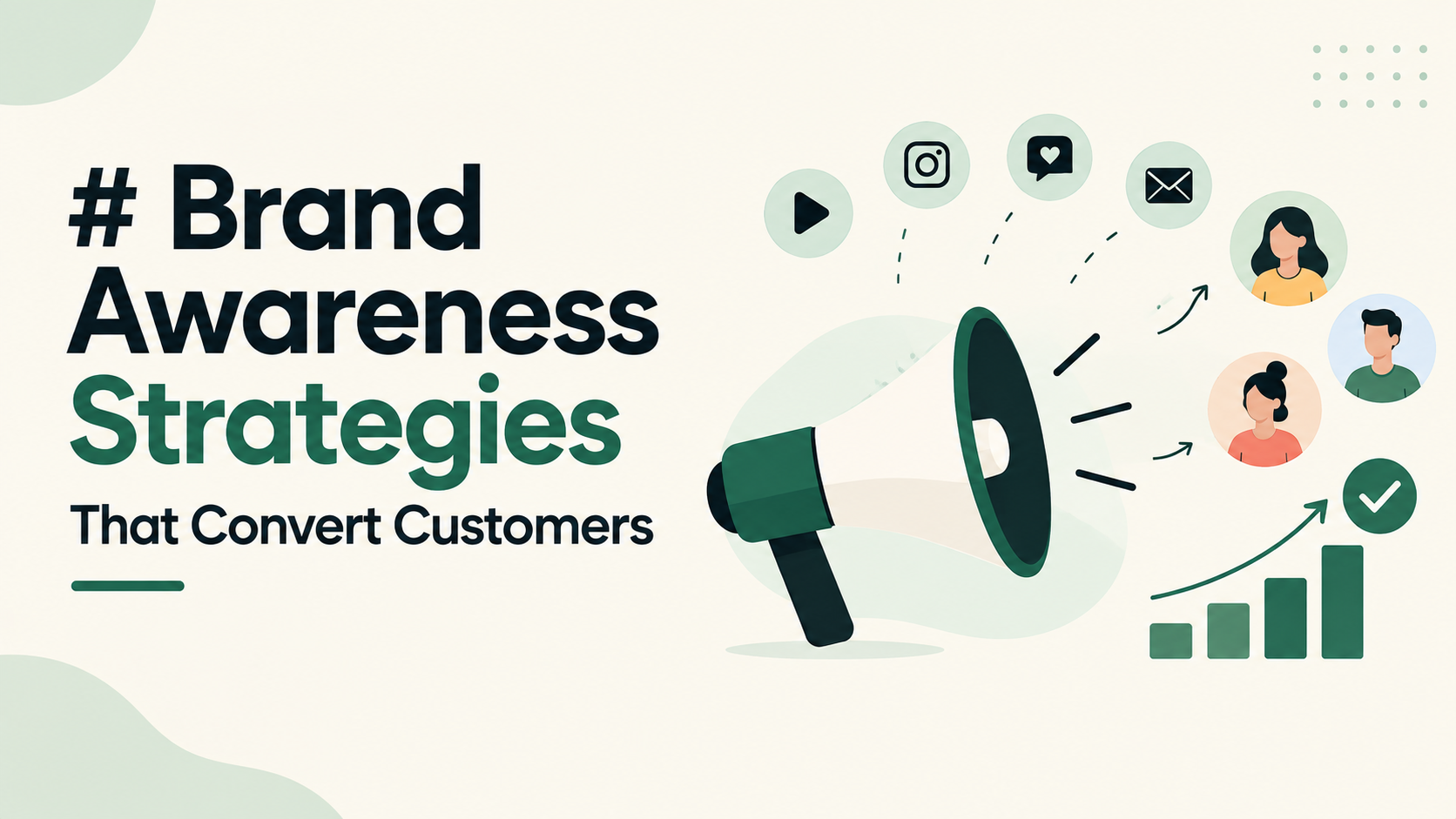
Brand Awareness Strategies That Convert Customers
Most brand awareness spend never turns into sales. Not because awareness does not work, but because nobody sets a number it has to beat.
Here is the short answer. Awareness converts when three things are true: people see you where they already buy, they see the same proof every time, and every touch has a way to capture them. Everything else is decoration.
This guide gives you a breakeven formula, a six step system, real USD math, and a clear rule for when to stop spending. It is written for US Shopify and marketplace brands doing roughly $2M to $20M a year, the same stage covered in our guide to scaling a Shopify brand from 7 to 8 figures.
What “converts” actually means here
Plenty of guides tell you to post more and build community. That is fine advice. It is also unmeasurable.
For this article, awareness converts when you can point to one of these:
- Branded search volume goes up, and those searches buy
- A geo holdout test shows higher total revenue in exposed regions
- New customer count rises while blended CAC stays flat or drops
- Repeat purchase rate climbs on cohorts that came in during the awareness push
If your awareness program cannot move at least one of those, it is a brand exercise, not a growth channel. Both are valid. Just do not confuse them in a board deck.
Why most awareness budgets get killed
Here is the pattern we see over and over inside brands:
- Leadership approves a top of funnel budget
- The team runs video, creator, and display
- Ninety days later, finance pulls last click reports
- Awareness shows a terrible ROAS
- Budget gets cut, right before the effect shows up
The measurement is the problem, not the channel.
Last click gives awareness credit only for the tiny slice of people who saw an ad and bought immediately. That is not how awareness works. Awareness works by making a later ad, a later email, or a later search cheaper.
The math that kills good programs
Take a $6M per year brand. That is about $500,000 a month in revenue.
- Top of funnel spend: $25,000 a month
- Branded search before: 9,000 searches a month
- Branded search after 120 days: 14,500 a month
- Lift: 5,500 searches, up 61%
Now follow the money on branded search alone:
| Step | Number |
|---|---|
| Extra branded searches | 5,500 |
| Click through to site at 38% | 2,090 sessions |
| Convert at 5.2% | 109 orders |
| AOV $78 | $8,477 revenue |
| Gross margin 62% | $5,256 gross profit |
| Spend | $25,000 |
Looks like a disaster. CAC of $230 on a $78 order.
But that same brand ran a geo holdout. Exposed regions did 6.4% more total revenue than control regions. On $500,000 a month that is $32,000 in incremental revenue, or $19,840 in gross profit.
Same campaign. The holdout number is 3.8 times bigger than the branded search number.
That gap is why awareness budgets get cut by mistake.
Set your breakeven lift before you spend a dollar
This is the single most useful number in the article. Write it down before you launch.
Breakeven incremental revenue = awareness spend divided by gross margin
For the brand above:
- $25,000 divided by 0.62 = $40,323
- On $500,000 in monthly revenue, that is an 8.1% lift
So the rule for that brand is simple. If the holdout does not show at least an 8.1% lift, the program does not pay for itself this month.
Their actual result was 6.4%. Below the line. That does not mean quit. It means fix the creative or the targeting, or accept you are buying future repeat customers on purpose and say so out loud.
Run your own version now:
- Monthly awareness spend: ______
- Gross margin: ______
- Breakeven incremental revenue: spend divided by margin
- Breakeven lift percent: that number divided by monthly revenue
Most brands have never done this. It takes four minutes and it ends a lot of arguments.
The SIGNAL framework
Six steps. Run them in order. Skipping one is what makes awareness feel like a black hole.
S. Set one metric that ties to money
Pick one. Not five.
- Best default: branded search volume in Google Search Console plus Google Trends
- Backup: direct traffic plus new customer count
- Gold standard: a geo holdout you rerun every quarter
Write the breakeven lift next to it. Review it monthly.
I. Introduce the brand where buying already happens
Awareness on a platform where nobody buys your category is expensive theatre.
Rank your channels by how close they sit to a real purchase:
| Channel | Time to first signal | Converts well for |
|---|---|---|
| Amazon Sponsored Brands and DSP | 2 to 4 weeks | Products people already search for |
| Meta video plus retargeting stack | 3 to 6 weeks | Impulse and visual categories |
| Creator content with a discount code | 2 to 8 weeks | Beauty, apparel, food, pets |
| YouTube in feed and Shorts | 6 to 12 weeks | Considered purchases over $80 |
| SEO and comparison content | 4 to 9 months | High research, high ticket |
| Podcast reads | 8 to 16 weeks | Subscription and supplements |
| Out of home and TV | 3 to 9 months | Brands over $30M only |
If you are under $10M a year, the bottom two rows are usually a mistake. You do not have the frequency budget to make them work.
G. Give the same three proofs everywhere
Consistency is not about your logo. It is about your claims.
Pick three proofs and repeat them until your team is sick of them:
- One outcome proof: what changes for the buyer
- One trust proof: reviews, testing, guarantee, or a named certification
- One risk proof: returns, shipping, or warranty
Then put those three on your ads, your PDP, your packaging insert, and your email footer. Word for word.
This matters more than most people think. Salsify’s Q4 2025 Ecommerce Pulse Report found 87% of shoppers will pay more for a product because they trust the brand, even though 55% say price is their top priority. Trust is what lets you skip the discount.
N. Narrow to one audience before you widen
The fastest way to waste an awareness budget is spreading it across five audiences at low frequency.
- Pick one segment you already win with
- Check your own order data, not a persona doc
- Spend 70% of the awareness budget there for one full quarter
- Widen only after you beat your breakeven lift
Low frequency across many people beats nothing. High frequency with one group beats everything.
A. Add a capture step to every awareness touch
An awareness touch with no capture is a rented impression.
Every single placement should offer one of these:
- An SMS or email signup with a real reason to join
- A quiz or fit finder
- A free sample or sample pack
- A waitlist for a drop
- A creator code that survives the click, which is where UGC ads earn their keep
Simple test: if you turned off the ad tomorrow, would you still own anything from it? If the answer is no, add a capture step.
L. Log the lift monthly, cut what does not move it
Once a month, in one page:
- Branded search, this month versus the same month last year
- New customers and blended CAC
- Holdout lift if you ran one
- Breakeven lift
- Verdict: keep, fix, or cut
Give one person the pen. Awareness dies in committees.
Where the AI answer engines changed the game
This is new and most articles have not caught up.
Buyers now ask ChatGPT, Perplexity, and Google AI Overviews for recommendations before they search. If your brand is not named in those answers, you are invisible at the exact moment someone is shortlisting.
What actually helps:
- Get listed in third party roundups and “best of” pages that the models read
- Publish comparison pages that state your position plainly, including where you lose
- Keep specs, sizing, materials, and pricing in plain text on your site, not buried in images
- Earn mentions on Reddit and niche forums honestly, by being useful, and tighten social reach alongside it
Worth noting: Salsify’s 2026 Consumer Research Report found only 14% of shoppers trust AI recommendations alone to make a purchase. So AI mentions are a shortlisting tool, not a closing tool. The close still happens on your product page.
A correction worth making
A lot of brand awareness articles repeat that “it takes seven touches to make a sale.” You will see it everywhere.
There is no credible modern study behind that number. It traces back to 1930s movie studio marketing lore. Treat it as folklore, not a benchmark.
The useful version is this: measure your own touch count. Most Shopify brands can pull it from their attribution tool in ten minutes. We see anywhere from 2 to 14 depending on price point. Use your number, not a repeated one.
When NOT to spend on awareness
Nobody writes this section, so here it is.
Hold off on top of funnel spend if any of these are true:
- Your gross margin is under 40%. The breakeven lift will be brutal.
- Your repeat purchase rate is under 15% at 12 months. Fix retention first with a loyalty program and post purchase offers.
- Your bottom of funnel is not saturated. If retargeting and branded search still have room, spend there first. It is cheaper.
- Your site converts under 1.5% on desktop. You will pay to send traffic to a leak, so run conversion fixes first.
- You cannot fund the same channel for 90 days. Awareness stopped at day 40 is money burned.
Fix those first. Awareness makes a working machine bigger. It does not fix a broken one. If your paid engine itself is the weak link, start with performance marketing fundamentals.
A 90 day plan you can actually run
Days 1 to 15
- Calculate your breakeven lift
- Record branded search baseline and new customer baseline
- Pick your one audience and your three proofs
- Choose one channel from the table above
Days 16 to 60
- Run at real frequency in one audience, one channel
- Add a capture step to every placement
- Keep bottom of funnel budget untouched so you can read the change
- Do not change creative more than once every 14 days
Days 61 to 90
- Run or read your geo holdout
- Compare lift to breakeven
- Keep, fix, or cut
- Only then consider adding a second channel
What this takes to actually execute
The plan above is not complicated. It is just relentless.
Someone has to pull branded search weekly, run the holdout, refresh creative, keep the three proofs consistent across every channel, and write the one page report. Most lean brand teams start strong and drop it by week six.
That execution gap is where dedicated teams earn their keep. Not strategy decks. The weekly grind of measurement, creative refresh, and channel management.
If you are choosing between hiring three specialists and embedding a team that already runs this, look at performance marketing and growth and marketplace management first. Awareness that converts is an operations problem more than a creative one.
FAQ
How long does brand awareness take to show up in sales?
Expect 6 to 12 weeks for the first readable signal on paid social and creator channels, and 4 to 9 months on SEO. If you stop before 90 days, you will not know if it worked.
What is the single best metric for brand awareness in ecommerce?
Branded search volume. It is free to track in Google Search Console, hard to fake, and it moves when awareness moves. Pair it with a quarterly geo holdout for the truth.
How much should I spend on brand awareness?
Start with 10% to 15% of total ad budget, and only after your bottom of funnel is saturated. Calculate your breakeven lift first so you know what the spend must return.
Why does my awareness campaign show terrible ROAS?
Because last click attribution gives awareness almost no credit. In the example in this article, the holdout number was 3.8 times larger than the branded search number for the same campaign. Use a holdout before judging.
Can a small brand build awareness without a big budget?
Yes, but only by narrowing. One audience, one channel, high frequency. Spreading $5,000 across four platforms produces nothing readable.
Does brand awareness lower customer acquisition cost?
It should. When it works, your retargeting and branded search get cheaper because more people already recognize you. Watch blended CAC, not channel CAC, to see it.
Do AI search tools like ChatGPT matter for brand awareness?
They matter for getting shortlisted. Salsify’s 2026 research found only 14% of shoppers trust AI recommendations alone, so treat AI mentions as a way to enter the consideration set, not as a closing channel.
When should I stop an awareness campaign?
When measured lift stays below your breakeven lift for two consecutive quarters, and creative and audience changes have not moved it. That is a cut, not a pause.
Final thought
Awareness is not a mood. It is a number with a breakeven.
Set the number, pick one audience, repeat three proofs, capture every touch, and read the lift monthly. Do that for two quarters and you will know more about your brand’s real demand than most companies your size.
Book a call if you want a team that runs this every week instead of every quarter.