
Building an ecommerce website that consistently attracts visitors, converts them into customers, and scales sustainably has become a necessity for modern businesses. As competition grows and customer expectations evolve, the process of setting up and optimising an ecommerce website demands a deeper, more strategic approach. This comprehensive guide breaks down everything you need to understand, from foundational setup to advanced scaling techniques, to build an ecommerce website that ranks, converts, and performs.
What Is an Ecommerce Website?
An ecommerce website is an online storefront that enables customers to browse, compare, and purchase products or services digitally. It integrates product catalogues, shopping carts, checkout systems, payment gateways, and backend management tools that help businesses operate efficiently.
But in today’s digital economy, simply launching an ecommerce website is not enough. Customers expect speed, security, intuitive design, curated shopping experiences, and frictionless checkout journeys. This makes the planning, design, and optimisation stages crucial for long-term success.
Why an Ecommerce Website Matters More Than Ever
A high-performing ecommerce website is a growth engine, offering advantages that traditional stores cannot match.
Always-on Global Presence
Your online store operates 24/7, allowing you to serve customers across different time zones without physical limitations.
Lower Operational Costs
Running an ecommerce website reduces staffing, rental, and inventory handling expenses, allowing better margins and scalable growth.
Data-driven Strategy
Every click, scroll, and purchase provides insights that help refine your marketing, pricing, and product assortment.
High Scalability
As your business grows, your ecommerce website can scale with additional features, automation, and integrations, all without the overhead of expanding physical stores.
Essential Features Every Ecommerce Website Must Have
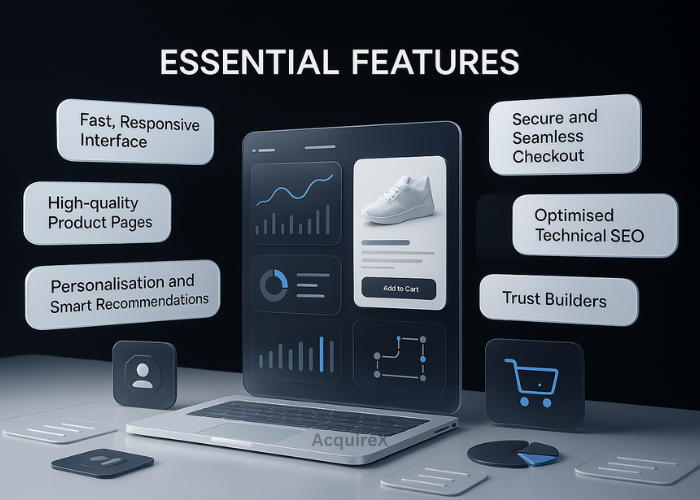
Strong ecommerce website performance depends on several mission-critical features:
Fast, Responsive Interface
A slow ecommerce website directly leads to abandoned carts. Speed, mobile responsiveness, and streamlined navigation ensure smooth user journeys.
Secure and Seamless Checkout
SSL certificates, trusted payment gateways, and simplified checkout flows reduce friction and encourage conversions.
High-quality Product Pages
Product pages should include titles, feature highlights, benefits, comparison tables, and high-resolution visuals. Well-structured content helps customers make informed decisions quickly.
Optimised Technical SEO
Clean URL structures, schema markup, structured data, compressed media, and efficient internal linking help improve organic visibility.
Personalisation and Smart Recommendations
Behaviour-based suggestions, dynamic search results, and personalised offers create meaningful shopping experiences and increase average order value.
Trust Builders
Elements such as reviews, ratings, testimonials, and certifications reduce hesitation and improve your credibility.
How to Build an Ecommerce Website: Complete Step-by-Step Guide
Setting up an ecommerce website involves a structured and strategic approach. Below is a detailed roadmap:
Step 1: Select Your Platform and Technology Stack
Choose a scalable and secure foundation. Whether you use open-source frameworks, cloud-based platforms, or custom development, ensure the solution supports growth and integrations.
Step 2: Plan Your Information Architecture
Structure your categories, product pages, filters, search mechanisms, and navigation before designing. A well-planned architecture improves both user experience and SEO.
Step 3: Design an Intuitive UI/UX
Minimalistic layouts, logical content grouping, clean visual hierarchy, and a clutter-free user interface are essential for improving engagement and conversions.
Know All About – Design Management
Step 4: Develop Conversion-focused Product Pages
Add compelling storytelling around product benefits, usage scenarios, and unique selling points. Product media should include multiple views, 360-degree previews, and zoom features.
Step 5: Integrate Secure Payment Options
Offer multiple gateways such as UPI, cards, wallets, and BNPL (Buy Now Pay Later) options. Reducing friction increases transaction completion rates.
Step 6: Enable Search, Filters, and Sorting
Advanced search capabilities improve discoverability. Intelligent filters and sorting reduce bounce rates and increase product engagement.
Step 7: Implement Strong SEO Foundations
Your ecommerce website must follow best practices such as:
- Metadata optimisation
- Image compression
- Schema integration
- Internal linking
- High-authority content
- Faster server response times
Step 8: Connect Email, Marketing, and Automation Tools
Automation helps nurture customers, recover abandoned carts, and maintain strong communication across the customer journey.
Step 9: Add Analytics and Tracking
Using GA4, heatmaps, behaviour recordings, and funnel tracking helps identify bottlenecks, improve UX, and enhance conversions.
Step 10: Launch, Test, and Iterate
An e-commerce website is never “complete.” Continuous testing, design iterations, performance monitoring, and SEO improvements are essential for long-term success.
Technology & Tools Needed to Run an Ecommerce Website
To build and operate a competitive ecommerce website, the right tools and technology stack make all the difference:
Platforms and Frameworks
Shopify, WooCommerce, Magento, BigCommerce, and custom frameworks such as React and Node.js offer flexibility and scalability.
Analytics & Optimization Tools
Google Analytics, Hotjar, Microsoft Clarity, and Search Console help identify user behaviour and optimisation opportunities.
Marketing & Automation Tools
Klaviyo, HubSpot, Mailchimp, and automated SMS tools support personalisation, retargeting, and campaign management.
Inventory & Order Management
Tools such as Zoho Inventory or Unicommerce help synchronise stock, manage multi-warehouse setups, and streamline fulfilment.
How to Scale Your Ecommerce Website
Once established, here are advanced strategies to scale your website:
Conversion Rate Optimisation (CRO)
Through A/B testing, UX research, and funnel refinement, businesses can improve conversion rates without increasing traffic.
Content and SEO Expansion
Long-form content, topic clusters, category optimisation, and backlink strategies build domain authority and attract organic traffic.
Marketing Automation & Personalisation
Customer segmentation, behavioural targeting, automated campaigns, and dynamic recommendations boost repeat orders and loyalty.
Marketplace Integration
Listing products on leading Marketplaces broadens your audience reach and opens new revenue channels, while your e-commerce website remains the central hub.
Omnichannel Commerce
Integrating your ecommerce website with social platforms, mobile apps, and offline stores creates a unified and seamless shopping experience.
Common Mistakes to Avoid
When building or scaling an e-commerce website, avoid the following pitfalls:
- Slow loading pages
- Poorly written or incomplete product content
- Confusing navigation or unstructured product categories
- Multi-step or complicated checkout
- Weak or missing trust signals
- Ignoring SEO from the beginning
- Not testing or updating the experience regularly
Fixing these issues significantly improves performance, conversions, and customer satisfaction.
Conclusion
Building and scaling an e-commerce website is not a one-time project but an ongoing strategic journey. The most successful online stores combine strong technical foundations with user-centric design, data-driven decision-making, and continuous optimisation. Whether you’re launching for the first time or refining an existing store, focusing on speed, security, usability, and discoverability will position your e-commerce website for long-term growth. As online competition intensifies, brands that invest in technology, seamless experiences, and customer trust will consistently outperform others. With the right structure, tools, and strategy, your website can evolve from a basic online store into a powerful revenue-generating engine built to scale.
FAQ’s
1. What is an ecommerce website?
An ecommerce website is an online store where customers browse, add products to a cart, and complete purchases through a secure checkout system.
2. How much does it cost to build an ecommerce website?
Costs vary based on design, features, platform, and integrations. Basic sites are affordable, while advanced or custom ecommerce websites require higher investment.
3. What features make an ecommerce website successful?
Fast loading, mobile-friendly design, secure checkout, strong product pages, easy navigation, SEO optimisation, and trust signals like reviews are essential.