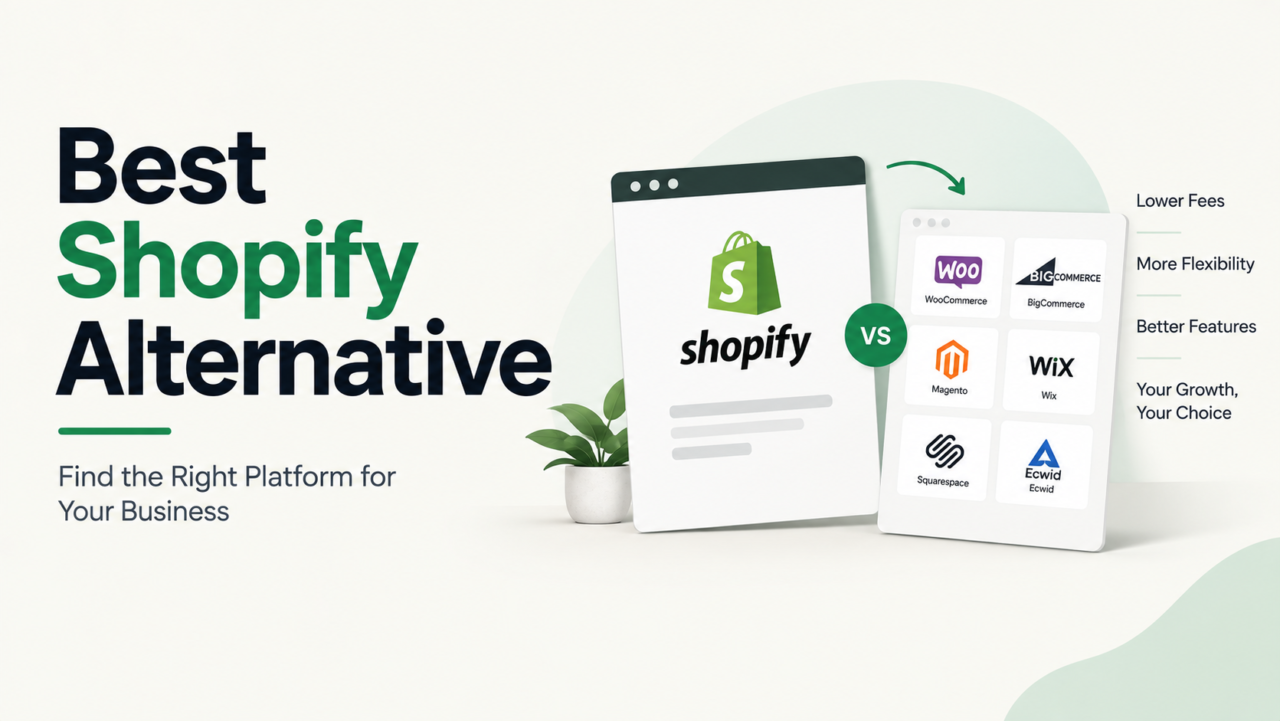
Your Shopify bill keeps growing. Apps here, fees there. Now you are wondering if another platform would save money or give you more control.
Here is the short answer:
- WooCommerce is best if you want full ownership and have a developer.
- BigCommerce is best for B2B and brands that want more built-in features.
- Adobe Commerce (Magento) is best for large companies with big tech budgets.
- Wix and Squarespace are best for small, simple stores.
But “cheaper” is often a myth. Below, we run the real math on a $1M store. We also share a simple test to tell if you should switch at all.
Quick Comparison Table
| Platform | Starting Price (billed yearly) | Extra Fee if You Use Your Own Payment Provider | Best For |
|---|---|---|---|
| Shopify | $29/mo (Basic) | 2% on Basic, 1% on Grow, 0.6% on Advanced | Most D2C brands |
| WooCommerce | Free plugin (you pay hosting) | None from WooCommerce | Brands that want full control |
| BigCommerce | $29/mo (Core) | 2% on Core, 1% on Growth, 0.6% on Scale, $0 on its built-in partners | B2B and catalog-heavy stores |
| Adobe Commerce | Custom quote | Depends on contract | Enterprise brands |
| Wix | $29/mo (Core) | None from Wix | Small stores and service businesses |
| Squarespace | Under $30/mo for entry plans | 2% on the lowest plan | Creators and design-first brands |
Prices checked on each platform’s pricing page in September 2026. They change often, so confirm before you decide.
First, Is Shopify Really the Problem?
Before you pack up and move, know this. Shopify is not a shrinking platform.
In Q2 2026, Shopify merchants sold $115.57 billion in goods. That is up 31.6% from the year before, per Digital Commerce 360. B2B sales on Shopify grew 76%.
So the platform works. The real question is whether it works for you.
In our work running store operations for US brands, we see the same pattern again and again:
- The brand blames Shopify for high costs.
- We audit the store and find 20+ apps, many unused.
- We cut the app stack, and the “platform problem” shrinks.
If that sounds familiar, read our guide on which Shopify apps to keep or cut before you migrate anything.
Why Brands Look for a Shopify Alternative
Still, some reasons to leave are real:
- Payment fees. If you use a payment provider other than Shopify Payments, Shopify adds a fee of 0.2% to 2%, based on your plan.
- Checkout limits. Deep checkout changes need Shopify Plus, which starts at $2,300/month.
- Complex B2B needs. Price lists, quotes, and custom approval flows can feel forced.
- Data ownership. On Shopify, you rent your store. On open source tools, you own the code.
- Custom URL rules. Shopify locks some URL paths like
/products/and/collections/.
The 5 Best Shopify Alternatives, Reviewed
1. WooCommerce: Best for Full Control
WooCommerce is a free plugin that turns a WordPress site into a store.
What you get:
- Full ownership of your code and data
- Total control over URLs and SEO
- Thousands of plugins
- Card fees with WooPayments of 2.9% + $0.30 in the US (source)
The catch:
- You handle hosting, speed, security, and updates.
- Plugin conflicts can break your store on a busy day.
- “Free” turns expensive fast without a skilled developer.
Pick it if: you run a content-heavy brand and have tech support on hand.
2. BigCommerce: Best for B2B and Big Catalogs
BigCommerce is the closest match to Shopify. It is hosted, so you do not manage servers.
What you get:
- Strong B2B tools built in
- No extra fee when you use its built-in payment partners like Stripe or PayPal (source)
- Good support for headless setups
The catch most reviews miss:
- Each BigCommerce plan has a sales cap. Core covers up to $30K a year. Growth covers up to $100K. Scale covers about $400K.
- Pass those limits and you move up a plan. At $1M+, you are on Performance, which starts at $1,499/month.
- Many competitor articles say BigCommerce has “no transaction fees.” That is only half true. Fees of 0.6% to 2% apply if you use a payment provider outside its partner list.
Pick it if: you sell B2B, have a large catalog, or want built-in features over apps.
3. Adobe Commerce (Magento): Best for Enterprise
Magento started in 2008. Adobe bought it in 2018 and now sells it as Adobe Commerce. A free version, Magento Open Source, still exists.
What you get:
- Deep control over catalogs, pricing, and multi-store setups
- Strong tools for global and B2B brands
The catch:
- Pricing is by custom quote.
- You need a skilled developer team to build and maintain it.
- Projects often take months, not weeks.
Pick it if: you are a large brand with a dedicated tech team and budget.
4. Wix: Best for Small, Simple Stores
Wix is a drag-and-drop website builder with store features.
What you get:
- Easy setup, no code needed
- Store features start on the Core plan at $29/month billed yearly
- Built-in booking tools for service businesses
The catch:
- Harder to scale past a small catalog
- Fewer deep ecommerce tools than Shopify
Pick it if: you are just starting or sell a few products next to a service.
5. Squarespace: Best for Design-First Brands
Squarespace is known for clean, beautiful templates.
What you get:
- Great design out of the box
- Simple product setup
- Entry plans under $30/month (see pricing)
The catch:
- The lowest plan adds a 2% fee on sales.
- Limited apps and integrations
- Not built for high volume
Pick it if: you are a creator or small lifestyle brand where looks matter most.
The Real Cost Math: A $1M Store
Let’s compare yearly costs for a US store doing $1,000,000 in sales with a $60 average order. That is about 16,667 orders a year.
| Setup | Platform Fee | Card Fees | Extra Fee | Yearly Total |
|---|---|---|---|---|
| Shopify Grow + Shopify Payments | $948 | $32,000 | $0 | $32,948 |
| Shopify Grow + outside payment provider | $948 | $34,000 | $10,000 | $44,948 |
| WooCommerce + WooPayments | $3,000* | $34,000 | $0 | $37,000 |
| BigCommerce Performance | $17,988 | $33,733 | $0 | $51,721 |
*Our example assumes $100/month for managed hosting and $150/month for paid plugins. Your costs will vary.
How we got these numbers:
- Shopify card fees: 2.7% + $0.30 on Grow
- Outside provider example: 2.9% + $0.30, plus Shopify’s 1% fee on Grow
- WooPayments: 2.9% + $0.30
- BigCommerce: 2.89% + $0.29, at the Performance starting price
What this tells you:
- Using Shopify Payments saves this store $12,000 a year versus an outside provider.
- WooCommerce costs about $4,000 more here, and that is before paying a developer.
- BigCommerce’s sales caps push a $1M store into a much higher plan.
The lesson? Switching platforms rarely saves money by itself. Fees, apps, and team costs matter more.
The SWITCH Test: Should You Actually Leave Shopify?
Use this 6-point check before you commit. Give each one a yes or no.
- S: Sales model. Do you need B2B tools Shopify can’t handle on your plan?
- W: Workflows. Are you forcing complex processes through 5+ apps?
- I: Integrations. Does your ERP or warehouse system work better elsewhere?
- T: Team. Do you have developers to run an open source or enterprise platform?
- C: Cost. Did you run the math above with your real numbers?
- H: Hosting and ownership. Is owning your code a true business need?
How to score it:
- 0 to 2 yes: Stay on Shopify. Fix your app stack and operations instead.
- 3 to 4 yes: Test the move. Build a small pilot store first.
- 5 to 6 yes: Plan a migration with a clear timeline and team.
Which Platform Fits Your Stage?
- Just starting ($0 to $100K): Shopify Basic, Wix, or Squarespace
- Growing ($100K to $2M): Shopify Grow or Advanced, or WooCommerce with tech help
- Scaling ($2M to $20M): Shopify Plus or BigCommerce
- Enterprise ($20M+): Shopify Plus, BigCommerce Enterprise, or Adobe Commerce
- Selling mostly B2B: BigCommerce or Adobe Commerce
If You Do Switch: A 5-Step Plan
- Map your data. List products, customers, orders, and reviews to move.
- Save your SEO. Set up 301 redirects for every old URL. Our Shopify Plus migration checklist covers this step in detail.
- Rebuild key flows. Test checkout, emails, tax, and shipping.
- Run both stores side by side. Keep the old one live until the new one is proven.
- Watch the numbers for 90 days. Track traffic, conversion rate, and page speed. Check our guide on JavaScript SEO for fast ecommerce sites if speed drops.
The Truth: Your Platform Is Rarely the Bottleneck
Here is what we see most often. A brand moves platforms, and six months later, the same problems are back.
Why? Because the real issues were:
- Slow product uploads and messy listings
- Ads nobody was watching daily
- Support tickets piling up
- No one owning the process end to end
A new platform won’t fix that. A system will.
That is where AcquireX helps. We build dedicated offshore teams that plug into your business and own the work, from catalog management to performance marketing to marketplace management. See why brands choose a dedicated team over an agency.
Want to see how lean a store can run? Read how to run a Shopify store with a lean offshore team.
FAQs
What is the best Shopify alternative in 2026?
It depends on your needs. WooCommerce is best for full control. BigCommerce is best for B2B and large catalogs. Adobe Commerce fits large enterprises. Wix and Squarespace suit small, simple stores.
Is WooCommerce cheaper than Shopify?
Not always. The plugin is free, but you pay for hosting, plugins, and developer time. In our $1M store example, WooCommerce cost about $4,000 more per year than Shopify Grow with Shopify Payments, before developer costs.
Does BigCommerce charge transaction fees?
BigCommerce charges no extra fee when you use its built-in payment partners like Stripe or PayPal. If you use an outside provider, it charges 0.6% to 2% based on your plan. Card processing fees still apply either way.
Is it hard to move from Shopify to another platform?
It takes planning. You need to move your data, set up 301 redirects to protect SEO, rebuild key flows, and test everything. Most brands should run both stores side by side before fully switching.
Should I leave Shopify because of fees?
Check your setup first. Switching to Shopify Payments removes Shopify’s extra fee, and cutting unused apps often saves more than a platform move. Use the SWITCH test in this guide before you decide.
Ready to Scale Without the Chaos?
Before you rebuild your whole store, fix the system behind it.
Talk to AcquireX and get a dedicated team that owns your ecommerce execution, so you can focus on growth.