The top 100 online marketplaces generated nearly $3.9 trillion in gross merchandise value in 2024. That number is still climbing in double digits heading into 2026. And yet, most people still think building an online marketplace is the same thing as building a regular ecommerce store.
It is not. Not even close.
A multi vendor marketplace is a completely different animal. It is a platform where hundreds — sometimes thousands — of independent sellers list, sell, and ship products through one shared website.
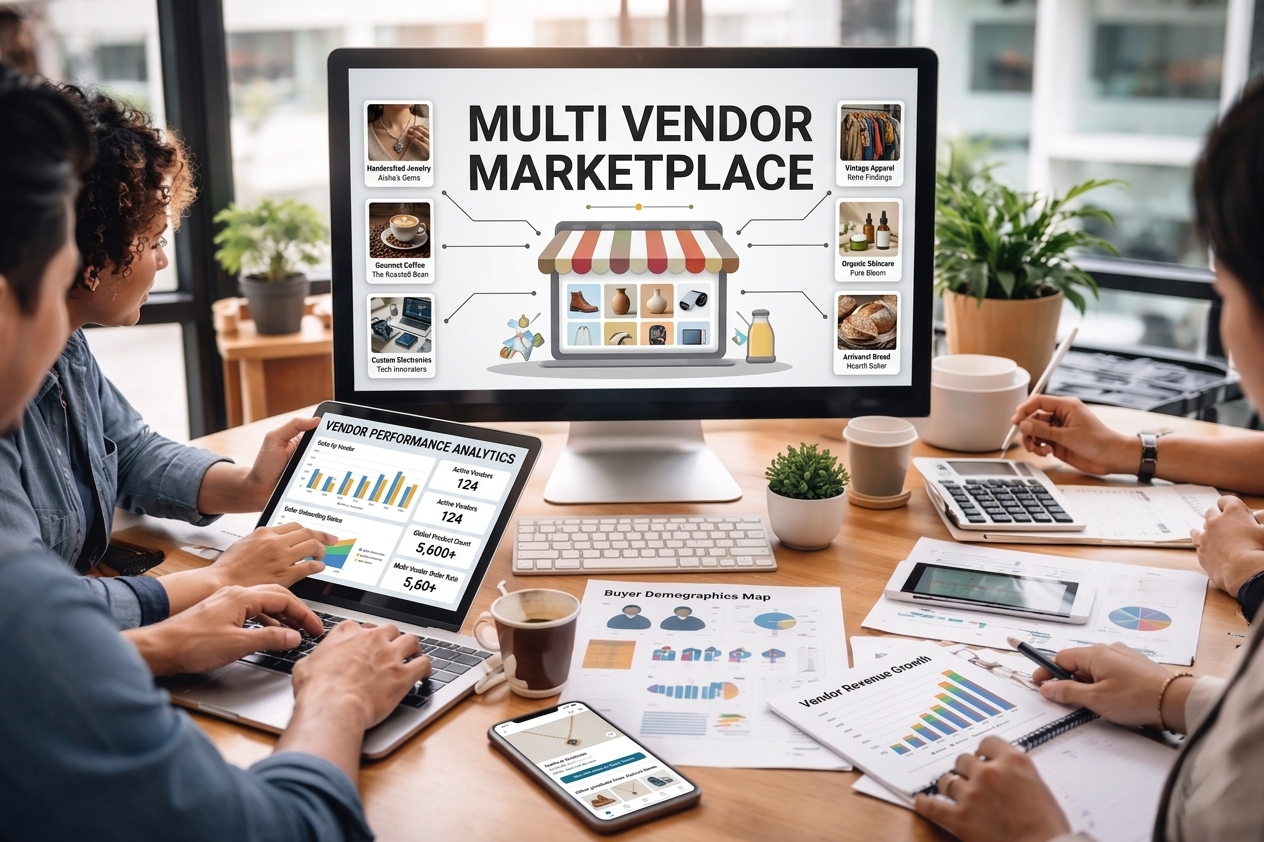
You do not hold inventory. You do not ship products. You build the infrastructure. And you earn revenue from every transaction that happens on your platform.
Amazon, Etsy, Airbnb, Alibaba — they all run on this model. But you do not need to be a billion-dollar company to launch one.
Entrepreneurs, startups, and existing retailers are doing it right now in niches like handmade goods, groceries, fashion, freelance services, B2B supplies, and even digital products.
This guide covers everything. What a multi vendor marketplace is. How it makes money. Which platforms to use. What features you actually need. How much it really costs. And a step-by-step blueprint to build one from scratch — whether you are technical or not.
No fluff. No recycled filler. Just clear, actionable strategies for sustainable growth
What Is a Multi Vendor Marketplace?
A multi vendor marketplace is an online platform where multiple independent sellers offer products or services through one shared website or app. The marketplace owner runs the platform. Sellers bring the inventory. Buyers get a single shopping experience with products from many different vendors.
Think of it like running a digital shopping mall. You own the building. Vendors rent space and sell their goods. Customers walk in and shop from everyone under one roof.
Unlike a traditional ecommerce store where one company sells its own products, a multi seller ecommerce platform connects buyers with a wide variety of sellers. The platform owner does not need to stock, ship, or even touch any products.
There are three essential roles in every multi vendor marketplace:
1. Marketplace Owner/Operator (You) — You build and manage the platform. You set the rules. You handle vendor onboarding, payments, and the overall buyer experience. You earn money from commissions and fees.
2. Vendors/Sellers — Independent businesses that list their products or services on your platform. They control pricing, manage inventory, and usually handle fulfillment.
3. Buyers/Customers — The people who shop on your platform. They search, compare, and purchase from multiple sellers in one checkout.
When all three roles work together, you get network effects — more sellers attract more buyers, which attracts more sellers. That compounding growth is what makes the marketplace model so powerful.
How Does a Multi Vendor Marketplace Actually Work?
The mechanics are simpler than most people think. Here is the step-by-step flow:
- Vendor registration — A seller signs up, creates a profile, and submits their business for approval.
- Product listing — The approved vendor uploads products with images, descriptions, pricing, and shipping details.
- Admin review — The marketplace admin reviews and approves product listings (optional but recommended for quality control).
- Buyer browsing — A customer visits the marketplace, searches for products, and adds items from multiple vendors to a single cart.
- Checkout and payment splitting — The buyer pays once. The payment gateway automatically splits the money — the vendor gets their share, and the marketplace keeps its commission.
- Order fulfillment — Each vendor ships their products directly to the buyer. The marketplace tracks all orders centrally.
- Reviews and payouts — The buyer leaves a review. The vendor receives their payout on the scheduled cycle.
The most critical piece? Payment splitting. Unlike a regular online store where all money goes to one account, a multi vendor marketplace needs to divide payments automatically between you and every seller. Tools like Stripe Connect and PayPal Marketplace handle this natively.
If you are building a marketplace that involves complex supply chain operations, the order routing and fulfillment logic becomes even more important.
Multi Vendor Marketplace vs. Single Vendor Store
This is one of the most common questions people search before starting a marketplace. Let us break it down clearly:
| Feature | Single Vendor Store | Multi Vendor Marketplace |
|---|---|---|
| Who Sells? | Only the store owner | Multiple independent sellers |
| Inventory Risk | High — you stock everything | Low — vendors handle their own inventory |
| Product Variety | Limited to your catalog | Grows with every new vendor |
| Revenue Model | Product margins only | Commissions, fees, subscriptions, advertising |
| Scalability | Slow — tied to your supply chain | Fast — onboard more sellers to grow |
| Startup Cost | Higher (inventory + warehousing) | Lower (no inventory needed) |
| Customer Trust | Depends on your brand alone | Built through reviews, ratings, and platform reputation |
| Operational Complexity | Lower | Higher — managing vendors, disputes, payouts |
When to choose a single vendor store: You manufacture your own products, you want full brand control, and you have the capital for inventory.
When to choose a multi vendor marketplace: You want to scale without inventory risk, earn from multiple revenue streams, and build a platform that grows through network effects.
Most profitable ecommerce business ideas in 2026 lean toward the marketplace model because of lower upfront costs and faster scaling potential.
Why Build a Multi Vendor Marketplace in 2026?
The numbers tell the story:
- 67% of all online sales now flow through marketplaces, up from 58% in 2023.
- The global ecommerce market is projected to surpass $83 trillion by 2030.
- Nearly 95% of all retail transactions are expected to take place online by 2040.
- The multi-vendor support services market hit $57 billion in 2025 and is growing to nearly $69 billion.
- Mobile commerce drives 73% of marketplace traffic in 2026.
But beyond the market size, here is why the model works so well:
No inventory risk. Vendors manage their own stock. You never worry about unsold products sitting in a warehouse.
Multiple revenue streams. Commissions, subscriptions, listing fees, advertising, premium tools — marketplaces have more ways to make money than single-vendor stores.
Scalability on demand. Want to expand into a new product category? Just onboard vendors in that space. No supply chain overhaul needed.
Network effects compound. Every new seller adds products. More products attract more buyers. More buyers attract more sellers. This flywheel effect is what made Amazon, Etsy, and Alibaba unstoppable.
Lower capital requirements. You can launch a marketplace MVP for under $5,000 using existing platforms and plugins.
If you are exploring how AI is redefining ecommerce, multi vendor marketplaces are one of the biggest beneficiaries — from AI-powered product recommendations to automated vendor onboarding.
Types of Multi Vendor Marketplace Business Models
Not all marketplaces work the same way. The business model you choose shapes your technology requirements, vendor relationships, and growth strategy. Pick the wrong model and you waste months building the wrong features.
B2C Marketplace (Business to Consumer)
Professional vendors sell directly to everyday consumers. Amazon, Flipkart, and Zalando operate this way. This is the most common model and the easiest to understand. Buyers expect fast shipping, easy returns, and a smooth checkout experience.
Best for: Product-based marketplaces in fashion, electronics, home goods, and general retail.
C2C Marketplace (Consumer to Consumer)
Regular people sell to other regular people. eBay, Poshmark, and Facebook Marketplace are classic examples. The platform provides the trust layer — ratings, payment protection, and dispute resolution — that makes strangers comfortable transacting with each other.
Best for: Secondhand goods, vintage items, local classifieds, and peer-to-peer selling.
B2B Marketplace (Business to Business)
Suppliers, manufacturers, and wholesalers sell to other businesses. This is the fastest-growing segment — the global B2B ecommerce market reached $30.1 trillion in 2025. B2B marketplaces require features like corporate accounts, negotiated pricing, RFQ (request for quote) workflows, bulk ordering, and net-30/net-60 payment terms.
Best for: Industrial supplies, raw materials, wholesale goods, and professional services. If you are exploring B2B operations, understanding procurement and sourcing workflows is essential.
Service Marketplace
Instead of products, vendors offer services — freelance work, home repairs, tutoring, consulting, or bookings. Upwork, Fiverr, and TaskRabbit follow this model. The technical requirements are different: scheduling systems, availability calendars, and milestone-based payment releases replace inventory management and shipping.
Best for: Freelancer platforms, home services, coaching, and professional consulting.
Rental and Booking Marketplace
Users temporarily access assets — apartments, cars, equipment, event venues, or co-working spaces. Airbnb and Turo are the leaders here. Availability calendars, cancellation policies, security deposits, and insurance integrations are critical.
Best for: Short-term rentals, equipment sharing, event space booking, and vehicle sharing.
Hybrid and Multi-Vertical Marketplace
The biggest trend in 2026 is platforms that combine multiple models. Uber started with rides, added food delivery, then freight. Grab offers rides, food, payments, and financial services. A multi-vertical marketplace integrates multiple product or service categories within one platform.
This model increases user lifetime value and app engagement, but it is significantly more complex to build and manage. Start with one vertical, prove it works, then expand.
Which Model Should You Choose?
| Model | Complexity | Capital Needed | Best Starting Point |
|---|---|---|---|
| B2C Product | Medium | Low–Medium | Niche product category |
| C2C Resale | Low–Medium | Low | Local or category-specific |
| B2B | High | Medium–High | Industry you already know |
| Service | Medium | Low | One service category first |
| Rental/Booking | Medium–High | Medium | Single asset type |
| Multi-Vertical | Very High | High | Only after proving one vertical |
Multi Vendor Marketplace Revenue Models: How You Actually Make Money
This is the section most guides rush through. Do not make that mistake. Your revenue model shapes everything — your pricing, your platform features, and your vendor relationships.
The most successful marketplaces layer multiple revenue models. Here are the proven ones:
1. Commission on Sales (The Most Common)
You take a percentage of every transaction. Commission rates typically range from 5% to 30% depending on the category. Amazon takes 6–45% depending on product type. Etsy charges 6.5%.
Best for: High-volume product and service marketplaces.
2. Vendor Subscription Fees
Sellers pay a monthly or annual fee to access your platform. Amazon charges Professional sellers $39.99/month. eBay Stores range from $27.95 to $2,999.95/month depending on the tier.
Best for: Platforms with strong seller tools and large buyer audiences.
3. Listing Fees
Vendors pay a small fee each time they list a product. Etsy charges $0.20 per listing. This works well for marketplaces with high product turnover.
Best for: Peer-to-peer marketplaces and classifieds.
4. Featured Listings and Marketplace Advertising
Vendors pay to boost their products in search results or category pages. This is one of the highest-margin revenue streams available. Amazon’s advertising business alone generated over $47 billion in a single year.
Best for: Mature marketplaces with consistent traffic.
5. Transaction Fees
A flat fee per transaction on top of (or instead of) commissions. This covers payment processing and platform costs.
6. Premium Seller Tools and Value-Added Services
Advanced analytics, promotional tools, priority customer support, or enhanced storefront designs sold as paid add-ons. These typically generate 20–35% of total platform revenue at maturity.
7. Freemium Model
Free basic access for sellers with paid upgrades for advanced features. Research shows this approach generates 23% more total revenue than paid-only models because it lowers the barrier for new vendors.
Pro tip: Studies show that marketplaces combining subscriptions with commissions achieve 27% higher profit margins compared to commission-only models. Do not rely on a single revenue stream.
Understanding the right pricing strategies for ecommerce growth is critical when designing your marketplace monetization.
Revenue Model Quick Comparison
| Model | Revenue Type | Best For | Example |
|---|---|---|---|
| Commission | Variable — per sale | High-volume marketplaces | Amazon, Etsy |
| Subscription | Recurring monthly/annual | Platforms with seller tools | eBay Stores |
| Listing Fee | Per listing | High-turnover catalogs | Etsy, Craigslist Pro |
| Advertising | Pay-per-click or boost | Mature marketplaces | Amazon Ads |
| Freemium | Free base + paid upgrades | Early-stage growth | Gumroad |
| Premium Tools | Add-on fees | Established platforms | Shopify Marketplace |
15 Must-Have Features for Every Multi Vendor Marketplace
Missing even one of these features can cripple your marketplace. Here is your complete checklist:
1. Vendor Registration and Onboarding
Make it dead simple for sellers to sign up, verify their identity, and start listing products. Automated onboarding with KYC verification can reduce vendor setup time by up to 70%. Include document verification, business profile setup, and agreement acceptance in one smooth flow.
2. Seller Dashboard
Each vendor needs their own command center — product management, order tracking, earnings reports, and performance analytics. A good seller dashboard reduces support tickets dramatically and keeps vendors self-sufficient.
3. Product Listing Management
Bulk upload via CSV, product variants, multiple images, inventory tracking, and automated category management. Your vendors should be able to manage thousands of SKUs without needing your help. For complex catalogs, consider professional catalog management services.
4. Split Payment System
Non-negotiable. Your payment gateway must automatically split payments between you and each vendor at checkout. Stripe Connect, PayPal Marketplace, and Mangopay are the industry standards for marketplace payment processing.
5. Commission Management
Set different commission rates by vendor, product category, order value, or even individual product. Flexible commission rules let you incentivize vendor behavior, reward top sellers, and maximize your revenue per transaction.
6. Multi-Vendor Cart and Checkout
Buyers should add products from different vendors into a single cart and check out once. Each vendor gets their portion of the order routed to them separately. This is table stakes for any serious multi seller marketplace.
7. Order Management System
Centralized order tracking that lets you — and each vendor — see real-time order status, shipping updates, and delivery confirmations. Automated notifications keep everyone in the loop without manual effort.
8. Shipping Management
Vendors need to set their own shipping rates, connect to their preferred carriers, and print labels. Integration with FedEx, UPS, USPS, DHL, and regional carriers is a must. Real-time shipping rate calculators improve the buyer experience at checkout.
9. Review and Rating System
Verified purchase badges. Photo reviews. Seller ratings separate from product ratings. Vendor response capability. This system builds trust, helps buyers decide, and gives you a quality enforcement tool.
10. Dispute Resolution and Refund System
When a buyer complains about a vendor’s product, you need a structured resolution flow. Escrow-style payment holds, mediation tools, and clear refund policies protect both buyers and sellers. Strong customer service management is what separates good marketplaces from great ones.
11. Marketplace Analytics Dashboard
You need visibility into total GMV, revenue by vendor, conversion rates, top-performing products, customer acquisition costs, and seller activity. Without analytics, you are making decisions based on guesses.
12. Marketplace SEO Tools
SEO-friendly URLs, customizable meta tags, automatic schema markup (Product, Review, Organization), XML sitemaps covering all vendor and product pages, and canonical tags. Organic traffic is the cheapest customer acquisition channel you have.
13. Buyer-Seller Communication
Built-in messaging so buyers can ask vendors questions before purchasing. This increases conversion rates and reduces post-purchase returns. Keep communication on-platform to maintain control and provide dispute evidence if needed.
14. Mobile-Responsive Design
With 73% of marketplace traffic coming from mobile devices in 2026, your platform must work flawlessly on phones and tablets. Not just “responsive” — actually optimized for small-screen shopping, touch-based navigation, and fast mobile load times.
15. Vendor Payout Automation
Automated payouts on configurable schedules (daily, weekly, biweekly, monthly) with hold periods for refund windows. Manual payout management becomes impossible once you pass 50 vendors.
Best Multi Vendor Marketplace Platforms in 2026
Choosing the right platform is the single most important technical decision you will make. The wrong choice costs months and thousands of dollars. Here is a breakdown organized by who each platform actually serves best.
For Startups and Small Businesses
Sharetribe
- No-code marketplace builder. Launch in days, not months.
- Best for: Service marketplaces, rental marketplaces, peer-to-peer platforms.
- Pricing: Starts around $39/month (hosted version). Sharetribe Flex for custom builds.
- Limitation: Less customizable than code-based solutions for complex product marketplaces.
Yo!Kart
- One-time license fee with no recurring charges. Built specifically for multi vendor ecommerce.
- Best for: Cost-conscious startups that want full code ownership.
- Includes: Vendor storefronts, multi-language, abandoned cart recovery, responsive design, multiple payment gateways.
- Trusted by 5,500+ businesses worldwide.
Kreezalid
- SaaS marketplace builder with drag-and-drop design tools.
- Best for: Service and rental marketplaces with small teams and limited budgets.
For WordPress Users (WooCommerce Multi Vendor Marketplace)
Dokan Multivendor
- WordPress plugin that turns any WooCommerce store into a full multi vendor marketplace.
- Best for: WordPress users who want flexibility with a familiar ecosystem.
- Free version available. Premium starts at $149/year.
- Huge plugin library for extending features.
WCFM Marketplace
- Another WooCommerce-based multi vendor marketplace plugin with a strong free tier.
- Best for: Budget-conscious operators who need vendor dashboards and commission management without heavy investment.
For Shopify Users (Multi Vendor Marketplace Shopify)
Webkul Multi Vendor Marketplace
- Shopify app that converts any Shopify store into a multi seller marketplace.
- Supports B2C, B2B, C2C, hyperlocal, booking, and auction marketplace models.
- Features: Automated payouts, bulk CSV uploads, seller badges, real-time chat, API access, RMA.
Shipturtle
- Shopify marketplace app that works as a full Order Management System for multi vendor stores.
- 200+ shipping integrations, inventory management, vendor payout automation.
If you are already running a Shopify store and considering marketplace expansion, check out the best Shopify alternative platforms compared for a wider perspective.
For Enterprise and Large-Scale Operations
Mirakl
- SaaS platform built exclusively for enterprise-level marketplace operations.
- Used by major global retailers. Advanced AI, fraud detection, deep integrations.
- The most expensive option. Designed for serious scale and compliance requirements.
Magento (Adobe Commerce) Marketplace Extension
- Deep customization, B2B capabilities, and AI-powered personalization.
- Implementation costs easily exceed $5,000+.
Spree Commerce / Medusa (Open Source Multi Vendor Marketplace)
- Headless, API-first open source frameworks for maximum flexibility.
- Best for: Development teams building completely custom marketplace experiences.
- Free to use, but requires developer expertise.
Platform Comparison at a Glance
| Platform | Type | Best For | Pricing | Headless? | Open Source? |
|---|---|---|---|---|---|
| Sharetribe | SaaS | Startups | $39+/month | Yes (Flex) | Partial |
| Yo!Kart | License | SMBs | One-time fee | No | No |
| CS-Cart | Self-hosted | Mid-market | $1,450+ one-time | No | Partial |
| Dokan | WP Plugin | WordPress users | Free + $149/yr | No | Yes |
| Webkul | Shopify App | Shopify stores | Monthly sub | No | No |
| Mirakl | Enterprise SaaS | Large enterprises | Custom | Yes | No |
| Medusa | Open Source | Dev teams | Free | Yes | Yes |
How to Build a Multi Vendor Marketplace: Step by Step
Follow these steps in order. Skipping ahead is how marketplaces fail.
Step 1: Pick Your Niche
Generic marketplaces are saturated. Amazon already won that race. Instead, focus on a specific vertical where you can provide better value than the giants.
Niche marketplaces succeed because they build trust faster, attract passionate buyer communities, and face less competition. Reverb dominates musical instruments. StockX dominates sneakers. Houzz dominates home renovation. None of them tried to be Amazon.
Ask yourself:
- What market do I genuinely understand?
- Where do existing buyers struggle to find what they need?
- What communities are underserved by Amazon and generic platforms?
Step 2: Validate Your Idea Before Building Anything
Talk to at least 20 potential vendors. If you cannot get 20 sellers excited about joining your platform before you build it, stop. Rethink your value proposition.
Also talk to potential buyers. Where do they currently shop for these products? What frustrates them? What would make them switch to your marketplace?
This is the step 87% of marketplace founders skip. Do not be in that group.
Step 3: Choose Your Revenue Model
Lock this down before touching any technology. Your revenue model determines your platform requirements.
For most new marketplaces, start with commissions (5–15%) to keep the barrier low for vendors. Add subscription tiers and advertising once you have consistent traffic.
Step 4: Select Your Platform
Match your budget, technical skills, and scale expectations:
- Under $500/month budget, no developers: Sharetribe or Kreezalid.
- WordPress-savvy, budget-conscious: Dokan or WCFM on WooCommerce.
- Already on Shopify: Webkul or Shipturtle.
- Want code ownership, one-time cost: Yo!Kart or CS-Cart.
- Custom build with dev team: Medusa, Spree Commerce, or full custom.
Step 5: Design Three Separate User Experiences
Your marketplace has three distinct users. Each needs a different experience:
Buyer UX: Search, browse, filter, compare, add to cart, checkout, track orders, leave reviews. The buying experience should feel as smooth as shopping on Amazon.
Vendor UX: Register, list products, manage orders, view earnings, handle shipping, communicate with buyers. Make this so simple that non-technical sellers can use it without training.
Admin UX: Approve vendors, set commissions, manage disputes, view platform analytics, configure settings. This is your control center.
Good design management across all three experiences is what separates marketplaces that retain users from those that lose them.
Step 6: Set Up Payments with Split Payment Support
Integrate a payment gateway that supports multi-party payouts from day one. Do not try to manage this manually — it becomes impossible past 10 vendors.
Stripe Connect is the industry standard. It supports automated payment splitting, vendor payouts, and marketplace-specific compliance (KYC, tax reporting).
PayPal Marketplace is a good alternative if your vendor base already uses PayPal.
Set up automated vendor payouts on a schedule (daily, weekly, or monthly) with configurable hold periods for dispute windows.
Step 7: Onboard Your First 10–20 Vendors
Do not wait for perfection. Get quality vendors on board before your public launch.
- Reach out directly via LinkedIn, industry forums, or local business networks.
- Offer early adopters reduced commission rates for their first 90 days.
- Help them set up their storefronts personally. White-glove onboarding builds loyalty.
- Collect feedback on every friction point in the vendor experience.
Step 8: Launch Your MVP
Launch with the minimum features needed: vendor registration, product listings, search, checkout with split payments, order management, and basic analytics. Ship. Learn. Iterate.
Reality check: Most marketplace projects fail within 18 months. Not because of bad ideas, but because founders over-build before validating. Start lean and grow based on actual user behavior.
If you want to learn how selling on Amazon works before building your own marketplace, studying their vendor experience is one of the best research methods available.
How Much Does It Cost to Develop a Multi Vendor Marketplace?
Real numbers, not vague estimates:
| Approach | Cost Range | Timeline | Best For |
|---|---|---|---|
| SaaS Platform (Sharetribe, Kreezalid) | $39–$500/month | Days to weeks | Validating ideas quickly |
| Licensed Solution (Yo!Kart, CS-Cart) | $1,000–$5,000 one-time | 2–4 weeks | Budget-conscious startups |
| WordPress + Plugin (Dokan, WCFM) | $0–$500 + hosting | 1–3 weeks | WordPress-savvy operators |
| Shopify + App (Webkul, Shipturtle) | $29–$200/month + app fee | 1–2 weeks | Existing Shopify stores |
| Custom Development | $15,000–$200,000+ | 3–12 months | Unique requirements at scale |
Hidden costs to budget for:
- Payment gateway fees: 2.9% + $0.30 per transaction (standard)
- Hosting: $20–$500/month depending on traffic
- SSL certificate: $0–$100/year (often included with hosting)
- Marketing and customer acquisition: $500–$5,000+/month
- Ongoing developer maintenance: $500–$3,000/month
- Customer support tooling: $50–$300/month
For most startups, the smartest path is launching with a SaaS or licensed platform ($1,000–$5,000 total), validating the business model, then investing in custom development once revenue justifies it.
If you are planning your ecommerce sales funnel, factor in that marketplace funnels are more complex than single-store funnels because you are optimizing for both buyer and vendor conversions.
Top Multi Vendor Marketplace Niches in 2026
Not sure what type of marketplace to build? These are the niches seeing the most growth right now:
Product Marketplaces
- Fashion and Apparel: New, vintage, and secondhand clothing. The US secondhand market alone is projected to reach $82 billion.
- Handmade and Artisan Goods: The Etsy model. Community-driven, high customer loyalty, strong emotional connection to products.
- Electronics: New and refurbished devices. Requires solid return/warranty policies.
- Groceries and Food: Hyperlocal grocery delivery is booming. The global hyperlocal services market was valued at nearly $3.7 trillion in 2024 and is headed toward $10 trillion by 2032.
Service Marketplaces
- Freelancer Platform: Designers, developers, writers, consultants connecting with businesses. Recurring revenue through project management tools.
- Home Services: Plumbing, cleaning, electrical, landscaping. Hyperlocal with strong repeat purchase behavior.
- Rental Marketplace: Equipment, vehicles, event venues, co-working spaces.
Specialized Marketplaces
- B2B Marketplace: Connecting manufacturers, wholesalers, and distributors. Requires corporate accounts, negotiated pricing, and RFQ workflows. This is a massive growth area — the global B2B ecommerce market hit $30.1 trillion in 2025.
- Digital Products: Ebooks, templates, software, courses, stock photos. Zero shipping costs, infinite scalability.
- NFT Marketplace: Digital art, collectibles, tokenized assets. Niche but growing.
- Secondhand/Circular Commerce: Sustainability-driven buyers are fueling explosive growth in resale platforms.
Marketplace SEO: How to Get Free Organic Traffic
Paid ads get expensive fast. Organic search traffic is the most sustainable growth channel for any multi vendor marketplace website. Here is how to get it right.
On-Page SEO
- Unique product descriptions: Do not let vendors copy-paste manufacturer descriptions. Duplicate content kills rankings. Create guidelines and templates for vendors to follow.
- SEO-friendly URLs: Use clean URLs like
/category/product-nameinstead of/p?id=28374. - Schema markup: Add Product, Review, BreadcrumbList, and Organization schema so Google shows rich snippets with star ratings, prices, and availability.
- Internal linking: Connect category pages, vendor pages, and product pages with smart contextual links.
Content Strategy for Marketplace SEO
- Blog: Publish buying guides, product comparisons, and how-to content targeting long-tail keywords. This is how platforms like Etsy and Houzz built massive organic traffic.
- Vendor pages as landing pages: Each vendor storefront should be its own optimized page with unique meta titles, descriptions, and content.
- User-generated content: Reviews, Q&A sections, and customer photos add fresh content that search engines reward.
Technical SEO for Marketplaces
- Page speed: Compress images, enable caching, and use a CDN. Slow pages kill mobile conversions.
- XML sitemaps: Auto-generate sitemaps that include all vendor and product pages. Submit them to Google Search Console.
- Canonical tags: Prevent duplicate content issues when the same product appears in multiple categories.
- Hreflang tags: If your marketplace targets multiple countries and languages, hreflang SEO is critical for avoiding global traffic loss.
For more on optimizing your marketplace listings for maximum sales, check out our deep-dive guide.
Also consider voice search optimization — an increasing share of product discovery is happening through voice assistants, and marketplace product pages that answer natural-language queries rank higher.
Marketplace Marketing: How to Grow Both Sides of the Platform
SEO brings organic traffic, but a multi vendor marketplace needs a broader marketing strategy that grows both the buyer side and the vendor side simultaneously. This is the famous “chicken-and-egg” problem — and solving it requires deliberate tactics.
Vendor Acquisition Strategies
- Direct outreach: Personally contact 50–100 ideal vendors via LinkedIn, email, or industry events. High-touch outreach has the highest conversion rate for early-stage marketplaces.
- Industry partnerships: Partner with trade associations, supplier directories, and industry publications to reach vendors at scale.
- Referral programs: Offer existing vendors a commission or credit for every new vendor they recruit.
- Content marketing for vendors: Publish case studies, “seller success stories,” and data-driven reports that demonstrate the ROI of selling on your platform.
- Reduced launch fees: Offer 0% commission for the first 90 days or waive subscription fees for founding vendors.
Buyer Acquisition Strategies
- SEO and content: Long-form buying guides, product comparisons, and category pages optimized for search intent.
- Paid advertising: Google Shopping Ads, Meta Ads, and marketplace-specific PPC marketing tactics that target product-level keywords.
- Social media: Leverage user-generated content, vendor spotlights, and product highlights across Instagram, TikTok, and Pinterest. Effective social media marketing can drive both awareness and direct sales.
- Email marketing: Abandoned cart emails, new product notifications, and personalized recommendations based on browsing behavior.
- Influencer and creator partnerships: In 2026, creator-led commerce is exploding. Partner with niche influencers who can curate and promote vendor products to their audience.
Solving the Chicken-and-Egg Problem
Every new marketplace faces this: buyers will not come without products, and vendors will not list without buyers. Here is the proven playbook:
- Start with supply (vendors). Recruit your first 10–20 vendors before public launch. Help them list products personally.
- Seed initial demand. Use paid ads, social media, and personal networks to drive your first 100 buyers.
- Show traction to both sides. Share metrics — “200 products listed” to buyers, “500 unique visitors this week” to vendors.
- Focus on one geography or niche first. A marketplace that dominates one local area or niche is more attractive than one that is “available everywhere” with no real traction.
- Incentivize reviews and engagement. Early reviews build trust for both buyers and future vendors evaluating your platform.
Marketplace Analytics and KPIs to Track
You cannot improve what you do not measure. Here are the most important metrics for any multi vendor marketplace:
| Metric | What It Measures | Why It Matters |
|---|---|---|
| GMV (Gross Merchandise Value) | Total value of goods sold | Overall marketplace health |
| Take Rate | Your revenue as % of GMV | Revenue efficiency |
| Vendor Churn Rate | % of vendors who stop selling | Vendor satisfaction |
| Buyer Repeat Rate | % of buyers who purchase again | Customer loyalty |
| Average Order Value (AOV) | Average spend per order | Revenue optimization |
| Conversion Rate | Visitors who complete a purchase | UX and trust effectiveness |
| Vendor Activation Rate | % of registered vendors who list products | Onboarding effectiveness |
| Customer Acquisition Cost (CAC) | Cost to acquire one buyer | Marketing efficiency |
| Lifetime Value (LTV) | Total revenue per customer over time | Long-term profitability |
| Time to First Sale (Vendor) | Days from vendor signup to first sale | Vendor experience quality |
For deeper insights into tracking performance, explore how business intelligence tools can centralize your marketplace data.
Multi Vendor Marketplace with Payment Splitting: A Deep Dive
Payment splitting is the single biggest technical challenge in marketplace development. Get it wrong, and you face legal risks, vendor complaints, and accounting nightmares.
How Payment Splitting Works
When a buyer purchases from three different vendors in one order:
- The payment gateway charges the buyer once for the full amount.
- The system identifies which products belong to which vendor.
- Each vendor’s share is calculated based on product price minus your commission.
- Payment gateway fees are deducted.
- Funds are held in escrow for a configurable period (usually 3–14 days for refund protection).
- After the hold period, vendor payouts are processed automatically.
Best Payment Splitting Solutions
Stripe Connect: The gold standard. Supports marketplace-specific features including onboarding, compliance (KYC/AML), automatic 1099 generation, and flexible payout scheduling. Available in 40+ countries.
PayPal Marketplace: Good for markets where PayPal has high adoption. Simpler setup than Stripe but fewer customization options.
Mangopay: Popular in European marketplaces. Strong compliance features for EU regulations.
Razorpay Route: Best option for India-based marketplaces.
Key considerations:
- Never collect vendor funds into your own account and redistribute manually. This creates legal liability and tax complications.
- Ensure your payment provider handles vendor tax reporting (1099s in the US).
- Build in configurable hold periods so you can resolve disputes before funds are released.
Vendor Onboarding Best Practices
Your vendors are your supply side. Lose them, and your marketplace has nothing to sell. Here is how to onboard and retain quality sellers:
Make Registration Frictionless
- Require only essential information upfront: business name, email, product category, and bank details for payouts.
- Do not ask for 20 fields on the signup form. Collect additional details after they are on the platform.
- Offer social login or single-click signup options.
Provide Guided Setup
- Walk new vendors through their first product listing with tooltips or a setup wizard.
- Provide template product descriptions and image guidelines.
- Offer a “launch checklist” that gamifies the setup process.
Support and Education
- Create a vendor help center with tutorials, FAQs, and best practices.
- Assign a dedicated onboarding contact for your first 50 vendors.
- Host monthly vendor webinars to share marketplace updates and selling tips.
Incentivize Early Adoption
- Offer 0% commission for the first 90 days.
- Feature early vendors prominently in search results and homepage placements.
- Share marketplace traffic data to demonstrate growth potential.
Effective vendor onboarding is really a form of relationship management. Treat your vendors as partners, not just users.
Legal, Tax, and Compliance Considerations
Most marketplace guides skip this section entirely. That is a mistake. Ignoring legal requirements can shut down your platform overnight.
Business Structure
Register your marketplace as a formal business entity (LLC, corporation, or equivalent in your country). This protects your personal assets if a vendor or buyer files a legal claim. Consult a business attorney before launching — the cost is minimal compared to the legal exposure of operating without proper structure.
Marketplace Terms and Conditions
You need three separate legal documents at minimum:
- Buyer Terms of Service: Purchase policies, return rights, dispute procedures, and data privacy.
- Vendor Agreement: Commission structure, listing guidelines, product quality standards, prohibited items, payout schedules, and termination clauses.
- Privacy Policy: GDPR (if serving EU customers), CCPA (if serving California residents), and your data collection, storage, and usage practices.
Tax Obligations
- Sales tax / VAT collection: In many jurisdictions, the marketplace operator is responsible for collecting and remitting sales tax or VAT — not the individual vendors. This is called “marketplace facilitator” law in the US.
- Vendor tax reporting: In the US, you must issue 1099-K forms to vendors who exceed reporting thresholds. Stripe Connect and PayPal handle this automatically.
- International tax: If you sell across borders, research digital service taxes and cross-border VAT obligations.
Product Liability and Insurance
Even though vendors sell the products, marketplace operators can face liability claims. Consider marketplace insurance that covers product liability, cyber liability, and errors and omissions.
Intellectual Property Protection
Implement a DMCA takedown process for copyrighted material and a trademark infringement reporting system. Without these, your platform becomes a target for counterfeit goods and legal action.
Payment Compliance
If you handle money between buyers and vendors, you may be subject to money transmission laws. Using regulated payment processors like Stripe Connect keeps you compliant without needing your own money transmitter license.
If you are building an international marketplace, understanding ethical issues in ecommerce will help you avoid compliance pitfalls across different markets.
9 Mistakes That Kill Multi Vendor Marketplaces (And How to Avoid Them)
1. Treating it like a regular online store.
A marketplace is infrastructure for hundreds of businesses. The complexity is fundamentally different from a single-store ecommerce setup. Plan for multi-tenant architecture, not a shop with “vendor add-ons.”
2. Ignoring the chicken-and-egg problem.
No sellers means no buyers. No buyers means no sellers. Solve this by recruiting sellers first. Offer them incentives, marketing support, and premium placement.
3. Skipping payment splitting from day one.
If you collect all money and manually send vendor payments, you will drown in accounting headaches and legal risk. Automate with Stripe Connect or similar from the start.
4. Over-building before launch.
You do not need 50 features at launch. You need vendor registration, product listings, checkout with payment splitting, and order tracking. Ship. Learn. Add features based on real feedback.
5. Neglecting vendor experience.
Happy vendors list more products, fulfill orders faster, and bring their own customers. Invest as much effort in your seller dashboard as your buyer experience.
6. No quality control.
Without product approval workflows and vendor vetting, your marketplace fills with junk. That kills buyer trust permanently and tanks your search rankings.
7. Forgetting about mobile.
73% of marketplace visits come from mobile. If your platform is not mobile-first in 2026, you are leaving most of your potential revenue untouched.
8. No SEO strategy from the start.
Most marketplace founders treat SEO as an afterthought. But your URL structure, schema markup, and content strategy need to be baked in from day one. Retrofitting SEO into a live marketplace is expensive and painful. If you are not sure where to start, explore why semantic HTML matters for SEO in 2026.
9. No dispute resolution system.
Marketplace transactions involve two parties (buyer and seller) with the platform in the middle. Without a clear dispute process, negative experiences destroy your reputation on both sides.
Multi Vendor Marketplace Trends Shaping 2026
Stay ahead by watching these trends:
AI-Powered Everything
AI agents now handle 80–90% of common customer queries. AI also powers product recommendations, dynamic pricing, automated product descriptions, fraud detection, and vendor scoring. Marketplaces that do not adopt AI tools for ecommerce growth will fall behind fast.
Headless and API-First Architecture
73% of ecommerce businesses now operate on headless architecture — the front-end is completely decoupled from the back-end. This gives total flexibility to build custom experiences across web, mobile apps, smart devices, and voice commerce. Learn more about what headless commerce is and its advantages.
Creator-Led Marketplaces
Influencers and content creators are building their own curated marketplaces. This blends community, content, and commerce in a way traditional marketplaces cannot match. Expect more creator-first platforms in fashion, wellness, and lifestyle niches.
Vertical and Niche Dominance
The growth is in specialized verticals — sustainable fashion, hyperlocal groceries, B2B micro-manufacturing, and circular commerce. Vertical specialization builds deeper trust and reduces competition from generalists.
Embedded Finance
Marketplaces are adding financial services directly into the platform — vendor lending, buy-now-pay-later for buyers, insurance, and instant payouts. These features increase vendor and buyer stickiness while creating entirely new revenue streams.
AI-Powered Chatbots for Marketplace Support
Marketplaces with AI chatbots reduce customer service costs by up to 30% while improving response times. Both buyer-facing and vendor-facing chatbots are becoming standard. Conversational AI chatbots are now a competitive requirement, not a nice-to-have.
Marketing Automation for Scale
As vendor counts grow, manual marketing becomes impossible. Automated email campaigns, personalized product recommendations, and triggered notifications keep both sides of the marketplace engaged. Ecommerce marketing automation is the backbone of marketplace growth at scale.
Real-World Multi Vendor Marketplace Success Stories
Learning from what works is more valuable than theory. Here are three models worth studying:
Amazon — The Commission + Subscription + Advertising Flywheel
Amazon generates revenue from all three models simultaneously. Third-party sellers pay 6–45% commissions, $39.99/month professional accounts, and billions in advertising spend. The lesson? Layer revenue models as you scale. Do not rely on just one.
Etsy — Niche Community as a Moat
Etsy focused on handmade and vintage items — a category Amazon could not serve well. By building a passionate community around artisan commerce, they created a marketplace where buyers specifically seek products Amazon does not carry. The lesson? Niche focus creates defensibility that pricing cannot beat.
Airbnb — Trust Systems as Infrastructure
Airbnb invested heavily in trust — host verification, guest reviews, insurance, and payment escrow. These systems were more important than the listing features. The lesson? For service and rental marketplaces, trust architecture matters more than product features.
Marketplace Technology Stack: What to Use Under the Hood
If you are building a custom marketplace or evaluating technical partners, understanding the technology stack helps you ask the right questions.
Frontend (What Buyers and Vendors See)
- React or Next.js: The most popular choices for fast, responsive marketplace frontends. Next.js supports server-side rendering for better SEO.
- Vue.js / Nuxt.js: A lighter alternative with a gentler learning curve.
- Tailwind CSS: Utility-first CSS framework that speeds up design without custom stylesheets.
- Mobile: React Native or Flutter for cross-platform mobile apps if your marketplace needs native mobile functionality.
Backend (Server, Logic, and Data)
- Node.js: Fast, scalable, and widely used for marketplace backends.
- Python (Django/Flask): Great for marketplaces that need strong data processing or AI/ML features.
- Ruby on Rails: Rapid development framework — Shopify was originally built on Rails.
- PostgreSQL or MySQL: Relational databases for structured marketplace data (orders, users, products).
- Redis: For caching and real-time features like chat and notifications.
- Elasticsearch: For fast, faceted product search across thousands of multi-vendor listings.
Infrastructure
- AWS, Google Cloud, or Azure: Cloud hosting that scales with your traffic.
- CDN (Cloudflare, AWS CloudFront): Content delivery network for fast page loads globally.
- Docker + Kubernetes: Container orchestration for managing complex, multi-service marketplace architecture.
Headless vs. Monolithic Architecture
In 2026, 73% of ecommerce businesses operate on headless architecture, where the frontend and backend are completely decoupled via APIs. This gives you total flexibility to:
- Build different frontends for web, mobile, and even voice commerce.
- Swap out components without rebuilding the entire platform.
- Scale individual services independently.
However, headless architecture requires a stronger development team. For startups, a monolithic platform (Sharetribe, Yo!Kart, or Dokan) is usually the smarter starting point. Move to headless when your scale demands it.
If you are evaluating headless options, our guide on headless commerce and its advantages breaks down when it makes sense.
For teams considering custom development, working with experienced software development and outsourcing partners can reduce time-to-market significantly.
Marketplace UX: Designing for Buyers, Sellers, and Admins
A multi vendor marketplace has three completely separate user experiences running on one platform. Weak UX on any one of them creates friction that kills growth.
Buyer UX Best Practices
- Search must be fast and smart. Sub-second response times. Faceted filtering (price, brand, rating, vendor, shipping speed). Autocomplete with product suggestions.
- Product pages need trust signals. Verified purchase reviews, seller ratings, return policy badges, and clear shipping estimates reduce purchase anxiety.
- Multi-vendor cart should feel like single-vendor checkout. Buyers should not feel like they are buying from three separate stores. Show combined totals, per-vendor shipping costs, and estimated delivery dates clearly.
- Mobile-first design. With 73% of traffic coming from phones, design for mobile first and adapt upward for desktop.
Vendor UX Best Practices
- Dashboard should show money first. Vendors care about earnings, pending payouts, and order status. Put revenue metrics front and center.
- Product listing should take under 5 minutes. If it takes longer, vendors will not list inventory. Include image optimization, category suggestion, and pricing guidance built into the flow.
- Notifications that matter. New order alerts, low-stock warnings, buyer messages, and payout confirmations. Avoid notification overload — vendors will turn them off entirely.
Admin UX Best Practices
- Real-time dashboard. GMV, active vendors, pending approvals, open disputes, and revenue metrics — all visible in one screen.
- Bulk actions. Approve/reject vendors in bulk. Update commission rates across categories. Export reports instantly.
- Escalation workflows. Flag high-severity disputes, product quality issues, and vendor compliance violations for immediate review.
Good marketplace UX is not just about pretty design — it is about reducing friction at every step of the buyer journey, vendor journey, and admin workflow. Investing in professional design management pays for itself through higher conversion rates and lower churn.
Scaling Your Multi Vendor Marketplace: From 10 Vendors to 10,000
Getting your first 10 vendors and 100 buyers is one challenge. Scaling to 1,000 vendors and 100,000 buyers is an entirely different game. Here is what changes as you grow:
Phase 1: Launch (0–50 Vendors)
- Manual vendor onboarding. You personally help every seller set up.
- Focus on quality over quantity. Ten great vendors beat 100 mediocre ones.
- Fix UX issues in real-time based on direct feedback.
- Marketing is hands-on: personal outreach, social media, local events.
Phase 2: Growth (50–500 Vendors)
- Automate vendor onboarding with self-service tools and approval workflows.
- Invest in SEO and paid acquisition channels.
- Build out analytics to identify top-performing vendors and product categories.
- Add premium features (advertising, promoted listings, enhanced analytics) as revenue streams.
- Hire dedicated customer support for both buyers and vendors.
Phase 3: Scale (500+ Vendors)
- Platform infrastructure must handle spikes (Black Friday, flash sales).
- AI-powered search, recommendations, and fraud detection become necessary.
- Vendor quality scoring and automated enforcement replace manual review.
- Consider international expansion with multi-currency and multi-language support.
- Evaluate ERP integration for managing complex operational workflows across vendors.
When to Consider a Marketplace App
If your marketplace consistently sees more than 50% of traffic from mobile (and in 2026, most do), building a dedicated multi vendor marketplace app — either native or using React Native/Flutter — can dramatically improve engagement and repeat purchase rates. Push notifications alone can increase buyer retention by 20–30%.
Frequently Asked Questions
What is a multi vendor marketplace?
A multi vendor marketplace is an online platform where multiple independent sellers list and sell products or services through a shared website. The marketplace owner manages the platform and earns revenue through commissions, fees, and other monetization methods.
How does a multi vendor marketplace make money?
The most common revenue models include commissions on every sale (5–30%), vendor subscription fees, product listing fees, featured listing advertising, and premium seller tools. Most successful marketplaces combine multiple models.
What is the best multi vendor marketplace platform for startups?
For non-technical founders, Sharetribe and Kreezalid offer the fastest launch. For WordPress users, Dokan is the most popular. For Shopify stores, Webkul and Shipturtle are the leading apps. For code ownership without recurring costs, Yo!Kart is a strong choice.
How much does it cost to build a multi vendor marketplace?
SaaS platforms start at $39/month. Licensed solutions cost $1,000–$5,000 one-time. Custom development ranges from $15,000 for a basic MVP to $200,000+ for a full-featured enterprise platform.
Can I build a multi vendor marketplace for free?
You can start with free tools like the Dokan free version on WordPress/WooCommerce, or open-source frameworks like Medusa and Spree Commerce. You will still need to pay for hosting, a domain, and payment gateway fees.
What is the difference between a multi vendor marketplace and a single vendor store?
A single vendor store sells products from one company. A multi vendor marketplace lets many independent sellers list products through one platform. The marketplace earns from commissions and fees rather than product margins.
How does payment splitting work in a multi vendor marketplace?
Payment gateways like Stripe Connect automatically divide each payment at checkout. The marketplace keeps its commission, and each vendor receives their share on a scheduled payout cycle. Funds can be held in escrow for dispute resolution.
Is it worth starting a multi vendor marketplace in 2026?
Yes. Generic marketplaces are saturated, but niche and vertical marketplaces continue growing fast. The global ecommerce market is projected to surpass $83 trillion by 2030. Focused marketplaces that solve specific problems are thriving.
What is the best revenue model for a new marketplace?
Start with commissions (5–15%) to keep the barrier low for vendors. Add subscription tiers and advertising once you have consistent traffic. Research shows layering subscription fees on top of commissions boosts profit margins by about 27%.
How long does it take to build a multi vendor marketplace?
SaaS platforms: days. Licensed solutions: 2–4 weeks. WordPress plugins: 1–3 weeks. Custom development: 3–12 months. Timeline depends on features, customization level, and team size.
What are the best multi vendor marketplace niches in 2026?
Top growth areas include fashion resale, hyperlocal grocery delivery, B2B industrial supplies, freelance services, rental marketplaces, digital products, and sustainability-focused circular commerce.
How do I get vendors to join my new marketplace?
Start with direct outreach on LinkedIn and industry forums. Offer reduced commissions for early adopters. Provide white-glove onboarding support. Show traffic data and growth projections. Make the seller signup process as frictionless as possible.
What Should You Do Next?
You now have everything you need to build a multi vendor marketplace that actually works. Here is your action plan:
1. Pick your niche. Choose a specific market you understand and can serve better than generic platforms.
2. Validate before building. Talk to 20 potential vendors and 20 potential buyers. If you cannot generate excitement, refine your value proposition.
3. Choose your revenue model. Commission + subscription is the safest combination for new marketplaces.
4. Select your platform. Match your budget, skills, and scale expectations using the comparison guide above.
5. Onboard 10–20 quality vendors. Before you go public, get real sellers live on the platform.
6. Launch your MVP. Do not wait for perfection. Ship, learn, iterate.
7. Invest in SEO from day one. Organic traffic is the cheapest and most sustainable growth channel.
The multi vendor marketplace model is not going away. It is getting bigger, faster, and more accessible than ever. The question is not whether to build one. It is when you start.
Need help with marketplace management services or performance marketing for growth? AcquireX helps ecommerce businesses scale with expert digital marketing services built specifically for marketplaces and online stores.