
In today’s competitive digital marketplace, data is abundant, but actionable insight is rare. That’s where AI for Marketing is transforming the e-commerce industry. From predictive analytics to real-time personalization, artificial intelligence enables brands to understand customers at a granular level and act with precision.
For e-commerce businesses striving to increase conversions, improve customer retention, and optimise ad spend, AI for Marketing is no longer optional, it’s strategic infrastructure.
This guide explores how AI reshapes customer insights, improves marketing ROI, and builds sustainable growth for modern online retailers.
What is AI for Marketing in E-commerce?
AI for Marketing refers to the use of artificial intelligence technologies, such as machine learning, natural language processing, and predictive analytics, to automate and optimise marketing decisions.
In e-commerce, this means:
- Predicting customer behavior
- Personalising product recommendations
- Automating email and ad campaigns
- Improving customer segmentation
- Enhancing search and voice commerce
Unlike traditional marketing analytics, AI for Marketing continuously learns from user interactions and refines strategies in real time.
According to IBM, AI enables systems to analyse vast datasets, identify patterns, and make data-driven decisions at scale.
Why AI for Marketing Matters for Online Retailers
E-commerce brands operate in a hyper-competitive ecosystem. Customers expect seamless experiences, relevant recommendations, and instant responses.
Here’s why AI for Marketing is critical:
1. Deeper Customer Insights
AI analyses browsing behavior, purchase history, demographics, and engagement patterns to build dynamic customer profiles.
2. Real-Time Personalisation
From homepage banners to product suggestions, AI customises experiences for each user.
3. Smarter Ad Spend Allocation
AI predicts which channels, creatives, and audiences deliver the highest ROI.
4. Improved Conversion Rates
By delivering the right message at the right time, AI increases purchase intent.
5. Enhanced Customer Lifetime Value (CLV)
Predictive models identify high-value customers and recommend retention strategies.
In short, AI for Marketing transforms raw data into profitable action.
Core Applications of AI for Marketing in E-commerce
Let’s explore how AI for Marketing works across the e-commerce funnel.
Predictive Customer Segmentation
Traditional segmentation groups users based on static attributes. AI-powered segmentation dynamically clusters users based on real-time behavior.
This allows marketers to:
- Identify churn risk early
- Target high-intent buyers
- Create hyper-specific campaigns
Product Recommendation Engines
Recommendation systems are a cornerstone of AI for Marketing. By analysing previous purchases and browsing data, AI suggests products customers are likely to buy.
Amazon’s recommendation engine reportedly drives a significant portion of its revenue, showcasing the impact of AI-driven personalization.
AI-Powered Email Automation
AI optimises:
- Send times
- Subject lines
- Content personalization
- Abandoned cart sequences
This increases open rates, click-through rates, and conversions.
Chatbots and Conversational Commerce
AI chatbots handle customer queries, suggest products, and guide users through checkout.
Benefits include:
- 24/7 availability
- Reduced support costs
- Higher engagement
Dynamic Pricing Optimisation
AI analyses competitor Pricing, demand trends, and customer behavior to adjust prices in real time.
For e-commerce brands, this ensures competitiveness without sacrificing margins.
Data + Machine Learning: The Engine Behind AI for Marketing
At its core, AI for Marketing depends on structured and clean data.
Key data sources include:
- Website analytics
- CRM systems
- Email marketing platforms
- Ad campaign performance
- Social media engagement
Machine learning algorithms detect patterns across these datasets and continuously refine performance predictions.
However, implementation requires:
- Strong data governance
- Privacy compliance (GDPR, CCPA)
- Ethical AI practices
Brands must prioritise transparency and data security to build long-term trust.
The Founders Behind Modern AI Marketing Platforms
Many leading AI for Marketing platforms were founded by visionary technologists who recognised early the power of predictive intelligence in commerce.
For example:
- Salesforce – Founded in 1999 by Marc Benioff, Parker Harris, Dave Moellenhoff, and Frank Dominguez. Salesforce introduced AI-powered marketing automation through its Einstein AI suite.
- HubSpot – Established in 2006 by Brian Halligan and Dharmesh Shah, HubSpot integrates AI into inbound marketing and CRM tools.
- Shopify – Founded in 2006 by Tobias Lütke, Daniel Weinand, and Scott Lake. Shopify incorporates AI-driven insights and automation features for merchants worldwide.
These companies played a foundational role in mainstream adoption of AI for Marketing within e-commerce ecosystems.
Benefits of AI for Marketing for E-commerce Growth
Implementing AI for Marketing offers measurable advantages:
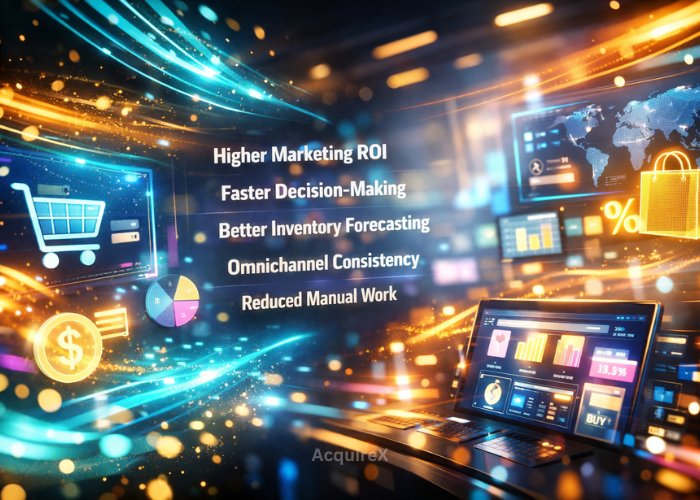
Higher Marketing ROI
AI eliminates guesswork and focuses budget on high-performing campaigns.
Faster Decision-Making
Real-time dashboards powered by AI deliver instant insights.
Better Inventory Forecasting
AI predicts demand trends, helping reduce stockouts and overstock issues.
Omnichannel Consistency
AI unifies messaging across email, ads, website, and social platforms.
Reduced Manual Work
Automation allows marketing teams to focus on strategy rather than repetitive tasks.
When executed properly, AI drives both efficiency and revenue growth.
Challenges and Ethical Considerations
While the benefits are compelling, brands must navigate:
- Data privacy concerns
- Algorithmic bias
- Over-reliance on automation
- Integration complexity
E-commerce businesses should:
- Conduct regular AI audits
- Ensure transparent data usage
- Combine AI insights with human oversight
Ethical implementation strengthens brand credibility and aligns with Google’s EEAT (Experience, Expertise, Authoritativeness, Trustworthiness) standards.
The Future of AI for Marketing in E-commerce
The next phase of AI for Marketing includes:
- Generative AI for personalised content
- AI-driven voice commerce optimisation
- Advanced predictive lifetime value modelling
- Hyper-automated performance marketing
- Emotion AI for sentiment analysis
As algorithms become more sophisticated, personalisation will shift from reactive to predictive, anticipating needs before customers express them.
E-commerce brands that adopt AI early will outperform competitors in acquisition, retention, and profitability.
Best Practices for Implementing AI for Marketing
To maximise results:
- Start with clear business objectives.
- Ensure data quality and integration.
- Choose scalable AI tools aligned with your platform.
- Train teams to interpret AI-driven insights.
- Continuously test and optimise campaigns.
Remember: AI for Marketing is not a replacement for strategy, it’s an accelerator of smart strategy.
Conclusion
AI for Marketing Delivering Sharper Customer Insights is not just a technological advancement, it is a competitive necessity in modern e-commerce.
By combining machine learning, predictive analytics, and automation, AI for Marketing Empowers Online Retailers to understand customers deeply, personalise experiences intelligently, and allocate budgets efficiently.
As consumer expectations continue to rise, brands that leverage AI will build stronger relationships, improve ROI, and lead the future of digital commerce.
The question is no longer whether to adopt AI, but how fast you can implement it effectively.
FAQ’s
How does AI for Marketing improve customer experience in e-commerce?
It personalises recommendations, optimises messaging, and predicts customer needs, creating seamless and relevant shopping journeys.
Is AI for Marketing suitable for small e-commerce businesses?
Yes. Many SaaS platforms offer affordable AI-powered tools that scale with business growth.
What data is required to implement AI for Marketing?
Customer behavior data, transaction history, CRM information, and campaign performance metrics are essential.
Can AI for Marketing increase conversion rates?
Yes. By delivering targeted offers and real-time personalisation, AI significantly improves engagement and conversions.
How do businesses ensure ethical use of AI in marketing?
By maintaining data transparency, following privacy regulations, conducting audits, and combining AI with human oversight.