
In today’s digital-first economy, Business Growth Strategies play a decisive role in determining whether an e-commerce business achieves long-term sustainability or struggles to survive in a competitive marketplace. Rising acquisition costs, evolving consumer expectations, and operational complexity demand growth frameworks that are scalable, data-driven, and resilient.
This comprehensive guide on Business Growth Strategies is tailored for e-commerce founders, investors, analysts, and researchers seeking proven methods to scale online businesses while maintaining profitability and operational stability.
What Are Business Growth Strategies in Ecommerce?
Business Growth Strategies are structured plans designed to increase revenue, expand market reach, improve efficiency, and strengthen brand equity over time. In the e-commerce industry, these strategies are closely linked to digital infrastructure, logistics, customer experience, pricing intelligence, and performance marketing.
Unlike traditional retail, ecommerce growth is measurable and scalable, but only when growth strategies are implemented with a long-term vision rather than short-term tactics.
Why Business Growth Strategies Matter for Ecommerce Brands
The e-commerce sector operates in a high-competition, low-switching-cost environment. Well-executed growth strategies help businesses:
- Improve customer lifetime value (CLV)
- Lower customer acquisition costs (CAC)
- Achieve predictable revenue growth
- Strengthen brand trust and loyalty
- Attract institutional investors and strategic partners
For researchers and decision-makers, strong growth strategies signal operational maturity and sustainable business models.
Core Business Growth Strategies for Sustainable Ecommerce
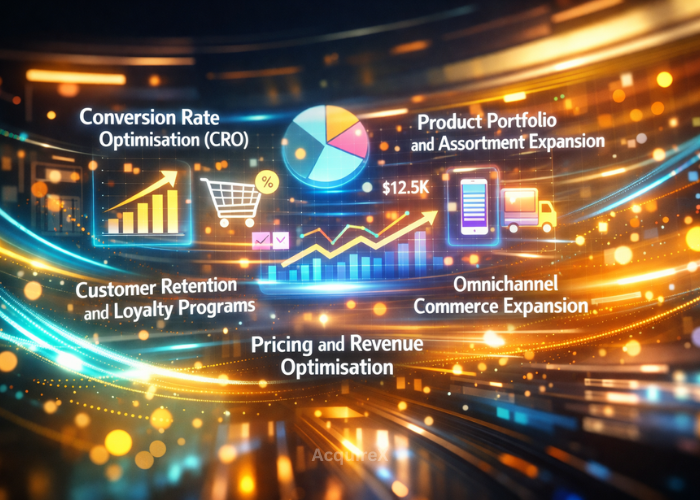
1. Conversion Rate Optimisation (CRO)
One of the most efficient Business Growth Strategies is increasing conversions from existing traffic. Ecommerce CRO focuses on:
- Faster website performance
- Clear product messaging
- Frictionless checkout experiences
- Trust elements such as reviews and guarantees
Incremental improvements in conversion rates often deliver exponential revenue impact at scale.
2. Product Portfolio and Assortment Expansion
Product expansion is a foundational component of Business Growth Strategies. Ecommerce brands scale by:
- Launching complementary products
- Creating bundles and value packs
- Developing private-label offerings
Data-driven assortment planning reduces inventory risk and improves profitability.
3. Customer Retention and Loyalty Programs
Retention-led Business Growth Strategies consistently outperform acquisition-heavy models. Retained customers typically:
- Purchase more frequently
- Generate higher average order values
- Cost less to re-engage
Effective tactics include loyalty programs, personalised email flows, and post-purchase engagement.
Read All About: Customer Service Management System for Better Retention
4. Omnichannel Commerce Expansion
Sustainable Business Growth Strategies integrate multiple sales channels while maintaining brand consistency. These include:
- Direct-to-consumer (D2C) websites
- Online marketplaces
- Social commerce platforms
Omnichannel expansion increases reach while reducing dependency on a single platform.
Read All About: Sales Techniques That Transform Growth
5. Pricing and Revenue Optimisation
Pricing is a critical lever in advanced Business Growth Strategies. Ecommerce brands increasingly rely on:
- Competitive pricing intelligence
- Dynamic pricing models
- Demand-based discounting
Optimised pricing protects margins while remaining competitive in crowded markets.
Read All About: Pricing Strategies for E-commerce Growth
Technology-Driven Business Growth Strategies
Automation and Operational Efficiency
Automation is essential for scalable growth strategies. High-growth ecommerce businesses invest in:
- Inventory and order management systems
- Automated fulfilment workflows
- Marketing automation platforms
These technologies reduce manual effort and support rapid growth without operational bottlenecks.
Data-Driven Decision Making
Modern growth strategies are powered by analytics. Key performance indicators include:
- Customer acquisition cost (CAC)
- Customer lifetime value (CLV)
- Cart abandonment rate
- Inventory turnover ratio
Data-first decision-making enables faster experimentation and controlled scaling.
Financial Planning and Unit Economics in Business Growth Strategies
Financial discipline is a cornerstone of sustainable growth strategies in e-commerce. Revenue growth alone is insufficient without strong unit economics and cash flow management.
Understanding Unit Economics
Unit economics assess profitability at the order or customer level. Core metrics include:
- Customer acquisition cost (CAC)
- Customer lifetime value (CLV)
- Contribution margin per order
- Fulfilment and return costs
Successful Business Growth Strategies ensure CLV significantly exceeds CAC over time.
Cash Flow and Working Capital Management
Many ecommerce businesses fail due to poor cash flow despite strong sales. Effective Business Growth Strategies prioritise:
- Demand forecasting and inventory planning
- Supplier credit optimisation
- Controlled marketing expenditure
- Real-time financial dashboards
Strong cash flow enables growth without excessive reliance on external funding.
Profitability Frameworks for Sustainable Growth
Advanced Business Growth Strategies focus on profitability through:
- Gross margin optimisation
- Logistics and warehousing efficiency
- Subscription and repeat-purchase revenue models
Profit-first frameworks build resilience during market downturns.
Global Expansion as a Growth Lever
Cross-border ecommerce is a powerful component of long-term growth strategies. Successful global expansion requires:
- Localised pricing and payment methods
- Regional fulfilment capabilities
- Compliance with international tax and data regulations
While complex, global expansion significantly increases total addressable market.
Trust, Brand Authority, and Sustainable Growth
Trust is a critical driver of e-commerce success. Sustainable growth strategies focus on:
- Transparent policies and disclosures
- Authentic customer reviews
- Secure payment and data protection systems
Brand credibility directly impacts conversion rates and customer retention.
Common Mistakes in Business Growth Strategies
Even experienced teams make avoidable errors, such as:
- Scaling paid advertising before optimising conversions
- Expanding product lines without validating demand
- Ignoring retention and customer feedback
Effective growth strategies prioritise fundamentals before aggressive scaling.
Future Trends Influencing Business Growth Strategies
The next generation of ecommerce growth will be shaped by:
- AI-driven personalisation
- Predictive analytics for demand forecasting
- Sustainable and ethical commerce models
Brands that adapt their growth strategies early will gain long-term competitive advantages.
Conclusion
In a rapidly evolving digital marketplace, Business Growth Strategies determine whether an ecommerce business achieves sustainable success or stagnates. By aligning customer-centric thinking, financial discipline, and technology-driven execution, ecommerce brands can scale responsibly and profitably.
For founders, investors, and researchers, mastering the right growth strategies is essential to building long-term value in the e-commerce industry.
FAQ’s
What are Business Growth Strategies in ecommerce?
Business Growth Strategies in e-commerce are structured approaches that increase revenue, customer base, and profitability by optimising marketing, operations, technology, and customer experience.
Which Business Growth Strategies are most effective for sustainable e-commerce?
The most effective growth strategies include conversion rate optimisation, customer retention programs, data-driven pricing, automation, and strong unit economics to ensure long-term profitability.
How do Business Growth Strategies reduce customer acquisition costs?
Well-planned growth strategies reduce acquisition costs by improving retention, increasing repeat purchases, optimising conversion rates, and leveraging owned channels like email and loyalty programs.
Why are unit economics important in Business Growth Strategies?
Unit economics ensure that each transaction or customer is profitable. Sustainable growth strategies require customer lifetime value (CLV) to consistently exceed customer acquisition cost (CAC).
How can e-commerce startups implement Business Growth Strategies with limited budgets?
E-commerce startups can implement growth strategies by focusing on conversion optimisation, retention marketing, operational efficiency, and data-driven decision-making before scaling paid advertising.