The e-commerce industry is evolving at an unprecedented pace. Consumer expectations are higher than ever, competition is intense, and personalization is no longer optional. In this landscape, Generative AI has emerged as a transformative force that is reshaping sales, marketing, and customer engagement strategies.
From AI-driven product descriptions to predictive personalization and automated customer support, Generative AI is redefining how online retailers acquire, convert, and retain customers. This guide explores its practical use cases, ROI insights, and how e-commerce brands can adopt it strategically.
What Is Generative AI and Why It Matters in Ecommerce?
Generative AI refers to artificial intelligence systems capable of creating text, images, videos, code, and other content based on learned data patterns. Unlike traditional automation tools, AI produces new outputs rather than simply analysing or categorising existing information.
In e-commerce sales, this means:
- Automatically generating optimized product descriptions
- Creating personalized email campaigns
- Designing ad creatives
- Powering conversational shopping assistants
- Generating data-driven sales scripts
According to insights published by McKinsey & Company, AI technologies could add trillions in annual value across industries, with retail and e-commerce among the highest-impact sectors.
For e-commerce brands, AI is no longer experimental, it’s a competitive advantage.
Key Use Cases of Generative AI in Ecommerce Sales
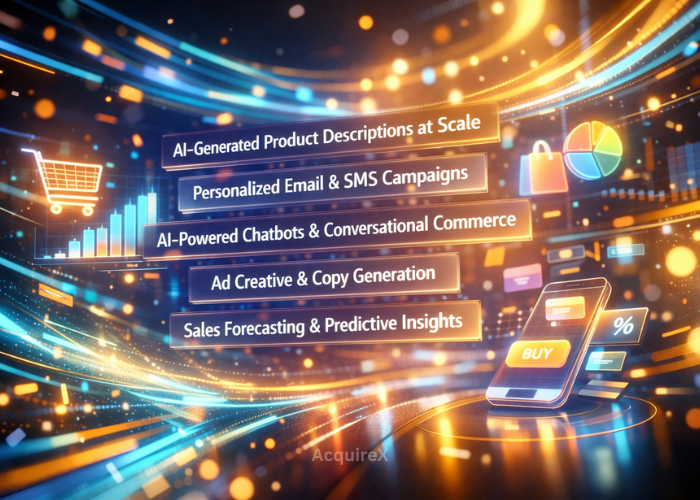
1. AI-Generated Product Descriptions at Scale
Writing unique, SEO-optimized descriptions for thousands of SKUs is resource-intensive. Generative AI can:
- Create keyword-rich descriptions instantly
- Maintain consistent brand voice
- Adapt tone for different customer segments
- Optimize for search and conversions
This reduces content production time while improving organic visibility and product page engagement.
Read All About: Automated Content Creation for Effortless SEO Scale
2. Personalized Email & SMS Campaigns
Modern consumers expect relevance. AI analyzes customer behavior and creates:
- Dynamic product recommendations
- Behavior-triggered follow-ups
- Personalized abandoned cart emails
- Region-specific promotions
This level of hyper-personalization directly impacts click-through rates and conversion rates, leading to measurable revenue growth.
3. AI-Powered Chatbots & Conversational Commerce
Conversational commerce is growing rapidly. AI-powered chatbots using Generative AI can:
- Answer product queries in real-time
- Suggest products based on browsing history
- Handle objections during checkout
- Guide customers through upselling opportunities
These intelligent assistants operate 24/7, reduce cart abandonment, and enhance customer satisfaction.
4. Ad Creative & Copy Generation
Paid advertising demands constant creative testing. AI helps by:
- Creating multiple ad variations instantly
- Generating platform-specific headlines
- Personalizing ad messaging by audience segment
- Optimizing copy for performance
This allows sales teams to focus on strategy while AI handles repetitive creative production.
5. Sales Forecasting & Predictive Insights
Beyond content, Generative AI can analyze sales data patterns to generate insights such as:
- Seasonal demand predictions
- Pricing recommendations
- Inventory optimization signals
- Cross-sell opportunities
Retailers that combine predictive analytics with automated content generation see faster decision-making and better ROI.
Measuring ROI of Generative AI in Ecommerce
Adopting AI without measurement leads to unclear outcomes. To evaluate ROI effectively, focus on:

Revenue Metrics
- Increase in conversion rate
- Growth in average order value (AOV)
- Reduction in cart abandonment
Cost Efficiency
- Reduced content production costs
- Lower customer support expenses
- Reduced ad creative costs
Productivity Gains
- Faster campaign launches
- Shorter product listing cycles
- Automated reporting workflows
When implemented strategically, AI delivers both direct revenue growth and operational efficiency improvements.
Implementation Strategy for Ecommerce Brands
Introducing Generative AI requires a structured approach:
Step 1: Identify High-Impact Areas
Start with repetitive, scalable processes such as product content or email marketing.
Step 2: Integrate with Existing Platforms
Ensure compatibility with:
- CMS platforms
- CRM systems
- Marketing automation tools
- Inventory systems
Step 3: Maintain Human Oversight
While Generative AI accelerates output, human review ensures:
- Brand consistency
- Compliance accuracy
- Cultural sensitivity
- Ethical marketing practices
Risks & Ethical Considerations
Like any technology, AI carries potential risks:
- Data privacy concerns
- AI-generated inaccuracies
- Over-automation reducing human touch
- Dependence on training data quality
Brands must maintain transparency, protect user data, and align AI usage with global compliance standards.
Future Trends of Generative AI in Ecommerce Sales
The future of AI in e-commerce includes:
- AI-generated product images and videos
- Real-time multilingual content creation
- AI-powered virtual shopping assistants
- Predictive customer lifetime value modeling
- Fully automated sales funnels
As AI models become more advanced, hyper-personalized digital storefronts will become the norm rather than the exception.
Data-Driven Ecommerce Growth Framework
To successfully implement Generative AI, brands should follow a measurable growth framework:
- Audit Existing Sales Processes: Identify bottlenecks in product content, ads, and support.
- Define Clear KPIs: Track revenue impact, engagement rates, and automation savings.
- Start with Pilot Campaigns: Test AI-generated emails, ads, or product listings before full rollout.
- Optimize Based on Data: Continuously refine AI prompts and workflows.
- Scale Across Channels: Expand AI usage to marketplaces, social commerce, and owned platforms.
This structured approach ensures that AI contributes directly to sales growth rather than becoming just another tool.
Final Thoughts
The e-commerce industry is at a turning point. Brands that leverage AI strategically will unlock scalable personalisation, improved operational efficiency, and stronger customer relationships.
The key is not simply adopting AI, but aligning Generative AI initiatives with measurable sales goals, ethical standards, and long-term brand value.
As competition intensifies, those who combine human expertise with intelligent automation will lead the future of e-commerce sales.
FAQ’s
How does Generative AI improve ecommerce sales?
Generative AI enhances personalization, automates content creation, and optimizes campaigns, leading to higher conversions and operational efficiency.
Is Generative AI suitable for small ecommerce businesses?
Yes. Many AI tools are scalable and affordable, making them accessible for startups and SMEs.
Can Generative AI replace human marketers?
No. Generative AI supports marketers but still requires human oversight for strategy, compliance, and quality control.
What is the biggest ROI driver of Generative AI?
Personalization combined with automation of repetitive tasks typically delivers the fastest and most measurable ROI gains.
Is Generative AI secure for handling customer data?
When implemented with proper compliance measures, secure infrastructure, and data governance policies, it can operate safely within global data protection frameworks.