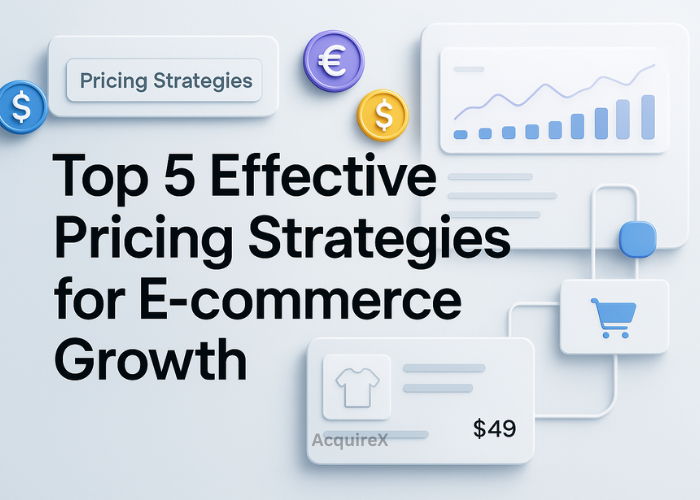
Top 5 Effective Pricing Strategies for E-commerce Growth can completely transform your online store’s performance, driving both profitability and brand trust. In today’s competitive online Marketplace, price is more than a number, it’s a reflection of your value proposition, positioning, and credibility.
The right Pricing Strategies not only boost conversions and average order value (AOV) but also help your E-commerce brand stay ahead of competition. This guide explores five proven strategies that can help you scale effectively in 2025 and beyond.
What Are Pricing Strategies in E-commerce?
Pricing Strategies are structured approaches that determine how businesses set product prices based on customer psychology, market trends, and competition.
In the E-commerce world, pricing directly impacts perceived value, profitability, and brand loyalty. Effective pricing ensures that your brand appeals to the right audience while maintaining sustainable profit margins.
A well-designed pricing framework can be the difference between short-term sales spikes and long-term customer retention. By combining data insights with consumer behavior analysis, brands can price smarter, increase lifetime value, and build a loyal community that sees value beyond cost.
Why Pricing Strategies Matter for E-commerce Success
Pricing plays a critical role in shaping how customers view your brand and how likely they are to make a purchase. Studies show that more than 60% of E-commerce customers compare prices before buying a product.
Smart Pricing Strategies help you:
- Build trust and credibility among online shoppers
- Increase profit margins without sacrificing value
- Stay relevant in a price-sensitive market
- Adapt quickly to shifting market conditions
Simply put, pricing is not just about revenue; it’s a reflection of your Business Intelligence and brand maturity.
Top 5 Pricing Strategies That Drive E-commerce Growth
Let’s explore the five most effective Pricing Strategies that successful E-commerce businesses use to grow sustainably.
1. Value-Based Pricing
Value-Based Pricing focuses on what customers believe your product is worth, rather than its production cost. This strategy emphasizes emotional connection and perceived value, making it suitable for premium brands like Apple or Nike.
Pros: Builds brand authority and supports higher margins.
Cons: Requires deep customer and market research.
Pro Tip: Conduct customer surveys and monitor product reviews to understand how customers define value. This insight will help you refine your pricing model for better alignment with expectations.
2. Dynamic Pricing
Dynamic Pricing adjusts product prices in real time according to demand, seasonality, and competitor activity. Leading E-commerce companies like Amazon and Airbnb rely on data-driven pricing algorithms to stay competitive.
Pros: Maximizes profits during high-demand periods and reduces losses during slow Sales cycles.
Cons: Frequent price changes can confuse or frustrate loyal customers.
Best For: Established online stores equipped with analytics and automation tools that track pricing trends.
Dynamic pricing also enables smaller brands to compete more effectively by leveraging machine learning models that track customer behavior, helping identify the optimal price point for conversion.
3. Psychological Pricing
Psychological Pricing leverages consumer perception by using numbers strategically. For instance, a product priced at $49.99 appears significantly cheaper than $50, even though the difference is minimal.
Pros: Enhances sales conversions and encourages impulse buying.
Cons: Can appear manipulative if overused.
Tip: Combine odd-even pricing, limited-time offers, and anchor pricing such as “was $99, now $79” to create a sense of urgency and perceived savings.
4. Competitive Pricing
Competitive Pricing involves aligning or slightly undercutting competitor prices to attract customers. This approach works best in categories like fashion, electronics, or beauty, where customers are highly price-sensitive.
Pros: Keeps your store competitive and prevents customer churn.
Cons: Can lead to reduced profit margins if used excessively.
Use Tool: Price2Spy to monitor market rates and maintain a balanced approach that safeguards both competitiveness and profitability.
When executed strategically, competitive pricing can also highlight your brand’s transparency and fairness, reinforcing customer confidence and increasing return purchase rates.
5. Bundle Pricing
Bundle Pricing offers related products together at a slightly discounted price. For example, a “Work Essentials Kit” may include a laptop stand, wireless mouse, and headset.
Pros: Increases average order value and clears excess inventory.
Cons: If discounts are too large, profit margins can decline.
Best For: E-commerce stores selling complementary products or seasonal collections that naturally fit together.
Bundle pricing also encourages customers to explore your product range, increasing brand engagement and improving upsell potential for future purchases.
How to Choose the Right Pricing Strategy
Selecting the ideal pricing model requires a clear understanding of your brand goals, target audience, and market positioning.
- Define your revenue and growth objectives.
- Study competitor pricing across similar categories.
- Understand what drives your customers’ purchase decisions.
- Experiment with A/B testing to identify optimal price points.
- Leverage analytics platforms like Shopify or WooCommerce to measure performance.
Successful E-commerce pricing is a balance between competitive awareness, customer psychology, and business data.
Key Metrics to Measure the Success of Your Pricing Strategies
To know whether your Pricing Strategies are truly effective, monitor these key performance indicators:
- Conversion Rate: Measures how many visitors turn into paying customers after viewing product prices.
- Average Order Value (AOV): Tracks how much customers spend per transaction.
- Gross Profit Margin: Indicates how much profit you retain after covering costs.
- Customer Lifetime Value (CLV): Evaluates how much each customer contributes to long-term revenue.
- Price Elasticity: Helps determine how sensitive your customers are to price changes.
By analyzing these metrics regularly, E-commerce brands can make data-driven pricing adjustments that maximize revenue and ensure consistent growth.
Future Trends in E-commerce Pricing Strategies
The next evolution of Pricing Strategies will be driven by technology and personalization. Brands are increasingly adopting:
- AI-powered real-time price optimization
- Personalized offers based on browsing history and purchase intent
- Subscription pricing to retain long-term customers
These innovations are reshaping how E-commerce brands create pricing models that drive consistent growth.
By integrating data analytics, behavioral economics, and automation tools, forward-thinking brands can not only respond to market dynamics but also predict them, setting a new benchmark for competitive pricing excellence.
Final Thoughts
Your pricing strategy defines your business success. Whether you choose value-based, dynamic, or psychological pricing, consistent testing and customer insight are essential.
Effective Pricing Strategies do more than increase sales, they build trust, enhance loyalty, and position your E-commerce business as a market leader. By staying data-driven and customer-focused, your brand can achieve sustainable growth in an ever-evolving digital landscape.
FAQs
1. What are the best pricing strategies for E-commerce stores?
The best Pricing Strategies for E-commerce include value-based pricing, dynamic pricing, psychological pricing, competitive pricing, and bundle pricing. These methods help brands balance profitability and customer satisfaction while staying ahead of competitors. The ideal strategy depends on your niche, audience, and long-term business goals.
2. How do I choose the right pricing strategy for my online store?
To choose the right Pricing Strategy, start by analyzing your target audience, competitor pricing, and product positioning. Then, test multiple approaches, such as discount models or dynamic pricing, to see which maximizes profit and conversion. Use analytics tools like Shopify Reports or Google Analytics to track pricing impact on customer behavior and revenue.
3. Which metrics should I track to measure the success of my pricing strategies?
The most important metrics to track include conversion rate, average order value (AOV), gross profit margin, customer lifetime value (CLV), and price elasticity. Monitoring these indicators helps determine if your Pricing Strategies are driving sustainable growth and profitability in your E-commerce business.