

Top Ecommerce Challenges in 2026 and How to Overcome Them is a crucial discussion as the global e-commerce industry enters a more competitive, regulated, and customer-centric phase.
The digital commerce ecosystem is expanding rapidly, but growth also brings complexity. From rising acquisition costs to operational inefficiencies, E-commerce Challenges are becoming more layered and strategic in nature. For online business owners, decision-makers, analysts, and researchers, understanding these Ecommerce Challenges is essential to sustain growth and profitability in 2026 and beyond.
This comprehensive guide explores the most critical Ecommerce Challenges and offers actionable, future-ready solutions aligned with industry best practices.
Understanding Ecommerce Challenges in 2026
E-commerce Challenges refer to the business, technology, marketing, and compliance-related obstacles faced by online retailers. In 2026, these challenges go far beyond launching an online store. They now involve customer trust, scalability, logistics, personalization, data protection, and long-term sustainability.
As consumer expectations evolve and competition intensifies, Ecommerce Challenges demand strategic planning, not short-term fixes.
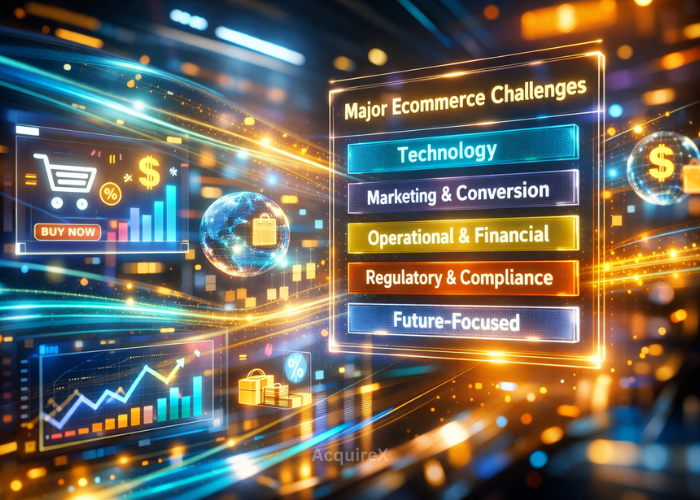
Major Ecommerce Challenges Businesses Face Today
Rising Customer Acquisition Costs (CAC)
One of the most persistent Ecommerce Challenges is the continuous rise in customer acquisition costs. Paid advertising platforms are crowded, bidding costs are high, and organic reach is increasingly competitive.
How to overcome it:
- Invest in SEO-driven content and brand authority
- Focus on customer retention and loyalty programs
- Build first-party data through email and owned channels
Reducing dependence on paid ads is a long-term solution to this Ecommerce Challenge.
Building and Maintaining Customer Trust
Trust has become a core factor in E-commerce Challenges, especially with increasing awareness around data privacy and online fraud. Customers expect transparency, security, and reliability.
How to overcome it:
- Use secure payment gateways and HTTPS protocols
- Display clear privacy, return, and refund policies
- Include genuine reviews and trust signals
According to global e-commerce standards published by platforms like Shopify, trust directly impacts conversion rates and customer lifetime value.
Supply Chain and Fulfillment Complexity
Logistics and inventory management remain major E-commerce Challenges in 2026. Delayed deliveries, stock mismatches, and rising shipping costs affect both customer experience and margins.
How to overcome it:
- Diversify suppliers and logistics partners
- Use demand forecasting and inventory automation
- Communicate realistic delivery timelines
Efficient fulfillment reduces friction across the customer journey.
Check out what’s included in Supply Chain Management
Technology-Related Ecommerce Challenges
Website Performance and Scalability
Slow-loading websites and downtime are serious Ecommerce Challenges that directly impact revenue. Performance issues become more visible as traffic grows.
How to overcome it:
- Optimize site speed and mobile responsiveness
- Use scalable hosting and cloud infrastructure
- Consider headless or modular commerce architectures
Performance optimization is no longer optional in competitive e-commerce markets.
Google’s Search Central Documentation highlights that page experience, mobile performance, and site reliability directly impact visibility and user engagement.
Read All About: E-commerce Technologies Solutions
Managing Complex Tech Stacks
As businesses grow, they adopt multiple tools for marketing, analytics, CRM, and inventory. Managing these systems becomes one of the hidden E-commerce Challenges.
How to overcome it:
- Choose tools with strong integration capabilities
- Avoid unnecessary software overlap
- Centralize data through unified dashboards
A simplified tech stack improves efficiency and decision-making.
Marketing and Conversion Ecommerce Challenges
Low Conversion Rates Despite High Traffic
Driving traffic without conversions is one of the most frustrating Ecommerce Challenges. Many stores struggle to turn visitors into customers.
How to overcome it:
- Improve UX/UI and simplify checkout
- Use social proof such as reviews and ratings
- Continuously test landing pages and CTAs
Conversion rate optimization should be an ongoing process.
Content Saturation and SEO Competition
SEO itself has become one of the toughest Ecommerce Challenges. Thousands of stores publish similar content, making it difficult to rank.
How to overcome it:
- Focus on topical authority instead of isolated keywords
- Publish in-depth, research-backed content
- Regularly update existing pages
Search engines reward relevance, expertise, and consistency.
Read All About: Performance Marketing & Growth Solutions
Operational and Financial Ecommerce Challenges
Managing Profit Margins
Discount-led growth has created profitability-related Ecommerce Challenges. Rising costs and aggressive pricing often squeeze margins.
How to overcome it:
- Optimize pricing strategies
- Reduce operational waste
- Focus on lifetime value instead of one-time sales
Sustainable growth requires disciplined financial planning.
High Return Rates and Reverse Logistics
Returns, especially in fashion and electronics, remain costly Ecommerce Challenges.
How to overcome it:
- Use accurate product descriptions and visuals
- Offer size guides and comparison tools
- Analyze return data to identify root causes
Lower return rates directly improve profitability.
Regulatory and Compliance Ecommerce Challenges
Taxation and Cross-Border Regulations
Selling across regions introduces complex legal and tax-related Ecommerce Challenges. Regulations vary widely by country and region.
How to overcome it:
- Use automated tax calculation tools
- Stay updated with regional compliance laws
- Seek professional advice when expanding internationally
Compliance protects businesses from penalties and reputational damage.
Future-Focused Ecommerce Challenges
Adapting to Changing Consumer Expectations
Modern consumers expect personalization, speed, and transparency. Meeting these expectations is one of the evolving E-commerce Challenges.
How to overcome it:
- Use data responsibly to personalize experiences
- Invest in customer support and post-purchase engagement
- Continuously collect and act on customer feedback
Customer-centric brands are more resilient to market changes.
Preparing for Long-Term Ecommerce Success
Overcoming E-commerce Challenges requires a shift from short-term tactics to long-term strategy. Businesses that invest in trust, technology, and customer experience are better positioned for sustainable growth.
Key priorities for 2026 include:
- Building strong brand authority
- Leveraging first-party data ethically
- Improving operational efficiency
- Staying aligned with search engine and platform guidelines
Final Thoughts on Ecommerce Challenges
E-commerce challenges in 2026 are complex but manageable. They reflect the maturity of the industry rather than its limitations. Businesses that understand these challenges deeply and respond with informed, data-driven strategies will gain a competitive edge.
By focusing on scalability, trust, compliance, and customer experience, e-commerce businesses can turn challenges into long-term opportunities. Staying adaptable, informed, and customer-first remains the most effective way to overcome Ecommerce Challenges and succeed in the evolving digital commerce landscape.
FAQ’s
What are Ecommerce Challenges in 2026?
The challenges in 2026 include rising customer acquisition costs, intense competition, supply chain complexity, data privacy concerns, scalability issues, and increasing regulatory compliance requirements.
Why are Ecommerce Challenges increasing every year?
The challenges are increasing due to market saturation, evolving consumer expectations, higher advertising costs, rapid technology changes, and stricter global regulations affecting online businesses.
Which Ecommerce Challenges impact profitability the most?
The challenges that most affect profitability are high customer acquisition costs, frequent product returns, logistics inefficiencies, heavy discounting, and poor conversion rates.
How can businesses overcome major Ecommerce Challenges?
Businesses can overcome the challenges by focusing on customer retention, improving website performance, strengthening trust and data security, optimizing operations, and adopting long-term, data-driven strategies.
Are Ecommerce Challenges the same for all online businesses?
No, challenges vary depending on business size, industry, target market, geography, and growth stage, though core issues like trust, competition, and scalability affect most ecommerce businesses.