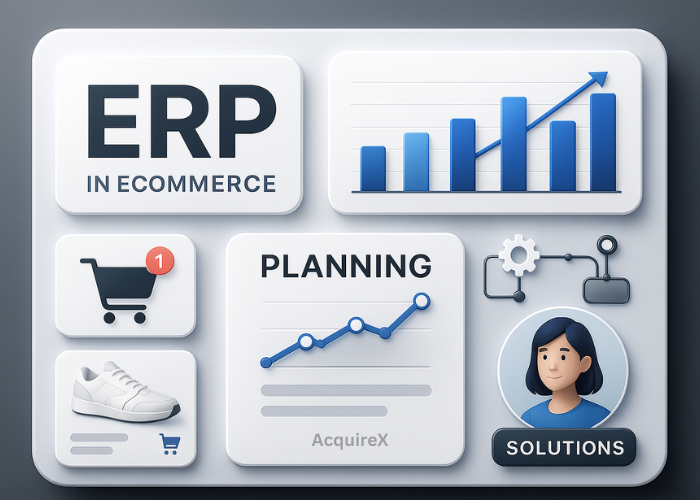
What Is ERP in Ecommerce and How It Works is a question many online businesses are asking as the industry becomes more competitive, data-driven, and operationally complex. As digital commerce expands, the role of ERP In Ecommerce is becoming increasingly vital. An ERP system brings together all core business functions, inventory, finance, logistics, sales, procurement, HR, and customer management, into one centralized platform, giving e-commerce owners complete visibility and control over operations.
In the fast-moving world of online retail, the ability to make decisions based on real-time data is what separates profitable brands from those that struggle to keep up. This is exactly where ERP In Ecommerce provides value. It unifies fragmented workflows, automates time-consuming tasks, and ensures smoother operations across all departments. Whether you manage a startup online store or a large-scale e-commerce enterprise, a robust ERP system can transform your operational efficiency and business scalability.
Founding Team, Owner, and Establishment Year of ERP In Ecommerce Solutions
ERP solutions for e-commerce were introduced by global software pioneers who recognized the need for integrated digital operations. Leading ERP providers such as SAP (founded in 1972 by Hopp, Wellenreuther, Tschira, Plattner, and Hector) and Oracle (founded in 1977 by Larry Ellison, Bob Miner, and Ed Oates) expanded their solutions into e-commerce-specific modules during the early 2000s as the online retail industry grew rapidly.
Modern cloud-based ERP solutions, like NetSuite (founded in 1998 by Evan Goldberg), were purpose-built for fast-growing e-commerce businesses that needed scalable, real-time systems. Over time, ERP technology evolved from complex on-premise tools to cloud-native, AI-enabled, and API-driven platforms capable of powering today’s digital-first retail world.
These innovators created the foundation of ERP In Ecommerce by designing systems that seamlessly connect inventory, warehouses, finances, Marketing, HR, and customer data.
What Is ERP In Ecommerce?
ERP In Ecommerce refers to the use of Enterprise Resource Planning software to manage critical e-commerce operations within a single unified system. Instead of relying on disconnected apps for inventory, accounting, order processing, and customer support, ERP allows businesses to run everything from one centralized dashboard.
Key Features of ERP In Ecommerce
- Centralized inventory management
- Automated order processing
- Real-time sales and financial reporting
- Warehouse and supply chain tracking
- Integrated accounting and tax management
- CRM capabilities for customer engagement
- Multi-channel marketplace integration
- Vendor and procurement automation
By bringing all these functions into one system, ERP In Ecommerce improves accuracy, efficiency, and speed across every operation.
How ERP In Ecommerce Works
ERP In Ecommerce works by connecting your online store with backend systems through automated workflows, data synchronization, and API integrations. Once implemented, the ERP acts as the central operating system for your entire e-commerce business.
Step-by-Step Working Process
1. Integration With Online Storefronts
- The ERP system integrates with platforms like Shopify, WooCommerce, Magento, Amazon, and Flipkart. This allows real-time data exchange between your sales channels and ERP dashboard.
Check out what’s included in Marketplace Management
2. Real-Time Inventory Synchronization
- Whenever an order is placed, inventory levels update instantly across all platforms. This prevents overselling, stockouts, and inconsistencies.
3. Automated Order Processing
- The ERP system automatically generates picking slips, packing lists, shipping labels, and customer notifications, reducing manual effort and ensuring accuracy.
4. Financial Reporting and Tracking
- ERP In Ecommerce integrates with accounting systems to record transactions, prepare tax summaries, and generate financial statements.
5. Supply Chain and Warehouse Visibility
- Businesses can track vendor performance, purchase orders, lead times, and warehouse operations in real-time.
Check out what’s included in Supply Chain Management
6. Customer Management
- Customer data is centralized, helping businesses understand buying patterns, repeat purchase rates, and preferences for better retention strategies.
Read All About: Customer Service Management for Better Retention And Customer Relationship Management
7. Data Analytics and Business Intelligence
- ERP systems offer dashboards and KPIs that empower business owners to forecast demand, manage stock wisely, and make smart decisions.
Benefits of ERP In Ecommerce
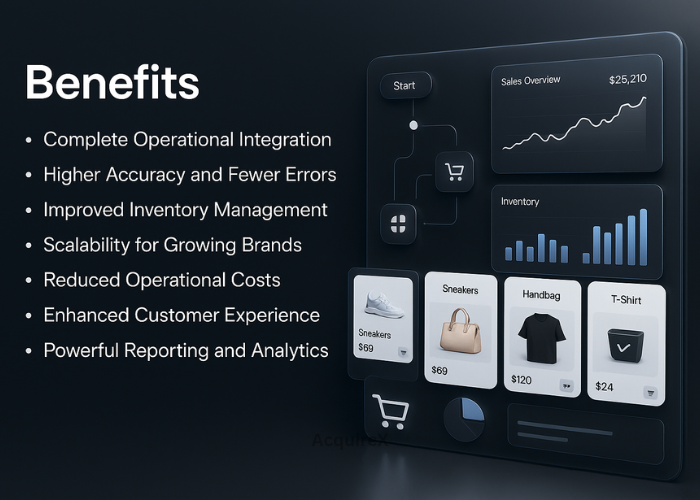
1. Complete Operational Integration
- All departments, including inventory, Sales, finance, HR, Marketing, and Procurement, are connected through one system.
2. Higher Accuracy and Fewer Errors
- Automation eliminates manual mistakes in order processing and data entry.
3. Improved Inventory Management
- Real-time stock visibility reduces carrying costs and ensures optimal inventory levels.
4. Scalability for Growing Brands
- ERP In Ecommerce supports multi-warehouse operations, global currencies, and marketplace expansion.
5. Reduced Operational Costs
- Automation cuts labor time and streamlines workflows.
6. Enhanced Customer Experience
- Faster order processing, transparent tracking, and personalized communication boost customer loyalty.
7. Powerful Reporting and Analytics
- Businesses get clearer insights into profits, expenses, customer behaviour, and operational performance.
Who Needs ERP In Ecommerce?
ERP In Ecommerce is ideal for:
- Multi-channel e-commerce brands
- D2C brands scaling rapidly
- Online marketplaces and sellers
- Subscription box businesses
- B2B and wholesale e-commerce stores
- High SKU or high-volume retailers
- Dropshipping businesses needing automated workflows
If your business struggles with inventory mismanagement, manual reporting, or scaling challenges, ERP implementation becomes a critical milestone.
Use Cases of ERP In Ecommerce
1. Multi-Channel Inventory Synchronization
- ERP keeps inventory accurate across Amazon, eBay, Shopify, and other platforms.
2. High SKU Management
- Stores with thousands of SKUs depend on ERP to eliminate duplication and errors.
3. Fast-Growing Startups
- Businesses scaling from hundreds to thousands of orders per month rely on ERP to automate manual tasks.
4. International Expansion
- ERP supports multi-currency, multi-language, and multi-warehouse operations for global brands.
Integration Capabilities of ERP In Ecommerce
Modern ERP systems integrate seamlessly with:
- Payment gateways
- Shipping aggregators
- CRM tools
- Accounting software
- Marketing automation platforms
- Warehouse management systems
API integrations ensure smooth data flow and reduce manual work.
Challenges of Implementing ERP In Ecommerce
Some challenges include:
- High initial setup and customization cost
- Data migration complexity
- Training and adoption time
- Risk of integration mismatches
- Limited flexibility in lower-tier plans
With proper planning and expert implementation, these challenges can be significantly minimized.
Conclusion
ERP In Ecommerce is not just a technology upgrade, it becomes the digital backbone of a successful online retail business. As e-commerce becomes increasingly competitive, ERP provides the automation, accuracy, and real-time intelligence needed to stay ahead. Whether you run a small online store or a global multi-channel business, ERP helps you improve efficiency, reduce costs, and deliver exceptional customer experiences. Investing in ERP In Ecommerce today ensures long-term operational excellence, scalability, and sustainable business growth.
FAQ’s
1. What Is ERP In Ecommerce and Why Is It Important?
ERP In Ecommerce refers to using Enterprise Resource Planning software to manage and automate key online retail operations such as inventory, orders, finance, supply chain, and customer data. It is important because it centralizes workflows, improves accuracy, reduces operational costs, and helps businesses scale faster with real-time insights.
2. How Does ERP In Ecommerce Improve Inventory and Order Management?
ERP In Ecommerce synchronizes inventory across all sales channels in real time, preventing stockouts, overselling, and manual errors. It also automates order processing, from capturing orders to generating packing slips, shipping labels, and customer notifications, leading to faster fulfillment and better customer satisfaction.
3. Which Businesses Should Implement ERP In Ecommerce?
Businesses that handle large SKU volumes, manage multiple sales channels, experience rapid growth, or face operational inefficiencies should implement ERP in Ecommerce. It is ideal for D2C brands, B2B sellers, online marketplaces, subscription-based businesses, and global e-commerce stores looking to streamline workflows and scale sustainably.