Running a D2C brand in 2026 feels like filling a bucket with a hole in the bottom. Sales come in. Costs leak out faster. Ads get pricier. Shipping eats margins. And payroll? It just keeps climbing.
Here’s something most founders don’t say out loud: the brands winning right now aren’t hiring more people. They’re hiring smarter. By moving key roles offshore, D2C brands are slashing operational costs by up to 40% without cutting quality or firing their core team.
According to a Deloitte Global Outsourcing Survey, 78% of fast-growing retailers already outsource part of their operations. McKinsey reports that brands using offshore CX teams reduce support costs by nearly 50% while boosting customer satisfaction by up to 25%.
This guide breaks down exactly how they do it, what to outsource first, and the real costs behind the savings. No fluff. No jargon. Just what works.
Why D2C Costs Are Getting Out of Control
Most D2C founders hit a wall between the $1M–$5M revenue mark. Here’s why:
- Meta and Google ad costs have climbed sharply over the past 3 years
- U.S. labor costs rose faster than most margins can handle
- Tech stacks bloated with 15–20 paid SaaS tools
- Returns, chargebacks, and support tickets keep growing
- Teams hired in panic during growth spikes now sit idle
A U.S.-based customer support rep costs around $45,000–$60,000 per year. The same skilled agent from the Philippines or India costs $10,000–$15,000 per year. Same work. Same hours. A fraction of the price.
Want to dive deeper? Read our guide on how to choose the right ecommerce outsourcing partner.
What “Offshore Teams” Actually Means (In Plain English)
Offshore means hiring skilled talent from countries where the cost of living is lower. Salaries are lower. But the work quality stays the same.
It’s not cheap labor. It’s smart value.
Here are the top offshore hubs D2C brands use today:
- Philippines — Top pick for customer support, chat, and virtual assistants. English-proficient and culturally aligned with Western brands.
- India — Strongest for developers, SEO specialists, Shopify Experts, graphic designers, and data work.
- Latin America (Colombia, Mexico, Argentina) — Perfect for U.S. time-zone alignment and bilingual support.
Still deciding between a virtual assistant and a full offshore team? Read Ecommerce Virtual Assistant vs. Dedicated Team.
Case Study: How a $3M Skincare Brand Saved $247,000 in One Year
Based on industry benchmarks and patterns seen across D2C brands of this size:
The Brand: A U.S.-based skincare D2C company doing $3M in annual revenue.
Before outsourcing:
- 12 in-house team members
- Monthly operations cost: $52,000
- Profit margin: 8%
After moving 6 roles offshore:
- 6 in-house (strategy, brand, founder roles) + 7 offshore (support, design, dev, VA)
- Monthly operations cost: $31,400
- Profit margin: 23%
Total savings in Year 1: $247,200.
That’s not theory. That’s the math hundreds of D2C brands run every quarter.
Where the 40% Savings Actually Come From
| Role | U.S. Cost (Monthly) | Offshore Cost (Monthly) | Monthly Savings |
|---|---|---|---|
| Customer Support (2 agents) | $8,000 | $2,000 | $6,000 |
| Shopify Developer | $7,500 | $2,500 | $5,000 |
| Social Media Manager | $5,000 | $1,500 | $3,500 |
| Graphic Designer | $4,500 | $1,200 | $3,300 |
| Virtual Assistant | $3,500 | $800 | $2,700 |
| Content Writer | $4,000 | $1,000 | $3,000 |
| TOTAL | $32,500 | $9,000 | $23,500 |
That’s a 72% cost reduction on these roles alone. Blended across your whole operation, most brands land at the 40% mark. Some hit 50%.
Expert Insight: What the Data Says
“Companies that outsource CX effectively see an average 15–25% boost in CSAT scores and up to a 30% reduction in Average Handle Time, all while reducing support costs by nearly 50%.” — McKinsey & Company, Customer Care Report
“70% of businesses increased development capacity through outsourcing, reflecting its growing role in scaling operations.” — Deloitte Global Outsourcing Survey
The data is clear: offshoring isn’t just a cost play anymore. It’s a performance play.
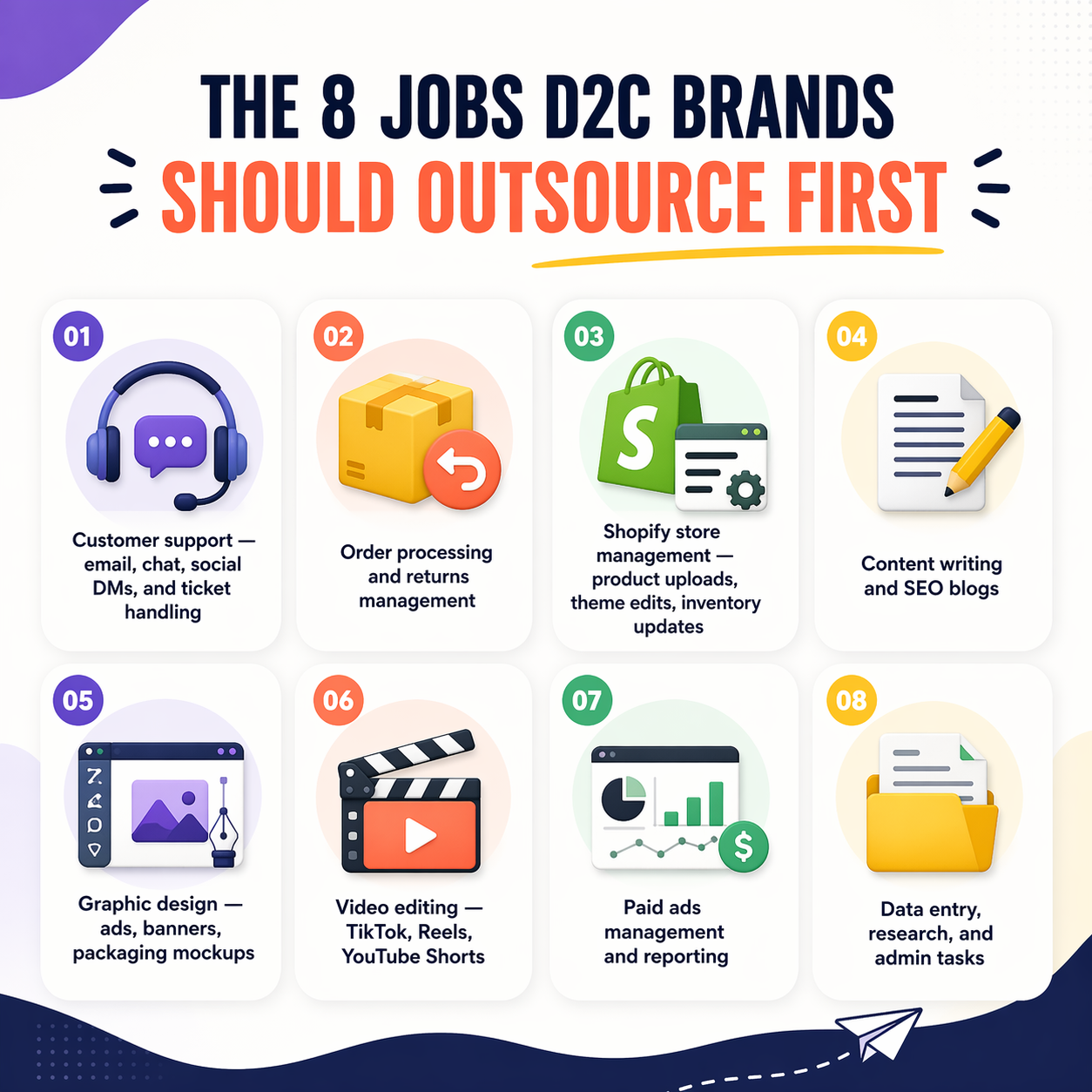
The 8 Jobs D2C Brands Should Outsource First
Start with roles that are trainable, repeatable, and don’t require sitting in your office:
- Customer support — email, chat, social DMs, and ticket handling
- Order processing and returns management
- Shopify store management — product uploads, theme edits, inventory updates
- Content writing and SEO blogs
- Graphic design — ads, banners, packaging mockups
- Video editing — TikTok, Reels, YouTube Shorts
- Paid ads management and reporting
- Data entry, research, and admin tasks
Keep your brand strategy, founder decisions, and creative direction in-house. Outsource execution. Not thinking.
For a complete setup guide, check out Offshore Ecommerce Team: The Full Playbook.
The 3-Step Offshore Playbook That Actually Works
Most brands fail at outsourcing because they rush. Use this simple framework instead.
Step 1: Document Before You Delegate
If you can’t explain how the task is done, no one else can do it right. Record a 5-minute Loom video. Write a 1-page SOP. That’s it.
Step 2: Hire Slow, Fire Fast
Don’t fall for the best-looking resume. Run a small paid trial task with 2–3 candidates. Look at:
- How fast they reply
- How they handle feedback
- Whether they ask smart questions
- Communication quality
Step 3: Build Systems, Not Dependencies
Create SOPs for everything. Use shared dashboards. Build playbooks. So when someone leaves, your business doesn’t break.
For a deeper dive, read Dedicated Ecommerce Team vs. Agency: Which One Wins?.
The Hidden Mistakes That Cost Brands Thousands
Here’s what no one tells you in those “hire offshore for $3/hour” YouTube videos:
- Chasing the cheapest rate usually ends with you redoing the work yourself
- No onboarding documents means endless Slack messages and wasted hours
- Zero time-zone overlap creates customer service delays that hurt brand trust
- Treating offshore team as vendors kills loyalty and performance
Treat them like your in-house team. Celebrate wins. Pay on time. Give real feedback. That’s what separates the brands saving 40% from the ones starting over every 6 months.
Want more context? Read BPO Process Outsourcing: Powering Ecommerce Growth.
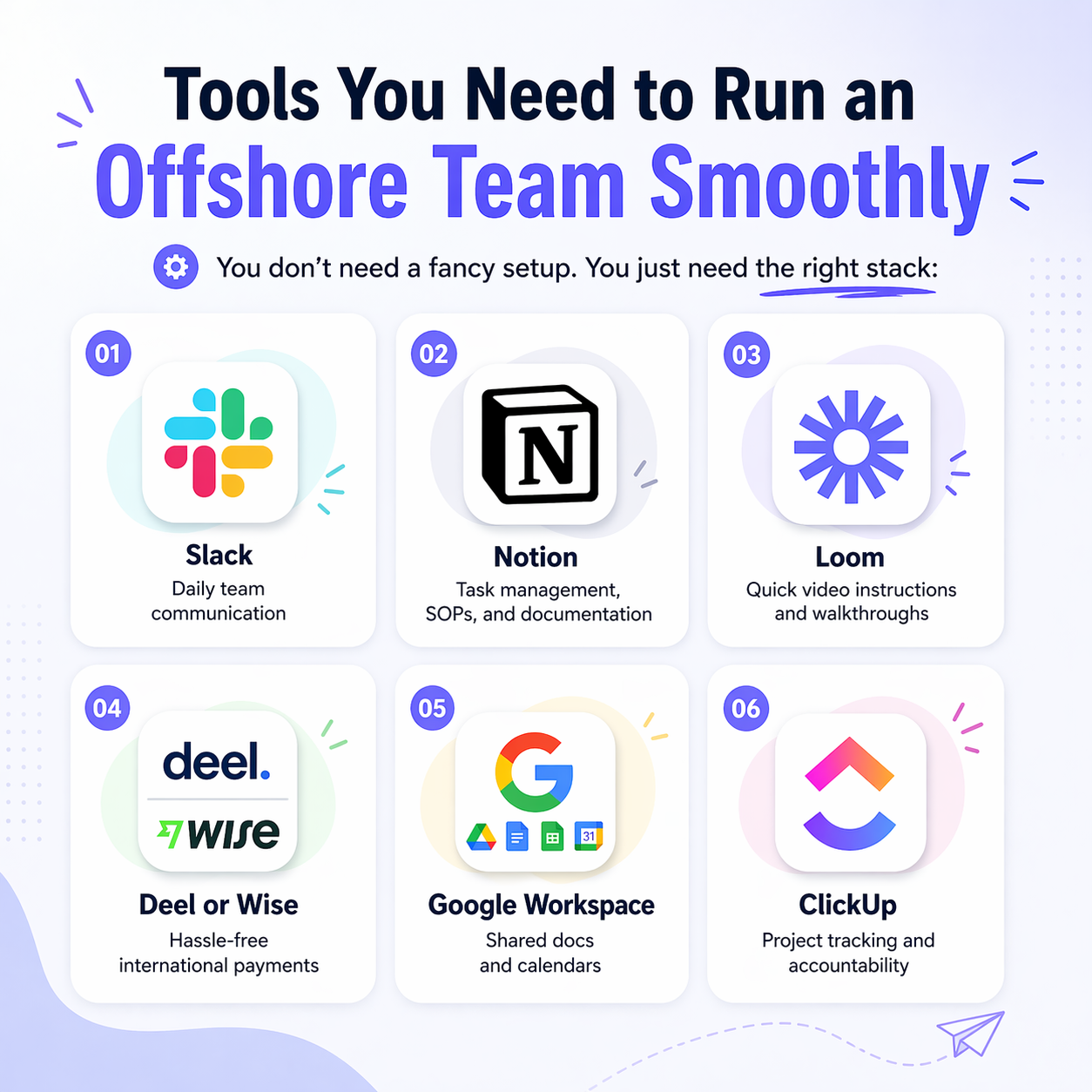
Tools You Need to Run an Offshore Team Smoothly
You don’t need a fancy setup. You just need the right stack:
- Slack — daily team communication
- Notion — task management, SOPs, and documentation
- Loom — quick video instructions and walkthroughs
- Deel or Wise — hassle-free international payments
- Google Workspace — shared docs and calendars
- ClickUp — project tracking and accountability
For more automation ideas, see How AI Automation Is Transforming Ecommerce.
Signs You’re Ready for an Offshore Team
Ask yourself honestly:
- Am I doing $10 tasks while my business needs $1,000 decisions?
- Is my core team burned out and overworked?
- Am I stuck in my inbox all day?
- Do I keep saying “I’ll just do it myself” because hiring locally feels too expensive?
If you said yes to even two of these, it’s time.
Frequently Asked Questions (FAQ)
How much can a D2C brand save with offshore teams?
Most D2C brands save between 30–50% on operational costs within the first 6 months. The exact number depends on which roles you offshore and how well you document your systems.
Is quality a concern with offshore teams?
Not anymore. The Philippines, India, and Latin America have mature talent pools with years of ecommerce experience. Quality often matches or beats local hires when you follow a proper hiring process.
What’s the best country for D2C offshore hiring?
Philippines — best for customer support and VAs
India — best for developers, SEO, and design
Latin America — best for U.S. time-zone coverage
How long does it take to set up an offshore team?
With proper SOPs and a clear hiring process, 2–4 weeks. Without documentation, it can stretch to 2–3 months.
What roles should I never outsource?
Keep brand strategy, product direction, financial decisions, and founder-level calls in-house. Outsource execution, not leadership.
Can I outsource just one role to start?
Yes, and you should. Most successful D2C brands begin with a VA or customer support rep, then scale from there.
How do I pay international team members?
Use Deel, Wise, or Payoneer. These platforms handle global payments, contracts, and compliance automatically.
Does outsourcing affect customer experience?
Done right, it improves it. According to McKinsey, brands using trained offshore CX teams see CSAT scores rise by 15–25%.
The Bottom Line
Cutting 40% of your operational costs isn’t a hack. It’s a strategy hundreds of profitable D2C brands run every single day.
Start small. Document one process this week. Hire one offshore role next month. Then scale.
The D2C brands winning in 2026 aren’t the ones with the biggest teams. They’re the ones with the smartest, leanest, most scalable ones.
Ready to Build Your Offshore Dream Team?
At AcquireX, we help D2C and ecommerce brands build high-performing offshore teams that deliver results, not headaches. From customer support to Shopify development, we handle hiring, onboarding, and ongoing management.
👉 Book a free strategy call and find out exactly how much you could save in the next 90 days.