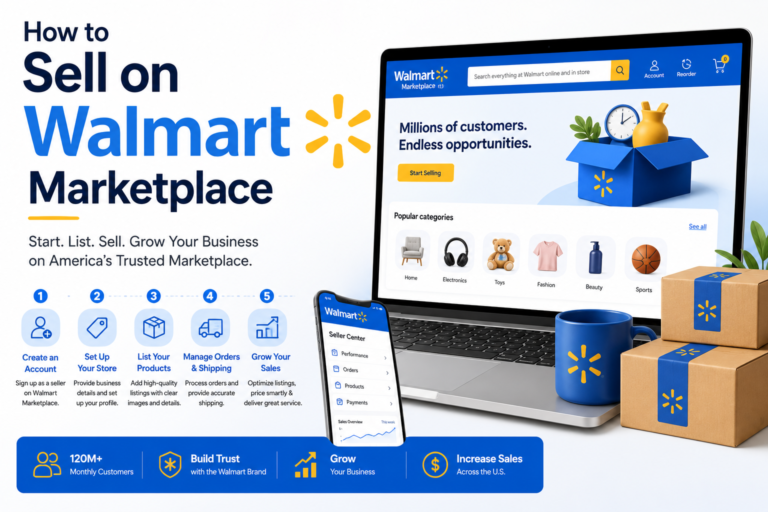
You have one product. One budget. And one big choice — Walmart Marketplace or Amazon?
For ten years, the answer was easy. Sell on Amazon first. Not anymore.
Walmart added 44,000 new sellers in just five months of 2025. Amazon raised its FBA fees again in January 2026. The math has flipped. This guide gives you real fees, real data, and a simple framework to pick the right marketplace for your brand in 2026.
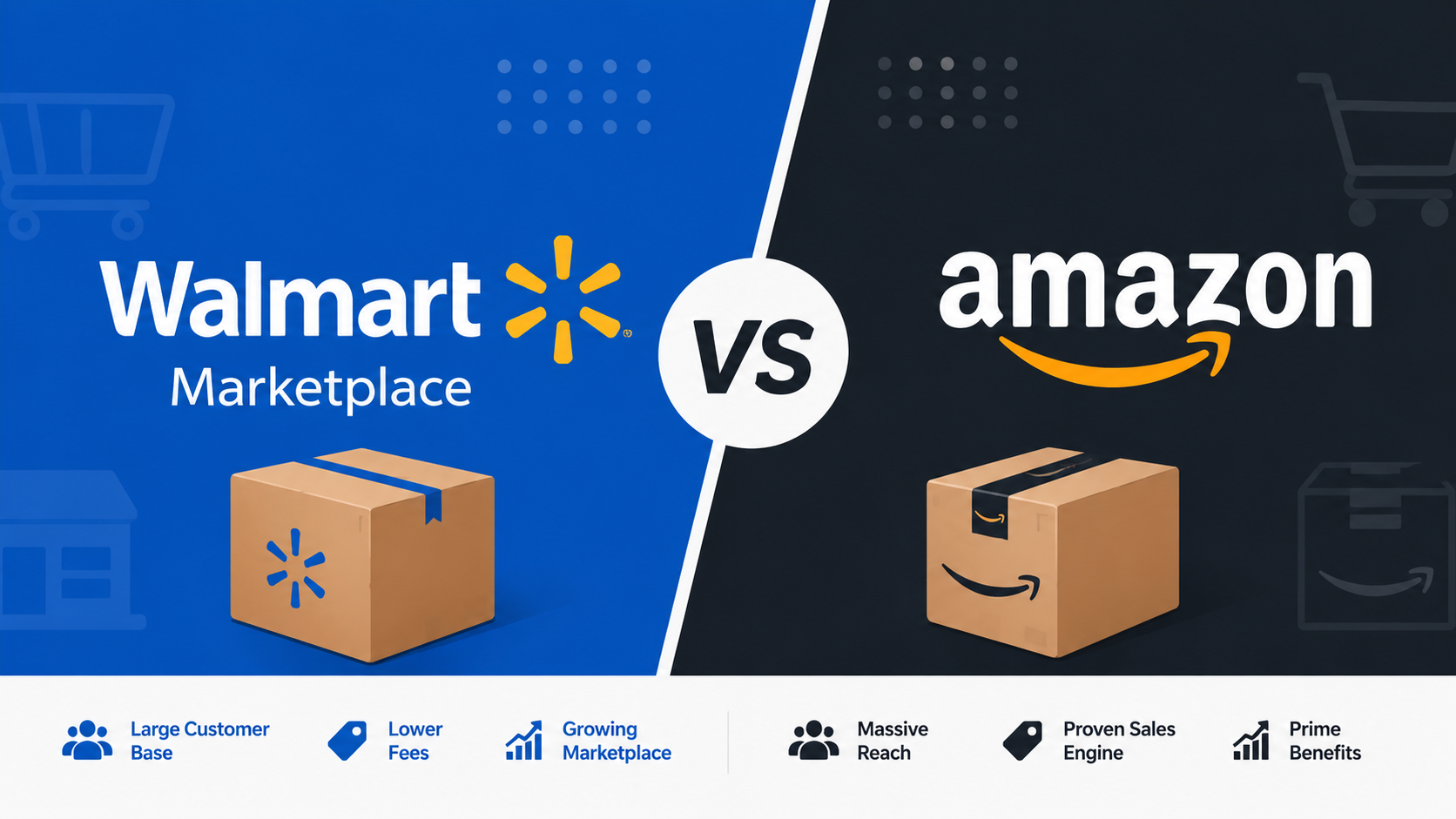
Quick Answer
- Start with Amazon if you are brand new with no past sales record.
- Start with Walmart if you already sell on Shopify or eBay and have a US business.
- Walmart wins on fees. $0/month vs Amazon’s $39.99/month.
- Amazon wins on speed. 24-hour approval vs Walmart’s 5-14 days.
Walmart vs Amazon at a Glance
| Factor | Amazon | Walmart |
|---|---|---|
| Monthly fee | $39.99 | $0 |
| Referral fee | 8% – 45% | 6% – 15% |
| Active US sellers | ~1.9 million | ~200,000 |
| Monthly US visitors | ~200 million | ~130 million |
| Approval time | 24–48 hours | 5–14 business days |
| Storage in Q4 | $2.40 per cu ft | $0.75 per cu ft |
| Best for | Volume, premium products | Margin, everyday products |
The takeaway? Amazon gives you reach. Walmart gives you margin.
Where to Sell First: 5-Second Decision Matrix
Find your situation. That’s your answer.
| Your Situation | Sell First On |
|---|---|
| Brand new, no online sales history | Amazon |
| Already selling on Shopify or eBay | Walmart |
| Premium or niche product | Amazon |
| Everyday or value product | Walmart |
| Tight margins (under 30%) | Walmart |
| Need a sale this week | Amazon |
| No US business entity | Amazon |
| Want to avoid heavy competition | Walmart |
| Selling Q4 / seasonal items | Walmart |
Selling Fees: The Real Math
Most articles stop at the headline numbers. Let’s go deeper.
Subscription Fees
- Amazon: $39.99 per month. That’s $479.88 a year before you sell anything.
- Walmart: $0 per month. Year-round.
Referral Fees
- Amazon: 8% to 45% of each sale. Most categories sit at 8% to 15%.
- Walmart: 6% to 15%. Mostly between 8% and 15%.
For most everyday product categories, Walmart’s fee is 1–5 points lower than Amazon’s. On $1M in sales, that’s $10,000–$50,000 saved.
Real Example: $50 Speaker, 100 Units a Month
| Cost Item | Amazon | Walmart |
|---|---|---|
| Subscription (year) | $479.88 | $0 |
| Referral fee (8%) | $4,800 | $4,800 |
| Fulfillment | ~$4,200 | ~$4,620 |
| Storage (with Q4 spike) | ~$600 | ~$300 |
| Total Year 1 | ~$10,080 | ~$9,720 |
The gap looks small. But Amazon CPCs run 30–50% higher than Walmart Connect. On a $60K sales year, that ad gap saves you another $3,000–$5,000 on Walmart.
Want help running real fee math for your catalog? Our marketplace management team builds per-SKU profit models so you know which channel pays you more — before you list anything.
Traffic and Buyers: Two Different Audiences
Most “vs” articles miss this. Amazon and Walmart buyers are not the same person.
The Amazon Buyer
- 200 million monthly US visitors
- Younger (25–44 core)
- Loyal to Prime — 180+ million Prime members
- Pays more for fast shipping
The Walmart Buyer
- 130 million monthly US visitors
- Older on average, suburban and middle America
- Price-sensitive but brand-loyal
- 35 million Walmart+ households
The number most sellers miss: 30–40% of US households strongly prefer Walmart. They never shop on Amazon. If you only sell on Amazon, you cannot reach them.
Approval and Listing Rules
Amazon Approval
- Anyone can sign up.
- Bank account + ID + tax info = approved in 24–48 hours.
- Some categories need extra approval (supplements, beauty, jewelry).
Walmart Approval
- Requires a US business with EIN. No sole proprietors with SSN only.
- Requires GS1-verified UPC codes for every product.
- Requires proof of past sales (Amazon, eBay, or Shopify history).
- Now takes 5–14 business days (down from 4 weeks in 2024).
Listing Quality Score (LQS)
Walmart uses an LQS that rewards:
- Clean product attributes
- Titles between 50–75 characters
- 1000×1000 px white-background images
- 150+ word descriptions
- Item Spec 5.0 compliance
Score above 85 = faster ranking and Buy Box wins.
Sloppy listings kill your sales. Fixing your catalog and content is often the fastest profit lever — bigger than chasing more ad spend.
Fulfillment: WFS vs FBA
FBA Wins When
- You need same-day delivery and Prime badge
- You sell oversized items (up to 150 lbs)
- You have high-volume products
- Speed matters more than cost
WFS Wins When
- You want flat $0.75/cu ft storage all year
- You sell normal-sized everyday items
- You want lower fees with TwoDay Delivery badge
- You’re a Walmart+ target seller
About 66% of Walmart sellers now use WFS. It handles 45% of marketplace orders.
Advertising: Walmart Connect vs Amazon Ads
Amazon Ads
- Most mature ad platform
- Average CPC: $1.20+ in competitive categories
- Sellers spend 20–40% of revenue on ads
- Healthy TACoS: 8–12%
Walmart Connect
- Less mature, growing fast
- CPC is 30–50% lower than Amazon
- Healthy TACoS: 10–15% during ramp
- Walmart Connect ad revenue grew 24% in 2024
The takeaway? Amazon wins on depth. Walmart wins on cost.
Most brands waste 30–50% of their ad spend. A focused performance marketing system can cut that waste in 60 days.
Performance Standards
Both platforms suspend sellers who fail metrics. Here’s what each watches.
Amazon
- Order Defect Rate: under 1%
- Pre-Fulfillment Cancel Rate: under 2.5%
- Late Shipment Rate: under 4%
- Enforcement is fast and sometimes harsh.
Walmart
- Order Defect Rate: under 2%
- On-Time Shipment Rate: over 99%
- Valid Tracking Rate: over 99%
- More forgiving — they work with you via a “Plan of Action” before suspending.
The 6-Question Framework: Pick Your First Marketplace
Score yourself. Tally the points.
Q1. Do I have proof of past online sales?
- Yes → +1 Walmart
- No → +1 Amazon
Q2. Is my product premium or niche?
- Yes → +1 Amazon
- No, it’s everyday → +1 Walmart
Q3. Do I have a US business with EIN?
- Yes → either works
- No → +1 Amazon (Walmart will reject you)
Q4. How fast do I need my first sale?
- This week → +1 Amazon
- A month is fine → +1 Walmart
Q5. Are my margins under 30%?
- Yes → +1 Walmart
- No → +1 Amazon
Q6. Brand or reseller?
- Brand → +1 Walmart
- Reseller → +1 Amazon
Score:
- 4+ Walmart → Start with Walmart
- 4+ Amazon → Start with Amazon
- 3-3 split → Use the category guide below
Category-by-Category Quick Picks
| Category | Best Start | Why |
|---|---|---|
| Apparel & Accessories | Walmart | Lower fees, less knockoff competition |
| Beauty (mass market) | Walmart | Value buyers concentrate here |
| Electronics | Walmart | Lower fees beat Amazon’s Q4 storage |
| Home & Kitchen | Either | Run both if bandwidth allows |
| Health & Personal Care | Amazon | Bigger active buyer base |
| Pet Supplies | Walmart | 50%+ category growth in 2025 |
| Books and Media | Amazon | Walmart buyers don’t shop these |
| Toys & Seasonal | Walmart | Flat storage saves you in Q4 |
| Office Supplies | Amazon | B2B-style buyers favor Amazon |
| Grocery & Essentials | Walmart | Walmart’s grocery muscle wins |
| Jewelry (>$250) | Walmart | 6% referral fee crushes Amazon’s 8–20% |
| Premium / Tech / Specialty | Amazon | Premium buyers concentrate here |
3 Honest Truths Most Articles Skip
Truth #1: Walmart is Faster But Stricter Now
Old guides say 4 weeks for approval. In 2026, most sellers get approved in 5–10 business days. But rejection rates are higher. Have these ready:
- US tax ID (EIN), W9 form
- Business licenses
- GS1 UPC codes
- Past sales history
- 5–10 sample products
Truth #2: Amazon’s Easy Start is Also a Trap
Yes, you can sign up for Amazon in a day. But you’re entering a market 9.5x more crowded than Walmart. New sellers spend 90+ days fighting for page-one rank. Many burn $2,000–$5,000 on PPC before they break even.
Walmart feels harder to enter. But once you’re in, you have 90% less competition. Faster ranking. Cheaper ads. Better margins. That’s the real trade.
Truth #3: “Sell on Both” is Wrong for Year One
Every article ends with “sell on both!” That advice breaks new sellers.
Two marketplaces means double the listings, double the inventory, double the customer service. Most solo founders cannot do both well in year one.
Pick one. Hit $10K/month. Then expand.
Scaling without an operations backbone is how brands burn out. Our dedicated ecommerce teams handle multi-channel execution so founders can focus on growth.
Your 90-Day Launch Plan
Pick the path that matches you.
Path A: Brand New, No Sales History
- Week 1–2: Apply to Amazon. Set up Seller Central.
- Week 3–4: List 5–10 products. Optimize titles and images.
- Month 2: Run small Sponsored Products campaigns. Aim for 50+ sales and 10+ reviews.
- Month 3: Apply to Walmart with your sales history.
- Month 4+: Start Walmart with top 5 SKUs.
Path B: Already on Shopify or eBay
- Week 1: Apply to Walmart this week.
- Week 2: Migrate top 10 SKUs only.
- Week 3: Enroll in WFS for Buy Box and TwoDay badge.
- Week 4: Launch Walmart Connect ads. Budget 15–20% TACoS.
- Month 2–3: Use Review Accelerator to build review velocity.
Path C: Established Amazon Seller
- Week 1: Apply to Walmart. Don’t quit Amazon — diversify.
- Week 2: Pick top 20 ASINs by margin (not revenue).
- Week 3: Build native Walmart listings. Don’t copy Amazon listings.
- Week 4: Send WFS inventory equal to 30 days of Amazon velocity.
- Month 2–3: Run Sponsored Brands campaigns. Optimize TACoS to 10–12%.
Need help launching on a new marketplace fast? Our sales enablement and account growth team handles end-to-end marketplace expansion for scaling brands.
Frequently Asked Questions
Where should US brands sell first in 2026 — Walmart or Amazon?
For most US brands selling everyday products, start with Walmart Marketplace. Lower fees, less competition, faster organic ranking. Premium and niche brands should start with Amazon for the buyer demographic match.
Is Walmart Marketplace better than Amazon for new sellers?
If you have prior sales history (Shopify, eBay, Amazon), Walmart is often better. If you’re brand new with zero history, Amazon is easier because Walmart requires proof of past sales.
Are Walmart’s fees really lower than Amazon’s?
Yes, for most categories. Walmart charges 6–15% vs Amazon’s 8–45%. Add Amazon’s $39.99 monthly fee and Q4 storage spike, and Walmart often saves sellers 15–30% per year.
How long does Walmart approval take in 2026?
Most sellers report 5–14 business days. Walmart accelerated onboarding in late 2025. Have your business docs, UPC codes, and sales history ready before applying.
Can I sell on Walmart as a non-US business?
Yes, since 2021. You still need a US tax ID (EIN) and US return address. About 34% of active Walmart sellers are now international.
Should I use WFS or fulfill orders myself?
Use WFS if you want the Buy Box and TwoDay Delivery badge. About 66% of Walmart sellers use WFS. Self-fulfillment works only if you can hit Walmart’s 99% on-time delivery requirement.
What’s the biggest mistake new Walmart sellers make?
Copying Amazon listings word-for-word. Walmart’s algorithm weights structured attributes more than keyword titles. Build native Walmart listings.
Is it worth selling on both Amazon and Walmart?
Yes, eventually. But not in year one. Focus on one until you hit $10K–$25K/month. Running both with no operational support breaks more brands than it builds.
What products sell best on Walmart vs Amazon?
Walmart wins: everyday essentials, household goods, value electronics, apparel, pet supplies, toys, grocery. Amazon wins: premium electronics, books, niche/specialty products, supplements, B2B office supplies.
How much should I budget to launch on Walmart?
For 5–10 SKUs with serious launch: $3,000–$8,000 for the first 90 days. Covers WFS inventory, Sponsored Products, Review Accelerator, and listing setup.
The Bottom Line
The “Amazon-first” rule is broken in 2026.
For most new US brands selling everyday products, Walmart Marketplace is the smarter starting point. Lower fees. Less competition. Faster ranking. The trade-off is a stricter approval and tighter pricing rules.
For premium, niche, or specialty products, Amazon still wins on volume.
The real question isn’t “which is better.” It’s “which platform pays me the most margin per hour of work, given my current stage?” Answer that — and the right choice becomes obvious.
Ready to Stop Guessing and Start Scaling?
If you’re a US brand doing $50K–$5M/month and stuck on the marketplace decision, AcquireX builds dedicated ecommerce teams that handle Amazon, Walmart, Shopify, and beyond — end to end.
Not an agency. Not freelancers. A real team that owns your execution while you focus on growth.
→ See how our marketplace management works → Talk to our team