Your ad costs went up. Shipping rates went up. Suppliers raised prices again. And now your team wants raises too.
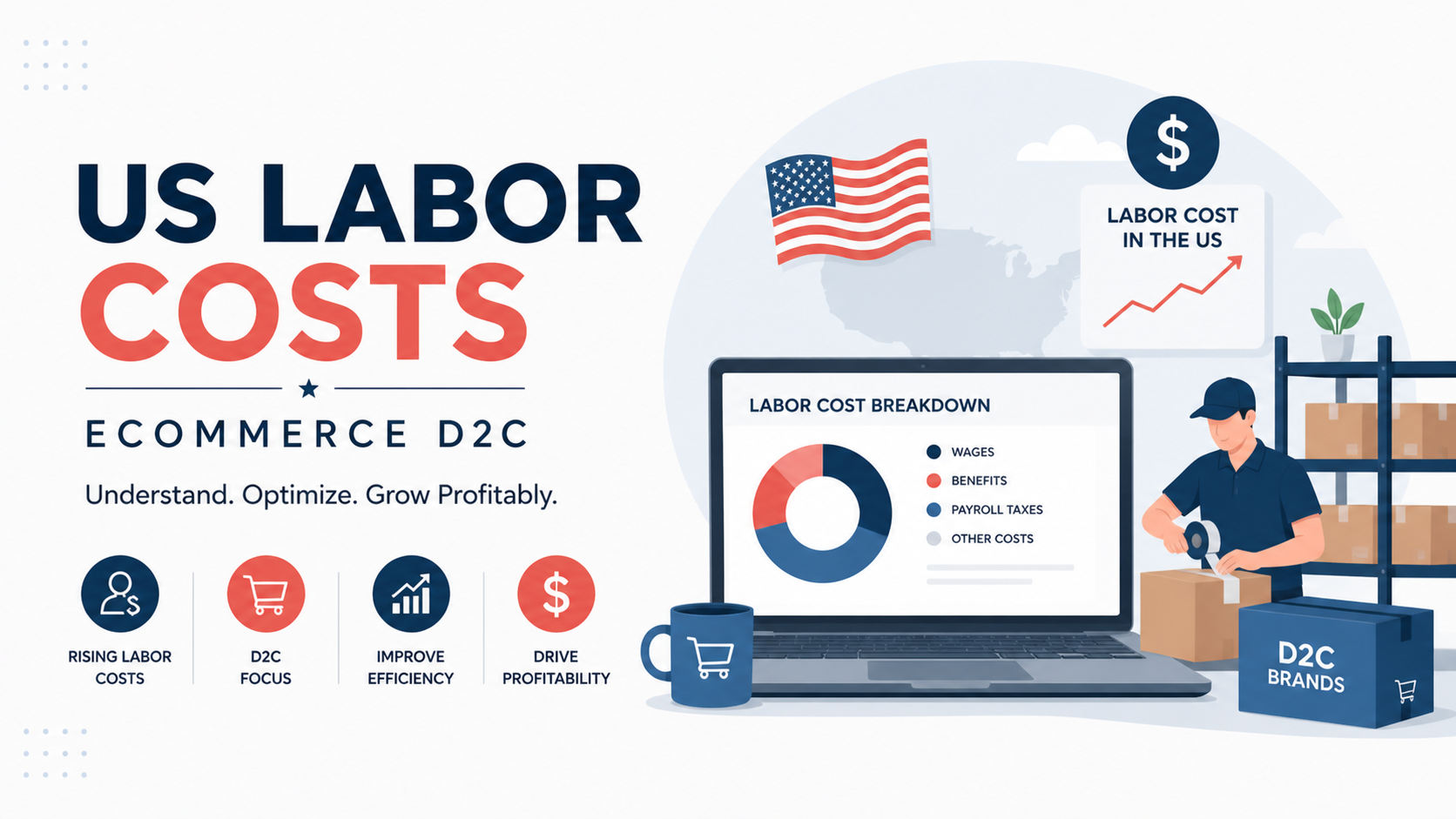
This is the squeeze every D2C brand is feeling in 2026. US private sector wages climbed 3.4% in the past year, with benefits jumping 3.6%. On a 10-person team, that’s $30K to $80K more in payroll — with zero matching jump in gross margin.
If your brand does $1M to $10M in annual revenue, this is the wall most founders hit. You can’t keep raising prices. You can’t keep cutting product costs. The only real lever left is the cost of people. And here’s the thing nobody wants to say out loud:
Most operational roles in a D2C business do not need to be in the US.
This article is the exact 7 roles to move offshore first if you’re running a US Shopify or marketplace brand right now — with real loaded-cost numbers, a savings table, two case patterns, and the mistakes that kill 60% of offshore hires. No fluff. No theory.
How rising US labor costs hit ecommerce D2C brands harder than anyone else
D2C margins were always thin. Now they’re being attacked from three directions at once.
- Wage growth is sticky. US private sector wages rose 3.4% YoY through March 2026, per the Bureau of Labor Statistics. Benefits rose faster.
- Loaded costs are the silent killer. Most founders forget that a $60K US hire actually costs ~$78K once you add health insurance (~$8K), payroll tax (~$4.5K), PTO, and 401k match. That’s a 30% premium on top of base salary.
- Minimum wage pressure keeps creeping up. California, New York, and Washington keep pushing entry-level rates higher, dragging every salary band up with them.
Meanwhile, your customer acquisition cost is up. Returns are still expensive. CAC payback periods are stretching. The math is brutal: revenue per customer is flat, but cost to serve that customer keeps rising.
Compare that to the offshore market. Among US-headquartered multinationals, offshore headcount grew 32% since 2019, while onshore grew just 16.7%. That gap is not closing — it’s widening.
Brands like Allbirds and Casper showed the world how brutal D2C unit economics get when costs run unchecked. The brands quietly thriving in 2026 are the ones who restructured their team before the squeeze got worse. For more on the broader cost picture, see how D2C brands cut operational costs by 40% with offshore teams.
The simple test before you offshore any role
Don’t move a role offshore just because someone wrote a blog post saying you should. Run every seat in your org chart through this 3-question filter first:
- Is the work repeatable? If you can write an SOP for it, it can be offshored.
- Does it require physical presence in the US? If yes, keep it in-house.
- Does it directly shape brand voice or senior customer relationships? If yes, think twice. If no, offshore it.
That’s it. You’ll have your offshore list in 10 minutes.
US vs offshore salary comparison: 7 D2C roles, side by side
This is the table every D2C founder needs to see before their next hire.
| Role | US loaded cost (annual) | Offshore cost (annual) | Savings % | Best country |
|---|---|---|---|---|
| Customer support agent | $50K – $65K | $9K – $15K | ~75% | Philippines |
| Ops VA / order coordinator | $55K – $70K | $7K – $14K | ~80% | Philippines / India |
| Content / SEO writer | $60K – $90K | $12K – $25K | ~70% | India / Philippines |
| Production graphic designer | $65K – $95K | $10K – $22K | ~75% | India / Philippines |
| Shopify developer | $90K – $140K | $18K – $40K | ~70% | India |
| Bookkeeper / AP | $55K – $75K | $10K – $20K | ~75% | Philippines / India |
| Paid ads operator | $60K – $85K | $12K – $25K | ~70% | India / Philippines |
Source: BLS Employment Cost Index 2026, plus current market rates from BruntWork, MicroSourcing, OnlineJobs.ph, and Smart Outsourcing Solution salary guides.
The 7 D2C roles to move offshore first (in this order)
1. Customer support agents
This is where every brand should start. Highest volume, most repeatable, lowest risk.
Filipino support agents are the gold standard. English fluency is high, cultural alignment with US shoppers is strong, and the BPO industry there is 30+ years mature. You can find someone with 2–3 years of Shopify and Gorgias or Intercom experience for a fraction of US rates. McKinsey research shows brands with well-run offshore CX teams see CSAT scores rise 15–25% — not fall.
Pro tip: Don’t hire one full-timer. Hire two part-time agents in different shifts. You get extended coverage and built-in redundancy when one is sick.
For a deeper look at how this works at scale, read our breakdown of BPO process outsourcing for ecommerce growth.
2. Virtual assistant for ops and admin
Order tagging, refund processing, supplier follow-ups, calendar wrangling, inbox triage. None of this needs to happen in your time zone — and most of it doesn’t even need to happen during your business hours.
This role frees up the founder’s time more than any other hire. If you’re personally tagging orders or chasing supplier emails at 11pm, this is your first offshore hire — not your fifth.
Still wondering whether you need a single VA or a full team? See our comparison: Ecommerce virtual assistant vs dedicated team.
3. Content writer / SEO writer
Blog posts, product descriptions, email newsletters, landing page copy. One of the most overpriced functions in a US D2C team.
The catch: you have to invest 2–3 weeks training them on your brand voice, products, and customer. Most brands skip this step and then complain that “offshore writers don’t get it.” That’s a hiring and onboarding problem, not a geography problem.
4. Production graphic designer (not creative direction)
This is the split that catches most founders out. There’s a real difference between a creative director who shapes your brand and a production designer who resizes ads, builds email graphics, and updates product imagery. Move the second one offshore. Keep the first close.
Philippines and India both have huge pools of designers fluent in Figma, Photoshop, and Canva. For static creative production at scale, the quality gap is essentially zero.
5. Shopify developer / store maintenance
Theme tweaks, app installs, speed optimization, custom Liquid sections, checkout edits. Most stores need a developer most weeks but rarely need a full-time US one.
India is the deepest market for Shopify talent globally. The country produces 1.5M engineering graduates yearly and has a thriving Shopify Partner ecosystem. Browsing the Shopify Partner directory shows you exactly how concentrated the talent is in Bangalore, Pune, and Ahmedabad.
6. Bookkeeper / accounts payable
Invoice reconciliation, expense categorization, vendor payments, monthly close prep. Process-heavy work that follows clear rules. Perfect offshore role.
One caveat: Keep your CPA or fractional CFO local. They sign tax filings and need to understand US tax code. But the day-to-day data entry that feeds them? That should be offshore. The Philippines has thousands of accountants trained in QuickBooks, Xero, and US GAAP.
For the broader business case on back-office offshoring, see our guide on 7 proven knowledge process outsourcing benefits.
7. Paid ads operator (not strategist)
Same logic as the designer split. Strategy stays close. Execution moves offshore.
An ads operator handles campaign builds, ad uploads, creative testing, audience setup, UTM tagging, and reporting. They are not making the call on what to spend or where to spend it. That’s the strategist’s job.
The same logic applies to sales execution. Read high-impact sales team outsourcing to boost revenue for the same approach in the sales function.
The savings math: a $3M D2C brand worked example
Let’s say you’re a $3M D2C brand with these 7 roles filled in the US.
| Role | US loaded cost | Offshore cost | Annual savings |
|---|---|---|---|
| Support agent | $58,000 | $12,000 | $46,000 |
| Ops VA | $62,000 | $11,000 | $51,000 |
| Content writer | $75,000 | $18,000 | $57,000 |
| Production designer | $80,000 | $16,000 | $64,000 |
| Shopify developer | $115,000 | $30,000 | $85,000 |
| Bookkeeper | $65,000 | $14,000 | $51,000 |
| Ads operator | $72,000 | $18,000 | $54,000 |
| TOTAL | $527,000 | $119,000 | $408,000 |
That’s $408,000 per year back in your pocket. On a $3M business doing 12% net margins, that’s nearly tripling your bottom line. Without selling a single extra unit. Without launching a single new product.
This isn’t theoretical. Deloitte’s Global Outsourcing Survey shows 78% of fast-growing retailers already do this. The brands that haven’t are competing against the ones that have — and losing.
2 case patterns we see again and again
Case pattern A: The skincare brand at $2M ARR
US team of 6: founder, 2 marketers, 1 ops manager, 1 support rep, 1 designer. Burning $440K on payroll. Net margin: 6%.
They moved support, design, and ops VA offshore over 90 days. New annual payroll: $260K. Margin jumped to 19% within two quarters. They used the freed cash to scale Meta spend and add a 2nd product line.
Case pattern B: The supplements brand at $5M ARR
10-person US team, all in-house. Tried offshoring once before, hired the cheapest VA on Upwork, terrible results, swore off offshoring forever.
Second attempt: hired through a vetted partner, paid mid-market rates, invested 3 weeks in onboarding, treated the new hires like full team members. Outcome: 4 offshore roles replaced 6 US ones. Saved $230K. Same output, fewer mistakes than before.
The difference between failure and success was never geography. It was the hiring and onboarding process. We break this down further in how to choose the right ecommerce outsourcing partner.
The 4 mistakes that kill 60% of offshore hires
- Hiring on rate alone. The cheapest hire is rarely the best. A $5/hour VA will cost you 10x more in mistakes than an $8/hour one. Aim for the middle of the market.
- Skipping the onboarding investment. Plan for 2–4 weeks of structured onboarding. SOPs, Loom videos, daily check-ins. If you onboard them like a freelancer, you’ll get freelancer results.
- Treating them as vendors. They are your team. Pay on time. Give real feedback. Celebrate wins. Brands saving 40%+ on operations are the ones who treat offshore hires exactly like in-house ones.
- No SOPs. If the work only lives in your head, no offshore hire can replicate it. Document one process this week before you post a single job ad.
If you’re weighing the agency route vs building a dedicated team, our piece on dedicated ecommerce team vs agency spells out exactly why ownership beats outsourcing-by-task.
Time zone management for D2C teams
The biggest fear founders have: “What if my customer needs help at 2pm EST and my Filipino agent is asleep?”
Three solutions, in order of simplicity:
- Shift overlap. Filipino agents already work US night shifts. Their 9am–5pm Manila time is roughly 9pm–5am EST. Hire two agents on staggered shifts and you cover ~18 hours a day.
- Nearshore for time zones. If full real-time overlap matters, look at Latin America — Colombia, Mexico, Argentina. Slightly higher rates than the Philippines but identical to US business hours.
- Hybrid model. Keep one US-based support lead for senior issues during business hours. Offshore handles tier 1 around the clock. Best of both.
Where to find offshore D2C talent (3 paths, ranked)
- Founder referrals. Best path. If a brand owner you trust has a great offshore hire, ask if their team has recommendations. Most do. Highest hit rate, near-zero risk.
- Vetted partners. Agencies and dedicated team builders handle vetting and payroll. Slightly higher rates than DIY but 10x faster to hire and far lower failure rate. This is what we do at AcquireX — we build embedded ecommerce teams, not freelancer placements.
- Marketplaces. Upwork, OnlineJobs.ph, Freelancer. Cheapest, but you do all the vetting yourself. Best for solopreneurs starting out — or anyone with strong recruiting instincts and time to spare.
To pay them legally, use Deel, Wise, Remote, or Payoneer. They handle global contracts, payroll, and compliance. For 1–2 contractors, Wise is the simplest. For a team of 5+, an Employer of Record (EOR) like Deel is worth the small fee. For a deeper read on how to structure this, see our guide to building an offshore ecommerce team.
Should every ecommerce D2C brand offshore? Honest answer
No.
- Under $500K revenue: You probably don’t have the SOPs or volume to make offshore work properly. Hire one VA for ops, that’s it. Focus on revenue, not org charts.
- $1M–$10M revenue: This is your sweet spot. Every role on the list above should be evaluated for offshore. The savings here are the biggest single lever you have to fix margins.
- Over $10M revenue: You should already be running a hybrid team — senior roles in the US, execution roles offshore. If you’re not, you’re leaving 6+ figures on the table every quarter.
How to start this week (a 30-day plan)
- Days 1–3: Pick the role with the most repeatable workload. Usually customer support. Document the SOP. Record 5–10 short Loom videos.
- Days 4–10: Post the role on OnlineJobs.ph or contact a vetted partner. Aim for 5–10 strong applicants. Don’t shortcut this — your hire quality is set here.
- Days 11–14: Run two interviews per shortlisted candidate. Give a paid test task that mirrors real work. Pay them for it even if you don’t hire them.
- Days 15–21: Onboard. Daily 15-minute check-ins. Shared docs. Slack access. Make them feel like part of the team from day one.
- Days 22–30: Shadow the work, give feedback, refine SOPs. By day 30, they should be running 70% of the role independently.
Repeat this cycle for the next role 60 days later. Don’t try to offshore three roles at once — you’ll do all of them badly.
The bottom line on US labor costs and ecommerce D2C margins
US wage growth is not slowing down. Healthcare premiums are not coming down. The federal minimum wage debate keeps pushing the floor higher. None of this is changing in 2026 or 2027.
The brands that figured this out 12 months ago are running leaner, shipping faster, and quietly stealing market share from competitors still paying $60K for tasks that can be done excellently for $12K.
You don’t have to gut your team. You just have to be smart about which seats need to be in the US and which don’t.
Start with one role this month. Customer support is the easiest. Document the process, hire one offshore agent, give it 60 days. Then come back and read this list again — because by then, the case for moving roles 2 through 7 will be obvious.
FAQ
How much can a D2C brand really save by offshoring?
Most D2C brands save 30–50% on total operational costs within the first 6 months, with role-by-role savings of 70–80%. The exact number depends on which roles you offshore and how documented your processes are. A $3M brand offshoring 7 core roles can realistically save $400K+ per year.
Is offshore quality really comparable to US hires?
For execution roles like customer support, content writing, design production, and bookkeeping — yes. The Philippines and India have 30+ year-old outsourcing ecosystems and millions of professionals trained for global work. Quality gaps come from bad onboarding, not bad geography.
Philippines or India — which is better for ecommerce?
Philippines is stronger for customer-facing roles (support, VA, account management) thanks to high English fluency and US cultural alignment. India is stronger for technical roles (Shopify development, SEO, data analysis, paid ads). Most growing D2C brands end up using both.
What’s the first role I should offshore?
Customer support, almost always. It’s the highest-volume, lowest-risk, most documentable role in a D2C operation. Get this right, then expand to ops and content next.
How do I pay offshore team members legally?
Use platforms like Deel, Wise, Remote, or Payoneer. They handle global contracts, payroll, and compliance. For 1–2 contractors, Wise is the simplest. For a team of 5+, an Employer of Record (EOR) like Deel is worth the small fee.
Will my customers notice if support is offshored?
Only if you hire badly. Trained Filipino agents speaking with US shoppers consistently get higher CSAT scores than founders expect. McKinsey reports brands with well-run offshore CX teams see CSAT rise 15–25%, not fall.
What’s the difference between offshore, nearshore, and outsourcing?
Outsourcing means hiring a third party for a function — they could be in the next city. Offshoring means hiring in a different country (typically Philippines, India). Nearshoring means hiring in a country with similar time zones — for US brands, that’s Latin America (Colombia, Mexico, Argentina).
How long does it take to hire an offshore D2C team member?
Through a vetted partner: 1–2 weeks from job posting to signed contract. DIY through marketplaces: 3–6 weeks if you’re vetting properly. Onboarding to full productivity: another 3–4 weeks on top.
Stop bleeding margin to US labor costs.
If you’re doing $1M–$10M in D2C revenue and your payroll is eating your profit, you don’t need another agency or another freelancer hire. You need a dedicated team that owns execution while you focus on growth.
That’s exactly what we build at AcquireX — embedded offshore teams for D2C and marketplace brands across customer support, marketplace management, performance marketing, design, and Shopify development.
👉 Book a free strategy call and we’ll show you exactly how much your brand could save in the next 90 days.