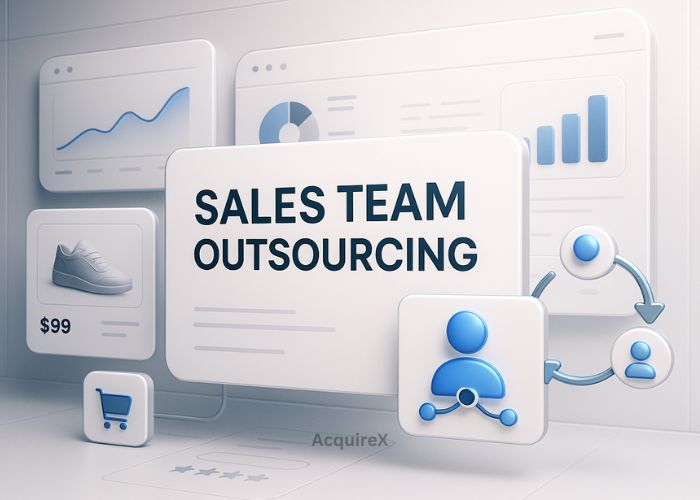
Sales team outsourcing means hiring an outside partner to do some or all of your sales work. That can be finding leads, booking calls, closing deals, or growing current accounts.
Why do companies do it? Three reasons:
- Speed. A trained team can start in weeks. A new hire can take months.
- Cost. One US sales rep can cost over $100,000 a year once you add benefits, tools, and hiring.
- Focus. Founders stop chasing deals and start running the business.
But outsourcing is not right for everyone. This guide shows you what it costs, when it works, when it fails, and a simple 5 step plan to launch it.
Key Takeaways
- Sales outsourcing can cover one task (like booking meetings) or the full sales cycle.
- A US-based rep costs about $103,000 a year in pay and benefits alone, using BLS data.
- Common outsourced pricing runs from about $3,000 to $15,000 a month, or $250 to $1,200 per meeting.
- It works best for new markets, new products, and brands with no sales team yet.
- It fails when the offer is unproven, goals are unclear, or nobody owns the handoff.
- Dedicated teams beat shared agency reps for long-term growth.
What Is Sales Team Outsourcing?
Sales team outsourcing is when a company pays an outside firm to handle sales tasks. The outside team sells on your behalf, under your brand.
It is sometimes called:
- Outsourced sales
- Sales as a service
- Contract sales (a contract sales organization, or CSO)
- Outsourced SDR (sales development rep) services
Simple example: A skincare brand wants to get into 200 US boutiques. It has no sales staff. It hires an outsourced team to find store owners, email them, book calls, and open wholesale accounts. The brand ships the orders. The team does the selling.
How Does Sales Outsourcing Work?
Most setups follow the same 4 stages.
- Plan. You and the partner agree on goals, target buyers, pricing, and reports.
- Onboard. The team learns your products, prices, and brand voice. They set up your CRM and outreach tools.
- Sell. Reps reach out by email, phone, and LinkedIn. They book calls or close deals.
- Improve. Every week you review numbers. Every month you adjust scripts, lists, and targets.
Who owns what?
| You own | The partner owns |
|---|---|
| Product, pricing, and final discounts | Daily outreach and follow-up |
| Brand voice and approvals | Lead lists and research |
| Big deal sign-off | Booking calls and first meetings |
| Customer data (always) | Weekly reports |
Types of Outsourced Sales Services
Not every company needs a full team. Pick the type that fits your gap.
| Type | What they do | Best for |
|---|---|---|
| Lead generation | Build and clean lists of buyers | Teams with closers but no leads |
| Appointment setting | Book meetings for your team | Founders who close well but have no time |
| Inside sales | Sell by phone, email, and video | Mid-price deals, repeat buyers |
| Full-cycle sales | Find, pitch, and close deals | Companies with no sales team |
| Account management | Grow and keep current accounts | Wholesale and repeat B2B buyers |
| Field or channel reps | Sell in person or through partners | Retail and regional markets |
For ecommerce brands, the biggest wins usually come from two types most guides skip: wholesale account opening and account management (getting current stores to reorder). Both work best when reps have the playbooks and content covered in our guide to sales enablement for ecommerce.
The Power of Sales Team Outsourcing: 7 Real Benefits
1. You start selling in weeks, not months
Hiring a rep means posting a job, interviewing, and training. Then the rep still needs months to hit full speed. An outsourced team already has the skills and tools. It only needs to learn your brand.
2. You cut fixed costs
In-house reps come with salary, benefits, payroll taxes, tools, and hiring fees. Outsourcing turns much of this into one monthly fee you can raise or lower.
3. You scale up or down fast
Busy season coming? Add reps. Slow quarter? Scale back. No layoffs. No long hiring cycles.
4. You get proven skills and tools
Good partners already run CRMs, email tools, dialers, and data tools. They know which scripts work. You skip years of trial and error.
5. You test new markets with less risk
Want to try a new region, a new product line, or wholesale for the first time? An outsourced team lets you test before you commit to full-time hires. If you later bring the function in-house, see what it takes to build a high-impact ecommerce sales team.
6. Your team stays focused
Your in-house people keep doing what they do best. The outside team handles the grind of prospecting and follow-up.
7. You get clear numbers every week
A good partner reports on calls, replies, meetings, and revenue. That makes sales easier to measure than when “sales” is just the founder’s inbox.
How Much Does Sales Team Outsourcing Cost?
This is the question most readers want answered. Here are real numbers.
What an in-house US rep really costs
The US Bureau of Labor Statistics (BLS) says the median pay for wholesale and manufacturing sales reps was $72,080 a year in May 2025 (BLS). For technical and scientific products, it was $104,920.
Benefits add more. In June 2026, benefits were 30% of total pay costs for private industry workers (BLS).
| Cost item | Yearly amount (USD) |
|---|---|
| Base pay (BLS median) | $72,080 |
| Benefits (so they equal 30% of total pay) | $30,891 |
| Sales tools (CRM, email, data) | $6,000 |
| Recruiting cost | $10,000 |
| Total first year | $118,971 |
Tools and recruiting are our estimates. Benefits math: $72,080 ÷ 0.70 = $102,971 total pay, so benefits = $30,891.
For more on this, see our breakdown of US labor costs for ecommerce and D2C brands.
Common outsourced pricing models
| Model | Typical range (2026) | Good for |
|---|---|---|
| Monthly retainer | $3,000 to $15,000 per month | Steady, ongoing programs |
| Dedicated rep | Priced per rep, per month | Long-term account growth |
| Pay per meeting | $250 to $1,200 per meeting | Short tests |
| Hybrid | Base fee plus bonus per result | Shared risk |
Ranges come from published 2026 vendor guides (Revnew). Prices vary a lot by country, skill level, and deal size.
Worked example: in-house vs dedicated offshore rep
| In-house US rep | Dedicated offshore rep | |
|---|---|---|
| Yearly cost | $118,971 | $48,000 ($3,500 × 12, plus $6,000 tools) |
| Savings | $70,971 (about 60%) |
$3,500 a month is an example, not a quote.
The honest part: cheaper only wins if the team brings in real revenue. A cheap team sending spammy emails can hurt your brand. Judge any partner on accounts opened and revenue, not just price.
What the Savings Can Turn Into: A Wholesale Example
Cost is half the story. Here is what one month of outreach can look like for a D2C brand selling to boutiques.
Your team contacts 400 boutiques:
- 6% reply = 24 replies
- Half book a call = 12 calls
- 40% open an account = about 5 new stores
At a $2,500 first order, that is about $12,500 in new revenue. If each store reorders 3 times a year, those 5 stores are worth about $37,500 a year.
Repeat that each month and the accounts stack up. That is the real power of sales team outsourcing: it builds a pipeline that keeps paying.
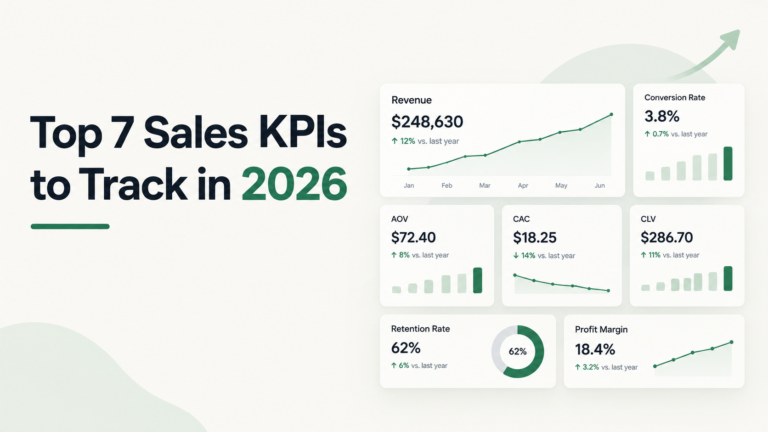
These rates are examples. Track your own from week one. Our guide to sales KPIs worth tracking shows which numbers matter.
Pros and Cons of Sales Outsourcing
| Pros | Cons |
|---|---|
| Fast start | Less direct control |
| Lower fixed cost | Reps may not know your product at first |
| Easy to scale | Brand risk if outreach is sloppy |
| Proven tools and playbooks | Shared reps at some agencies |
| Clear weekly reports | Time zone and culture gaps |
| Low risk way to test markets | Needs your time for setup and feedback |
Most cons can be fixed with the right setup. Time zones, for example, can become an advantage. Learn how in our guide to managing offshore teams across time zones, and see our tips on working across cultural differences.
When Should You Outsource Your Sales Team?
Outsource when:
- You have a product that sells, but no one to sell it full time
- You want to test wholesale, B2B, or a new region
- You are launching a new product and need fast reach
- The founder is the only salesperson and deals are slipping
- Hiring in-house would take too long or cost too much
Do not outsource when:
- You have no proven offer. Close your first 10 deals yourself.
- Your margins can’t handle wholesale. Retail buyers often expect big discounts. Check your contribution margin per order before you commit.
- Every deal needs deep technical skill. Keep expert sellers in-house.
- You want to hand it off and forget it. Outsourced teams still need your feedback.
Freelancer vs Agency vs Dedicated Team
| Option | Best for | Main risk |
|---|---|---|
| Freelance rep | A small test | Works for many clients at once |
| Sales agency | Short campaigns | Shared reps, focus on meetings not revenue |
| Dedicated team | Long-term growth | Needs clear setup and SOPs |
Our view: dedicated teams beat agencies for most growing brands. Your reps work only on your brand. They learn your buyers. They own the results.
Compare the options in more depth: dedicated ecommerce team vs agency and virtual assistant vs dedicated team.
The REACH Framework: How to Launch an Outsourced Sales Team
Here is our simple 5 step system. We call it REACH.
R: Revenue target
Set one clear goal.
- Good: “Open 15 new wholesale accounts in 90 days.”
- Bad: “Grow sales.”
E: Exact buyer profile
Tell the team exactly who to target:
- Type of buyer (boutique, chain, distributor, corporate buyer)
- Location
- Company size and price range
- What a good first order looks like
Need help finding these buyers? See our guide on improving B2B lead generation.
A: Accountable metrics
Track 5 numbers every week:
- Outreach sent
- Reply rate
- Meetings booked
- Accounts opened (or deals closed)
- Revenue and reorder rate
Judge on revenue, not activity. 1,000 emails mean nothing if nobody buys.
C: Channels and scripts
Pick where your team reaches buyers:
- Email and LinkedIn for decision makers
- Phone for warm leads
- Wholesale marketplaces like Faire for retail buyers (more on B2B marketplaces)
- Trade show follow-ups
Write the first scripts together. Test and improve them monthly. Smart sales automation can handle the repetitive follow-ups.
H: Handoff rules
This is where most programs break. Decide early:
- When a lead moves to you or your closer
- Who approves discounts
- Who owns reorders and check-ins
- Where every note lives (your CRM, never someone’s inbox)
Write it all into SOPs. Our guide to SOPs for remote ecommerce teams shows how.
Your First 90 Days
| Timeline | What should happen |
|---|---|
| Weeks 1 to 2 | Training, CRM setup, buyer lists, first scripts approved |
| Weeks 3 to 4 | Outreach goes live, first replies, first calls booked |
| Month 2 | First deals or accounts, scripts improved based on replies |
| Month 3 | Review results against your REACH target. Scale, fix, or stop. |
Tip: Agree on “stop” rules before you start. For example: “If we have fewer than 5 qualified calls by day 60, we change the target list.”
How to Choose a Sales Outsourcing Partner
Ask these 7 questions before you sign:
- Will my reps work only on my brand? Shared reps split their focus.
- Have you sold products like mine? Software sales skills don’t always carry over to physical products.
- Who owns the buyer data? It must be you.
- How do you replace a rep who leaves? Get the timeline in writing.
- What does a weekly report look like? Ask for a real sample.
- How do you train reps on my brand? Look for a clear onboarding plan.
- Can we start with a 90 day test? Good partners are not afraid of one.
For a full checklist, read how to choose an ecommerce outsourcing partner.
5 Mistakes That Kill Outsourced Sales Programs
- Unclear goals. “More sales” is not a goal. Pick a number and a date.
- Changing strategy every week. Give a plan 60 to 90 days before big changes.
- Buying a list and blasting it. Spam burns your brand with buyers.
- No CRM from day one. Notes in email vanish when people leave.
- Only chasing new buyers. Current accounts are often the fastest growth. Reorders are easier than first orders.
Fact Check: Stats You Should Not Trust
We checked the numbers other sales outsourcing articles repeat. Two are worth a warning:
- “79% of companies that outsourced sales scaled faster.” This stat appears on many pages, but we could not trace it to an original survey. We left it out.
- Big market size numbers. Estimates for the sales outsourcing market vary widely between research firms. They tell you little about whether outsourcing will work for your brand. Your own cost per account and revenue per rep matter more.
Every number in this guide links to its source or is marked as an example.
Final Word: Stop Chasing Deals, Build a Sales System
Sales team outsourcing is not about cheap help. It is about building a sales system that runs without you in every email.
Done right, you get:
- More accounts and repeat buyers
- Lower cost per rep
- A founder who can focus on growth
At AcquireX, we build dedicated offshore sales teams for US ecommerce brands. Your team works only for you, inside your CRM, and reports on revenue, not busywork. See our sales enablement and account growth service, or learn how an offshore ecommerce team supports the rest of your operations, from customer support to marketplace management.
Ready to stop losing deals? Book a free 30 minute strategy call and we will map out your sales team setup.
Frequently Asked Questions
What is sales team outsourcing?
Sales team outsourcing means hiring an outside partner to handle some or all of your sales work. This can include finding leads, outreach, booking meetings, closing deals, and managing repeat accounts.
How much does it cost to outsource a sales team?
Most outsourced sales programs cost about $3,000 to $15,000 a month, or $250 to $1,200 per booked meeting. A US in-house rep costs about $103,000 a year in pay and benefits alone, based on BLS data.
What are the benefits of outsourcing sales?
The main benefits are a faster start, lower fixed costs, easy scaling, proven tools, low risk market testing, and clear weekly reporting.
What are the risks of outsourcing sales?
The main risks are less control, brand damage from poor outreach, reps who don’t know your product, and shared reps who split their time. A dedicated team, clear SOPs, and weekly reviews reduce these risks.
Is sales outsourcing good for ecommerce brands?
Yes, if you sell wholesale, B2B, or bulk orders. An outsourced team can open retail accounts and grow reorders. It is less useful if all your sales come from online shoppers.
How long does it take to see results?
Plan for about 90 days. Setup takes 2 weeks, outreach starts in weeks 3 to 4, and deals usually start in month 2.
Should I outsource sales or hire in-house?
Outsource if you need speed, flexible costs, or want to test a new market. Hire in-house if every deal needs deep product skill or you already have a proven sales process to hand to a new hire.
Who owns the leads and customer data?
You should. Your contract should state that all buyer data, notes, and contacts belong to your company, and the team should work inside your CRM.