Summary: A sales playbook is a written, regularly updated guide that tells your sales team who to sell to, how deals move from first contact to reorder, what to say at each stage, and how success is measured. For ecommerce brands selling wholesale, to retailers, or to B2B buyers, it turns founder-led selling into a repeatable process any rep can run.
Most consumer brands start selling wholesale the same way: the founder knows the product, knows a few buyers, and closes the first accounts personally. That works until you hire your first sales rep, add a distributor, or try to open fifty new stockists in a quarter. Suddenly nobody agrees on which accounts to chase, what the pricing rules are, or what “qualified” means.
A sales playbook solves that. Most sales playbook guides are written for software companies with demos and annual contracts. This one is built for product brands: retail buyers, line sheets, minimum orders, sell-through, and reorders. You will get the sections every playbook needs, a stage-by-stage process with exit criteria, scripts and objection handling for wholesale, a template, and a plan to roll it out. For the bigger picture on supporting reps with content and tools, see our guide to ecommerce sales enablement.
What is a sales playbook?
A sales playbook is the single source of truth for how your company sells. It documents your ideal customers, buyer personas, value proposition, sales stages, qualification rules, messaging, objection handling, pricing and terms, tools, and the metrics used to judge performance.
The point is not the document. A good sales playbook makes your best rep’s judgment available to every rep, on every call. It shortens ramp time for new hires, keeps pricing and terms consistent, and makes your pipeline numbers mean something because everyone uses the same definitions.
Sales playbook vs sales process vs sales enablement: what is the difference?
| Term | What it is | Example |
|---|---|---|
| Sales process | The stages a deal moves through | Target → Engage → Discover → Propose → Commit → Launch → Grow |
| Sales playbook | The guide for running that process: who, what to say, what to send, when to move on | Discovery questions for an independent boutique buyer; how to answer “your margin is too low” |
| Sales enablement | The ongoing function that equips reps: content, training, tools, coaching | Updating the line sheet, building the CRM, training reps on a new product launch |
| Sales script | Word-for-word talk tracks for one moment | A 30-second cold call opener for a regional grocery buyer |
In short, the process is the map, the playbook is the driving manual, and enablement keeps the car running.
Why do ecommerce and wholesale brands need a sales playbook?
Selling to businesses is different from selling to shoppers on your site. The buyer is a professional, the order is larger, the decision involves margin and shelf space, and the real win is not the first purchase order but the reorders. A playbook helps in specific ways:
- It protects your pricing. Clear wholesale price tiers, minimums, and discount rules stop reps from inventing deals that erode margin or break your MAP policy.
- It gets new reps productive faster. Instead of shadowing the founder for months, a rep can learn the ideal account, the pitch, and the objections from one place.
- It focuses effort on the right accounts. Not every store is a good fit. A defined ideal customer profile keeps reps from chasing accounts that will never reorder.
- It makes forecasting possible. When every rep uses the same stages and exit criteria, pipeline reports and sales forecasts become trustworthy.
- It drives reorders, not just opening orders. A wholesale playbook should cover account growth after launch, which is where most of the lifetime value sits.
What should a sales playbook include?
Almost every strong playbook covers the same core sections. Keep each one short and practical. The test is whether a rep can find the right answer in under a minute while preparing for a call.
1. Company overview and goals
One page: what you sell, who you sell it to, this year’s revenue and account targets, and which channels the playbook covers, such as independent retail, chains, distributors, corporate gifting, or B2B marketplaces.
2. Ideal customer profile (ICP)
Describe the accounts you win and keep: store type, size, location, category, price point, customer demographic, and buying signals such as a new location opening or a category reset. Just as important, list who you do not sell to, for example discounters who would undercut your direct-to-consumer price.
3. Buyer personas
Map the people involved: the owner of an independent store, a category buyer at a chain, a merchandise planner, a distributor rep, a procurement manager for corporate orders. For each, note what they are measured on, their common concerns, and what they need to see from you.
4. Value proposition and messaging
Write one clear sentence on why a retailer should stock you, then three to five supporting points written in the buyer’s language: margin, sell-through, customer demand, marketing support, reliable fulfillment. Include proof points such as reviews, repeat purchase behavior, press, or results from existing stockists, using only numbers you can verify.
5. Sales stages and exit criteria
Define each stage and the evidence required to move a deal forward. This section is covered in detail below.
6. Qualification framework
Choose a simple, shared definition of a qualified account. Many teams adapt BANT (budget, authority, need, timing) or a lighter version of MEDDIC for larger accounts.
7. Outreach plays and scripts
Cold email and call sequences, trade show follow-ups, warm introductions, and inbound wholesale enquiries. Give templates, but encourage reps to personalize the first line.
8. Objection handling
The ten objections reps hear most, each with a tested response and a follow-up question.
9. Pricing, terms, and order rules
Wholesale price lists, volume tiers, minimum order quantity, payment terms, freight rules, returns or damage policy, exclusivity rules, and who can approve exceptions.
10. Tools and data rules
Which CRM fields must be filled at each stage, where the line sheet and sample request form live, and how orders are entered.
11. Metrics and reporting
The handful of numbers that define success, and how often they are reviewed.
What are the stages of a B2B ecommerce sales process?
Here is a stage model built for product brands selling to retailers and business buyers. The key is that each stage ends with something the buyer has confirmed, not something the rep hopes.
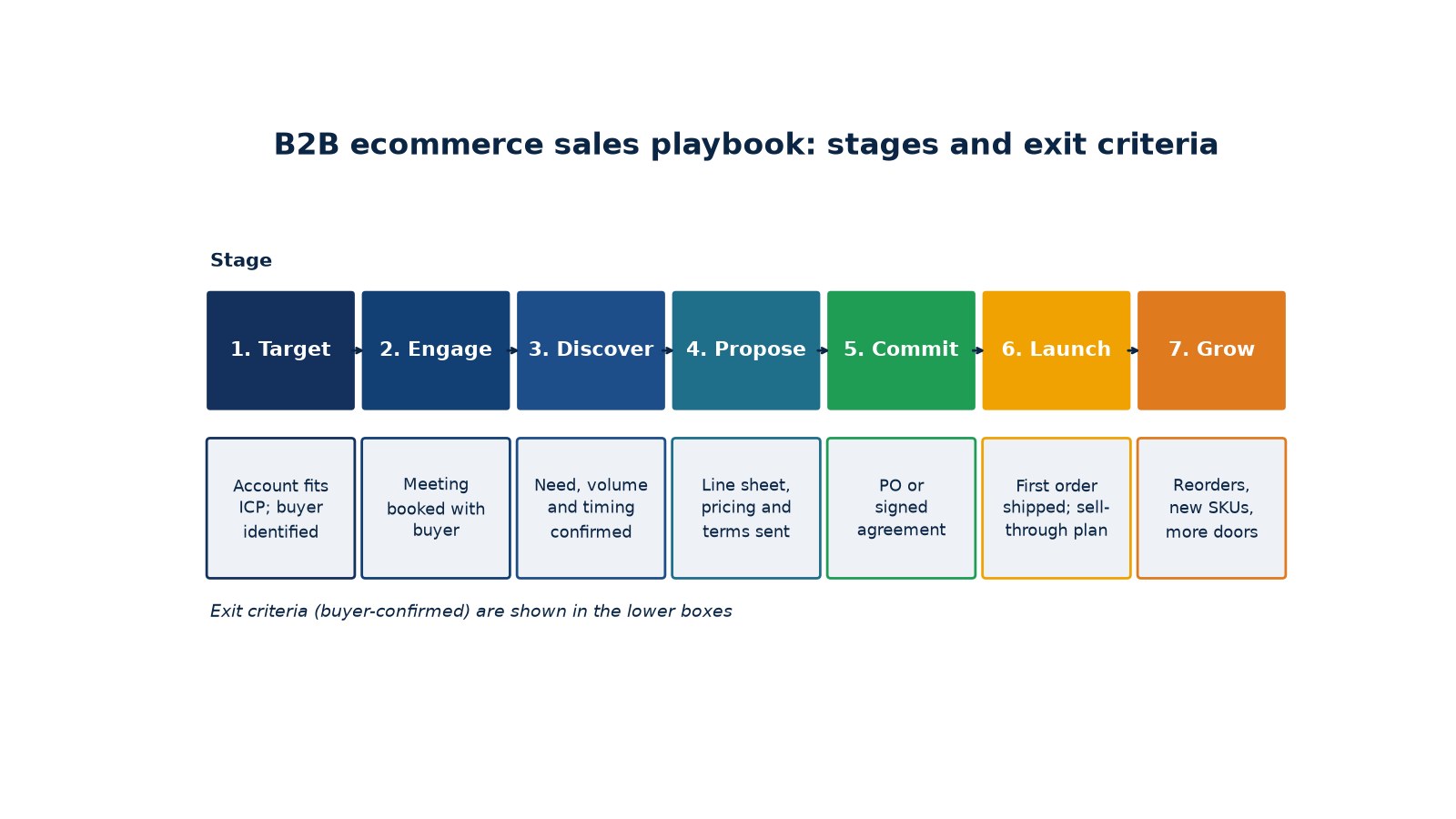
| Stage | Goal | Rep actions | Exit criteria | Assets to use |
|---|---|---|---|---|
| 1. Target | Build a list of ideal-fit accounts | Research stores, chains, and distributors that match the ICP; find the buyer’s name | Account matches ICP; decision-maker identified | ICP checklist, account research template |
| 2. Engage | Earn a first conversation | Run the outreach sequence; send samples where it makes sense | Meeting or call booked with the buyer | Email sequence, one-page brand overview, sample request form |
| 3. Discover | Understand the buyer’s needs | Ask discovery questions about category, price points, current brands, timing, and volumes | Buyer confirms interest, category fit, and a buying window | Discovery guide, category data |
| 4. Propose | Make it easy to say yes | Send line sheet, wholesale pricing, terms, and a suggested opening order | Proposal reviewed; open questions listed | Line sheet, price list, suggested assortment |
| 5. Commit | Close the opening order | Handle objections; agree quantities, terms, and delivery date | Purchase order or signed agreement received | Order form, terms sheet, vendor setup documents |
| 6. Launch | Make the first order sell | Confirm delivery, train store staff, share marketing assets, set a sell-through check-in | Order delivered; sell-through review date set | Retailer welcome kit, shelf and display guidance, social assets |
| 7. Grow | Turn the account into a repeat buyer | Review sell-through, suggest reorders, add SKUs, expand to more locations | Reorder placed or expansion agreed | Account review template, new product deck |
Notice that two of the seven stages happen after the first order. In wholesale, closing the opening order is the start of the sale, not the end. A retailer that does not sell through will not reorder, and a playbook that stops at the purchase order misses most of the revenue.
How do you qualify wholesale and retail accounts?
A simple scorecard keeps reps from spending weeks on accounts that will never be profitable. Score each item as yes, partly, or no.
| Criterion | What to confirm | Why it matters |
|---|---|---|
| Fit | Their customers, price point, and category match your brand | Poor fit means poor sell-through and no reorder |
| Authority | You are talking to the person who places orders, or you know who does | Prevents stalled deals |
| Need and timing | They have a gap, a category reset, or a season they are buying for | Tells you when a decision will happen |
| Volume | Expected order size meets your minimums and makes freight worthwhile | Protects margin per order |
| Credit and terms | They can pay on your terms, or you know what they require | Avoids collection problems later |
| Channel conflict | They will not undercut your pricing or damage the brand | Protects DTC and other retailers |
Write down what counts as qualified, for example “fit and authority confirmed, plus two of the remaining four,” so every rep uses the same bar.
What discovery questions should reps ask retail buyers?
- What are your best-selling brands in this category, and what makes them work in your store?
- Which price points sell best for your customers?
- What gaps do you see in the category right now?
- How do you usually test a new brand: a small opening order, a single location, or a seasonal window?
- What sell-through or margin do you need to see before you reorder?
- When do you plan buying for the next season, and who else is involved?
- What support helps new brands succeed with you: displays, staff training, marketing, or samples?
- What has gone wrong with new vendors in the past?
The last question is often the most useful. It tells you exactly which fears your proposal has to address, whether that is late deliveries, damaged goods, or brands that did no marketing after launch.
How should a playbook handle common wholesale objections?
| Objection | Underlying concern | Suggested response | Follow-up question |
|---|---|---|---|
| “Your margin is too low.” | Profit per unit on the shelf | Show the full margin picture, including suggested retail price, sell-through, and any marketing support. Offer a tier that improves margin at higher volume where your economics allow. | “What margin do your best brands in this category give you?” |
| “Your minimum order is too high.” | Risk of unsold stock | Offer a smaller starter assortment of proven sellers, a mixed-SKU minimum, or a one-time trial order. | “If we started with the five best sellers, would that work for a test?” |
| “We already carry a similar brand.” | Shelf space and cannibalization | Position the gap you fill, such as price point, customer segment, or format, rather than replacing their current brand. | “Which customers are you not serving with that brand today?” |
| “Your products are cheaper on your website or Amazon.” | Price undercutting | Explain your pricing policy and how you enforce it across channels. | “If pricing is consistent everywhere, would that address the concern?” |
| “Send me some information.” | Not yet convinced or too busy | Send a short, specific follow-up and ask for a time to review it together. | “What would you need to see to decide whether it’s worth a call?” |
| “Not this season.” | Timing | Ask when they plan the next buy and schedule the follow-up now. | “When do you start planning the next season, and can I send samples before then?” |
Treat this table as a living section. Ask reps to log new objections in the CRM, and update the responses quarterly based on what actually works. If your minimums cause friction, our guide to minimum order quantity explains how to set them so they protect margin without blocking new accounts.
Which metrics should a sales playbook track?
Pick a small set and review them every week. A playbook without measurement turns into a document nobody opens.
| Metric | What it shows | Review cadence |
|---|---|---|
| New accounts opened | Acquisition progress against target | Weekly |
| Stage conversion rates | Where deals stall in the process | Weekly or monthly |
| Average opening order value | Whether reps are selling the right assortment | Monthly |
| Sales cycle length | How long it takes to go from first contact to purchase order | Monthly |
| Reorder rate | The share of accounts that buy again within a set period | Monthly |
| Sell-through by account | Whether products are moving off the shelf | Monthly or per season |
| Revenue per account and account growth | Whether the Grow stage is working | Quarterly |
For more on choosing and defining sales metrics, see our guide to sales KPIs to track.
What does a simple sales playbook template look like?
Copy this outline into a shared document or your CRM’s knowledge base and fill in each line. Keep it to a length reps will actually read, and link out to longer assets rather than pasting them in.
- Header: playbook name and channel, owner, last updated date, next review date.
- Goals: revenue, new accounts, and reorder targets for the year.
- ICP: target account types, must-have criteria, disqualifiers.
- Personas: role, goals, concerns, what they need to see, a key question to ask.
- Positioning: one-sentence value proposition and three to five proof points.
- Stages: stage name, goal, rep actions, exit criteria, assets.
- Qualification: scorecard and the definition of a qualified account.
- Plays: outreach sequences, trade show follow-up, inbound enquiry handling, reorder play.
- Discovery questions: eight to twelve questions, grouped by topic.
- Objections: objection, concern, response, follow-up question.
- Pricing and terms: price tiers, minimums, payment terms, freight, approval rules for exceptions.
- Tools and data: CRM fields required at each stage, where assets live.
- Metrics: KPIs, targets, and review cadence.
How do you build and roll out a sales playbook?
- Interview your best sellers. Usually that includes the founder. Record how they find accounts, what they say, and why deals were won or lost.
- Review recent deals. Look at the last 20 to 30 won and lost accounts. What did the good accounts have in common? Where did lost deals stall?
- Draft the core sections first. ICP, stages with exit criteria, pricing rules, and the top objections. Perfect is not required; useful is.
- Test it with one rep or one channel. Run it for four to six weeks and collect feedback on what is missing or confusing.
- Put it in the workflow. Build the stages and required fields into your CRM so the playbook is followed by default, not by memory.
- Train and coach. Walk through the playbook in onboarding, role-play objections, and review real calls against it.
- Review quarterly. Update objections, messaging, and pricing based on results. Assign one owner who keeps it current.
What mistakes make sales playbooks fail?
- Writing it once and never updating it. Products, pricing, and buyers change. An outdated playbook gets ignored quickly.
- Making it too long. A 90-page document does not get read. Aim for something a rep can scan before a call.
- Copying a software playbook. Demos and annual contracts do not map to line sheets, sell-through, and seasonal buying.
- Stopping at the first order. Without a launch and grow stage, reorders are left to chance.
- No owner. If nobody is accountable for the playbook, it decays within a quarter.
- Disconnecting it from the CRM. If stages and fields in the CRM do not match the playbook, reps will follow whichever is easier.
Where your leads come from matters too. If the top of the funnel is thin, pair the playbook with a clear prospecting plan; our guide on how to improve B2B lead generation covers the options.
Should you build the sales team in-house or outsource it?
Once a playbook exists, you can staff it in several ways: hire in-house reps, work with independent sales agents or showrooms, or use a dedicated outsourced team for prospecting, account management, and order support. In-house reps give the most control but take time and cost to hire. Agents bring relationships but split attention across many brands. A dedicated offshore team can run research, outreach, CRM upkeep, and reorder follow-up at lower cost while your senior people close key accounts. We compare these models in our post on sales team outsourcing.
How AcquireX helps brands build and run a sales playbook
AcquireX’s sales enablement and account growth services help ecommerce and consumer brands turn wholesale and B2B selling into a repeatable system. A dedicated AcquireX team can:
- Document your playbook: ICP, personas, stages, qualification, objections, and pricing rules.
- Build target account lists and run outreach sequences to retailers, distributors, and corporate buyers.
- Prepare line sheets, pitch decks, and account review templates.
- Set up and maintain your CRM pipeline so it matches the playbook.
- Run the launch and grow stages: sell-through check-ins, reorder reminders, and expansion proposals.
Want a sales playbook your team will actually use? Book a call with AcquireX to talk through your wholesale and B2B channels.
Key takeaways
- A sales playbook documents who you sell to, how deals move, what to say, and how success is measured.
- For product brands, the playbook must cover line sheets, pricing tiers, minimums, sell-through, and reorders, not just the opening order.
- Define every stage with buyer-confirmed exit criteria so your pipeline and forecast can be trusted.
- Keep it short, build it into the CRM, give it one owner, and update it quarterly.
- Track a small set of metrics, especially reorder rate and sell-through, to see whether the playbook is working.
Frequently asked questions
What is a sales playbook?
A sales playbook is a written guide that documents how your company sells: target customers, buyer personas, value proposition, sales stages, qualification rules, messaging, objection handling, pricing, tools, and metrics. It gives every rep the same process and the same answers, so results depend less on who happens to take the call.
What should be included in a sales playbook?
Include a company overview and goals, ideal customer profile, buyer personas, value proposition, sales stages with exit criteria, a qualification framework, outreach plays and scripts, discovery questions, objection handling, pricing and terms, tool and CRM rules, and the metrics you will review each week.
How long should a sales playbook be?
Long enough to answer the questions reps actually face, and short enough to scan before a call. Many teams keep the core playbook to around 10 to 20 pages, with links to longer assets such as line sheets, decks, and email templates rather than pasting everything in.
Who should own the sales playbook?
One person should own it, usually the head of sales, a sales manager, or a sales enablement lead. They gather input from reps, marketing, and operations, update it on a set schedule, and make sure the CRM stages and fields match what the playbook describes.
How is a wholesale sales playbook different from a SaaS playbook?
A wholesale playbook centers on retail buyers, line sheets, price tiers, minimum orders, delivery, and sell-through. Success is measured by reorders and account growth, so the process continues after the first purchase order. SaaS playbooks focus more on demos, trials, and contract renewals.
How often should you update a sales playbook?
Review it at least quarterly, and update it whenever pricing, products, target channels, or common objections change. Collect feedback from reps continuously through the CRM or a shared channel so updates are based on what is actually happening in deals.
Can a small brand without a sales team use a sales playbook?
Yes. Even when the founder does all the selling, writing down the ICP, pricing rules, and pitch makes it faster to hire the first rep or bring in an outsourced team. It also helps the founder sell more consistently and spot which types of accounts reorder.
What is the difference between a sales playbook and a sales script?
A sales script is word-for-word language for one moment, such as a cold call opener. A sales playbook is much broader: it covers who to target, the stages of the sale, qualification, objections, pricing, and metrics, and it may include several scripts as supporting assets.