Quick answer: A MAP policy (minimum advertised price policy) is a brand’s written rule setting the lowest price at which resellers may publicly advertise its products. It controls advertised prices, not final sale prices. A MAP policy works only when it is issued unilaterally, monitored across every channel, and enforced consistently, usually by suspending supply to violators.
If you sell through retailers, distributors, or third-party marketplace sellers, you have probably seen it happen: one seller drops your product price on Amazon, a repricing bot follows within hours, and soon your authorized retailers are complaining that they cannot compete. Your own Shopify store looks overpriced, your Google Shopping ads lose clicks, and margin disappears across the whole channel. A well-built MAP policy is the main tool brands use to prevent that race to the bottom.
This guide is written for ecommerce brand owners and operators. It explains what a MAP policy is and is not, how it differs from MSRP and resale price maintenance, what to put in the document, how to monitor prices across Amazon, Walmart, Google Shopping and independent sites, how to enforce it without creating legal risk, and how to deal with the hardest problem of all: unauthorized sellers. It is practical guidance, not legal advice, and any pricing policy you publish should be reviewed by qualified antitrust counsel.
What is a MAP policy?
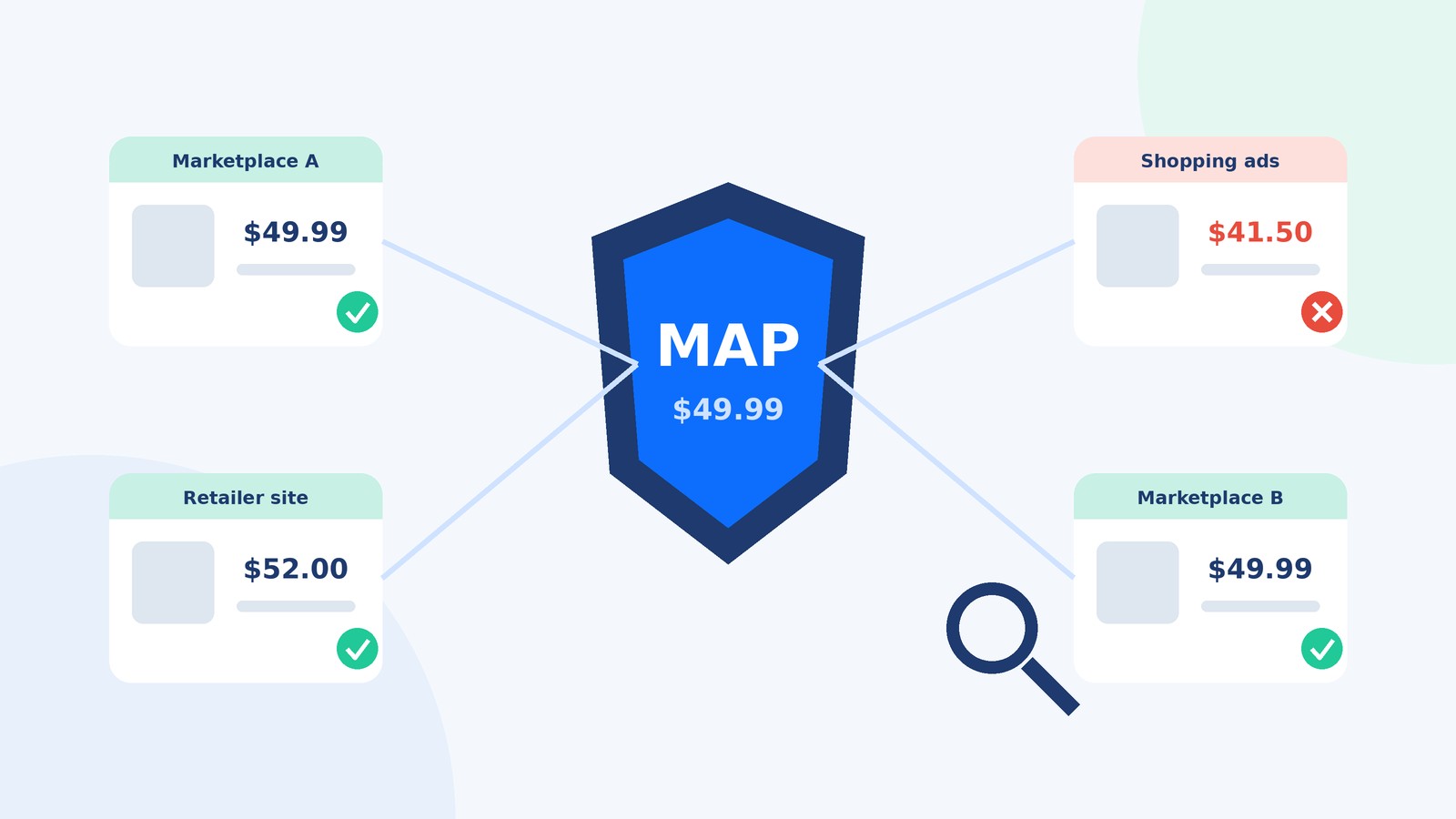
A MAP policy is a document in which a manufacturer or brand owner states the minimum price at which its products may be advertised by resellers, and the consequences if a reseller advertises below that price. MAP stands for minimum advertised price.
The most important sentence in any MAP policy is the one that says resellers remain free to sell at any price they choose. A MAP policy restricts the advertised price, not the transaction price. A retailer can still give a lower price at the register, over the phone, in a private quote, or (depending on how the policy is written) in the shopping cart. What it cannot do, if it wants to keep receiving supply, is publicly display a price below MAP in covered advertising.
In practice, MAP policies usually cover:
- Product detail pages and listings on marketplaces such as Amazon, Walmart Marketplace, eBay and Target Plus
- Retailer websites and their category and search pages
- Comparison shopping feeds and ads, including Google Shopping
- Email and SMS promotions, social media posts and print circulars
How is MAP different from MSRP, MRP and resale price maintenance?
These terms are often used interchangeably, but they mean different things, and the differences matter legally and operationally.
| Term | What it controls | Binding on resellers? | Typical enforcement | Risk level |
|---|---|---|---|---|
| MSRP (manufacturer’s suggested retail price) | A recommended selling price | No, it is a suggestion | None; used as a reference or “compare at” price | Low |
| MAP (minimum advertised price) | The lowest publicly advertised price | Only as a condition of continued supply under a unilateral policy | Warnings, suspension of supply, loss of authorized status | Moderate if drafted and enforced carefully |
| Minimum resale price maintenance (RPM) | The actual price at which a reseller may sell | Yes, by agreement | Contract remedies | Higher; judged under the rule of reason federally and treated more strictly by some states |
| UPP / unilateral pricing policy | The actual selling price, announced as a one-way policy | Only as a condition of continued supply | Refusal to deal with violators | Higher than MAP; demands strict discipline |
| Price floor in a marketplace repricer | Your own minimum price on your own offers | Applies only to you | Software settings | Low |
In short, MSRP is a suggestion, MAP is a rule about advertising, and resale price maintenance is a rule about selling. Most ecommerce brands choose MAP because it protects how the product is presented in public while leaving the reseller’s actual selling decisions alone.
Is a MAP policy legal in the United States?
MAP policies are widely used and generally lawful in the US when they are structured correctly, but the details decide the risk. Three legal ideas shape almost every well-drafted policy.
The Colgate doctrine. In United States v. Colgate & Co. (1919), the Supreme Court recognized that a manufacturer may announce in advance the terms on which it will deal and then refuse to deal with anyone who does not follow them. Because federal antitrust law targets agreements, a genuinely one-way announcement followed by an independent decision to stop supplying a violator is not an agreement. This is why most MAP policies are written as unilateral policies rather than contracts that resellers sign.
The Leegin decision. In Leegin Creative Leather Products v. PSKS (2007), the Supreme Court held that minimum resale price agreements are judged under the rule of reason at the federal level rather than being automatically illegal. That loosened federal rules, but state laws vary, and some states treat minimum resale price arrangements more strictly. A brand selling nationally has to plan for the strictest relevant state, not just federal law.
Advertised versus sold. Because MAP restricts advertising rather than resale, it has generally been viewed more favorably than resale price maintenance. But a MAP policy that in practice prevents any sale below a set price, for example by banning every form of in-cart discount on a platform where that leaves no practical way to sell lower, can be analyzed like resale price maintenance. Antitrust commentary from firms such as Foley & Lardner has highlighted a 2025 federal district court decision along these lines, which is a good reason to define in-cart pricing deliberately.
The quotable rule: a MAP policy stays defensible when the brand announces it, monitors it, and enforces it alone, and loses that protection the moment it starts negotiating compliance.
Why do ecommerce brands need a MAP policy?
MAP is often described as a way to protect margin, but the real reasons are broader:
- Protecting authorized retailers. Retailers that invest in content, demos, customer service and inventory depth cannot compete with a seller who undercuts the advertised price and offers none of that. Without MAP, your best partners often reduce orders or drop the line.
- Keeping marketplace prices stable. Repricing software reacts to competitors automatically. One aggressive seller can trigger a chain of price cuts in hours. Stable advertised prices make it easier to win and keep the Amazon Buy Box with a deliberate strategy instead of a constant price war.
- Protecting brand positioning. If a premium product is always advertised at a deep discount somewhere, shoppers learn to wait for the discount or assume the full price is inflated.
- Making your direct channel viable. Your own Shopify store and paid ads depend on not looking overpriced next to every reseller listing in search results.
- Giving you a reason to act. A written, published policy gives your team a consistent basis for cutting off sellers who repeatedly damage the channel.
MAP is not a fix for every pricing problem. If your wholesale pricing leaves resellers too little margin, if you oversupply the market, or if your distributors sell freely to anyone, a MAP policy will be violated constantly. Good MAP programs start with sound ecommerce pricing strategy and controlled distribution.
What should a MAP policy include?
A clear MAP policy is usually short, often two to four pages. It should answer every question a reseller or your own team might have, so nobody needs to “negotiate” an interpretation later. These are the sections most brands include.
1. Purpose and unilateral nature
State that the policy is the brand’s unilateral policy, that it is not an agreement, that the brand will not seek or accept a reseller’s agreement to it, and that the brand may change or withdraw it at any time. Briefly describe legitimate business reasons, such as protecting brand image and supporting retailers who invest in service.
2. Covered products and MAP prices
Reference a MAP price list by SKU, UPC or ASIN, with an effective date. Keep the list separate from the policy so you can update prices without reissuing the whole document. Specify how new products are added and how much notice you give before price changes.
3. What counts as advertising
Define covered advertising explicitly: marketplace listings, websites, search and shopping ads, feeds, emails, social posts, catalogs and circulars. Then define what is excluded. Most policies exclude in-store pricing, private quotes, and prices shown only after a product is placed in the cart or at checkout, but how you treat in-cart prices should be decided with counsel.
4. Prohibited practices
List behaviors treated as below-MAP advertising, such as “see price in cart” language that reveals a figure below MAP elsewhere, strikethrough prices that imply a lower price, bundle offers that effectively advertise a covered product below MAP, coupons that display a discounted price on the listing, and “free gift” bundles valued to circumvent MAP. Be specific; vague bans create disputes.
5. Permitted promotions
Explain whether and when the brand will run MAP holidays or approved promotional periods, and how they are announced. Holidays should be offered to all resellers on the same terms.
6. Monitoring
Say that the brand monitors advertised prices independently, including through third-party tools, and that screenshots or captured data constitute evidence of a violation.
7. Consequences
Describe the actions the brand may take, such as suspending shipments, removing authorized status, ending co-op advertising funds, or terminating the account. Many brands use escalating steps, but each step should be a brand decision, not a negotiation.
8. Communication rules
State that the brand will not discuss the policy with resellers beyond clarifying its terms, that sales representatives cannot grant exceptions, and that the brand does not act on one reseller’s complaints about another’s pricing as part of an agreement.
How do you monitor MAP compliance across channels?
A MAP policy without monitoring is a suggestion. Monitoring means capturing advertised prices for every covered SKU across every relevant channel, on a schedule, with evidence. The table below compares the main approaches.
| Monitoring approach | Best for | Strengths | Limitations |
|---|---|---|---|
| Manual spot checks | Brands with a handful of SKUs and resellers | No software cost; good for learning the landscape | Misses fast repricing changes; hard to document consistently; does not scale |
| Spreadsheet plus marketplace data exports | Small catalogs on one or two marketplaces | Cheap; uses data you already have | Limited visibility into other sellers and independent websites |
| Dedicated MAP monitoring software | Brands with dozens or hundreds of SKUs and many resellers | Frequent automated price capture, screenshots, seller identification, alerts | Subscription cost; still needs people to review, investigate and act |
| Outsourced brand-protection or marketplace team | Brands that lack in-house capacity for daily enforcement | Combines tools with trained people who investigate, document and run the enforcement workflow | Requires clear SOPs and escalation rules so the brand keeps every final decision |
Whatever method you choose, a good monitoring process covers these points:
- Channel map. List every place your products can appear: Amazon, Walmart, eBay, Target Plus, Google Shopping, social commerce, and your authorized retailers’ websites.
- SKU-to-listing mapping. Match each SKU to its ASINs, Walmart item IDs and retailer URLs. Duplicate or variation listings are where violations often hide, which is one reason clean product feed data and catalog hygiene matter.
- Capture frequency. Daily is a sensible baseline for marketplaces where prices change constantly; weekly may be enough for slower retailer sites.
- Evidence. Store a timestamped screenshot, the URL, the seller name and the advertised price for every violation.
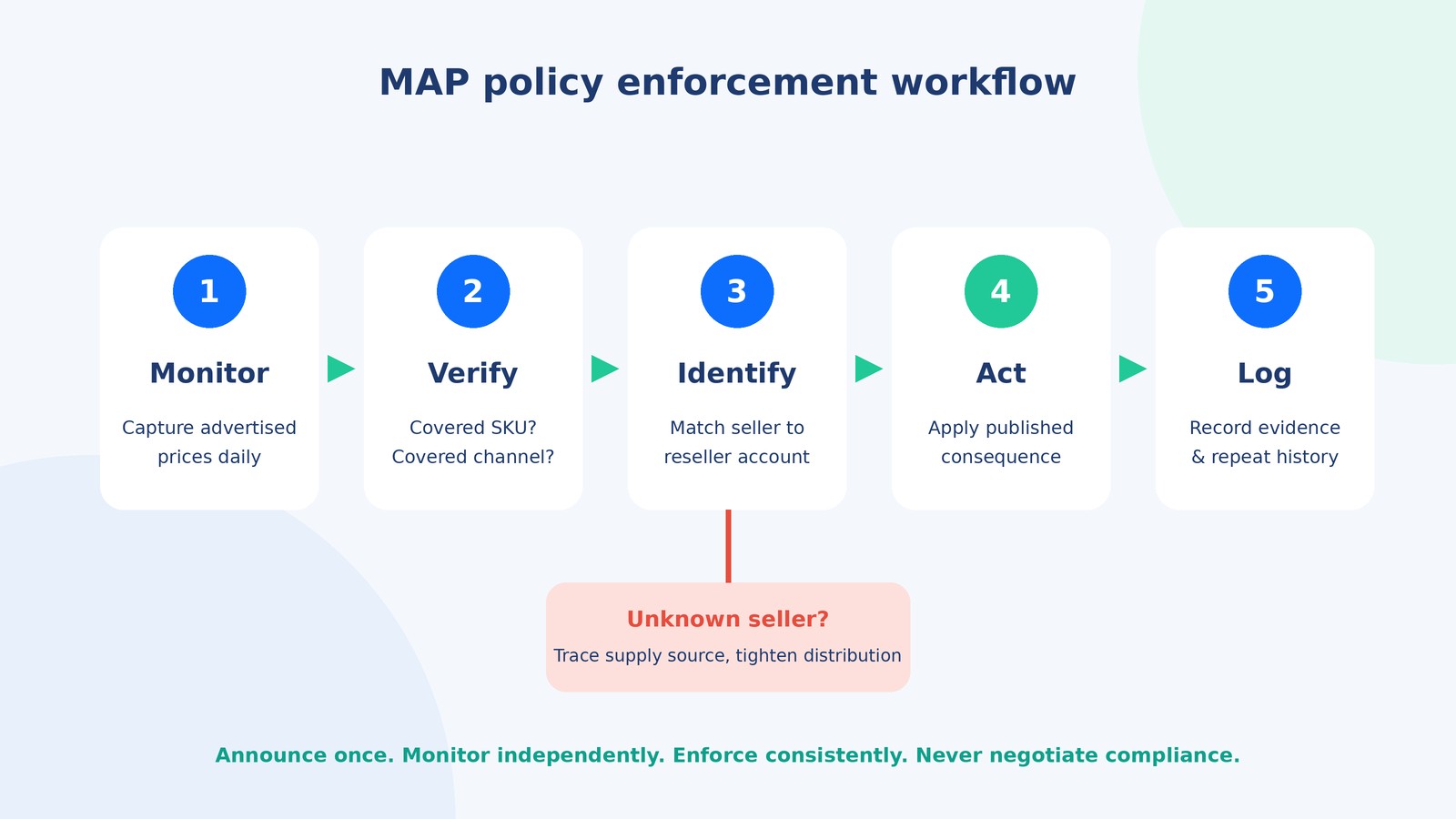
- Seller identification. Match the storefront to a known authorized reseller account, or flag it as unknown for investigation.
- Logging. Keep a single violation log so enforcement is consistent and auditable.
How do you enforce a MAP policy without creating legal risk?
Enforcement is where most MAP programs either succeed or fail. The goal is consistency without negotiation. Here is a workflow many brands follow, adapted to their counsel’s guidance:
- Verify the violation. Confirm the price is a covered advertised price for a covered SKU, not an in-cart price, a used or open-box listing, or an approved promotional period.
- Identify the seller. Determine whether the storefront belongs to an authorized reseller, and which account supplies it.
- Send a standard notice. Use a template that cites the policy, includes evidence, and states the consequence that applies. Do not ask the reseller to promise compliance, and do not offer a deal.
- Apply the published consequence. If your policy uses escalating steps, apply the step that matches the reseller’s history, the same way for every reseller.
- Record the outcome. Log the date, evidence, action and any change in the listing.
- Review reinstatement carefully. Reinstating a terminated reseller because it promised to comply can look like an agreement. Decide reinstatement policy with counsel in advance.
Things that commonly undermine a policy:
- Sales reps quietly granting exceptions to large accounts
- Asking resellers to sign or acknowledge the policy as a condition of supply, if your counsel has advised a purely unilateral structure
- Acting on a competitor retailer’s complaint as though it were a joint enforcement effort
- Enforcing against small sellers while ignoring big ones
- Letting your own direct-to-consumer store or outlet channel advertise below MAP
The fastest way to lose a MAP program is inconsistency: once resellers see that one partner gets a pass, every partner starts testing the line.
Will Amazon or Walmart enforce your MAP policy?
No. Marketplaces are not parties to your MAP policy. Amazon’s position, repeated in Seller Central forums and brand-protection guidance, is that it does not enforce MAP or MSRP pricing and that distribution and pricing disputes are a matter between the brand and its resellers. Expect the same from other marketplaces.
That has three practical consequences:
- Do not misuse IP reporting tools. Amazon Brand Registry and its Report a Violation tool are designed for intellectual property issues such as counterfeits and trademark misuse. Filing infringement reports against sellers of genuine goods simply because they are below MAP can backfire, and inaccurate reports are taken seriously. If a listing problem escalates, our guide to marketplace account suspension recovery explains how account health issues are handled.
- Your real lever is supply. MAP enforcement on a marketplace works only when you can trace the seller back to an account you supply and decide to stop supplying it.
- Your own pricing must be consistent. If you sell first-party or through your own seller account, keep your listings at or above MAP. A brand that undercuts its own policy has little credibility when enforcing it.
If you are expanding beyond Amazon, plan MAP monitoring for each new channel from day one. Our guide on how to sell on Walmart Marketplace covers the operational setup, and MAP coverage should be part of that launch checklist.
What can you do about unauthorized sellers breaking MAP?
Unauthorized sellers are the hardest MAP problem because a MAP policy only governs resellers you supply. A seller who bought your product from a liquidator, a retailer’s clearance sale, or a distributor that leaks stock has no relationship with you to suspend.
In the US, the first-sale doctrine generally allows someone who lawfully buys a genuine trademarked product to resell it. Courts have recognized exceptions, most notably when the goods being resold are materially different from those sold through authorized channels, for example because the manufacturer warranty does not apply, packaging has been altered, or the brand’s quality-control standards were not followed. Whether an exception applies is a legal question for your counsel, not something to assert casually.
A practical approach to unauthorized sellers:
- Trace the source. Use test buys, lot codes, serialized packaging or batch numbers to find which distributor or retailer the stock came from. Marketplace seller profiles now display business names and addresses, which helps.
- Tighten distribution. Add resale restrictions to distributor and retailer agreements, for example prohibiting resale to unapproved third-party marketplace sellers, and act on leaks once found.
- Build an authorized reseller program. Publish a list of authorized sellers and tie warranty coverage, support and quality standards to purchases from them. This can create the material differences that matter legally, and it gives shoppers a reason to choose authorized sellers.
- Control inventory flow. Avoid overselling to channels that cannot absorb volume, and plan clearance through controlled outlets rather than open liquidation.
- Escalate with counsel. For persistent sellers, legal letters or actions based on genuine trademark claims are a matter for an attorney.
How do you roll out a MAP policy step by step?
- Audit the current state. Capture advertised prices for your top SKUs across every channel for two to four weeks. Identify who is selling, at what price, and where the stock comes from.
- Fix the economics first. Make sure wholesale pricing gives authorized resellers a workable margin at MAP. A MAP price that nobody can profit at will not hold.
- Clean up distribution. Review distributor agreements and reseller lists. Decide which accounts are authorized to sell online and on which marketplaces.
- Draft the policy with counsel. Cover the sections listed above, decide on in-cart pricing treatment, and prepare notice templates.
- Set MAP prices by SKU. Usually a fixed amount or percentage below MSRP. Align MAP with your own DTC pricing.
- Announce the policy to all resellers at once. Use the same written communication for everyone with a clear effective date, typically allowing a reasonable window to update listings.
- Turn on monitoring before the effective date. You need a baseline and the ability to act on day one.
- Enforce consistently from day one. The first few weeks set expectations. Early exceptions are hard to undo.
- Review quarterly. Track violation rates, repeat offenders, unauthorized seller counts and price stability by channel, and adjust distribution or MAP levels as needed.
Who should own MAP monitoring and enforcement?
MAP programs fail most often from neglect, not bad policy. Somebody has to review alerts every day, verify violations, send notices, update the log and escalate repeat offenders. In small brands this lands on a founder or a busy marketplace manager, and it slips the moment a product launch or peak season arrives.
Three common ownership models work: an in-house brand-protection role in larger companies, a sales operations or channel manager supported by monitoring software, or an outsourced marketplace team that runs the daily workflow under the brand’s SOPs. Whichever you choose, keep the policy decisions, especially suspensions and terminations, with the brand, and keep the operational workload with people who have the time to do it daily. Our overview of marketplace management outsourcing explains how brands split that responsibility.
Need a team to run MAP monitoring every day? AcquireX’s marketplace management services for ecommerce give brands a dedicated team that monitors listings and advertised prices across Amazon, Walmart and other marketplaces, maintains clean catalog and listing data, documents violations, and runs your enforcement workflow under your rules, so your policy is applied consistently without consuming your internal team.
Book a call with our team to walk through your reseller landscape and how a monitoring and enforcement process would work for your catalog.
What are the most common MAP policy mistakes?
- Writing a vague policy. Undefined terms like “advertising” or “promotion” invite argument and selective interpretation.
- Setting MAP with no margin for resellers. If authorized sellers cannot profit at MAP, they will break it or leave.
- Ignoring your own channels. Your DTC store, outlet and email promotions must follow the same rules.
- Monitoring only Amazon. Violations on Google Shopping and retailer websites affect perception and price matching just as much.
- Treating MAP as an IP issue. Below-MAP pricing on genuine goods is a distribution problem, not infringement.
- Negotiating with violators. Deals and promises turn a unilateral policy into something that looks like an agreement.
- Forgetting the price list. Outdated MAP lists for discontinued or repriced SKUs create confusion and unfair enforcement.
Frequently asked questions about MAP policies
What does MAP stand for in ecommerce?
MAP stands for minimum advertised price. It is the lowest price at which a brand allows its resellers to publicly advertise a product, set out in a written MAP policy. Resellers can still choose their actual selling price.
Is MAP pricing the same as price fixing?
No. Price fixing usually refers to agreements among competitors on prices. A MAP policy is a brand’s own rule about how its products are advertised. Structured unilaterally and enforced independently, MAP policies are generally lawful in the US, but poor drafting or negotiated compliance can create antitrust risk, so have counsel review yours.
Can a retailer sell below MAP?
Usually yes. A MAP policy restricts only the advertised price. A retailer may typically sell at a lower price in store, in a private quote, or, if the policy allows, in the shopping cart. What it should not do is publicly advertise a price below MAP in covered channels.
Does Amazon enforce MAP pricing?
No. Amazon does not enforce MAP or MSRP and treats pricing and distribution disputes as matters between the brand and its resellers. Brands enforce MAP on Amazon through their own supply relationships, not through Amazon’s IP reporting tools.
Do resellers need to sign a MAP policy?
Many brands deliberately do not ask resellers to sign, because a unilateral policy that the brand announces and enforces on its own is generally treated more favorably than a negotiated agreement. Some brands use contractual MAP terms instead. The right structure depends on your situation and should be chosen with counsel.
How is MAP price usually set?
Most brands set MAP as a fixed amount or percentage below MSRP, chosen so authorized resellers keep a workable margin and the product stays competitive. MAP is published in a SKU-level price list that can be updated with notice.
What is a MAP holiday?
A MAP holiday is a defined period, such as a seasonal sale event, during which the brand temporarily allows advertising below the normal MAP price. It should be announced in advance and offered to all resellers on the same terms.
How often should MAP compliance be checked?
Daily monitoring is a sensible baseline for marketplaces, where repricing tools change prices constantly. Retailer websites and slower channels can often be checked weekly. Whatever the frequency, capture timestamped evidence and log every violation consistently.