Quick Answer: To sell on Walmart Marketplace you need a registered US business (sole proprietorships are not accepted), a Business Tax ID, GS1 UPC codes or a GTIN exemption, a compliant catalog, and proof you have sold online before. Signing up is free. You pay a referral fee of 5% to 20% per sale by category. Business verification takes minutes to two business days. Full onboarding averages about 10 days. Plan 30 to 60 days from applying to your first sale. Two rules catch almost every new seller: your payouts are held back until 90 days have passed and you have received $7,500, and Walmart will silently unpublish any listing it judges priced too high.
Key facts at a glance
| Question | Answer |
|---|---|
| Cost to join | $0. No setup, monthly, or listing fees |
| Referral fee range | 5% to 20% by contract category |
| Business types accepted | LLC, S-corp, C-corp. Not sole proprietorships |
| Tax ID | Business Tax ID or Business License Number. SSN not accepted |
| Barcodes | GS1 GTIN or UPC, or an approved GTIN exemption |
| Business verification time | A few minutes to two business days |
| Full onboarding time | About 10 days on average |
| Apply to first sale | 30 to 60 days realistically |
| First payout hold | Lifts after 90 days and $7,500 received |
| Performance standards | 8 metrics. Failing any can suppress your account |
| New seller incentive | Up to $75,000 through New-Seller Savings 2026 |
Your application is not the hard part.
The hard part is the gap nobody warns you about. You can be approved, live, and selling, and still not have the cash from those sales in your bank account.
Walmart holds back a slice of every new seller’s payouts. The hold does not lift until 90 days have passed since your first shipped order and you have received $7,500. Both conditions. We read the eight highest-ranking guides for this topic. Not one mentions it.
There is a second silent killer. Walmart’s pricing rules can pull your listing down without warning. The reason code is one most sellers have never heard of.
This guide covers the full path from the day you apply to the day you get paid, including both traps. Every number comes from Walmart’s own published pages, checked the week this was written.
What is Walmart Marketplace, and how is it different from being a Walmart supplier?
Walmart Marketplace is Walmart’s third-party selling program. You keep ownership of your inventory, set your own price, and sell directly to shoppers on Walmart.com. Walmart takes a referral fee on each sale.
Being a Walmart supplier, also called first party, is different. Walmart buys your product wholesale and resells it. Walmart owns the stock and controls the price.
Marketplace is the faster door, because you do not need a buyer meeting, a purchase order, or a retail pitch deck. You need a clean business and a catalog that follows the rules.
Walmart reports that more than 270 million customers shop with the company each week across all its channels.
Still choosing a channel? Compare Walmart Marketplace vs Amazon on fees and traffic, or read how to choose the right marketplace for your business.
Who actually gets approved to sell on Walmart Marketplace?
Walmart approves businesses that can prove three things: a verifiable legal entity, a track record of selling online somewhere else, and a catalog that follows its rules.
Here is the published requirement list in plain words:
- A copy of a personal ID for the applicant or legal representative
- A Business Tax ID or Business License Number. A Social Security Number is not accepted
- A business entity type Walmart accepts
- Documents proving your business name and address
- A history of marketplace or ecommerce success
- GTIN or UPC codes with a real GS1 Company Prefix
- A catalog that passes the Prohibited Products Policy
- A US warehouse that can accept returns, or Walmart Fulfillment Services
Source: Walmart’s before you start selling guide.
Trap 1: the sole proprietorship rule
Walmart does not accept sole proprietorships on the US Marketplace. It also excludes non-profit organizations and Hindu Undivided Family entities.
This kills more applications than anything else, and popular guides get it wrong. You will find a top-ranking page stating “sole proprietors with an EIN qualify.” That is not correct for the US Marketplace. Walmart lists the exclusion in its own onboarding FAQ.
Fix it before you apply:
- Form an LLC or a corporation
- Get an EIN under that new entity
- Open a business bank account in the identical legal name
- Then apply
Check accepted types on Walmart’s business entity type guide.
Trap 2: barcodes, and the exemption most guides skip
Walmart wants GTIN or UPC codes tied to a real GS1 Company Prefix. Resold or cheap bulk barcodes often fail, because Walmart traces the prefix to its registered owner.
There is a documented path around it. If you sell products that genuinely have no product ID, such as private label or handmade goods, you can request a GTIN exemption.
So the accurate answer is not “you must buy GS1 barcodes.” Buy prefixes from GS1 US for standard products, and file exemptions for the ones that qualify.
Trap 3: categories that need pre-approval
Some categories need Walmart’s sign-off before you can list. These include luxury goods, fragrances, cell phones, and seasonal items such as Halloween.
Walmart also blocks products tied to sanctioned regions and prohibits fresh and frozen food. Shelf-stable food may be approved case by case.
Build this extra time into your plan, or day 30 arrives with half a catalog live.
Proving ecommerce history is easier if you already sell elsewhere. Our complete beginner guide to selling on Amazon covers building that track record first.
What is the RUNWAY Method for going from approval to first sale?
The RUNWAY Method is a six-step sequence for launching on Walmart Marketplace: Register, Unlock, Name, Weigh, Activate, Yield.
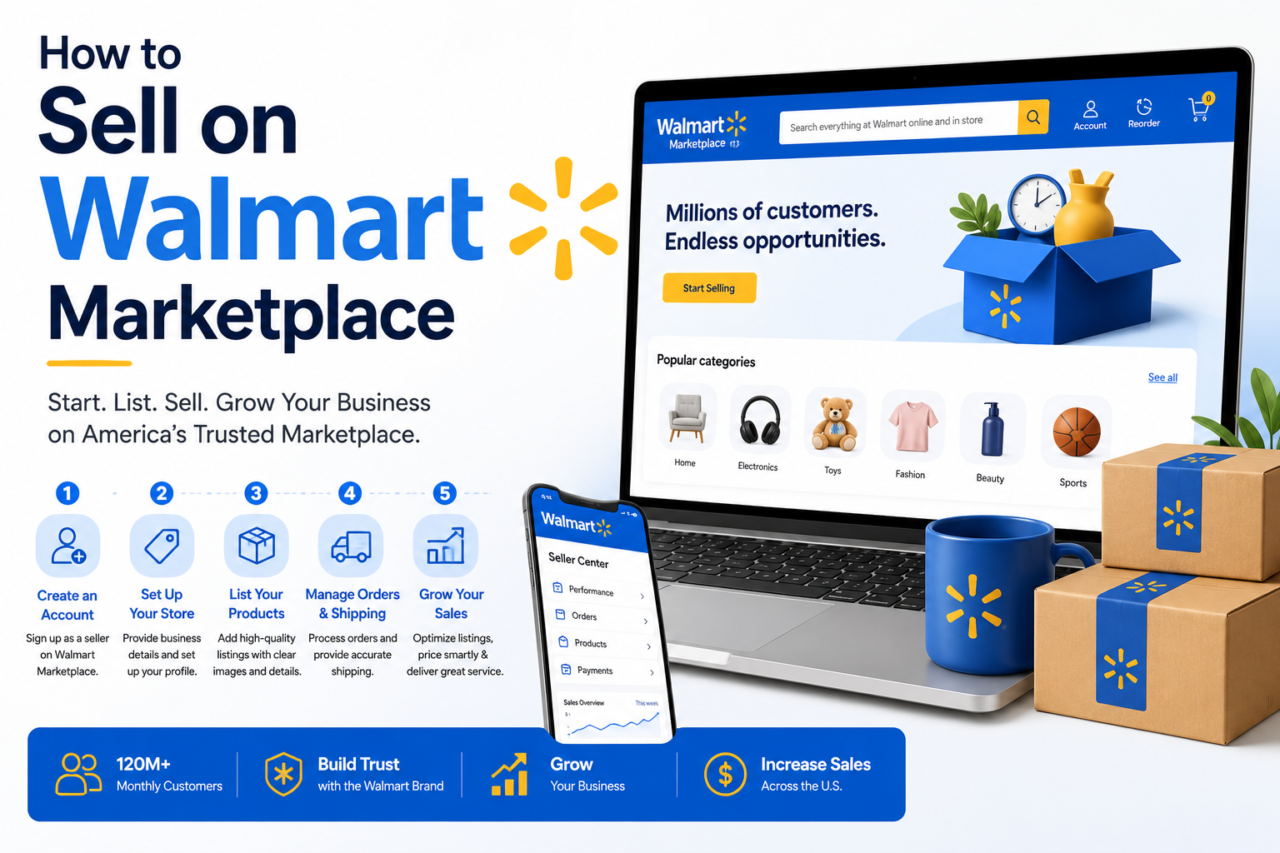
Walmart’s own onboarding runs five steps: verify your business, choose your payout method, add market details, manage fulfillment, and set up your catalog. RUNWAY wraps those five in the two things Walmart’s guide leaves out: what you do before you apply, and what keeps you alive after you launch.
| Step | What it means | Typical time |
|---|---|---|
| R | Register the right entity and barcodes | 1 to 3 weeks (if fixing) |
| U | Unlock your payout, and learn the hold | Minutes to 2 business days |
| N | Name and build your catalog | 3 to 7 days |
| W | Weigh the fulfillment math | 1 to 2 weeks |
| A | Activate savings, pricing, and ads | 1 day |
| Y | Yield to the eight metrics | Ongoing |
R: How do you register the right entity?
Complete all of this before you open the application form.
- Form an LLC, S-corp, or C-corp. Not a sole proprietorship
- Get an EIN from the IRS under that exact legal name
- Use a real US business address, not a PO box
- Open a business bank account in the same legal name
- Buy GS1 prefixes, or plan your GTIN exemptions
- Screen your catalog against the prohibited and pre-approval lists
- Use a business email on your own domain, not a free inbox
The name-match rule. Your legal name must read identically on your EIN letter, your bank account, your business documents, and your application. Walmart says your tax registration must precisely match your IRS records. One extra comma triggers a verification failure.
U: How do you unlock your payout, and when do you actually get paid?
This is the section other guides skip, and it matters more than any of them.
Business verification
You submit business details, entity type, tax registration, and a government ID. Walmart says verification runs from a few minutes to two business days.
That is verification only. Walmart separately says full onboarding averages about 10 days. Both numbers are true, and people confuse them constantly.
International sellers need more: a company PAN card, GST registration certificate, certificate of incorporation, a utility bill or bank statement, and a non-toll-free business phone number.
Choosing a payout method
Walmart does not pay you directly. You choose a third-party payment processor, register on their site, then link it back to Seller Center. Options vary by your country of incorporation.
The New Seller Payment Hold
The New Seller Payment Hold is a rolling delay on part of your payouts that begins on the day of your first shipped order.
| Country of incorporation | Rolling delay | When it lifts |
|---|---|---|
| United States | Up to 14 days | 90 days since first shipped order and $7,500 received |
| Non-US | Up to 21 days | 90 days since first shipped order and $7,500 received |
Read the “and” carefully. Both conditions must be met.
You will still get paid during this window. Walmart says payments can start as soon as 30 days after your first sale. But a slice keeps rolling until you clear both bars.
Which condition actually binds you:
| Your net monthly payout | Time to reach $7,500 | What holds you back |
|---|---|---|
| $5,000 | About 1.5 months | The 90 day clock |
| $2,500 | 3 months | Roughly a tie |
| $2,000 | About 3.75 months | The $7,500 threshold |
| $1,000 | About 7.5 months | The $7,500 threshold, badly |
What this means: a small launch does not escape the hold at day 90. A seller netting $1,000 a month stays in it for over half a year.
Plan cash for the first quarter as if part of your revenue arrives late. That is the most useful line in this guide.
Source: Walmart’s New Seller Payment Hold Policy.
To see your true cash cycle per unit, read cost per order in ecommerce.
N: How do you set up a catalog that sells?
You have four ways to load items. Most guides list three and miss the fastest one.
- Setup by Match. If the item already exists on Walmart.com, you attach your offer to that existing page. This is the fastest route to a first sale, because the page already has content and often reviews
- Single item setup. Good for small catalogs
- Bulk upload. Spreadsheet templates for larger catalogs
- API or a solution provider. For big, fast-changing catalogs
Walmart also offers an AI-powered listing tool for single and bulk setup.
If speed to first sale is your goal, start with Setup by Match on any SKU that already lives on Walmart.com. You skip the content build entirely.
Content rules that move your score
- Titles: brand, then product, then size or model. Clear, not stuffed
- Main image: at least 1000 x 1000 pixels, pure white background
- Extra images: angles, scale, and close-ups of key features
- Bullets: benefit first, spec second
- Attributes: fill every field. Blank fields drag your Content Quality Score down
Your Content Quality Score later gates the Pro Seller tiers, so building it right on day one saves a rebuild in month three.
One timing note: Walmart says it can take up to four hours after you add inventory for account setup to finish. Do not panic on hour two.
Go deeper on structured product data with catalog enrichment for ecommerce and mastering marketplace listings. If you list the same products on Amazon too, the Amazon product listing optimization guide shows where the two platforms differ. Running one catalog across several channels? Start with SKU management best practices.
W: Should you use WFS or fulfill orders yourself?
Two choices, and the math decides, not the marketing.
Current WFS fulfillment fees
Shipping weight is the greater of unit weight or dimensional weight, plus 0.25 lb packaging, rounded up.
| Shipping weight | Fee |
|---|---|
| 1 lb or less | $3.45 |
| 2 lb | $4.95 |
| 3 lb | $5.45 |
| 4 to 20 lb | $5.75 plus $0.40 per lb over 4 |
| 21 to 30 lb | $15.55 plus $0.40 per lb over 21 |
| 31 to 50 lb | $14.55 plus $0.40 per lb over 31 |
| 51 lb and up | $17.55 plus $0.40 per lb over 51 |
Add-ons: apparel add $0.50, hazardous materials add $0.50, retail price under $10 add $1.00, oversize add $3.00 or $20.00.
Storage: $0.75 per cubic foot per month from January through September. October through December adds $1.50 per cubic foot for items held past 30 days.
Check live numbers on the WFS pricing page.
The real argument for WFS is not shipping speed
Walmart states that if you use WFS, most performance metrics are met for you, with the exception of Negative Feedback Rate.
Read that again. Seven of the eight metrics that can get your account suppressed become Walmart’s problem instead of yours.
For a new seller with no shipping track record, that is not a convenience. It is risk removal. You are buying cover on the metrics that decide if your account survives.
If you have run Amazon FBA, the trade-off will feel familiar. Our FBA vs FBM comparison maps the same decision on the other platform, and 3PL vs in-house vs hybrid fulfillment covers the wider choice.
A note on the “50% lift” claim
Guides love citing a 50% sales lift from WFS. Walmart’s actual published claim is narrower.
Walmart reports 50% GMV growth on average for items carrying the Fulfilled by Walmart tag with delivery promises of two days or less. That is a specific subset, not a blanket promise on everything you send in.
Speed earns the lift, not the warehouse itself.
If you self-fulfill: use Simplified Shipping Settings. Walmart says meeting its criteria protects your On-Time Delivery metric from carrier delays outside your control. That is free downside protection.
Returns run through your Return Rate metric, and Walmart shoppers can return Marketplace items in store. Build the process properly using our ecommerce returns management guide.
Why do Walmart listings get unpublished without warning?
Walmart runs automated pricing rules. They can pull your offer off the site with no human review. This is the second silent killer for new sellers, and almost no guide explains it well.
The Pricing Rule
Walmart pulls down offers priced egregiously higher than the same item sells for elsewhere. It checks Walmart.com and rival websites. It also targets prices that look like price gouging.
Walmart reviews your listing price and your shipping fee together.
When an offer is flagged:
- It is unpublished automatically
- You are notified by email and in Seller Center
- It appears in the Unpublished Items dashboard
- The reason code reads “Reasonable Price Not Satisfied”
The Egregious Shipping Cost rule
A second rule targets high shipping fees. It can pull your offer down, or block it from the Buy Box. A cheap item with inflated shipping does not work here. Those offers also lose search visibility.
A correction most guides get wrong
Many guides call this strict “price parity.” They tell you to hold the lowest price on the internet. That goes too far, and sellers burn margin acting on it.
Walmart’s rule targets prices that are egregiously higher. It does not target a gap of a few cents. Being a bit higher will not pull your listing down. It does hurt your Buy Box odds, which is a different problem with a different fix.
How to get republished
Walmart works out a reference price for each item. It uses rival website prices, your past selling price, the Buy Box winner price, the average offer price, and Walmart’s own online and store prices. Use it to reprice and get back up.
Still down after 48 hours, and you think it is wrong? Contact Support with the Help button in Seller Center.
Source: Walmart’s pricing rules guide.
The takeaway: price plus shipping is one number to Walmart. Model them as one. Our effective pricing strategies for ecommerce guide covers setting floors that protect margin, and the same total-offer logic decides the Buy Box, as explained in our Buy Box strategy breakdown.
A: How do you activate New-Seller Savings and your first ads?
Walmart is running New-Seller Savings 2026, from February 2, 2026 to January 31, 2027. You must go live after February 1, 2026.
| Benefit | Amount |
|---|---|
| Referral discount, first $50K GMV | 20% off base rate |
| Referral discount, $50K to $500K GMV | 30% off base rate |
| Referral discount, over $500K GMV | 40% off base rate |
| Referral discount cap | Up to $72,000 |
| WFS credits | Up to $2,000 (10% off fulfillment fees) |
| Search Engine Marketing credits | Up to $1,000 |
| Walmart Connect ad credits | Up to $500 |
The trap: it is not automatic. Walmart says you must opt in after your store goes live, on the payments page in Seller Center. Miss that click and you pay full freight forever.
Terms: New-Seller Savings 2026.
On ads: do not launch paid search on day one. Gather roughly 30 days of organic data first, learn which SKUs convert unaided, then point your credits at the winners.
Two ad surfaces matter here. Sponsored Search puts you in front of shoppers already on Walmart. Search Engine Marketing pulls shoppers in from Google, and our search engine marketing guide explains how to use those credits well. Before you scale spend, set your profitability guardrails using ACoS vs TACoS, and see performance marketing for ecommerce brands for the wider channel plan.
What does a real Walmart unit look like in dollars?
The product:
- Kitchen item, Home / Kitchen / Decor & Garden (15% referral fee)
- Price: $34.99, landed cost: $9.50
- Packed: 10 x 8 x 4 inches, 2.2 lb
Working out the WFS fee:
- Volume: 10 x 8 x 4 = 320 cubic inches
- Dimensional weight: 320 / 139 = 2.30 lb
- Greater of 2.30 and 2.2 is 2.30 lb
- Plus 0.25 lb packaging = 2.55 lb, rounds up to 3 lb
- 3 lb tier = $5.45
Storage for 45 days:
- Cubic feet: 320 / 1,728 = 0.185
- 0.185 x 45 x ($0.75 / 30) = $0.21
| Line item | Without savings | With New-Seller Savings |
|---|---|---|
| Sale price | $34.99 | $34.99 |
| Referral fee (15%) | $5.25 | $4.20 |
| WFS fulfillment | $5.45 | $4.91 |
| WFS storage (45 days) | $0.21 | $0.21 |
| Cost of goods | $9.50 | $9.50 |
| Contribution profit | $14.58 | $16.17 |
| Margin | 41.7% | 46.2% |
Difference: $1.59 per unit. At 500 units a month that is $795 monthly, or $9,540 a year.
Full year-one program value
At 500 units a month you sell 6,000 units and $209,940 in GMV.
- First $50,000 GMV at 20% off a 15% referral fee: $1,500
- Next $159,940 at 30% off: $7,197
- WFS credits (10% of $32,700 in fees, capped): $2,000
- SEM credits: $1,000
- Walmart Connect credits: $500
Total year-one value: about $12,197.
Model this on your own category rate before committing. Our guide to contribution margin for ecommerce shows how to do it SKU by SKU.
Y: Which eight metrics decide whether your account survives?
There are two separate systems, and guides constantly blend them.
System 1: Seller Performance Standards (the survival bar)
Miss these and Walmart can suppress, suspend, or terminate you. Measured over the last 30 or 60 days.
| Standard | Requirement |
|---|---|
| Cancellation Rate | 2% or below |
| On-Time Delivery Rate | 90% or above |
| Valid Tracking Rate | 99% or above |
| Seller Response Rate | 95% or above (reply within 48 hours) |
| Negative Feedback Rate | 2% or below |
| Return Rate | 6% or below |
| Item Not Received Rate | 2% or below |
| Late Shipment Rate | 5% or below |
Two hard facts. Suspensions can be appealed with a plan of action. Terminations cannot be appealed at all.
Full detail: Walmart’s Seller Performance Standards.
System 2: Pro Seller tiers (the reward ladder)
| Metric | Rising | Advanced | Pro |
|---|---|---|---|
| On-time delivery rate | 90%+ | 92.5%+ | 95%+ |
| Cancellation rate | 2.5% or less | 2.0% or less | 1.5% or less |
| Seller responsiveness rate | 90%+ | 92.5%+ | 95%+ |
| Shipping speed score | 5%+ | 25%+ | 50%+ |
| Content quality score | 65%+ | 70%+ | 75%+ |
| Price competitiveness score | 65%+ | 70%+ | 75%+ |
All tiers also need more than 100 orders in 90 days, 90 days active, and full policy compliance.
Why climbing pays:
- Advanced Seller: 5% referral fee discount on qualified Pro Listings
- Pro Seller: 10% referral discount, the badge, SEM credit, Flash Deals, faster payouts
Walmart reports sellers saw an average GMV lift of more than 20% after reaching Pro Seller, and that Pro Sellers convert at 1.7 times the Marketplace average.
Note the stack: a Pro Seller running New-Seller Savings in year one gets both discounts on the same catalog.
Three habits that protect nearly every metric:
- Reply to customer messages within 48 hours, weekends included. Response rate is scored. Choosing “no response needed” does not hurt you
- Never promise a delivery date you cannot hit. Late is worse than slow
- Build reviews deliberately. Negative Feedback Rate is the one metric WFS does not cover for you
Reviews are the metric you own outright. Our guide on how to ask for reviews after purchase covers doing it without breaking marketplace rules. Support quality feeds several of these metrics, so track the right things using ecommerce customer support KPIs. If an account does get restricted, read marketplace account suspension recovery.
What does a realistic 60-day launch timeline look like?
| Days | What happens | Who owns it |
|---|---|---|
| 1 to 7 | Entity, EIN, bank, GS1 prefixes, exemption filings | Founder or ops |
| 8 to 10 | Submit application and documents | Ops |
| 10 to 12 | Business verification | Walmart, you respond fast |
| 13 to 18 | Payout processor setup and linking | Finance |
| 19 to 22 | Market details, shipping and returns settings | Ops |
| 23 to 32 | Catalog setup, starting with Setup by Match | Catalog team |
| 33 | Opt into New-Seller Savings | Ops |
| 34 to 40 | Inventory into WFS, or shipping templates tested | Supply chain |
| 41 to 50 | Go live, first orders, daily metric checks | Full team |
| 51 to 60 | Pre-approval categories clear, catalog completes | Catalog team |
| Day 50 onward | Payment hold clock starts at first shipped order | Finance |
| 60 to 90 | Gather organic data, then start ads | Growth |
| Day 90+ | Tier evaluation opens, hold lifts if $7,500 received | Full team |
Most brands miss this timeline for one reason. Nobody owns the rows. Walmart becomes a side project for whoever is already firefighting Amazon.
Write the owner next to each row before you start. Related: ecommerce SOPs for remote teams.
What do most Walmart guides get wrong?
We fetched and read the pages currently ranking for this topic. Six errors repeat.
- “Sole proprietors with an EIN qualify.” They do not on the US Marketplace. Walmart lists the exclusion directly
- “Referral fees run 5% to 15%.” The published schedule reaches 20% for jewelry under $250 and drops to 6% for personal computers
- “Apparel is a flat 15%.” It is tiered: 5% at $15 or less, 10% from $15 to $20, 15% above $20
- Nobody mentions the New Seller Payment Hold. This is a guide about your first sale. Leaving out when you get paid for it is a serious gap
- Performance standards listed as five or six metrics. Walmart publishes eight
- “You must always have the lowest price anywhere.” The rule targets egregiously higher pricing, not any difference. Acting on the overstatement burns margin for nothing
Even Walmart is inconsistent: its marketing page says fees “range from 6% to 15%,” while its own fee schedule shows 5% to 20%. Trust the schedule.
Key takeaways
- Fix your entity first. Sole proprietorships are rejected. Form an LLC or corporation
- Match every document exactly. Name mismatches are the top verification failure
- Barcodes have an escape hatch. File a GTIN exemption for private label and handmade
- Verification is fast, onboarding is not. Minutes to two days versus roughly 10 days
- Plan for the payment hold. It lifts only after 90 days and $7,500 received
- Setup by Match is the fastest path to a first sale. Attach to pages that already exist
- WFS covers seven of eight performance metrics for you. That is the real reason to use it
- Price and shipping are one number. Get it wrong and you get “Reasonable Price Not Satisfied”
- Opt into New-Seller Savings after going live. Worth up to $75,000, and not automatic
- Eight metrics decide survival, six decide your tier. Different systems
- Terminations cannot be appealed. Suspensions can
Stop treating Walmart as a side project
Most brands do not fail on Walmart for lack of knowledge. They fail because nobody has the hours.
The application needs a document owner. Payouts need finance. Item setup needs a catalog person. Pricing needs daily monitoring or listings vanish. Eight metrics need eyes on them. Ads need a hand on the dial. That is not a task you squeeze between Amazon fires.
AcquireX builds dedicated offshore ecommerce teams that own this end to end. Not an agency sending monthly reports. A team embedded in your business, running your Walmart account the way your own staff would, at a fraction of US hiring cost. Here is why a dedicated team beats an agency, and how to know when to outsource ecommerce operations.
We cover marketplace management, catalog and content, customer service, and performance marketing under one roof.
If Walmart has been “next quarter” for three quarters running, talk to us about a dedicated team.
See the model day to day: running a lean offshore ecommerce team.
Frequently asked questions
How long does Walmart Marketplace approval take?
Business verification takes anywhere from a few minutes to two business days. Walmart says full onboarding averages about 10 days. In practice, plan 30 to 60 days from applying to your first sale, since catalog setup and any pre-approval categories add time.
Can a sole proprietor sell on Walmart Marketplace?
No. Walmart does not accept sole proprietorships on the US Marketplace. It also excludes non-profit organizations and Hindu Undivided Family entities. Form an LLC or corporation, get an EIN under that entity, then apply.
When do you actually get paid on Walmart Marketplace?
Every new seller is placed under a rolling payment hold that starts with your first shipped order. US sellers see up to a 14 day delay, non-US sellers up to 21 days. The hold lifts only after 90 days have passed and you have received $7,500 in payments. Both conditions must be met. Payments can begin as soon as 30 days after your first sale.
How much does it cost to sell on Walmart Marketplace?
There are no setup, monthly, or listing fees. You pay a referral fee per sale, ranging from 5% to 20% depending on your contract category and price point. WFS fulfillment and storage cost extra if you use it.
Why was my Walmart listing unpublished?
The most common cause is Walmart’s automated Pricing Rule, which unpublishes offers priced egregiously higher than the same item elsewhere on Walmart.com or a competing site. Walmart counts your item price and shipping fee together. The reason code in your item report reads “Reasonable Price Not Satisfied.” Reprice using Walmart’s reference price to get republished.
Do I need GS1 barcodes to sell on Walmart?
Usually yes. Walmart wants GTIN or UPC codes backed by a GS1 Company Prefix, and traces the prefix to its registered owner. If your products genuinely have no product ID, such as private label or handmade goods, you can request a GTIN exemption instead.
Is WFS better than fulfilling orders myself?
For most new sellers, yes, and not mainly for shipping speed. Walmart states that WFS meets most performance metrics on your behalf, with the exception of Negative Feedback Rate. That removes the risk that a fulfillment mistake suppresses your account early. Sellers with proven logistics may keep more margin self-fulfilling.
What is New-Seller Savings, and how do I get it?
New-Seller Savings 2026 gives new sellers up to $75,000 in value: referral fee discounts of 20% to 40% capped at $72,000, up to $2,000 in WFS credits, $1,000 in SEM credits, and $500 in Walmart Connect credits. You must go live after February 1, 2026 and opt in on the payments page in Seller Center after your store goes live.
What are Walmart’s seller performance standards?
Walmart publishes eight: Cancellation Rate at 2% or below, On-Time Delivery at 90% or above, Valid Tracking at 99% or above, Seller Response Rate at 95% or above, Negative Feedback at 2% or below, Return Rate at 6% or below, Item Not Received at 2% or below, and Late Shipment at 5% or below.
What happens if my Walmart seller account gets suspended?
Suspensions and suppressions can be appealed by submitting a business plan of action showing how you will fix the performance issue. Terminations are different. Walmart does not accept appeals of termination, and your listings are deactivated.
What is the fastest way to get a first sale on Walmart?
Use Setup by Match on any product that already exists on Walmart.com. You attach your offer to an existing item page that already has content and often reviews, which skips the whole content build. Pair it with a competitive total offer price, since price plus shipping is the biggest factor in winning the Buy Box.
Is selling on Walmart Marketplace worth it?
It is worth it if you already ship well and can fund a slow first quarter. You get a huge customer base, no monthly fees, less seller competition than Amazon, and up to $75,000 in new seller credits. It is not worth it if your shipping is shaky, since eight metrics govern your account. It is also not worth it if you cannot absorb the payment hold on early sales.
What is the Walmart Pro Seller badge worth?
Pro Sellers get a 10% referral fee discount on qualified Pro Listings, the badge, SEM credit, Flash Deals access, and faster payouts. Walmart reports sellers saw an average GMV lift of more than 20% after reaching Pro Seller status, and that Pro Sellers convert at 1.7 times the Marketplace average.
Can I sell on Walmart without my own brand?
Yes. Resellers and private label sellers both qualify, as long as you meet the entity requirements, have valid barcodes or an exemption, and your catalog passes the Prohibited Products Policy. You do not need a registered trademark to apply.