You pick a fulfillment model once, and it quietly taxes every single order after that. Choose wrong, and Amazon fees can eat 30% to 40% of your sale price before you even count product cost. Choose right, and you protect margin on every unit you ship.
This guide breaks down Amazon FBA vs FBM in plain terms. You will see what each model really costs in 2026, a simple test to pick the winner for your product, and real math on the same item sold two ways. No fluff. Just the numbers that decide your profit.
Quick Answer
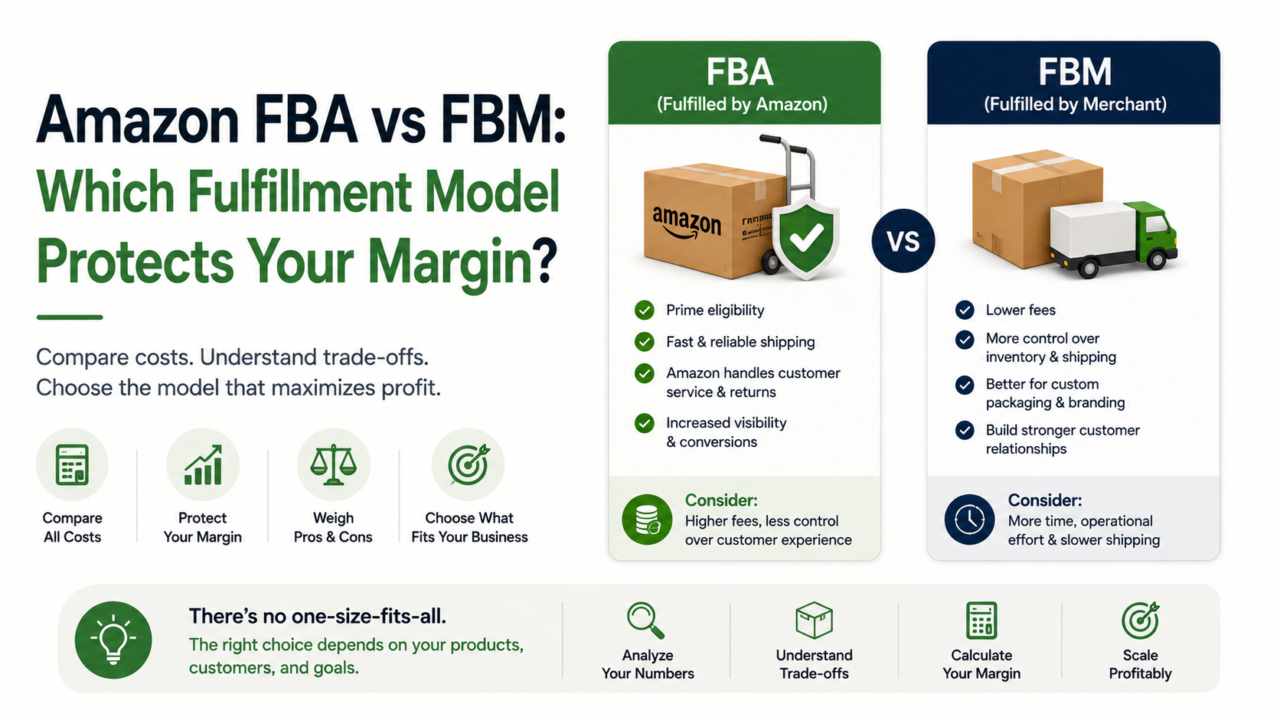
FBA (Fulfilled by Amazon): You send stock to Amazon. They pick, pack, ship, and handle returns. You get the Prime badge. You pay a per-unit fulfillment fee plus storage fees.
FBM (Fulfilled by Merchant): You store and ship orders yourself or through a 3PL. You skip Amazon’s fulfillment and storage fees. You pay for shipping, labor, and space instead.
The simple rule:
- Small, light, fast-selling items usually win with FBA.
- Big, heavy, slow-moving, or high-margin items often win with FBM.
- The referral fee (about 15% in most categories) applies either way.
Run the SHELF Test below and the numbers will tell you which one protects your margin.
What is the real difference between FBA and FBM?
Both models let you sell on Amazon. The only thing that changes is who handles the box.
FBA means Amazon does the work.
- You ship inventory into Amazon’s warehouses.
- Amazon stores it, packs it, and ships it with two-day Prime delivery.
- Amazon also handles customer service and returns.
- You pay a fulfillment fee per unit plus monthly storage.
FBM means you do the work.
- You keep stock in your own space, a garage, or a third-party warehouse.
- You pack and ship every order yourself.
- You handle your own customer service and returns.
- You skip Amazon’s fulfillment and storage fees.
One fee hits both models: the referral fee. That is Amazon’s commission for the sale. It is usually 15%, though it ranges from 8% to 45% by category, with a $0.30 minimum. You pay it whether Amazon ships the item or you do.
Here is the plain-English fee split.
| Cost | FBA | FBM |
|---|---|---|
| Referral fee (sales commission) | Yes | Yes |
| Amazon fulfillment fee (pick, pack, ship) | Yes | No |
| Amazon storage fee | Yes | No |
| Your own shipping cost | No | Yes |
| Your own labor and packaging | No | Yes |
| Your own storage or 3PL fee | No | Yes |
| Prime badge included | Yes | No (unless SFP) |
Why does the fulfillment choice decide your margin?
Because Amazon fees stack, and they stack per unit.
Every FBA sale carries two fees you cannot avoid: the referral fee and the fulfillment fee. On a $25 item, a 15% referral fee is $3.75 before anything else. Add a fulfillment fee near $3.65 for a small item, and you are down more than $7 in fees on a $25 sale. That is margin math, and it happens on every order.
FBM does not make fees vanish. It swaps them. You drop the FBA fee but pick up your own shipping and handling. For a small light item, retail carrier rates often cost more than Amazon’s per-unit fee. For a heavy item, the opposite can be true.
The 2026 fee reality: Amazon raised FBA fees by an average of $0.08 per unit in 2026, which is less than 0.5% of a typical item’s price. Amazon says there are no new fee types this year, and the change took effect January 15, 2026. Small per-unit changes sound tiny. At 10,000 units a month, an extra $0.08 is $800 a month, or $9,600 a year, straight off your margin.
Fulfillment operators also report a 3.5% fuel and logistics surcharge on FBA fulfillment fees that started April 17, 2026. On a $3.65 base fee, that adds about $0.13 per unit. Always confirm your exact fees in Amazon’s Revenue Calculator before you source stock.
Margin is the whole game here. If you want the full method for tracking it, see our guide on contribution margin for ecommerce.
FBA vs FBM: the side-by-side comparison
| Factor | FBA | FBM |
|---|---|---|
| Prime badge | Automatic | Only with Seller Fulfilled Prime |
| Buy Box strength | Stronger | Weaker without Prime |
| Fulfillment work | Amazon does it | You do it |
| Per-unit fee control | Low (Amazon sets it) | High (you negotiate) |
| Best for item size | Small and light | Large and heavy |
| Best for velocity | Fast movers | Slow movers |
| Storage fee risk | High for slow stock | Lower, you control it |
| Returns handling | Amazon | You |
| Startup effort | Low | Higher |
| Brand control (inserts, packaging) | Limited | Full |
FBA buys you speed and the Prime badge. Prime listings tend to convert better and win the Buy Box more often, which lifts sales velocity.
FBM buys you control. You set your own shipping deals, add branded packaging, and dodge Amazon storage fees on slow stock. That control is why many multi-channel sellers keep FBM in the mix. See our notes on SKU management for multi-channel sellers.
Choose FBA if:
- Your product is small and light.
- It sells fast, so stock does not sit.
- You have no shipping setup yet.
- You need the Prime badge to compete.
- Your margin can absorb the fees.
Choose FBM if:
- Your product is large, heavy, or bulky.
- It sells slowly, so storage fees would pile up.
- You already run a warehouse or a good 3PL.
- You want branded packaging and full control.
- Your margin is thin and every fee matters.
Most Amazon sellers lean on FBA. Industry data from Jungle Scout’s seller survey shows about 82% of sellers use FBA and roughly 22% use FBM only, with a slice running both. Popularity is not the point. The right model is the one that protects margin on your specific product.
The SHELF Test: how to pick the model that protects your margin
Most guides hand you a pros and cons list and leave you to guess. The SHELF Test gives you a score instead. Rate your product on five levers. Each one pushes you toward FBA or FBM.
S is for Size and weight.
- Small and light (under 1 lb): FBA fees are usually low. FBA wins.
- Large or heavy: FBA fulfillment and storage fees climb fast. FBM wins.
H is for Hold time (how fast it sells).
- Fast mover: stock leaves before storage fees pile up. FBA wins.
- Slow mover: FBA storage and aged-inventory fees drain you. FBM wins.
E is for Economics (margin per unit).
- Thin margin: every fee matters, so you need the cheaper path per product.
- Fat margin: you can afford FBA fees to buy speed and the Prime badge.
L is for Logistics muscle.
- You have a warehouse or a good 3PL: FBM is realistic.
- You have no shipping setup: FBA is the easy button.
F is for Fast-delivery need (Prime dependency).
- Your category is a Prime battleground: you likely need FBA or SFP.
- Your buyers are less speed-driven: FBM can hold its own.
How to score it: Give each lever one point to FBA or one to FBM. Add them up. The higher score is your starting model. When the score is close (like 3 to 2), run the real math below before you commit.
Most sellers do not have to pick just one. A hybrid split, FBA for small fast SKUs and FBM for bulky slow ones, often protects margin best across a full catalog.
Worked example: the same product, two very different margins
Numbers beat opinions. Here is one product sold two ways. All figures are for illustration, so confirm your own rates in Amazon’s calculator.
Case 1: Small, light item ($25 kitchen gadget, 12 oz)
FBA path:
- Sale price: $25.00
- Product cost: $6.00
- Referral fee (15%): $3.75
- FBA fulfillment fee: $3.65
- Storage (per unit): $0.15
- Profit per unit: $11.45
FBM path:
- Sale price: $25.00
- Product cost: $6.00
- Referral fee (15%): $3.75
- Your shipping (free shipping you absorb): $5.50
- Pick, pack, and packaging: $1.50
- Storage (per unit): $0.10
- Profit per unit: $8.15
Winner: FBA, by $3.30 per unit. For a small light item, Amazon’s per-unit ship rate beats what a small seller pays a retail carrier. You also get the Prime badge for free. At 2,000 units a month, that gap is $6,600 in extra monthly profit.
Case 2: Big, heavy item ($60 product, 15 lb)
FBA path:
- Sale price: $60.00
- Product cost: $20.00
- Referral fee (15%): $9.00
- FBA fulfillment fee (bulky): about $13.50
- Storage (per unit, higher volume): $0.80
- Profit per unit: about $16.70
FBM path:
- Sale price: $60.00
- Product cost: $20.00
- Referral fee (15%): $9.00
- Your freight (negotiated 3PL or regional carrier): $9.50
- Pick, pack, and packaging: $2.00
- Storage (per unit): $0.40
- Profit per unit: about $19.10
Winner: FBM, by $2.40 per unit. For a heavy item, your negotiated freight beats Amazon’s bulky fee. You also skip high cubic storage fees and aged-inventory surcharges. At 500 units a month, that gap is $1,200 in extra monthly profit.
The lesson: the winner flips with the product. Same seller, same marketplace, opposite answer. That is why a blanket “always use FBA” rule leaks money. Run the math per SKU.
When should you switch from FBA to FBM?
Switch when the FBA math stops working. Watch for these signals:
- Your item got bigger or heavier. New packaging or a bundle can push you into a costlier size tier.
- Storage fees are climbing. Slow stock racks up monthly fees. Once a unit sits 181 days or more, Amazon adds an aged-inventory surcharge on top. FBM lets you control space and avoid that penalty.
- Your margin is under 15%. Thin-margin products feel every fee. FBM can claw some back.
- You have reliable shipping. Once your own 3PL hits fast, cheap delivery, FBA loses its edge.
- You want brand control. Inserts, custom boxes, and unboxing only work with FBM.
You do not have to go all in. Many sellers move heavy or slow SKUs to FBM and keep fast movers on FBA. If ops are getting messy, that is a sign to outsource part of the workflow instead of guessing.
What is Seller Fulfilled Prime and does it change the math?
Seller Fulfilled Prime (SFP) lets FBM sellers show the Prime badge while shipping from their own warehouse. On paper it is the best of both worlds: you keep FBM control and cost, and you still get the Prime badge that lifts conversion.
The catch is the rules are strict, and Amazon tightened them again in 2026. As of mid-2026, SFP sellers must hold these standards, tracked weekly:
- On-Time Delivery Rate of 93.5% or higher.
- Pre-fulfillment cancel rate under 0.5%.
- Valid tracking rate of 99%.
- Same-day (zero-day) handling for one and two-day orders, with a cutoff no earlier than 2pm on weekdays.
- Ship at least one weekend day and offer free standard shipping to Prime buyers in the contiguous US.
Amazon also raised SFP delivery speed targets starting July 6, 2026. For standard-size items, 40% of Prime page views must now show one-day delivery (up from 30%), and 75% must show two-day (up from 70%). For most single-warehouse sellers, hitting those numbers means adding more warehouse locations.
So does SFP change the FBA vs FBM math? It can, when:
- You sell mid-size or heavy items where FBA fees hurt most.
- You already run a fast, multi-location shipping operation.
- You want the Prime badge without Amazon’s storage fees.
If you cannot hold these standards, SFP hurts more than it helps, since missing the marks risks your Prime status. Test it on a few SKUs before you move your whole catalog.
Common mistakes that quietly kill your margin
- Comparing only the FBA fee. You must add your own shipping and labor to the FBM side, or the compare is fake.
- Ignoring storage fees. Slow FBA stock bleeds cash every month. Model storage per unit, not just the ship fee.
- Forgetting the referral fee. It applies to both models. It is not a tiebreaker.
- Using averages, not your numbers. Amazon’s “$0.08 average” is not your product. Pull your exact fee.
- Set and forget. Fees change yearly. Re-run the math each January when new rates land.
- Blending ad cost into the wrong bucket. Your true unit profit needs ad spend too. See how to lower it in our guide on reducing ACoS on Amazon.
Key Takeaways
- FBA and FBM both pay the referral fee (about 15%). The real split is who pays for fulfillment and storage.
- FBA wins for small, light, fast SKUs. Low per-unit ship rate plus a free Prime badge.
- FBM wins for big, heavy, slow, or high-margin SKUs. You control shipping and skip storage fees.
- The SHELF Test picks your model: Size, Hold time, Economics, Logistics muscle, Fast-delivery need.
- Run the math per SKU. The winner flips with the product, so a hybrid split often protects margin best.
- Re-check every year. 2026 fees rose an average of $0.08 per unit, and small changes scale into real money.
Ready to protect your margin on every order?
Picking the right model is step one. Running it cleanly, at scale, across every SKU is where margin is won or lost.
AcquireX builds a dedicated ecommerce team that owns your Amazon fulfillment strategy end to end. We model FBA vs FBM per SKU, manage inventory placement, and keep your fee stack tight so you keep more of every sale.
- See how we run your channels with Marketplace Management.
- Tighten stock, freight, and 3PL choices with Supply Chain Management.
Stop managing fees by guesswork. Build a system that protects margin on every order.
Frequently Asked Questions
Is FBA or FBM cheaper?
It depends on your product. FBA is usually cheaper for small, light, fast-selling items because Amazon’s per-unit ship rate beats retail carriers. FBM is often cheaper for large, heavy, or slow-moving items where your own freight and storage cost less than Amazon’s fees.
Do you still pay Amazon fees with FBM?
Yes. FBM sellers still pay the referral fee, which is about 15% in most categories with a $0.30 minimum. FBM only removes Amazon’s fulfillment and storage fees, not the sales commission.
Does FBM get the Prime badge?
Not by default. Standard FBM listings do not show the Prime badge. You can earn it through Seller Fulfilled Prime (SFP) if you meet Amazon’s strict delivery-speed and reliability rules while shipping from your own warehouse.
How much are Amazon FBA fees in 2026?
Amazon raised FBA fees by an average of $0.08 per unit in 2026, which is less than 0.5% of a typical item’s price. A small standard item’s fulfillment fee sits near $3.65, and most referral fees are 15%. Fulfillment operators also report a 3.5% fuel and logistics surcharge on fulfillment fees from April 17, 2026. Confirm your exact rates in Amazon’s Revenue Calculator.
Can you use FBA and FBM at the same time?
Yes, and many sellers do. A hybrid split puts small fast SKUs on FBA and bulky slow SKUs on FBM. This often protects margin better than forcing every product into one model.
When should I switch from FBA to FBM?
Switch when FBA fees outgrow the value. Common triggers are rising storage fees on slow stock, a product moving into a heavier size tier, margins under 15%, or when your own shipping becomes fast and cheap enough to compete.
What are the Seller Fulfilled Prime requirements in 2026?
SFP sellers must keep a 93.5% on-time delivery rate, a pre-fulfillment cancel rate under 0.5%, and a 99% valid tracking rate, all tracked weekly. You also need same-day handling with a cutoff no earlier than 2pm on weekdays and at least one weekend shipping day. From July 6, 2026, standard-size items must show one-day delivery on 40% of Prime page views and two-day on 75%, so most sellers need more than one warehouse to qualify.