Selling on Amazon used to be simple. List a product, ship it, get paid. Not anymore.
Today Amazon runs on ads, content, reviews, inventory rules, and policy changes that hit almost every week. One person cannot keep up with all of it. That is why brands hire Amazon marketplace management services.
Here is the short version: these services run your Amazon store for you. A team handles your listings, your ads, your stock, your customer messages, and your growth plan. You focus on the product and the brand.
This guide shows you what these services include, what they cost, how to pick the right partner, and what the first 90 days should look like. We run Amazon stores for a living, so this is the advice we give brands before they sign anything.
Key takeaways
- Marketplace management is done-for-you Amazon operations: listings, ads, inventory, support, and strategy in one place.
- It is not the same as “running ads.” Ads are one piece of a much bigger job.
- Most brands pay a monthly retainer, a percentage of sales or ad spend, or a mix of both.
- Use the CLEAR method to choose: Coverage, Lead team, Edge in your category, Accountability, Reporting.
- A dedicated team beats a generic agency or a single freelancer when you want to scale.
The quick answer
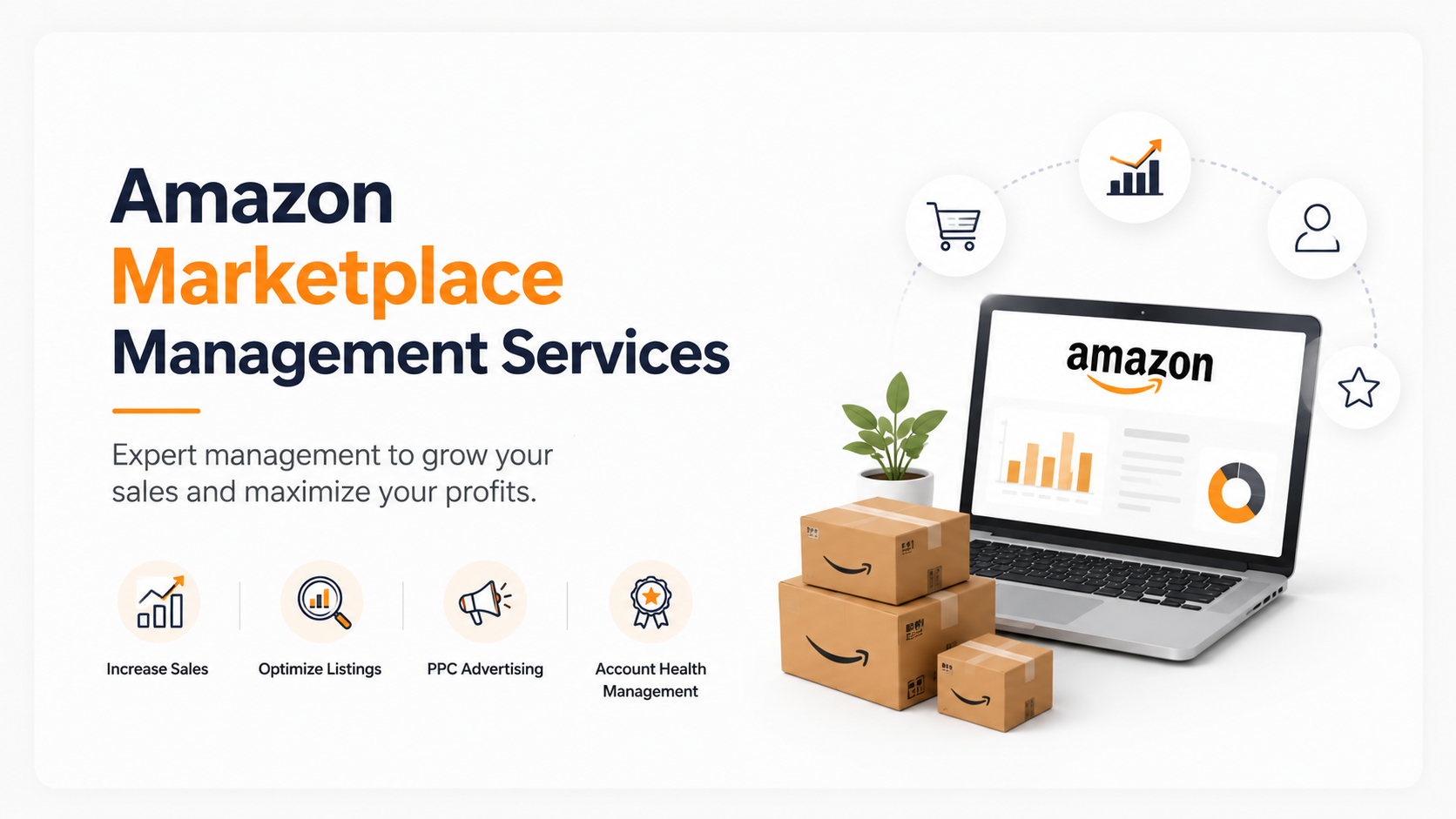
Amazon marketplace management services are done-for-you services where a team manages your full Amazon presence. That usually covers Seller Central or Vendor Central setup, product listings, A+ content, advertising (PPC), inventory and fulfillment, Buy Box and pricing, account health, customer support, and reporting. Most brands pay a monthly fee, a percentage of sales, or a mix of both. The best partner for you is one that owns outcomes, not just tasks.
Why winning on Amazon is harder now
Amazon is not a side channel anymore. For many brands it is the main store. But the easy days are over, and the data makes that clear.
- Third-party sellers now make up about 61 to 62% of all units sold on Amazon, and 69% of total sales value.
- Those sellers moved an estimated $575 billion in 2025, up roughly 15% in a year.
- Around 6 in 10 US shoppers now start their product search on Amazon, not Google.
Now the part most articles skip. The market is getting smaller at the top and more crowded at the bottom.
- Active US sellers dropped from about 584,000 in early 2025 to roughly 500,000 by early 2026.
- Fewer than 8,000 sellers, about 1.6% of all active sellers, now drive half of US third-party sales.
Read that again. A tiny group of sellers wins most of the money. They win because they run Amazon like a real operation, not a side task. That is the whole case for getting real help. Part-time effort loses to full-time systems.
What Amazon marketplace management services include
Good marketplace management is not one job. It is eight jobs working together. Here is what a full-service partner should cover, and what each one really means.
1. Account setup and health
- Setting up Seller Central (you sell) or Vendor Central (Amazon buys from you and sells)
- Enrolling in Brand Registry so you control your listings
- Fixing suspensions, listing takedowns, and policy flags fast, before they cost you sales
2. Listings and catalog
- Titles, bullets, and descriptions built around the words shoppers actually type
- A+ content (the rich images and text on your page) and a branded store
- Clean photos and videos that follow Amazon’s rules
3. Advertising and growth (PPC)
- Sponsored Products, Sponsored Brands, and Display ads
- DSP for larger brands
- This matters more every year. Amazon’s ad business pulled in about $21.3 billion in a single quarter, which shows how hard sellers now fight to be seen.
4. Inventory and fulfillment
- Planning FBA (Amazon ships for you) and FBM (you ship) so you never run out or overpay for storage
- About 82% of third-party sellers use FBA, so getting this right is not optional
5. Pricing and Buy Box
- Adjusting price to win the Buy Box (the “Add to Cart” spot) without killing your margin
- Stopping resellers from undercutting your brand
6. Customer support and reviews
- Answering buyer messages fast
- Handling reviews and feedback the right way
7. Supply chain and procurement
- Reorder planning and supplier coordination so stock lands on time
8. Reporting and strategy
- Clear weekly numbers you can read in two minutes
- A real growth plan, not just a list of tasks done
“Running ads” is not the same as management
This trips up a lot of founders. Someone offers to “manage your Amazon” but only touches your ads. That is like hiring a driver who only steers and never looks at the road.
- Ads alone can spend your money faster. They cannot fix a weak listing, a stock-out, or a suspended account.
- Full management ties ads, content, stock, pricing, and support together so every dollar works harder.
If a service only does one piece, that is fine. Just know you will need to fill the other seven yourself.
Signs your brand needs help on Amazon
You probably do not need a partner on day one. But these signs mean you have outgrown doing it alone.
- Your sales stalled and you do not know why
- Ad spend keeps rising but profit does not
- You keep losing the Buy Box to resellers
- Listings get flagged or suspended and you scramble to fix them
- You spend more time inside Seller Central than on your real business
- You run out of stock often, or you have too much sitting in storage
If two or more sound familiar, the cost of staying stuck is higher than the cost of getting help.
What Amazon marketplace management costs
Here is the honest breakdown most pages avoid.
There are three common pricing models:
- Flat monthly retainer. A set price for a set scope. Often a few thousand dollars a month for smaller catalogs, more as the work grows. Good when you want a predictable bill.
- Percentage of sales or ad spend. You pay a cut of what they help you earn or spend (often a single-digit percent of sales, or 10 to 20% of ad spend). Good when you want their pay tied to your growth.
- Hybrid. A base fee plus a performance piece. This is the most common model for serious brands.
What changes the price:
- Your catalog size (5 products is not 500 products)
- Your ad spend
- How much of the work you hand over
- The health of your account when they start
A few rules of thumb:
- Cheap is not a deal if the work is thin. A weak listing or wasted ad budget costs more than the fee.
- Tie pay to outcomes where you can.
- Ask what is included. “Management” with no ads, no content, and no strategy is just account babysitting.
The right partner should pay for itself through more sales, less waste, and fewer costly mistakes.
How to choose: the CLEAR method
Use this five-point check before you sign anything. Score each one from 1 to 5. If a partner is weak on Coverage, Lead team, or Accountability, keep looking.
- C is for Coverage. Do they run the whole store, or just one piece like ads? Full coverage beats a patchwork of vendors.
- L is for Lead team. Do you get a dedicated team that knows your brand, or a shared queue where you are one of fifty? Dedicated beats shared every time.
- E is for Edge in your category. Have they grown brands like yours before? A partner who knows your space ramps up faster.
- A is for Accountability. Are they paid for results, or just for tasks? You want someone who owns the outcome.
- R is for Reporting. Do you see real numbers every week? If reporting is vague, the work usually is too.
Dedicated team vs agency vs freelancer
Not all “Amazon help” is the same. Here is how the three options really compare.
| What you get | Freelancer | Typical agency | Dedicated team |
|---|---|---|---|
| Cost | Lowest | Medium to high | Medium |
| Coverage | One skill | A few skills | Full store |
| Focus on your brand | Splits time across clients | One of many accounts | Built around your brand |
| Owns outcomes | Rarely | Sometimes | Yes |
| Scales with you | No | Slowly | Yes |
A freelancer is fine for one small task. An agency can do more, but you often share their attention with dozens of other brands. A dedicated team works like part of your own company. They own the result and grow as you grow.
That last column is the model that scales without chaos.
What good onboarding looks like (the first 90 days)
A strong partner has a clear plan from day one. Ask to see it before you sign. Here is a healthy shape.
- Days 1 to 30: Full account audit. Fix account health and broken listings. Find quick wins and obvious waste in ad spend.
- Days 31 to 60: Rebuild listings and A+ content. Restructure ad campaigns. Set up clean reporting so you can see the numbers.
- Days 61 to 90: Scale what works. Tighten pricing and Buy Box strategy. Lock in inventory planning so you stop running out.
If a partner cannot tell you what month one looks like, that is a warning sign.
Red flags to watch for
Walk away if you see these.
- They promise a fixed sales number or a “guaranteed” rank
- They will not share past results or client references
- Reporting is fuzzy or only comes when you ask
- They lock you into a long contract with no exit
- One person does everything (what happens when they get sick?)
Questions to ask before you sign
Bring these to your first call.
- Who exactly will work on my account, and how many other brands do they handle?
- What does month one look like, and what do the first 90 days look like?
- How do you protect my margin while growing sales?
- How do you handle a sudden suspension or listing takedown?
- What happens if the work does not deliver?
A strong partner answers all of these without dodging.
What a turnaround usually looks like
Here is a pattern we see again and again with brands that come to us stuck.
- Before: Sales flat for months. Ad spend creeping up while profit drops. A few listings suspended. The founder is buried in Seller Central instead of building the brand.
- First fix: Clean up account health, rewrite the weak listings, and cut the wasted ad spend. This alone often frees up budget and steadies sales.
- Then: Rebuild the ad structure around the products that actually make money, fix inventory so nothing goes out of stock during peak weeks, and protect the Buy Box.
- After: Sales climb on steadier ad costs, the founder gets their time back, and growth stops feeling like a fire drill.
The numbers differ for every brand. The shape almost never does. Most stalls come from a broken system, not a bad product.
How AcquireX helps your brand grow
AcquireX is not an agency and not a pool of freelancers. We build a dedicated team that works inside your business and owns your Amazon results.
Here is what that looks like in practice:
- One team, full coverage. We handle marketplace management, performance marketing, catalog and content, customer support, supply chain, and creative under one roof. No juggling five vendors.
- Ownership, not task delivery. Your team is measured on growth and account health, not on a checklist. We win when you win.
- Built to scale. As your sales grow, your team grows with you. You add capacity without adding chaos or new hires to manage.
- Clear weekly reporting. You always know your numbers, your ad return, and your next move.
The goal is simple. You focus on the product and the brand. We handle the execution so growth does not stall.
Frequently asked questions
What are Amazon marketplace management services?
They are done-for-you services where a team manages your full Amazon store. This includes listings, A+ content, advertising, inventory, pricing, customer support, account health, and reporting.
How much do Amazon management services cost?
Most brands pay a flat monthly retainer, a percentage of sales or ad spend, or a hybrid of both. Price depends on your catalog size, ad spend, account health, and how much work you hand over.
Is marketplace management worth it for a small brand?
It can be, but timing matters. If you are brand new with one product, you may not need it yet. Once sales stall, ad costs climb, or you are buried in Seller Central, a dedicated team usually pays for itself.
What is the difference between management and just running ads?
Ads are one piece. Full management ties ads to your listings, stock, pricing, and support so the whole store works together. Ads alone cannot fix a weak page or a stock-out.
Can one partner manage both Seller Central and Vendor Central?
Yes, but not all of them do it well. Ask for proof they have run both before you sign.
How long until I see results?
Quick wins like cleaned-up listings and tighter ads can show in the first month. Steady growth usually shows over 90 days and beyond.
Dedicated team or agency: which is better?
A dedicated team focuses fully on your brand and owns the outcome. An agency often splits attention across many accounts. For brands that want to scale, a dedicated team is the stronger fit.
The bottom line
Amazon rewards brands that treat it like a real business, not a side project. The data proves it: a small group of sellers who run tight operations win most of the sales. Listings, ads, stock, support, and strategy all have to move together, and that is hard to pull off alone.
Pick a partner who covers the whole store, gives you a dedicated team, and owns the results. Run them through the CLEAR check first.
Want a team that runs your Amazon store like it is their own? Talk to AcquireX and see what a dedicated growth team can do for your brand