Your ads are working. Traffic is up. But sales are flat.
So the team blames the creative. Then the offer. Then the season.
Nobody checks the page itself.
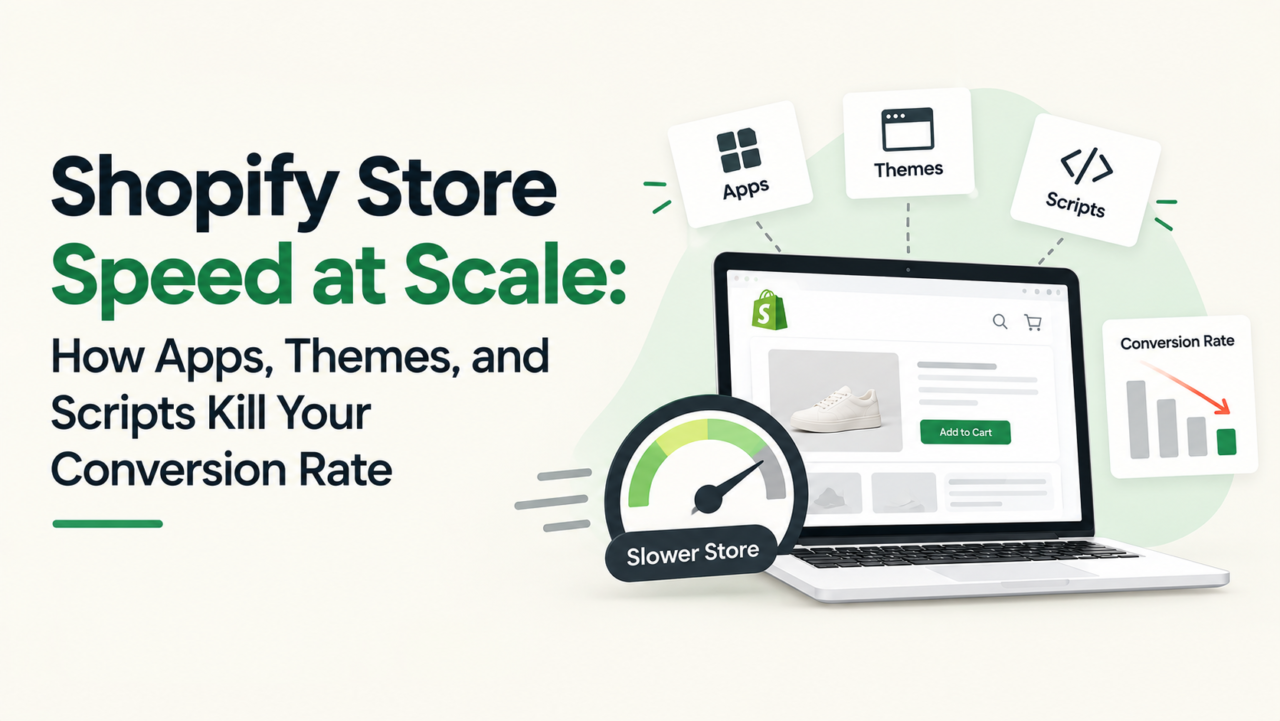
Here’s why they should. In 2026, Shopify studied its own stores. It found that for every 100 milliseconds slower a store loads, conversion tends to be about 3.5% lower (Shopify, 2026).
100 milliseconds is one tenth of a second. You can’t even blink that fast.
This guide shows you:
- What is slowing your Shopify store down
- How much it costs you, in real dollars
- How to find the exact app that’s hurting you (a 5 minute test)
- Who should own speed so it stays fixed
No developer jargon. Just what a scaling brand needs to act this week.
Key Takeaways
- Every ~100ms of delay can cost Shopify stores about 3.5% in conversion rate.
- Apps that load sitewide, heavy themes, and stacked tracking scripts are the usual culprits.
- Run a five-minute app weight test in Chrome DevTools before you cut or keep any app.
- Assign one owner for Shopify store speed so new scripts cannot sneak in unchecked.
- Judge each app by revenue lift versus load cost—not by PageSpeed vanity scores alone.
The Short Answer
Most Shopify stores don’t get slow in one day. They get slow one app at a time.
The three biggest causes are:
- Apps that load code on every page, even pages that don’t use them
- Heavy themes packed with sliders, videos, and effects
- Tracking scripts from ads, analytics, heatmaps, and pop ups
The fix is not “delete everything.” The fix is to measure what each script costs, keep what earns money, and give one person ownership of speed.
Speed Is a Revenue Problem, Not a Tech Score
Most brands check their PageSpeed score. They see 42 out of 100. They panic, or they ignore it.
Both are wrong. That score is a lab test on a fake phone. It is not your customers.
What matters is what real shoppers feel on real phones. Google measures that with three numbers called Core Web Vitals (web.dev):
| Metric | What it means | Good score |
|---|---|---|
| LCP (Largest Contentful Paint) | How fast the main image or text shows up | Under 2.5 seconds |
| INP (Interaction to Next Paint) | How fast the page reacts when someone taps “Add to cart” | Under 200 milliseconds |
| CLS (Cumulative Layout Shift) | How much the page jumps around while loading | Under 0.1 |
Shopify shows these for your real visitors in the Web Performance dashboard inside your admin (Shopify Help Center).
Operator tip: Stop reporting the lab score in meetings. Report mobile LCP and INP on product pages. That’s where money is made or lost.
What the data says
- Shopify (2026): Across actively selling Shopify stores, every 100ms slower LCP went with about 3.5% lower conversion. Every 32ms slower INP went with about 1.5% lower conversion. Stores with a 2.5 second LCP saw roughly 30% lower conversion than stores at 1.5 seconds (Shopify).
- Deloitte and Google: Across 37 brands and 30 million+ mobile sessions, a 0.1 second speed gain was linked to 8.4% more retail conversions and 9.2% higher order value (web.dev).
- Rakuten 24: In a true A/B test where only speed changed, the faster page earned 53.37% more revenue per visitor (web.dev).
Two honest notes.
- Shopify and Deloitte both show a strong link, not a guarantee. Shopify says so itself. Treat these numbers as a direction, then test on your own store.
- INP matters as much as load time. Most speed guides only talk about load time. But a slow “Add to cart” button costs sales even after the page has loaded. Heavy app code is the usual cause.
A stat you’ll see quoted wrong
Some top ranking guides say “a 1 second delay drops conversions by 7%” and credit Google and Deloitte. That’s not what the source says.
The 7% number comes from Akamai’s 2017 retail report. And it was about a 100 millisecond delay, not a full second (Akamai via PR Newswire). It’s also nine years old. Use Shopify’s 2026 data instead. It’s newer and built on Shopify stores.
What It Costs You: Real Math
Let’s use a typical scaling brand.
- 200,000 sessions per month
- 2.0% conversion rate
- $100 average order value
That’s 4,000 orders and $400,000 per month.
Now say you cut 100ms off mobile LCP. Using Shopify’s 2026 link (about 3.5%), conversion could move from 2.0% to about 2.07%.
- New orders: 200,000 x 2.07% = 4,140
- Extra orders: 140 per month
- Extra revenue: 140 x $100 = $14,000 per month
- Over a year: $168,000
Same traffic. Same ad spend. No new campaigns. No discounts.
Now flip it. Every app you added this year that slowed LCP by 100ms may be costing you that much. You just can’t see it on any dashboard.
Want a safer number? Use half the lift. That’s still $84,000 a year for a tenth of a second.
The 3 Silent Speed Killers
1. Apps that load everywhere
Here’s the trap. Many apps add a script that runs on every page. Your size chart app loads on the homepage. Your reviews widget loads on the cart page. Your quiz loads on the blog.
Not every app is equal. Here’s what we typically see:
| App type | Why it’s heavy | Lighter way to run it |
|---|---|---|
| Live chat | Big script loads on page open, even if nobody chats | Load it only after a tap on a chat button, or only on help and product pages |
| Reviews and UGC galleries | Photos, carousels, and code on every page | Show the star rating fast. Load full reviews lower on the page |
| Pop ups and spin to win | Runs on every page, often right away | Delay until scroll or exit intent. Turn off on checkout paths |
| Personalization and “you may also like” | Calls an outside server before showing products | Load below the fold, after the main content |
| Heatmaps and session recording | Watches every click and scroll | Record a sample of sessions, not all. Turn off when you’re not studying the data |
| Countdown timers and badges | Small, but often load on every page and shift layout | Only show on pages with a real offer. Reserve space so the page doesn’t jump |
| Currency and translation tools | Rewrite the page after it loads | Use Shopify Markets where possible |
Correction to a common myth. You’ll read that “Shopify recommends under 20 apps.” We couldn’t find that rule in any official Shopify document. Shopify’s own 2026 speed guide says to audit your apps but gives no number (Shopify).
App count is a weak signal. One heavy app can hurt more than ten light ones. Measure weight, not count.
2. Themes built for demos, not sales
Theme demos look amazing. They’re made to sell the theme, not your product.
Watch for:
- Big autoplay video in the hero
- Image sliders with 5+ slides (most shoppers only see slide 1)
- Many custom fonts and font weights
- Heavy animation and parallax effects
- Old themes that are not Online Store 2.0
What to do instead: One strong hero image. One or two fonts. Let the product do the talking.
3. Tracking and marketing scripts
Every growth tool wants a script on your store. Meta pixel, Google tags, TikTok pixel, heatmaps, affiliate tracking, A/B testing tools.
Each one is small. Together they fight for the phone’s attention while your shopper waits.
Watch out for doubles. We often see two tools doing the same job. Two heatmap tools. A pixel added in the theme and again through an app. That’s pure waste.
The move most guides miss: Many guides still say “put everything in Google Tag Manager.” But GTM itself can get heavy, and it runs on the main page.
Shopify’s Customer Events lets you add custom pixels that run in a sandbox, separate from your theme (Shopify Help Center). Moving tracking there keeps it out of your theme code. Test each pixel after moving it, since sandboxed pixels can behave differently.
The 5 Minute App Weight Test
Want to know exactly how much one app costs you? Pair this with a full Shopify app stack keep-or-cut review. You don’t need a developer. You need Chrome.
- Open a product page in Chrome. Press F12 to open DevTools.
- Go to the Network tab and reload. Find a script from the app you want to test (look for the app’s name in the file address).
- Right click it and choose “Block request domain” (Chrome DevTools docs). This turns the app off for you only. Shoppers see nothing.
- Run a Lighthouse test (in DevTools) with the app blocked. Then unblock it and run it again. Do each 3 times on mobile mode and take the middle result.
- Write down the difference in LCP and Total Blocking Time. That’s the app’s speed cost.
Now put it next to what the app earns. If an app adds 300ms and drives 2% of revenue, that’s a real conversation. If it adds 300ms and drives nothing, it’s gone.
Tip: Lab tests jump around. A difference under 100ms may just be noise. Look for big, repeatable gaps.
How to Find Ghost Code From Old Apps
When you uninstall an app, its code can stay in your theme. Older apps often wrote code straight into theme files. Newer apps built with Shopify’s theme app extensions don’t edit your theme code at all (Shopify.dev), so there’s much less to clean up.
Here’s how to check:
- Duplicate your live theme first. Always work on the copy.
- Go to Online Store, Themes, Edit code.
- Open theme.liquid. Look for script tags or
{% render %}lines with the names of apps you removed. - Check the Snippets folder for files named after old apps.
- Check App embeds in the theme editor. Turn off any that belong to removed apps.
- Remove one thing at a time, preview the store, and test checkout.
If you’re not sure what a line does, ask the app developer. Shopify also says you may need their help to fully remove old code.
Why It Gets Worse as You Scale
As order volume rises, every extra script taxes checkout. Brands planning a platform jump should also review the Shopify Plus migration checklist so speed work is not undone by a messy upgrade.
Speed problems are really ownership problems.
Here’s the usual story:
- Marketing adds a pop up for a launch.
- CX adds a chat widget.
- The agency adds a tracking script for a test.
- A freelancer edits the theme for Black Friday.
- Nobody removes anything.
Every change made sense alone. Together, they built a slow store.
No one owns the whole page. So no one says no.
That’s the real issue. Not the tools. The lack of a system.
The TRIM Framework: Fix Speed Without Losing Sales
Use this 4 step system. It works whether you have one developer or none.
T: Track the right numbers
Before you touch anything, set your baseline.
- Mobile LCP and INP on your top 3 product pages
- Conversion rate and revenue per session (last 2 to 4 weeks)
- Mobile add to cart rate
R: Rank every script by cost vs. value
List every app and script. Run the App Weight Test on the biggest ones. Then sort them:
| Earns money | Earns nothing | |
|---|---|---|
| Light | Keep it | Remove it anyway. Small leaks add up |
| Heavy | Keep it, but load it only where needed | Remove it today |
I: Isolate and fix
- Remove dead apps, then clean leftover theme code
- Load chat, reviews, and pop ups only on pages that need them
- Delay non critical scripts until after the page loads
- Move tracking pixels into Customer Events where you can
- Compress images and serve them at the right size
- Swap hero video for a still image on mobile
- Cut fonts down to one or two
Always test on a duplicate theme first. Then publish.
M: Maintain with one owner and a speed budget
This is the step everyone skips. It’s why stores get slow again within months.
Set a speed budget. It’s a simple rule the whole team follows. For example:
- Mobile LCP on product pages stays under 2.5 seconds
- Mobile INP stays under 200ms
- No new app can add more than 100ms to product page LCP
Then set the rules:
- One named owner for store speed (not “the team”)
- No new app or script goes live without the App Weight Test
- Monthly speed review next to your conversion report
- Quarterly app audit: remove anything not earning its place
A budget turns “is this app worth it?” from an argument into a yes or no.
When NOT to Chase Speed
Speed is a tool for revenue. It’s not the goal.
Don’t:
- Rip out apps that sell. A store with no reviews or upsells may load fast and still make less money.
- Chase a 100/100 score. Once you pass Core Web Vitals, the gains shrink. Shopify says nearly 80% of its stores already pass (Shopify).
- Judge by one test. Lab scores change every run. Watch real user data over weeks.
- Change everything at once. You won’t know what helped. Fix, measure, then fix again.
Your Speed Toolkit
| Tool | What it’s for | Cost |
|---|---|---|
| Shopify Web Performance dashboard | Real visitor LCP, INP, CLS | Free, in admin |
| PageSpeed Insights | Real user data plus a lab test for one page | Free |
| Google Search Console | Core Web Vitals report across your whole site | Free |
| Chrome DevTools | App Weight Test, blocking scripts, Lighthouse | Free |
| WebPageTest | Step by step load view on real devices | Free tier |
| GTmetrix | Waterfall chart of every file that loads | Free tier |
| Theme code editor | Finding ghost code | Free, in admin |
You don’t need a paid speed app to start. Most of the wins come from removing, delaying, and cleaning.
Who Should Own Store Speed?
Here’s the honest breakdown.
Option 1: Your agency
- Good for one time fixes
- Often not in the loop when marketing adds new tools
- Usually billed per task, so nobody watches daily
Option 2: A freelancer
- Cheap and fast for a cleanup
- Leaves when the project ends
- Speed slowly slips back
Option 3: A dedicated team member who owns it
- Runs the App Weight Test before any new app goes live
- Tracks speed next to revenue every month
- Has the authority to say “not this one”
For brands spending real money on ads, option 3 is the one that sticks. Speed isn’t a project. It’s a habit. Habits need an owner.
That’s how AcquireX works. We build dedicated offshore ecommerce teams that sit inside your business and own execution, including store health, conversion work, and the performance marketing that depends on a fast store.
[EDITOR NOTE, REMOVE BEFORE PUBLISHING: Add 2 to 3 anonymized AcquireX before/after audits here (store type, apps removed, LCP and INP before and after, conversion change). This is the single biggest ranking upgrade available. Do not publish invented numbers.]
Your 7 Day Speed Action Plan
- Day 1: Check the Web Performance dashboard. Write down mobile LCP and INP.
- Day 2: List every installed app. Note what each one does and earns.
- Day 3: Run the App Weight Test on your 5 biggest apps.
- Day 4: Uninstall apps you don’t use. Hunt for ghost code on a duplicate theme.
- Day 5: Move tracking pixels to Customer Events where you can. Remove doubles.
- Day 6: Compress hero and product images. Replace mobile hero video.
- Day 7: Name one speed owner. Write your speed budget. Book the monthly review.
Frequently Asked Questions
Do Shopify apps slow down my store?
Yes, many do. Apps often add code that loads on every page, even pages that don’t use the app. Removing unused apps and cleaning leftover theme code is one of the fastest ways to speed up a Shopify store.
How much does site speed affect conversion rate on Shopify?
Shopify’s 2026 study found that every 100 milliseconds slower a store loads, conversion tends to be about 3.5% lower. This is a strong link, not a guarantee, so test the impact on your own store.
What is a good speed for a Shopify store?
Aim for Google’s “good” Core Web Vitals on mobile: LCP under 2.5 seconds, INP under 200 milliseconds, and CLS under 0.1. These real user numbers matter more than your PageSpeed score.
How do I find which app is slowing down my Shopify store?
Open a product page in Chrome DevTools, block one app’s scripts in the Network tab, and run Lighthouse with and without it. The difference in LCP and Total Blocking Time is that app’s speed cost.
Will uninstalling an app remove its code?
Not always. Apps built with Shopify theme app extensions don’t edit your theme code, so there is little to clean up. Older apps may leave code in theme.liquid or the Snippets folder, so check your theme after every uninstall.
How many apps is too many on Shopify?
There is no official number. One heavy app can slow your store more than ten light ones. Judge each app by how much it slows the page and how much revenue it brings in.
Who should be responsible for Shopify store speed?
One named person who checks every new app and script before it goes live and reviews speed with revenue each month. Without a clear owner, stores usually slow down again within a few months.
The Bottom Line
A slow store is a tax on every ad dollar you spend—especially when you scale performance marketing for ecommerce.
You don’t need a perfect score. You need:
- Real numbers, tracked monthly
- Every app earning its place
- A speed budget everyone follows
- One person who owns the page
Stop patching speed every Black Friday. Build a system that keeps it fixed.
Ready to stop managing vendors and start scaling? Talk to AcquireX about a dedicated team that owns your store’s execution, from speed to conversion to growth.