Key takeaways: Ecommerce outsourcing means handing defined parts of your online store operations, such as marketplaces, catalog, customer service, ads or supply chain, to an external team. It makes sense once repeatable work slows growth. For ongoing operations, a dedicated offshore team usually beats agencies on cost, context and accountability.
Most ecommerce brands do not stall because demand dries up. They stall because the founder and a small core team end up doing everything: uploading listings at midnight, answering “where is my order” tickets, fixing a broken feed, chasing a supplier, and somehow still trying to plan next quarter’s growth. Ecommerce outsourcing is how growing brands break that ceiling without carrying the cost and hiring risk of a large in-house team.
This guide is written for the person who has to make the call. It covers what ecommerce outsourcing is, when it makes sense, exactly which functions to outsource (and which to keep), how in-house, agency and dedicated offshore models compare, how the costs really work, how to manage an offshore team day to day, which KPIs to put in the contract, and how to choose a partner without getting burned.
What is ecommerce outsourcing?
Ecommerce outsourcing is the practice of delegating some or all of an online store’s operational functions to an external provider instead of hiring and managing every role internally. Typical scopes include marketplace management, catalog and listing work, customer service, performance marketing, supply chain coordination, procurement, design and back-office tasks.
Not all outsourcing is the same, and the model you pick matters more than the vendor’s sales deck. There are four common models:
- Freelancers: individuals paid per task or per hour. Good for one-off projects, weak for anything that needs continuity.
- Agencies: a shared team serves many clients on a retainer. Good for specialist sprints, weaker on brand context because staff are spread across accounts.
- Task-based BPO: a provider processes volume (tickets, orders, data entry) to a script. Efficient for rules-based work, rarely owns outcomes.
- Dedicated offshore team: named specialists who work only on your brand, inside your tools, under your priorities, while the partner handles hiring, HR, training, infrastructure and quality control.
Definition: dedicated ecommerce team. A dedicated ecommerce team is a group of full-time specialists employed and managed by an outsourcing partner but assigned exclusively to one brand. They learn the brand’s products, customers and numbers, and they own a function end to end rather than completing isolated tasks.
That last distinction, owning a function versus completing tasks, is the single most important idea in this guide. It is the difference between a partner that waits for instructions and one that reports, “Your Amazon account health dipped, here is why, and here is what we already fixed.” For a deeper look at how the classic BPO model fits into this picture, see our breakdown of how BPO process outsourcing powers ecommerce growth.
When should an ecommerce brand outsource?
The right time to outsource is when repeatable operational work is consuming the hours your core team should spend on growth, and when you can describe that work clearly enough for someone else to own it. Waiting until everything is on fire makes the transition harder, not easier.
The 7 signals that it is time
- The founder is still doing operations. If the person who should be setting strategy is uploading products or answering tickets, the business is paying senior rates for junior work.
- Backlogs never clear. Listings wait weeks to go live, catalog errors pile up, and promotions launch late.
- Response times slip at peaks. Customer service quality drops every sale, holiday or launch.
- You are expanding channels. Adding Amazon, Walmart, Flipkart or a new region multiplies operational load faster than headcount.
- Hiring is slow or keeps failing. Roles stay open for months, or new hires leave before they become productive.
- Agency costs keep creeping. Change orders and “out of scope” requests make the retainer unpredictable.
- Nobody owns the numbers. Work gets done, but no one is accountable for marketplace health, return rate or ROAS.
If three or more of these describe your business, outsourcing is worth a serious evaluation. We go deeper on each signal in 7 signs it is time to outsource your ecommerce operations.
When you should not outsource yet
- You have not found product-market fit and the process changes every week.
- Nobody internally can make decisions or answer questions for the outsourced team.
- You want to outsource a problem you do not understand (for example, “fix our profitability”) without any agreed definition of success.
What ecommerce functions can you outsource, and what should you keep in-house?
Use one simple test: outsource execution and keep direction. Work that is frequent, measurable and documentable is a strong outsourcing candidate. Decisions about brand, pricing strategy, product roadmap and P&L stay with you. A capable partner will execute inside those guardrails and give you data that improves the decisions.
The Judgment-Frequency Matrix
Plot each task on two axes: how often it happens and how much brand-specific judgment it needs.
- High frequency, low judgment (order processing, listing uploads, tier-1 tickets, data hygiene): outsource first. These are the fastest wins.
- High frequency, high judgment (campaign optimization, marketplace account health, escalated complaints): outsource to a dedicated team with clear decision rights. This is where dedicated teams outperform agencies, because context compounds.
- Low frequency, low judgment (one-off migrations, bulk photo edits): use a project or freelancer.
- Low frequency, high judgment (pricing strategy, new category launch, brand positioning): keep in-house, supported by partner data.
Function-by-function outsourcing guide
| Function | What the outsourced team owns | What you keep | KPIs to track |
|---|---|---|---|
| Marketplace management | Listings, account health, A+ content, inventory sync, promotions, case handling, sponsored ads execution | Channel strategy, pricing floors, assortment | Account health, Buy Box share, listing uptime, marketplace TACoS |
| Catalog management | Product uploads, attributes, taxonomy, SEO titles, image specs, feed errors, price and stock updates | Product data standards, launch priorities | Time-to-live, listing error rate, feed rejection rate |
| Customer service | Email, chat and social tickets, order issues, returns and refunds within policy, review responses | Return policy, tone of voice, high-value escalations | First response time, resolution time, CSAT, QA score |
| Performance marketing & growth | Campaign build, bid and budget management, creative testing cadence, reporting, feed and tracking hygiene | Budget envelope, brand guidelines, target MER or ROAS | ROAS/MER, CAC, conversion rate, testing velocity |
| Supply chain management | Reorder tracking, PO follow-up, 3PL coordination, stock reports, shipment exceptions | Inventory investment, safety-stock policy | Stockout rate, on-time inbound, inventory days |
| Procurement & sourcing | Supplier research, RFQs, sample coordination, cost comparisons, vendor documentation | Final supplier selection, contract signature | Landed cost per unit, lead time, supplier defect rate |
| Sales enablement & account growth | Wholesale and B2B pipeline support, account research, CRM hygiene, outreach, reorder follow-ups | Key-account relationships, commercial terms | Pipeline value, reorder rate, account revenue growth |
| Design & creative | Ad creatives, listing images, banners, email design, store refreshes | Brand identity, final creative approval | Turnaround time, creative win rate |
You do not need to outsource all of this at once. Most brands start with one or two functions that are clearly bottlenecked, prove the model, then expand. AcquireX’s full range of ecommerce outsourcing services is built for exactly that kind of staged expansion: one dedicated team that grows function by function.
In-house vs agency vs dedicated offshore team: which model is right?
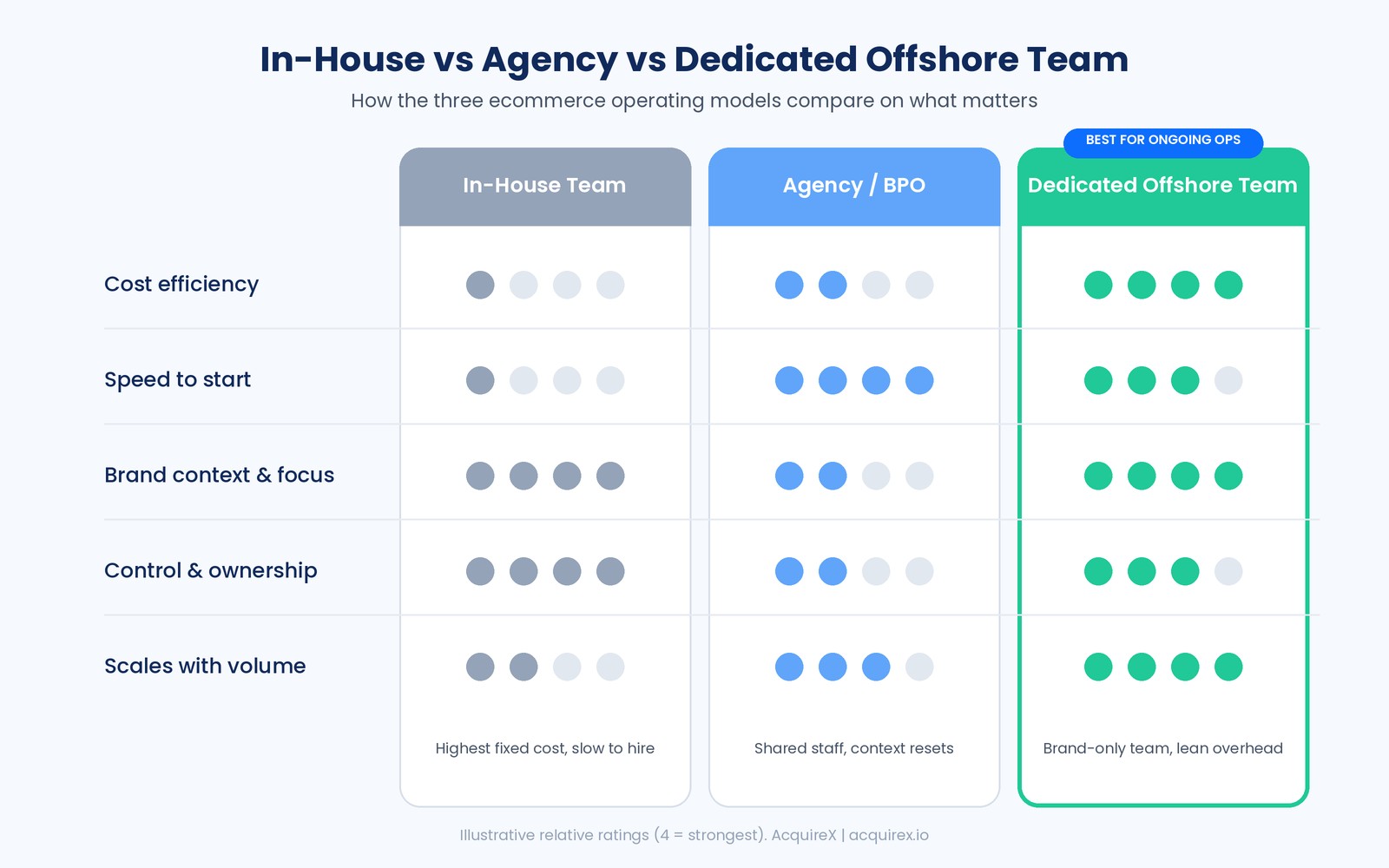
The short answer: build in-house for leadership and core strategy, use agencies for short specialist projects, and use a dedicated offshore team for ongoing operations that need both scale and brand context.
| Factor | In-house team | Agency | Dedicated offshore team |
|---|---|---|---|
| Cost structure | Highest fixed cost: salaries, benefits, office, tools, management | Retainer plus change orders; can be unpredictable | Predictable monthly fee per specialist; overhead carried by partner |
| Time to start | Slow: recruiting and ramp-up take months | Fast | Fast to moderate: weeks, depending on roles |
| Brand focus | Exclusive | Shared across many clients | Exclusive to your brand |
| Context retention | High, until people leave | Low: account staff rotate | High: same people, documented SOPs, partner-managed backups |
| Accountability | Direct | For deliverables, rarely outcomes | For function KPIs agreed in the SLA |
| Scaling up or down | Slow and costly | Easy, but quality varies | Add or remove specialists with notice |
| Best for | Leadership, strategy, P&L ownership | Replatforms, audits, one-off campaigns | Day-to-day ecommerce operations and growth execution |
A practical rule of thumb: if the work lasts less than about two months, hire a project resource; if it is ongoing, hire dedicated. We compare these models in more depth in dedicated ecommerce team vs agency: why ownership wins.
The hybrid model most scaling brands end up with
The most resilient structure for a growing brand is a small in-house core (founder or head of ecommerce, plus a brand or finance owner) directing a dedicated offshore team that runs operations, with specialist agencies brought in only for occasional sprints. This keeps strategy close and execution scalable. The same logic applies to revenue roles: many brands now extend their dedicated team into outsourced sales teams for wholesale and B2B growth.
How AcquireX does it: AcquireX builds your own experienced ecommerce team in Pune, India, that works only for your brand. The team owns marketplace management, catalog operations, customer service, performance marketing and more, end to end, inside ISO-certified processes. Book a call to map which functions to hand over first.
How much does ecommerce outsourcing cost?
Ecommerce outsourcing cost depends on the model, the functions in scope, seniority, coverage hours and how much management the partner provides. Comparing hourly rates alone is the most common mistake. Compare the fully loaded cost of output instead.
The four common pricing models
- Hourly: pay for time used. Flexible but hard to budget and gives the provider no incentive to be efficient.
- Per transaction: per ticket, per listing or per order. Works for high-volume, standardized work.
- Retainer: a fixed monthly fee for a defined scope. Common with agencies; watch for scope creep charges.
- Dedicated FTE: a fixed monthly fee per full-time specialist assigned only to you. The most predictable model for ongoing operations, and the one that aligns best with function ownership.
How to calculate the true cost of an in-house hire
When comparing a dedicated offshore specialist with a local hire, add up every line, not just salary:
- Base salary
- Payroll taxes, benefits and paid leave
- Recruiting cost and the months the seat sits empty
- Ramp-up time before the hire is fully productive
- Software seats, hardware and workspace
- Management time spent supervising, training and reviewing
- Replacement cost when the person leaves
In markets like the US, UK and Australia, these extras typically add a significant percentage on top of salary. A dedicated offshore team from a country like India can deliver experienced specialists at a substantially lower fully loaded cost, because the partner absorbs recruiting, HR, infrastructure and backup coverage. Our analysis of US labor costs and which ecommerce roles to offshore first walks through the role-by-role math.
Hidden costs to ask about before signing
- Onboarding or setup fees
- Charges for tools, licences or software seats
- Overtime, weekend or peak-season premiums
- Fees for QA, reporting or a team lead
- Minimum terms, notice periods and exit or transition fees
How do you transition to an outsourced ecommerce team? A 90-day plan
The transition is where most outsourcing relationships succeed or fail. A structured 90-day plan reduces risk and gets the team to full ownership quickly.
Days 1-30: Document and shadow
- Pick one or two functions with the clearest pain and the most measurable output.
- Record your current process: screen recordings, checklists and a list of every tool and login.
- Write a decision-rights list: what the team may do alone, what needs approval, and what is always escalated.
- Agree baseline metrics so improvement can be proven.
- The team shadows your current process, then reverse-shadows while you review their work.
Days 31-60: Own with review
- The team takes full ownership of the function, with daily review of exceptions.
- SOPs are rewritten by the team in their own words, which is the best proof that they understand the work.
- Weekly KPI reviews compare performance with the baseline.
Days 61-90: Optimize and expand
- Review cadence drops from daily to weekly.
- The team starts proposing improvements, not only executing.
- Decide on the next function to hand over based on results.
Strong, written SOPs make every step of this plan faster. Our guide to ecommerce SOPs for remote teams includes templates you can adapt.
How do you manage a dedicated offshore ecommerce team?
An offshore team should be managed like a part of your company, not like a vendor ticket queue. The brands that get the most from outsourcing invest a few hours a week in clear priorities and fast decisions.
A governance cadence that works
| Cadence | Purpose | Who attends |
|---|---|---|
| Daily (async) | End-of-day report: done, blocked, decisions needed | Team lead posts; brand owner reads |
| Weekly (30-45 min) | KPI review, priorities for next week, blockers | Brand owner, team lead |
| Monthly | Performance against SLA, process improvements, capacity planning | Brand leadership, partner account lead |
| Quarterly | Strategy alignment, new functions, roadmap | Founder or head of ecommerce, partner leadership |
Making time zones work for you
A team in India working while a US or European team sleeps can turn the time difference into an advantage: tickets answered overnight, listings updated before the morning, reports ready at the start of your day. The key is a short daily overlap window for live decisions and a written escalation rule for anything that cannot wait. We cover the three overlap models in detail in managing offshore teams across time zones.
Keep your tool stack lean
Every extra app is another login to share, another integration to maintain and another place for errors to hide. Before onboarding an outsourced team, run a Shopify app stack audit to cut redundant tools, so the team works in fewer, cleaner systems.
What KPIs and SLAs should be in an ecommerce outsourcing contract?
An SLA should define a measurable target for each outsourced function, how it is measured, who measures it, how often it is reported, and what happens when it is missed. A target without a measurement method is a promise, not a commitment.
- Customer service: first response time, resolution time, CSAT and an internal QA score.
- Catalog: turnaround time per batch, listing error rate and feed rejection rate.
- Marketplaces: account health metrics, case resolution time, listing uptime and stock sync accuracy.
- Performance marketing: ROAS or MER against target, CAC, testing cadence and reporting accuracy.
- Supply chain and procurement: stockout rate, inbound on-time rate and landed cost variance.
Also include three clauses that matter most when things go wrong: data ownership (your data, accounts and SOPs remain yours in exportable form), security obligations (access control, credential management, breach notification) and exit terms (notice period, handover support and data return).
What are the risks of ecommerce outsourcing, and how do you reduce them?
| Risk | What it looks like | How to reduce it |
|---|---|---|
| Quality drop | Listing errors, off-brand replies, missed tickets | Baseline metrics, QA sampling, written tone-of-voice guide |
| Loss of context | Team keeps asking the same questions | Dedicated (not shared) staff, SOP library, recorded walkthroughs |
| Data and account security | Shared passwords, unmanaged access | Role-based access, password manager, access logs, certified processes such as ISO standards |
| Marketplace account risk | Policy violations, suspensions | Team trained on marketplace policies, approval rules for risky actions |
| Attrition | Your best specialist leaves | Partner-provided backups, documented processes, retention practices |
| Vendor lock-in | Hard to leave or bring work in-house | Own all accounts and data, clear exit clause |
How do you choose the right ecommerce outsourcing partner?
Choose a partner on ecommerce depth, team exclusivity, process maturity and transparency, not on the lowest hourly rate. Score every candidate on the same criteria.
A weighted partner scorecard
- Ecommerce specialization (25%): proven work on your platforms and marketplaces, such as Shopify, Amazon, Walmart or regional marketplaces.
- Team model (20%): named, dedicated specialists versus a shared pool.
- Functional breadth (15%): can the same partner grow with you into marketing, supply chain or sales so you avoid juggling vendors?
- Process and security (15%): documented SOPs, QA, access controls and recognised certifications.
- Reporting and transparency (15%): clear dashboards, KPIs and direct access to the team.
- Commercial fairness (10%): predictable pricing, reasonable terms, a fair exit clause.
Questions to ask on the first call
- Will the people on my account work only for my brand?
- Who is my team lead, and how do you cover leave and attrition?
- Can I interview the specialists before they start?
- How do you handle access to my store, marketplaces and ad accounts?
- What does your first 30 days look like?
- Which KPIs will you commit to, and how are they reported?
Red flags
- Vague answers about who will actually do the work.
- Pricing that is far below market with no explanation.
- Reluctance to put KPIs or exit terms in writing.
- Requests to own or create your marketplace or ad accounts.
For a full evaluation checklist, read how to choose an ecommerce outsourcing partner.
How is AI changing ecommerce outsourcing?
AI tools now draft product descriptions, suggest ticket replies and summarize ad performance. That does not remove the need for an operations team; it shifts the value of outsourcing from raw labor to judgment, quality control and owning results. Ask every partner how they use AI and how they check its output before it reaches customers or listings.
A worked example: scaling a multichannel brand with a dedicated team
Consider an illustrative D2C home goods brand selling on Shopify and Amazon, with a founder, one marketer and one operations hire. Listings take weeks to go live, tickets pile up during sales, and the Amazon account receives repeated policy warnings.
- Month 1: a dedicated catalog and marketplace specialist takes over listings and account health, with a decision-rights list for pricing and promotions.
- Month 2: two customer service specialists cover email and chat overnight relative to the brand’s home market, so most tickets are handled before the core team starts work.
- Month 3: a performance marketing specialist joins to run creative testing and daily budget management, reporting to the in-house marketer.
The in-house team stops doing execution and starts directing it. The founder’s week moves from operations to product, partnerships and growth. That shift, not a single cost line, is the real return on ecommerce outsourcing.
Frequently asked questions about ecommerce outsourcing
What is ecommerce outsourcing?
Ecommerce outsourcing is delegating online store operations, such as marketplace management, catalog updates, customer service, performance marketing, supply chain and procurement, to an external provider. The provider supplies trained people and processes, while the brand keeps control of strategy, pricing and brand decisions.
Is ecommerce outsourcing worth it for small and mid-sized brands?
Yes, once repeatable work is slowing growth. Small and mid-sized brands often benefit most, because outsourcing gives them experienced specialists without the fixed cost, recruiting time and management load of building a full in-house team. Start with one bottlenecked function and expand when results are proven.
What should I outsource first?
Outsource high-frequency, measurable work first: catalog and listing updates, tier-1 customer service, order and marketplace operations. These deliver fast, visible wins. Keep brand strategy, pricing strategy and final product decisions in-house.
What is the difference between a dedicated offshore team and an agency?
A dedicated offshore team works only for your brand, inside your tools, and owns agreed KPIs. An agency shares its staff across many clients and usually delivers defined outputs. Dedicated teams build deeper brand context and suit ongoing operations; agencies suit short specialist projects.
How much does it cost to outsource ecommerce operations?
Cost depends on the pricing model (hourly, per transaction, retainer or dedicated FTE), functions in scope, seniority and coverage hours. Dedicated offshore specialists are usually priced as a predictable monthly fee and typically cost substantially less, fully loaded, than an equivalent hire in the US, UK or Australia.
How do I keep quality high with an outsourced team?
Set baseline metrics before handover, document SOPs, define decision rights, sample work for QA, and review KPIs weekly. Choose dedicated rather than shared staff so context builds over time, and put measurable SLAs and remedies in the contract.
Is it safe to give an outsourcing partner access to my store and marketplace accounts?
It can be, with the right controls. Use role-based user accounts instead of shared passwords, keep account ownership in your name, use a password manager, review access regularly, and choose a partner with documented security processes and recognised certifications such as ISO standards.
How long does it take to onboard an outsourced ecommerce team?
Most brands can have specialists working within a few weeks. Reaching full ownership of a function usually takes 60 to 90 days, moving from shadowing, to ownership with daily review, to independent operation with weekly reporting.
Ready to scale with your own dedicated ecommerce team?
Ecommerce outsourcing works best when it is not about handing off tasks, but about giving a function to people who own it. AcquireX builds experienced, dedicated teams in Pune, India, that work only for your brand and deliver your ecommerce operations end to end: marketplace management, catalog management, customer service, performance marketing and growth, supply chain, procurement and sourcing and sales enablement, all under ISO-certified processes.
Book a free strategy call with AcquireX and we will map which functions to outsource first, what your team should look like, and what success should look like in the first 90 days. You can also explore all AcquireX ecommerce services.