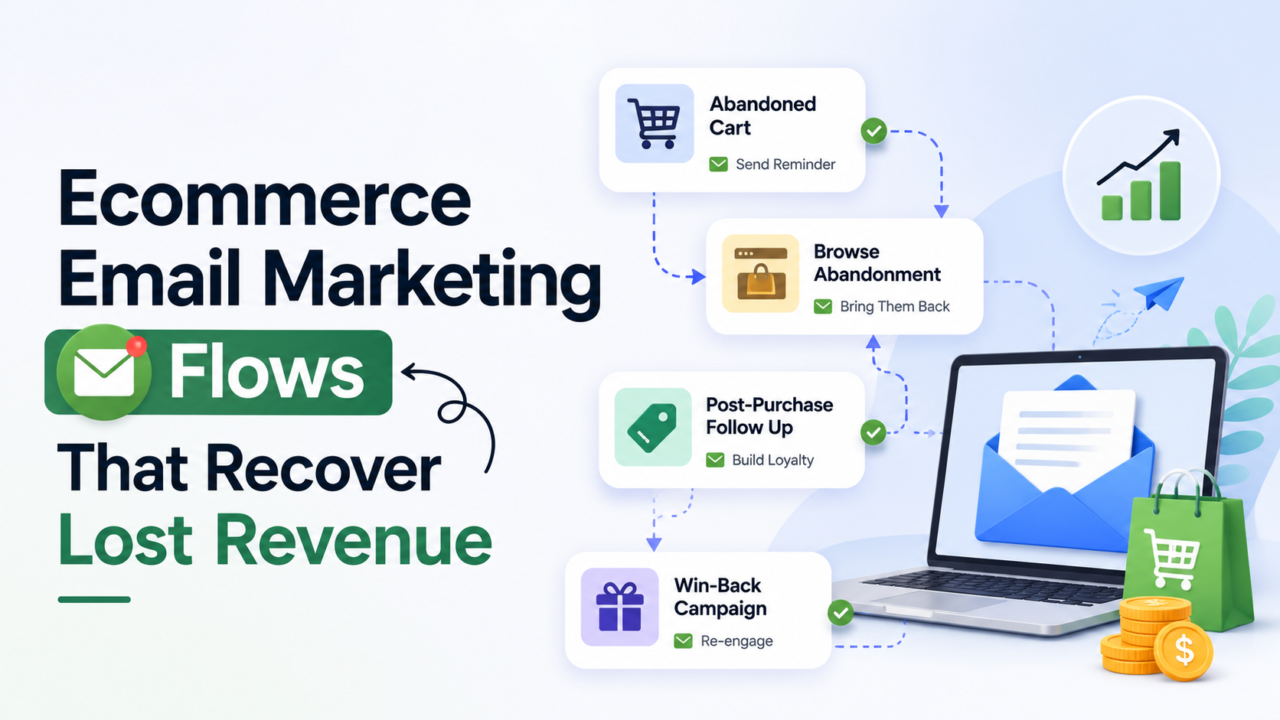
Quick Answer: Ecommerce email flows are automated email sequences that fire when a shopper does something, like joining your list, leaving a full cart, or getting an order shipped. They run on their own, day and night. The five flows that recover the most lost revenue are the welcome flow, the abandoned cart flow, the browse abandonment flow, the post purchase flow, and the win back flow. Klaviyo data from more than 183,000 brands shows automated flows drive about 41% of email revenue from just 5% of sends. Build them once and they keep earning.
Key Takeaways
- Flows beat one off campaigns. They send at the exact moment a shopper cares, so a small share of sends brings back a big share of revenue.
- Start with two flows: welcome and abandoned cart. Klaviyo names abandoned cart the top earning flow and welcome the second.
- About 70% of carts get abandoned (Baymard). No cart flow means that money just walks out the door.
- Use the CATCH method to build any flow: Catch the trigger, Act fast, Tell one story, Convert with a nudge, Hold the learning.
- Most brands do not need more flows. They need their few flows to actually be turned on, timed right, and tested.
You already paid to get people to your store, because ads, content, and deals all cost money. Then most of those shoppers leave without buying. That is not a traffic problem, it is a follow up problem.
Email flows are how you follow up without lifting a finger. A shopper adds a hoodie to their cart and then gets pulled away by a phone call. An hour later, an email reminds them, so they come back and buy. You did nothing, because the flow did the work.
This guide breaks down the five flows that bring back the most money. You get the goal of each one, how many emails to send, when to send them, and a simple build method you can copy today.
What Are Ecommerce Email Flows?
An email flow is a set of emails that sends by itself when a shopper takes an action. That action is called a trigger.
Think of it like a light with a motion sensor. Someone walks by, the light turns on. Someone joins your list, the welcome flow turns on.
Flows are not the same as campaigns. Here is the plain difference:
- Campaign: One email you write and blast to a big list at a set time. Good for sales and launches.
- Flow: A trigger based email that fires for one person at their moment. Good for revenue that repeats.
Campaigns need work every single time, since you write, design, and schedule each one. Flows do the work once and then run forever, which is why they matter so much.
Why Do Flows Recover More Revenue Than Campaigns?
The short answer is that timing beats volume.
A campaign hits everyone at 9am on a Tuesday whether they care or not. A flow hits one shopper the second their intent is highest, like right after they leave a full cart.
The numbers back this up. Klaviyo’s benchmark data from over 183,000 brands shows automated flows drive around 41% of email revenue while making up only about 5% of sends. That is a huge return for a small slice of your emails.
So if you have to pick where to spend your time, flows win. They compound. Every new subscriber and every new cart feeds them, and they never clock out.
Which Email Flows Recover the Most Lost Revenue?
There are five. We list them in the order most brands should build them, based on how much revenue they tend to bring back.
- Welcome flow. Turns a new subscriber into a first time buyer.
- Abandoned cart flow. Wins back shoppers who left a full cart.
- Browse abandonment flow. Nudges people who looked but never added to cart.
- Post purchase flow. Turns a first buyer into a repeat buyer.
- Win back flow. Revives customers who went quiet.
You do not need all five on day one. Two of them do most of the heavy lifting, and we cover the build order later.
Email Flow Cheat Sheet
Here is the whole system at a glance. The revenue per email column shows Klaviyo’s average across all brands, so it is a floor, not a ceiling. Top performers earn far more.
| Flow | Fires when | Emails | First send | Avg revenue per email |
|---|---|---|---|---|
| Welcome | Someone joins your list | 3 to 5 | Right away | $2.65 |
| Abandoned cart | A full cart is left at checkout | 3 | Within 1 hour | $3.65 (highest) |
| Browse abandonment | A product is viewed, not added | 1 to 2 | 2 to 4 hours later | $1.07 |
| Post purchase | An order is placed | 3 to 4 | Right away | $0.41 |
| Win back | A buyer goes quiet | 2 to 3 | After 60 to 120 days | Lowest of the five |
Revenue per email figures are Klaviyo benchmark averages. Your numbers depend on your traffic, offer, and average order value.
The CATCH Method: How to Build Any Flow
Every good flow follows the same five steps. Learn it once and you can build all five flows. We call it CATCH because these flows catch revenue before it falls through the cracks.
- C, Catch the trigger. Pick the one action that starts the flow. A signup. A left behind cart. A shipped order. One trigger per flow.
- A, Act fast. Send the first email while the shopper still cares. For carts, that means within an hour. Waiting a day loses sales.
- T, Tell one story. Give each email one job. Email one reminds. Email two answers doubts. Email three adds a nudge. Do not cram it all into one.
- C, Convert with a nudge. Give a clear reason to act now. That can be a review, a low stock note, or a small offer. A discount is not always needed.
- H, Hold the learning. Watch the results. Cut emails that flop. Keep what works. A flow is never finished.
Keep CATCH in your head as you read the five flows below. Each one is just CATCH applied to a different trigger.
Flow 1: The Welcome Flow (Turn New Subscribers Into First Buyers)
Someone joined your list, which means they already like you. This is the warmest they will ever be, so do not waste it with silence or a single email.
Trigger: A new email or SMS signup.
How many emails: 3 to 5.
Timing:
- Email 1: Right away. Say thank you and give the promised offer.
- Email 2: About a day later. Tell your brand story and why you exist.
- Email 3: Two to three days later. Show your best sellers with social proof.
- Emails 4 and 5: Optional. Answer common doubts and add a soft nudge.
Benchmark: Aim for 2% to 5% of new subscribers placing a first order. Klaviyo puts the average revenue per email for welcome flows at about $2.65, the second highest of any flow.
Subject line examples you can copy:
- Email 1: “Welcome. Here is your 10% off.”
- Email 2: “The story behind [brand]”
- Email 3: “Our most loved picks (see why)”
The one thing most brands miss: They stop at one welcome email. That leaves money on the table. A short series builds trust and moves people to buy far better than a lone hello.
Want new buyers to come back again? Pair this with our guide on how to turn first time buyers into repeat customers.
Flow 2: The Abandoned Cart Flow (Win Back Full Carts)
This is the big one. About 70% of carts get abandoned, per Baymard Institute, which is 7 in 10 shoppers who wanted to buy and did not. Klaviyo names this the highest earning flow of all.
Trigger: A shopper adds items and starts checkout but does not finish.
How many emails: 3.
Timing:
- Email 1: Within 1 hour. A simple reminder with the exact items they left.
- Email 2: About 24 hours later. Handle doubts. Show reviews, shipping info, or a return promise.
- Email 3: About 48 hours later. Add urgency. A low stock note or a small offer if your margins allow.
Benchmark: Klaviyo puts the average placed order rate for cart flows at 3.33%, with top performers near 7.69%. This flow earns the most of any flow, about $3.65 revenue per email on average.
Subject line examples you can copy:
- Email 1: “You left something behind”
- Email 2: “Still deciding? Here is what buyers say”
- Email 3: “Selling fast. Your cart is waiting.”
Watch out: A recovery email cannot fix a bad checkout. If people leave because of surprise shipping costs or a clunky mobile checkout, no email saves that sale. Fix the leak first. Our full guide shows you how to reduce your abandoned cart rate on web and mobile.
Flow 3: The Browse Abandonment Flow (Catch Window Shoppers)
Some people look at a product but never add it to their cart, yet they are still interested. This flow gives them a gentle push.
Trigger: A known shopper views a product page but does not add to cart.
How many emails: 1 to 2.
Timing:
- Email 1: A few hours after they browse. Show the product they viewed and one or two similar picks.
- Email 2: Optional, about a day later. Add a review or a helpful buying tip.
Benchmark: Browse flows convert lower than cart flows, around $1.07 revenue per email on average per Klaviyo. They scale on volume, so the small per email number still adds up.
Subject line examples you can copy:
- Email 1: “Still thinking about this one?”
- Email 2: “You might also like these”
Keep it light. This shopper is earlier in the journey than a cart abandoner. Do not push hard or lead with a discount. Be helpful, not pushy.
Flow 4: The Post Purchase Flow (Turn One Order Into Many)
The sale is not the finish line, it is the start of the next one. This flow builds loyalty and sets up the second order, which is far cheaper to earn than the first.
Trigger: A completed order.
How many emails: 3 to 4.
Timing:
- Email 1: Right after purchase. Confirm the order and set delivery expectations.
- Email 2: A few days later. Share tips on how to use the product.
- Email 3: After delivery. Ask for a review.
- Email 4: One to two weeks later. Suggest a matching product.
Benchmark: Judge this flow on repeat purchase rate, not one email. Its average revenue per email looks small, about $0.41 per Klaviyo, because the payoff shows up as second and third orders down the line.
Subject line examples you can copy:
- Email 1: “Order confirmed. Here is what happens next.”
- Email 2: “Get the most out of your [product]”
- Email 3: “How did we do? Leave a quick review”
- Email 4: “Goes great with your [product]”
The revenue lives in email 4. A smart cross sell here lifts your average order value over time. Learn the play in our guide on post purchase cross sell, and see how to ask for reviews after purchase the right way.
Flow 5: The Win Back Flow (Revive Sleeping Customers)
Some past buyers just stop. They are not gone, they are only quiet. This flow reminds them why they liked you in the first place.
Trigger: A customer goes a set time without buying, often 60 to 120 days based on your normal buying cycle.
How many emails: 2 to 3.
Timing:
- Email 1: We miss you. Show what is new since they last shopped.
- Email 2: A few days later. Share a top product or a fresh reason to return.
- Email 3: A few days later. A clear offer to bring them back.
Benchmark: Win back has the lowest revenue per email of the five core flows, since you are reaching people who already cooled off. Anything it brings back is bonus revenue you would not have earned otherwise.
Subject line examples you can copy:
- Email 1: “We miss you. Here is what is new.”
- Email 2: “Your favorites, back in the spotlight”
- Email 3: “A little something to welcome you back”
Expect lower engagement here. You are reaching people who already drifted. That is normal. Even a small win back rate is pure bonus revenue, since these customers had gone cold.
How Much Revenue Are Your Flows Leaving on the Table?
Let us put real numbers on it. These are example figures. Swap in your own.
Say your store looks like this:
- 2,000 shoppers abandon a cart each month.
- 1,000 new people join your email list each month.
- Your average order value is $60.
Without flows, both of those groups get nothing. You recover $0 from them.
Now add two flows.
Abandoned cart flow:
- 2,000 abandoners get the flow.
- A conservative 5% place an order. That is 100 orders.
- 100 orders times $60 = $6,000 per month.
Welcome flow:
- 1,000 new subscribers get the flow.
- A conservative 3% place a first order. That is 30 orders.
- 30 orders times $60 = $1,800 per month.
Add them up:
- $6,000 plus $1,800 = $7,800 per month.
- Times 12 = $93,600 per year.
That is money you were losing every month with no flows running. Two flows. Real math. And these are careful, low estimates. Klaviyo’s top performers convert far higher.
What Other Revenue Flows Should You Add Next?
The five above recover the most money for most stores. Once they run well, three more flows are worth adding, since each one catches revenue the core five miss.
- Checkout abandonment flow. This is not the same as the cart flow. It fires when a shopper starts checkout but does not finish. Their intent is higher than a cart abandoner, so a quick, firm reminder works well. Send the first email within 30 to 60 minutes.
- Back in stock flow. A shopper wanted a sold out item. When it returns, tell them fast. This flow reaches people with proven intent, so it converts high. Lead with “It is back” and a low stock note.
- Replenishment flow. Best for products people use up, like supplements, coffee, or skincare. Time an email to land right before they run out, with one click reorder. It turns a one time buy into a habit.
Treat these as layer two. Do not build them until the core five are live and earning.
What Order Should You Build Your Flows In?
Do not try to build all five at once, or you will burn out and ship none of them.
Follow this order:
- Week 1: Welcome flow and abandoned cart flow. These two alone can drive a large share of your total flow revenue.
- Week 2 to 3: Post purchase flow. Now you turn first buyers into repeat buyers.
- Month 2: Browse abandonment and win back. These fill the gaps once the big earners are live.
Ship the top earners first. Get them working. Then layer the rest.
What Are the Most Common Email Flow Mistakes?
Even good brands lose money to simple slip ups. Watch for these:
- One email where you need a series. A single welcome or a single cart reminder leaves most of the revenue behind.
- Sending too late. A cart email a full day later is far weaker than one within the hour.
- Leading with a discount every time. You train shoppers to wait for a coupon and you cut your own margin.
- Never testing. Flows are set and forget in the wrong way. Read the numbers and swap out weak emails.
- No plain text feel. Emails that look like a heavy ad get ignored. Simple and human wins.
When Flows Are an Ops Problem, Not a Copy Problem
Sometimes the writing is fine and the flows still underperform, which means the real issue sits deeper.
- Your Shopify data is not synced right, so flows fire on the wrong triggers.
- Nobody owns the email program, so it never gets tested or improved.
- Your team is stretched thin and email keeps slipping down the list.
This is where most growing brands get stuck. The strategy is clear. The execution is not.
A dedicated team fixes that. Instead of hiring, training, and managing a new email hire, you get an embedded team that owns the whole flow system end to end. They set up the triggers, write the emails, test the timing, and report the revenue. You focus on growth while they handle execution.
See how our performance marketing and growth team builds and runs retention systems, or read more on ecommerce marketing automation that scales without chaos.
Frequently Asked Questions
What are the best email flows for DTC brands?
The five flows that recover the most revenue are welcome, abandoned cart, browse abandonment, post purchase, and win back. For most DTC brands, welcome and abandoned cart bring back the largest share and should be built first.
How many emails should an abandoned cart flow have?
Three emails works well for most stores. Send the first within an hour, the second about a day later, and the third about two days later. Each one should have a single job: remind, reassure, then nudge.
What is the difference between a flow and a campaign?
A campaign is one email sent to a whole list at a set time, like a sale announcement. A flow is an automated email that fires for one person when they take an action, like leaving a cart. Flows run on their own and earn revenue around the clock.
Do I need Klaviyo to run email flows?
No. Klaviyo is popular for Shopify brands because it syncs store data well, but you can build flows in many email tools. The five flows and the CATCH method work no matter which platform you use.
How fast should I send an abandoned cart email?
Send the first cart email within one hour of the shopper leaving. Intent drops fast. A reminder sent a full day later recovers far fewer sales than one sent while the shopper still remembers your store.
Should every flow include a discount?
No. Discounts train shoppers to wait for a coupon and eat into your margin. Use reviews, low stock notes, product tips, and clear value first. Save offers for later emails in a flow, and only when your margins allow.
Ready to stop losing revenue you already paid to earn? Your flows are the cheapest growth you have. If they are not built, not timed right, or nobody owns them, that is revenue leaking every day. Talk to our team about building an email flow system that runs itself and reports its results.