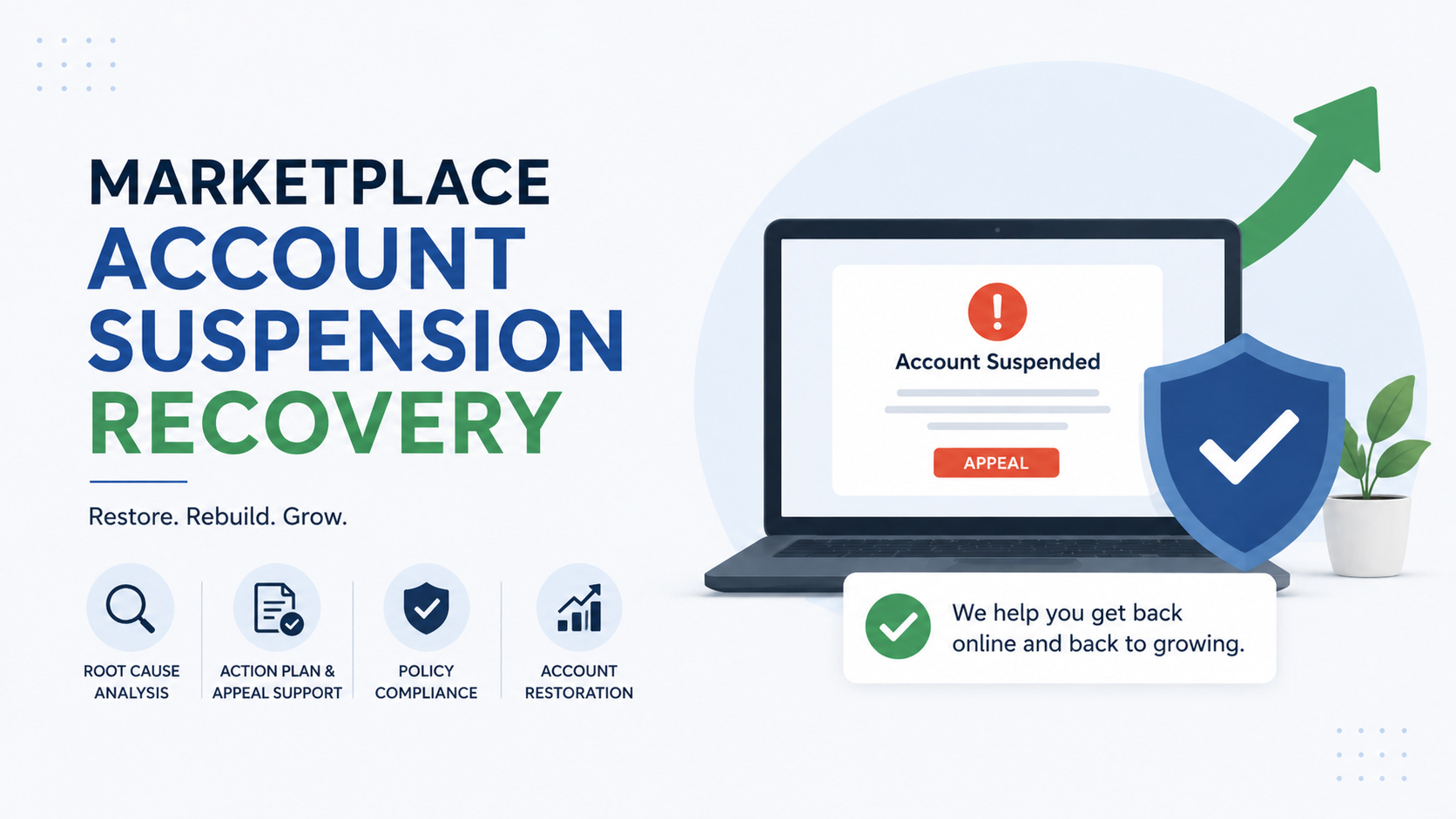
Marketplace account suspension recovery requires three steps: (1) identify the exact violation from your suspension notice, (2) write a 3-part Plan of Action covering Root Cause, Corrective Steps, and Prevention, and (3) submit through the official appeal channel. Most performance-based suspensions get reinstated within 7–14 days when the POA is precise. Amazon suspended 35% of sellers in 2024, and that number jumped 12% more in 2026.
Your Account Just Got Suspended. Now What?
You woke up to that email. Listings gone. Payouts frozen. Orders cancelled. Your team is panicking, and every hour costs you real money.
Here’s the truth most “experts” won’t tell you: most marketplace suspensions are 100% preventable, and 80% are recoverable — if you act fast and act right.
This guide is built from real data, real reinstatements, and the playbook we use at AcquireX to manage marketplace operations for ecommerce brands doing ₹50L–₹5Cr/month. No fluff. No theory. Just what works.
What Is a Marketplace Account Suspension?
A marketplace account suspension means the platform (Amazon, Walmart, Flipkart, eBay, etc.) has frozen your selling privileges. Three things happen instantly:
- Your listings disappear from search
- Your payouts get held (Amazon holds funds for 90 days)
- Your business stops earning until reinstated
There are four levels of marketplace enforcement you need to know:
| Level | What It Means | Recoverable? |
|---|---|---|
| Warning | Performance notification, no sales impact yet | ✅ Easy fix |
| Listing Suspension | Specific ASINs/products removed | ✅ Usually yes |
| Account Suspension | Full account deactivated, can appeal | ✅ With strong POA |
| Account Termination/Ban | Permanent closure, no appeal | ❌ Rarely |
🎯 Insider Insight: On Amazon, “deactivated” and “suspended” mean the same thing. “Closed” is different — it usually means appeals have been exhausted.
The Real 2026 Marketplace Suspension Stats (Why You Should Care)
The numbers are uglier than most sellers realize:
- 35% of Amazon sellers experienced a suspension in 2024 (SmartScout Voice of the Amazon Seller Report)
- Account suspensions increased by 12% in 2026 due to stricter AI-driven enforcement
- Mid-sized businesses ($100K–$1M revenue) report the highest suspension rates
- Amazon now has 9.7 million sellers worldwide competing under tighter rules
- Amazon’s AI-driven monitoring flags first, investigates later — your appeal often goes to algorithms before humans
- Walmart introduced a 2% Negative Feedback Rate cap in early 2026 — a brand new suspension trigger
💡 What this means for you: If you’re a mid-sized brand on Amazon, your statistical suspension risk is roughly 1 in 3 over a 12-month period. Without a system, it’s not a matter of “if” — it’s “when.”
Why Marketplaces Suspend Seller Accounts (Top 9 Real Causes in 2026)
Forget the generic lists you’ve seen. Here are the actual triggers we see hitting brands every week:
1. Performance Metrics Falling Below Threshold
Marketplaces track every move. The lethal limits:
| Metric | Amazon Limit | Walmart Limit |
|---|---|---|
| Order Defect Rate (ODR) | < 1% | < 2% |
| Late Shipment Rate (LSR) | < 4% | < 4% |
| Pre-Fulfillment Cancellation Rate | < 2.5% | < 2% |
| Valid Tracking Rate (VTR) | > 95% | > 99% |
| Negative Feedback Rate (NEW 2026) | — | < 2% |
2. Selling Counterfeit or Inauthentic Items
The fastest way to get banned. Even unintentional sourcing from unauthorized distributors can trigger this. In 2026, Amazon’s AI flags inauthenticity faster than ever.
3. Intellectual Property (IP) Complaints
Trademark, copyright, or patent complaints from brand owners. Pro-tip: Amazon Sellers Lawyer reports 240+ retraction wins in 2023–2025 by reaching out directly to brand owners — sometimes faster than appealing internally.
4. Related/Multiple Account Violations
This has been the #1 suspension cause since September 2021. Amazon tracks IP addresses, bank accounts, physical addresses, device fingerprints, and login patterns. Sharing any of these with another account (even accidentally) triggers it.
5. Review Manipulation
Even unintentional review violations get caught. Amazon’s algorithms flag patterns — review timing, sales-to-review ratios, customer communications, and product inserts. Many honest sellers get caught by third-party tools that violate Amazon’s terms without them knowing.
6. Restricted Product Listings
Selling supplements, electronics, medical devices, or any restricted category without proper approval = instant suspension.
7. Listing Policy Violations
- Prohibited claims in bullets (medical, unapproved certifications)
- Misleading product descriptions
- Wrong variation structures
- Manipulated category placement
8. Section 3 Violations (Code of Conduct)
The most serious tier — fraud allegations, deceptive practices, or business verification failures. Amazon Sellers Lawyer reports these now require video verification calls, and recovery often demands legal escalation.
9. Documentation & KYC Mismatches
Outdated business address. Bank account name doesn’t match registered business. New entity wasn’t reported. Any of these will get you flagged.
Suspension Types: Know What You’re Dealing With
Before you appeal, identify exactly which type of suspension you have:
1. Performance-Based Suspension
Triggered by metrics. Recoverable with a clear POA showing root cause + system fix. Recovery time: 7–14 days.
2. Inauthenticity / Counterfeit Suspension
Customer complaints or Amazon detection. Requires invoices from authorized distributors. Recovery time: 30–60 days.
3. IP Complaint Suspension
Brand owner filed against you. Best path: get the brand to retract. Recovery time: 7–10 days if retracted, 30+ days if contested.
4. Related Account Suspension
Amazon thinks you’re operating multiple accounts. Hardest to fix. Recovery time: 45–90 days, often denied.
5. Section 3 / Code of Conduct Suspension
The nuclear option. Requires legal documentation, often video verification. Recovery time: 60–120 days. Bring a lawyer.
Prevention: How to Suspension-Proof Your Marketplace Account
Recovery is hard. Prevention is cheap. Here’s the framework we deploy for AcquireX clients:
1. The Daily Compliance Layer
Pull these every single morning (yes, daily — not weekly):
- Account Health Dashboard score
- ODR, LSR, Cancellation rate
- Negative feedback (last 60 days)
- A-to-Z claims & chargebacks
- Policy violation alerts
- New IP complaints
🛠️ AcquireX Operator Tip: We assign one team member to own the Account Health Dashboard for every client account. They report daily in a 5-minute Slack message. That’s it. This single habit prevents 80% of preventable suspensions.
2. The Weekly Compliance Layer
- Review supplier documentation completeness
- Audit listing compliance (claims, certifications, restricted phrases)
- Check stockouts and inventory sync errors
- Monitor competitor IP filings (you can be hit by retroactive complaints)
- Review customer support response times
3. The Monthly Compliance Layer
- Full audit of customer feedback themes
- Refresh supplier authorization letters
- Quality control batch review
- Backup 3PL performance review
- Policy update review (Amazon updates 6–8x/year)
4. Build a “Compliance Folder” Before You Need It
Pre-build a folder with these documents — having them ready cuts appeal time in half:
- ✅ Supplier invoices (last 12 months)
- ✅ Brand authorization letters
- ✅ Quality control reports
- ✅ Business registration & GST/tax documents
- ✅ Customer support SOPs
- ✅ Returns and refund policy
- ✅ 3PL agreements
- ✅ Trademark registrations (if you own brands)
When suspension hits at 2 AM, you won’t have time to gather these. Build the folder when things are calm.
The Marketplace Account Suspension Recovery Playbook (Step-by-Step)
You got suspended. Don’t panic. Don’t email 10 times. Follow this exactly.
Step 1: Read the Suspension Notice Like a Lawyer
Identify the exact reason. Look for:
- Specific policy section cited
- ASINs or products mentioned
- Performance metric that failed
- Documentation requested
Don’t guess. Don’t assume. The reason determines the entire recovery strategy.
Step 2: STOP. Don’t Submit a Generic Appeal.
The biggest mistake: a panicked, emotional first appeal. Amazon’s review team rejects these instantly. Your first appeal is your strongest shot — make it count.
Step 3: Gather Your Evidence Stack
Before writing anything, collect:
- Supplier invoices matching the affected products
- Order screenshots showing the issue
- Any customer messages or photos
- Internal SOPs or process documentation
- Tracking data, delivery confirmations
Step 4: Write a Plan of Action (POA)
This is the document that gets you reinstated. See the next section for the exact framework.
Step 5: Submit Through the Right Channel
| Marketplace | Appeal Channel |
|---|---|
| Amazon | Seller Central → Account Health → Reactivate |
| Walmart | Seller Center → Performance → Submit Appeal |
| Flipkart | Seller Hub → Account Health → Raise Ticket |
| eBay | Resolution Center → Appeal |
Never email random support addresses. It hurts you.
Step 6: Wait. Don’t Spam.
Submitting 5 appeals in 3 days flags you as desperate and disorganized. Wait for a response. If rejected, wait 3–5 business days before resubmitting with refined details based on the rejection feedback.
Step 7: Escalate Smartly If Stuck
If 2–3 strong POAs fail, escalation paths:
- Amazon: managingdirector@amazon.com (last resort, rarely works)
- Amazon Section 3: Get a marketplace attorney
- Walmart: Partner Performance Team escalation
- Flipkart: Seller Support Plus + account manager
How to Write a Winning Plan of Action (The 3-Part Framework)
Based on analysis of 600+ successful reinstatements by Rosenbaum & Segall (2023–2025), here’s what actually works:
Part A: Root Cause (Be Brutally Specific)
❌ Bad: “We had some shipping issues last month.”
✅ Good: “On March 12, 2026, our 3PL warehouse in Mumbai shipped 47 orders late due to a 4-day staffing gap during the Holi holiday rush. This caused our Late Shipment Rate to spike from 2.1% to 6.3%, exceeding Amazon’s 4% threshold for category Health & Personal Care.”
Part B: Corrective Actions Already Completed (Past Tense Only)
❌ Bad: “We will hire more staff.”
✅ Good: “We have already (1) onboarded a backup 3PL partner with a 24-hour SLA, (2) increased buffer inventory by 20% across our top 50 SKUs, (3) implemented automated late-shipment alerts using ShipStation, and (4) hired two additional warehouse coordinators effective March 18, 2026.”
Part C: Long-Term Preventive Measures (Show You Built a System)
❌ Bad: “We’ll be more careful.”
✅ Good: “To prevent recurrence, we have established (1) daily SLA monitoring with red-yellow-green dashboards, (2) weekly performance reviews every Monday at 10 AM IST with all stakeholders, (3) a quarterly supplier audit framework, and (4) a compliance officer role with sole accountability for marketplace performance metrics.”
🎯 Pro Tip from 600+ Reinstatements: Amazon’s reviewers spend ~45 seconds on your POA. Use bullet points, bold key actions, and lead with concrete dates. Generic statements about “process improvements” signal you haven’t diagnosed the actual problem.
Real Recovery Timelines by Suspension Type
Based on actual 2025–2026 reinstatement data:
| Suspension Type | First Appeal Success Rate | Avg Recovery Time |
|---|---|---|
| Performance-related | 65% | 7–14 days |
| Listing policy violation | 55% | 14–21 days |
| IP complaint (with retraction) | 80% | 7–10 days |
| IP complaint (contested) | 35% | 30–45 days |
| Inauthenticity/Counterfeit | 40% | 30–60 days |
| Related account | 25% | 45–90 days |
| Section 3 (Code of Conduct) | 20% | 60–120 days |
Key insight: First appeal quality directly determines speed. A weak first POA can extend recovery by 2–3x because each rejection cycle adds 5–7 days.
Walmart, Flipkart & Multi-Marketplace Suspensions
Most guides only cover Amazon. Real ecommerce brands sell on multiple platforms. Here’s what’s different:
Walmart Marketplace (2026 Update)
Walmart introduced its strictest enforcement framework yet:
- Negative Feedback Rate cap: 2% (new in 2026)
- Three escalation levels: Suppression → Suspension → Termination (final, no appeal)
- Walmart Fulfilled Services (WFS) orders excluded from some metrics
- No fast-track appeals — reviewed in order received
📚 Read Walmart’s Performance Standards
Flipkart Marketplace (India)
- Account health tracked via Seller Hub
- Major triggers: Cancellation rate, RTO rate, customer rating < 4.0
- Appeal through Seller Support Plus (paid tier gets faster response)
- Smart Fulfilment SKUs treated separately
eBay & TikTok Shop
- eBay focuses heavily on Defect Rate and Late Dispatch
- TikTok Shop (2026) is the strictest new platform — counterfeit + IP enforcement is aggressive
- Both require pre-emptive brand registry enrollment
🚨 Multi-Marketplace Risk: A 2025 trend — suspension on one marketplace can trigger reviews on others if your business entity is the same. Build separate compliance systems per channel.
The 2026 Marketplace Compliance Checklist
Print this. Pin it to your team’s wall. Review monthly.
🔥 Immediate (This Week)
- [ ] Audit your Account Health Dashboard scores
- [ ] List every supplier and verify authorization status
- [ ] Build your “Compliance Folder” with documentation
- [ ] Assign one person to own daily metric monitoring
- [ ] Set up alerts for ODR, LSR, cancellation spikes
🟡 Short-Term (This Month)
- [ ] Document your customer support SOPs
- [ ] Establish a 24-hour complaint response policy
- [ ] Audit all listings for restricted claims
- [ ] Set up backup 3PL or fulfillment partner
- [ ] Subscribe to Amazon Seller Forums for policy updates
🟢 Long-Term (This Quarter)
- [ ] Build dedicated marketplace operations team (or partner with one)
- [ ] Implement quarterly compliance audits
- [ ] Set up Brand Registry on Amazon (if you own a brand)
- [ ] Develop Plan of Action templates by suspension type
- [ ] Create a marketplace policy update tracker
What Smart D2C Brands Do Differently
Every scaling brand we’ve worked with at AcquireX that runs cleanly on marketplaces does these three things:
- Treat marketplace operations as a dedicated function — not a side task for a junior team member
- Have someone (or a team) owning account health daily — not weekly, not when something breaks
- Build SOPs around compliance — not firefighting
This is exactly why we see brands hit ₹2–5Cr/month on Amazon while others get suspended at ₹30L. The difference isn’t luck. It’s systems.
The Cost of NOT Having a Compliance System
Real numbers from a brand we audited last quarter:
- 10 days suspended at ₹10L/day revenue = ₹1 Cr lost
- Held payouts during suspension = 6-week cash flow chaos
- Reinstatement consultant fees = ₹50K–₹3L
- Lost BSR rankings post-recovery = 3–6 months to rebuild
- Lost ad spend optimization = ₹15L wasted budget
- Team burnout & loss of focus = immeasurable
Total damage: ₹1.5–2 Cr from a single 10-day suspension.
The cost of prevention? A dedicated team handling compliance daily. The math is obvious.
Frequently Asked Questions
What is the most common cause of marketplace account suspension in 2026?
The most common cause is performance metrics failing thresholds — specifically Order Defect Rate above 1% and Late Shipment Rate above 4%. This is followed by inauthenticity claims, IP complaints, and related account violations.
Can I open a new Amazon account after suspension?
No. Opening a new account after suspension is treated as a “related account” violation and the new account will be suspended as soon as Amazon detects it (usually within days). Amazon tracks IP addresses, device fingerprints, bank accounts, and physical addresses. Always pursue reinstatement of your original account.
How long does Amazon hold my funds during suspension?
Amazon holds funds for a 90-day settlement period to cover potential customer refunds, chargebacks, and A-to-Z claims. After 90 days, you can request disbursement of remaining funds. If reinstated before 90 days, normal disbursement schedules resume.
Should I hire an Amazon suspension consultant or lawyer?
For performance-based suspensions, a strong internal team or marketplace operations partner can handle it. For Section 3 violations, IP complaints, or inauthenticity cases, hire a marketplace attorney — they can send pre-arbitration letters and brand retraction letters that consultants legally cannot.
How do I prevent IP complaints on Amazon?
Source only from authorized distributors, get brand authorization letters in writing, never piggyback on branded listings without rights, and enroll in Brand Registry if you own a brand. Always retain invoices for at least 12 months.
What happens if my Plan of Action is rejected?
Don’t resubmit the same POA. Read the rejection carefully — Amazon usually indicates what’s missing. Refine your POA with more specific evidence, additional documentation, and address each point Amazon raised. Wait 3–5 business days before resubmitting.
Can a marketplace suspension affect my other marketplaces?
Yes, in 2026. A suspension on Amazon can trigger reviews on Walmart, eBay, and TikTok Shop if your business entity, address, or banking is the same. Multi-marketplace sellers should build separate compliance systems per channel.
What’s the fastest way to get reinstated?
The fastest path: (1) submit a precise, evidence-backed first POA, (2) include all documentation upfront, (3) use Seller Central’s official appeal channel, and (4) avoid emotional language. Well-prepared appeals can be reinstated within 24–48 hours for performance issues.
Does video verification help my appeal?
For Section 3 cases and business verification suspensions, yes — video verification is now standard in 2026 and demonstrates legitimacy. For performance-based suspensions, video verification isn’t usually requested.
Are marketplace suspensions increasing in 2026?
Yes — significantly. Amazon suspensions increased by 12% in 2026 due to expanded AI monitoring. Walmart introduced a new Negative Feedback Rate cap. Section 3 enforcement is rising. Sellers report stricter, faster, less forgiving enforcement than ever.
Stop Firefighting. Build a System.
If you’re a scaling D2C or ecommerce brand doing ₹50L–₹5Cr/month, here’s the hard truth:
You can’t afford to lose your marketplace account. And you can’t afford to let one VA handle compliance on the side.
You need a dedicated team that:
- Monitors account health daily
- Responds to complaints within hours, not days
- Maintains compliance documentation proactively
- Handles POAs and appeals when issues arise
- Owns the outcome — not just the task
That’s exactly what we build at AcquireX. Not freelancers. Not an agency. A dedicated marketplace operations team embedded into your business — handling Amazon, Walmart, Flipkart, and beyond.
Stop managing vendors. Build a system. Focus on growth — we’ll handle execution.