Quick answer: The right marketplace is the one where your target buyers already shop, your product type is allowed, and the all-in fees still leave you a 25 to 30% profit margin. Use the 5-question filter below to choose in under 10 minutes. For mass-market products, that is usually Amazon or Walmart. For handmade or custom items, Etsy. For viral, video-friendly products, TikTok Shop. For brand control, your own Shopify store.
Pick the wrong marketplace and you can lose 30 to 50% of your margin before you ship a single order. Pick the right one and you scale faster with less cash burned on ads.
This guide gives you a clear decision framework, verified 2026 fee data from official sources, real profit math, and a 90-day testing playbook. Built for D2C founders, Shopify brands, and marketplace sellers doing $50K to $5M per month.
What Is an Online Marketplace?
An online marketplace is a website where many sellers offer products to one shared audience. Amazon, Walmart, Etsy, eBay, and TikTok Shop are the biggest examples. The platform brings the traffic. You bring the products. They take a cut of every sale.
You get fast exposure. You give up some margin, some control, and often the customer relationship.
Your own Shopify or WooCommerce store works the other way. You keep everything, but you must drive every visitor yourself.
Most successful brands do not pick one. They build a channel stack.
The 5-Question Framework to Choose Your Marketplace
Before comparing platforms, answer these five questions. Write the answers down. They are your filter.
- Who is my customer? Age, country, income, and where they already shop.
- What is my product? Handmade, mass-produced, vintage, B2B, digital, or impulse buy.
- What is my margin? If you cannot absorb 12 to 20% in fees, half the platforms are out.
- Do I want brand or volume? Both are valid. They lead to different platforms.
- Can I bring my own traffic? If yes, your own store wins. If no, you need a marketplace.
These five answers tell you 80% of the answer before you read another word.
Major Marketplaces Compared
Here is the head-to-head with numbers pulled from official seller terms, SEC filings, and recent earnings reports.
| Marketplace | Active Buyers / Traffic | Core Fees | Best For |
|---|---|---|---|
| Amazon | ~2.05 to 2.7B monthly visits (Similarweb, Semrush) | 8 to 17% referral + FBA | Mass-market goods, FBA sellers |
| Walmart | ~380 to 520M monthly visits | 5 to 20% referral, $0 monthly | US scale at lower fees |
| eBay | 135M active buyers (Q4 2025 official) | ~13.25% + $0.30 per order | Used, vintage, parts, collectibles |
| Etsy | 93.54M active buyers (Q4 2025 official) | 6.5% + 3% + $0.25 + $0.20 listing | Handmade, custom, personalized |
| TikTok Shop | 15M+ active sellers globally | ~6% commission (varies by category) | Beauty, fashion, viral products |
| Shopify (own store) | Your own audience | 2.4 to 2.9% + $0.30 per transaction | Brand builders |
Amazon
- Audience: Amazon.com drew 2.05 billion monthly visits in January 2026 (Semrush) and 2.7 billion in December 2025 (Similarweb, reflecting peak holiday season).
- Fees: Amazon referral fees range from 8% (Electronics, Computers) to 45% (Amazon Device Accessories), with most categories at 15%, and all rates are updated for 2026. Add $39.99 per month for the Professional plan, plus FBA fees if you use Amazon fulfillment.
- Best for: Mass-market products, sellers ready for FBA, brands that can handle high competition.
- Watch out: A 3.5% fuel and logistics surcharge on FBA fees took effect April 17, 2026. Build it into your margin math.
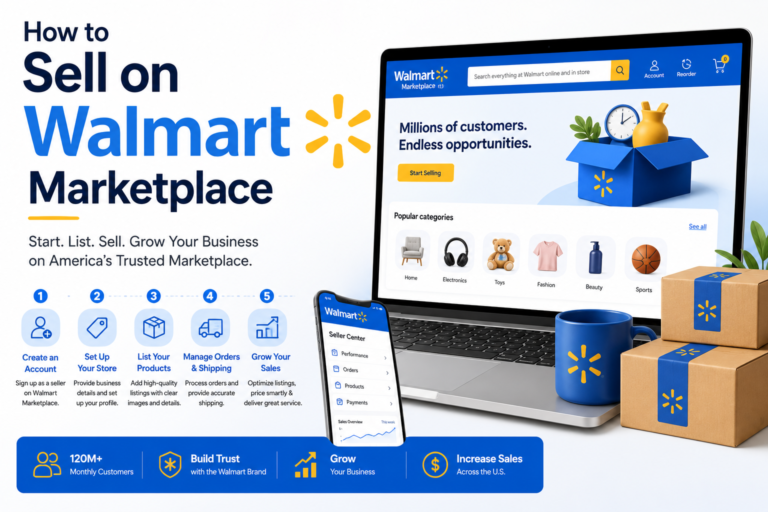
Walmart Marketplace
- Audience: Walmart.com receives roughly 380 to 520 million monthly visits depending on season (Similarweb data).
- Fees: Walmart charges no monthly subscription fees, no listing fees, and no item setup fees. You only pay referral fees of 5 to 20% per sale depending on category. Most categories sit at 15%, with electronics at 8%.
- Best for: Sellers tired of Amazon’s costs who still want US scale. Read our Walmart Marketplace vs Amazon comparison for the full breakdown.
- Watch out: Approval is selective. Not every seller gets in.
eBay
- Audience: At the end of 2025, eBay had 135 million active buyers and 2.5 billion live listings globally (eBay 10-K, FY2025).
- Fees: Most categories charge around 13.25% plus $0.30 per order. Rates vary by category and seller status.
- Best for: Used items, refurbished goods, collectibles, motors parts, electronics. eBay’s top 5 categories are Motors Parts & Accessories, Electronics, Collectibles, Home & Garden, and Fashion.
- Watch out: Buyer skews older. Not ideal for image-driven trendy brands.
Etsy
- Audience: Active buyers declined 2% year over year to 93.54 million (Q4 2025 official earnings, released Feb 19, 2026). Active sellers grew 7.7% to 8.76 million.
- Fees: A $0.20 listing fee per item sold, a 6.5% transaction fee on the total amount the buyer pays (including shipping), and a 3% + $0.25 payment processing fee for US sellers. Offsite Ads add 12 to 15% but only on ad-driven sales.
- Best for: Handmade, vintage, custom, personalized gifts. Around 33% of Etsy transactions involve personalized items.
- Watch out: Mass-produced products get flagged or removed.
TikTok Shop
- Audience: More than 15 million sellers are active on TikTok Shop globally in 2026. US TikTok Shop GMV grew over 200% year-over-year in 2024.
- Fees: TikTok Shop charges sellers a commission of about 6% on each order, with some categories varying slightly.
- Best for: Beauty & Personal Care is the highest-grossing category on TikTok Shop, generating $2.49 billion in GMV, more than 22% of total sales. Also fashion, gadgets, and impulse buys.
- Watch out: Needs constant short-form video or creator partnerships to actually move units.
Your Own Shopify Store
- Audience: Whoever you bring through ads, SEO, social, or email.
- Fees: Credit card processing fees for online transactions: 2.9% + $0.30 (Basic), 2.6% + $0.30 (Shopify), and 2.4% + $0.30 (Advanced). No marketplace commission on top.
- Best for: Brand builders who want full control of customer data, design, and offers. See our guide on scaling a Shopify brand from 7 to 8 figures.
- Watch out: Zero traffic comes free. Every visitor is paid for, earned, or referred.
Match Your Product to the Right Marketplace
If you only read one section, read this one.
- Handmade or custom items: Etsy
- Mass-market consumer goods: Amazon or Walmart
- Used, vintage, or collectible items: eBay
- Beauty, fashion, or viral gadgets: TikTok Shop plus your own store
- B2B or wholesale: Faire, Alibaba, or Amazon Business. See our B2B online marketplaces guide.
- Niche or hobby products: Specialty marketplaces like Reverb (music), Houzz (home), Poshmark (fashion)
- Full brand control: Your own Shopify store
The Profit Math No One Shows You
Take the same $50 product with a $15 cost of goods. Here is what you actually keep on each platform, using verified 2026 fee rates.
| Platform | Fee Calculation | Profit per $50 sale |
|---|---|---|
| Amazon | 15% referral ($7.50) + ~$5 FBA | $22.50 |
| eBay | 13.25% + $0.30 ($6.93) | $28.07 |
| Etsy | 6.5% ($3.25) + 3% + $0.25 ($1.75) + $0.20 listing | $29.80 |
| Walmart | 15% referral ($7.50), no FBA assumed | $27.50 |
| TikTok Shop | 6% commission ($3) | $32.00 (plus ad/creator costs) |
| Shopify (Basic) | 2.9% + $0.30 ($1.75) | $33.25 (you pay for traffic) |
That is up to $10.75 swing per order from platform choice alone. Multiply by 1,000 sales and that one decision is worth more than $10,000.
This is why scaling brands obsess over channel economics, not just total revenue.
How to Test a Marketplace Before Going All-In
Never bet the business on one platform. Test first.
- List 5 to 10 SKUs. Pick your best sellers from other channels or your top guesses.
- Run for 60 to 90 days. Marketplaces need time to index and rank your listings.
- Track 3 numbers: conversion rate, profit per order, and repeat buyer rate.
- Compare to your benchmark. If profit per order is below target, the channel leaks money.
- Scale or kill. No middle ground. If it works, push hard. If not, move on.
This is the same testing playbook our teams use across marketplace listing projects.
7 Red Flags That a Marketplace Is Wrong for You
Walk away if you see these signs.
- Your category has 20+ near-identical listings under $10 (you cannot win on price).
- The platform takes 20%+ of your sale and your margin is under 30%.
- Top competitors have quietly left the platform in the past year.
- You cannot name a single customer profile that matches your ideal buyer.
- The platform bans something core to your product (custom orders, supplements, certain electronics).
- Approval and setup take longer than your launch window.
- You have no way to drive external traffic or content to support your listings.
The Smart Move: Stack Channels, Do Not Pick One
Most growing brands do not pick one marketplace. They stack channels for compounding growth.
A proven playbook:
- Marketplace as discovery layer: Use Amazon, Walmart, or Etsy to find new customers fast.
- Own store as profit layer: Push repeat buyers to your Shopify site where you keep more margin.
- TikTok or Instagram as content layer: Use short-form video to feed both channels.
Marketplaces find the customer. Your own store keeps them. Content fuels both.
Brands relying on a single channel almost always plateau within 12 months. Diversified brands survive policy changes, ad cost spikes, and account suspensions.
The Operational Catch Most Founders Miss
Adding a marketplace is not just a sales decision. It is an operations decision.
Every new channel needs listings created and optimized for that platform’s algorithm, inventory synced across channels to prevent overselling, platform-specific advertising (Amazon PPC, Walmart Connect, TikTok creator partnerships), customer service handled inside each platform’s deadlines, and returns and disputes managed per platform rules.
Many founders run two marketplaces and burn out. The ones that scale either build a dedicated in-house team or partner with a team that lives inside their systems daily. That is the difference between scaling and just adding revenue you cannot keep up with.
Frequently Asked Questions
Which marketplace has the lowest fees in 2026?
Your own Shopify store with Shopify Payments has the lowest platform fees, starting at 2.9% + $0.30 per transaction on the Basic plan. Among true marketplaces, TikTok Shop is lowest at around 6% commission. Etsy is around 9.5% + $0.45 total. eBay is around 13.25%. Walmart and Amazon range from 5 to 20% by category, mostly 15%.
Can I sell on more than one marketplace at the same time?
Yes, and most growing brands do. Use inventory sync tools so you never oversell. The real risk is splitting focus too thin in the first 90 days. Start with one, prove the unit economics, then expand.
What is the fastest marketplace to start selling on?
Etsy and eBay let you list within an hour. Amazon and Walmart take days to weeks for approval. TikTok Shop needs an active content account and approval.
Is TikTok Shop worth it for new sellers?
Yes, if your product looks great in a 15-second video and your category is hot (beauty, fashion, gadgets). No, if your product needs long explanations, targets older buyers, or runs B2B sales cycles.
Should I leave Amazon if the fees feel too high?
Not without a plan. Test Walmart and your own Shopify store in parallel for 90 days. If they hit profitable numbers, shift inventory gradually. Never quit a working channel cold.
Do I need a brand to sell on Amazon?
Not to start, but registering your brand on Amazon (Brand Registry) gives you better listings, A+ content, copycat protection, and higher conversion rates. Most serious sellers register within their first 90 days. See our complete Amazon product listing optimization guide.
What is the best marketplace for a new D2C brand?
Start with your own Shopify store for brand control, then add one marketplace for discovery. Match the marketplace to your product: Amazon for mass-market, Etsy for handmade, TikTok Shop for trend-driven items.
How much money do I need to start on a marketplace?
Minimums vary widely. Etsy costs about $0.20 to list and a small payment processing fee. Amazon’s Professional plan is $39.99 per month plus referral and FBA fees. eBay has free listings for casual sellers. Walmart has no upfront fees but expects existing US operations. Budget at least $500 to $2,000 in initial inventory plus $200 to $500 for early advertising on any platform you take seriously.
Your Next Step
Stop researching. Pick one marketplace that matches your product, audience, and margin. List 10 SKUs this week. Run it for 90 days. Measure profit per order. Scale, fix, or kill based on the numbers.
If you are scaling past $50K to $5M per month and operational chaos is eating your time, the bottleneck is rarely the marketplace itself. It is who is running it. AcquireX builds dedicated offshore teams that run marketplace operations, listings, ads, and customer support as one system, so you can focus on growth instead of execution.
Talk to AcquireX about building your marketplace team. Stop managing vendors. Start owning your channels.