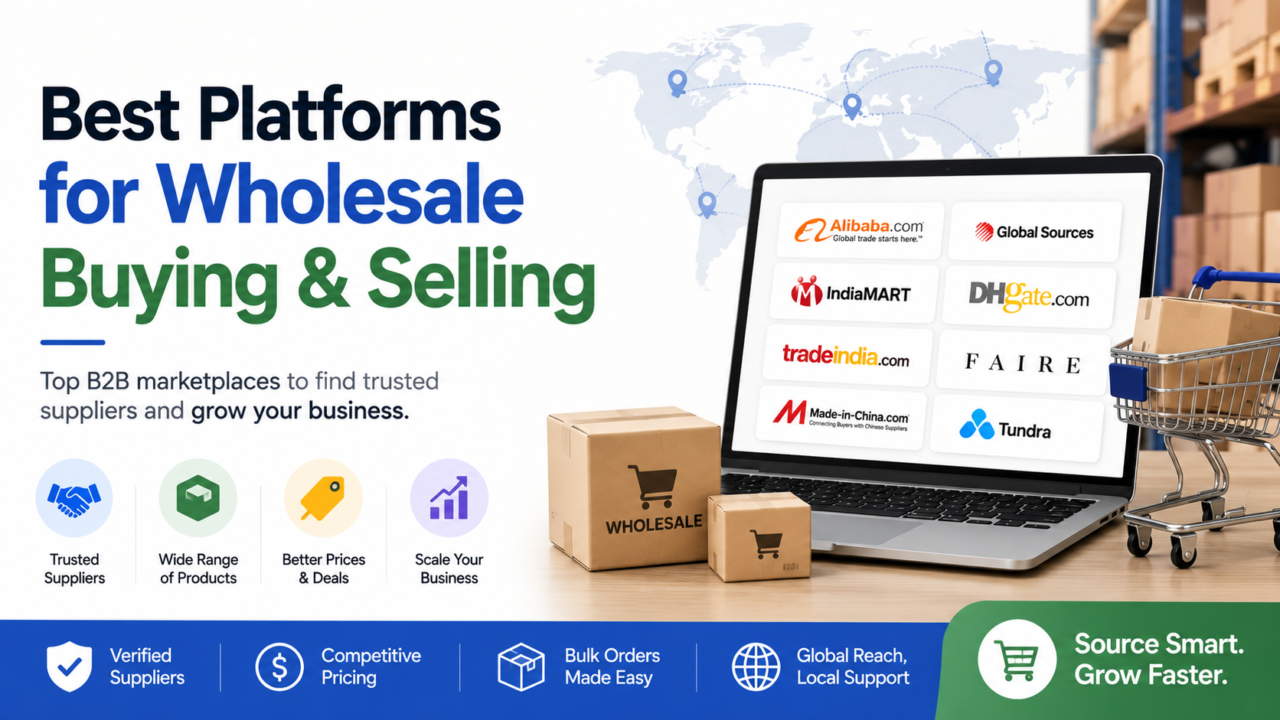
In 2026, the best B2B online marketplaces for a US small business depend on which side of the trade you are on and how much cash you can tie up.
- Buying, want low risk: Faire (Net-60 terms, low MOQs, domestic brands)
- Buying, want lowest unit cost: Alibaba (lowest price, but you carry freight, duty and tariff risk)
- Buying office and operating supplies: Amazon Business (fastest, tax exemption, approval workflows)
- Buying industrial parts in the US: Thomasnet (supplier directory, CAD files, custom manufacturing)
- Selling to independent US retailers: Faire, then Abound or Ankorstore
- Selling to enterprise procurement: Amazon Business, then Thomasnet
The number that decides it is not the list price. It is landed cost per unit multiplied by your realistic sell through rate. A $1.80 unit from Asia often costs more than a $4.10 unit from a domestic brand once you count freight, duty, tariffs and unsold inventory. The worked math is below.
Key Takeaways
- US B2B ecommerce reached $2.93 trillion in 2025, growing 13% while total US B2B sales grew only 0.4% . The channel is shifting, not the market.
- US B2B marketplace sales rose 519% between 2021 and 2024.
- Marketplace commission is charged on your reorders, not just your first sale. On a repeat buyer, that is the number that decides your margin.
- Low MOQ is worth more than low unit price for any business under roughly $2M in annual revenue, because unsold inventory is the largest hidden cost in wholesale.
- Most sellers should start on one platform, not five.
How We Ranked These Platforms
Most B2B marketplace lists are alphabetical directories with no opinion in them. This one is not. Here is exactly what we scored and why, so you can disagree with our weighting and still use the data.
| Criterion | Weight | Why it matters |
|---|---|---|
| Total cost to transact | 30% | Commission, subscription and listing fees compound on every reorder |
| Barrier to entry | 20% | MOQ and signup cost decide whether a small business can test at all |
| Buyer demand quality | 20% | A cheap platform with no buyers is not cheap |
| Payment protection | 15% | Escrow and dispute resolution on cross border orders |
| Data and customer ownership | 15% | Whether you can take the relationship off platform later |
What we did not score: platform user interface, marketing claims, and self reported user counts that could not be traced to a filing or a third party audit.
What this guide does not yet include: aggregated buyer review sentiment from third party sites. We would rather say that plainly than summarize reviews we have not systematically sampled.
How many we looked at: we reviewed 28 marketplaces, directories and supplier platforms before narrowing to the 12 below. Platforms were cut for one of three reasons: no meaningful US buyer base, no published fee information, or a catalog too narrow to serve more than one industry.
Where our data comes from: published fee schedules, Digital Commerce 360 and Forrester market data, and platform documentation reviewed in July 2026. Fee structures on these platforms change frequently. Every fee below is marked with what we could verify and what you should confirm yourself before you build a margin model on it.
What Is a B2B Online Marketplace?
A B2B online marketplace is a platform where businesses buy from and sell to other businesses in bulk.
Three groups make it work:
- Operators run the platform. They handle payments, verification and disputes.
- Suppliers list products, set price tiers and minimum order quantities.
- Buyers search, request quotes, and place bulk orders.
Four things separate it from a consumer store:
- Bulk orders. You buy 500 units, not five.
- Negotiable pricing. Most platforms run an RFQ system where suppliers compete on your requirements.
- Minimum order quantities. Sellers set a floor on the smallest order they will accept.
- Trade payment terms. Net-30, Net-60, escrow and trade assurance, none of which exist on consumer sites.
The channel is growing fast even while the underlying market is flat. Total US B2B sales grew just 0.4% in 2025, but B2B ecommerce grew 13% to $2.93 trillion. Buyers are not spending more. They are moving where they spend.
Which B2B Marketplace Is Best for a Small Business?
Start here if you only read one section. This is the recommendation matrix, then the detailed reviews.
| Your situation | Best platform | The catch |
|---|---|---|
| Boutique or gift shop stocking inventory | Faire | Commission is charged to the brand, so wholesale prices often absorb it |
| Testing a product before committing cash | DHgate | Quality is inconsistent, always sample first |
| Buying office and operating supplies | Amazon Business | Not a sourcing tool, it is a purchasing tool |
| Sourcing custom manufactured goods from Asia | Alibaba | You carry all freight, duty and tariff exposure |
| Sourcing industrial parts inside the US | Thomasnet | Directory first, transactions happen off platform |
| Selling handmade or small batch to US retailers | Faire, then Abound | Opening order commission is steep |
| Selling to European independent retailers | Ankorstore | Weak US buyer base |
| Reaching enterprise procurement teams | Amazon Business | Referral fees plus strict compliance requirements |
| Food and beverage sourcing | Torg | Small catalog compared to generalists |
| Building your own marketplace | Mirakl or OroCommerce | Six figure builds, you must drive your own traffic |
The LEDGER Framework: How to Evaluate Any B2B Marketplace
Before you sign up anywhere, run the platform through six questions. We call this LEDGER, and it is the same checklist our procurement team applies when we onboard a client’s sourcing channel.
L is for Landed cost. Not unit price. Unit price plus freight, duty, tariffs, insurance, brokerage and inspection, divided by the units that actually arrive sellable.
E is for Entry barrier. What is the smallest order you can place, and what does it cost to list or join? A $1,399 annual membership on a platform you have not tested is not a marketing spend, it is a bet.
D is for Demand. Are your buyers actually on this platform? A niche marketplace with 5,000 active buyers in your exact category beats a generalist with 10 million buyers in other categories.
G is for Guarantees. Escrow, trade assurance, dispute resolution, inspection integration. What happens on the day an order goes wrong?
E is for Exit rights. Can you contact your buyers off platform? Do you own the customer record? Faire Direct and similar programs matter enormously here, because a customer you brought yourself should not cost you commission forever.
R is for Reorder economics. This is the one almost everyone misses. Your first sale is a marketing cost. Your fortieth sale to the same buyer is your business. If a platform charges the same commission on both, your best customers become your least profitable ones.
Worked Example: Import vs Domestic Wholesale, in Real Dollars
Here is the math almost no other guide will show you. A US retailer needs 1,000 phone cases.
Option A: Source from Alibaba at $1.80 per unit
| Line item | Cost |
|---|---|
| 1,000 units at $1.80 | $1,800 |
| Sea freight and drayage | $420 |
| Customs duty at 6.5% | $117 |
| Section 301 tariff at 25% | $450 |
| Customs broker and documentation | $150 |
| Pre shipment inspection | $300 |
| Samples and express shipping | $90 |
| Total landed cost | $3,327 |
| Landed cost per unit | $3.33 |
Option B: Source from a domestic brand on Faire at $4.10 per unit, Net-60, MOQ 50
Cost per unit: $4.10. No freight, no duty, no tariff, no inspection.
At first glance Option A wins by $0.77 per unit, or $770 across the order.
Now add the two things that decide it.
Cash timing. Option A ties up $3,327 for roughly 75 days before you can sell. Option B ties up nothing for 60 days. At a 20% annual cost of capital, that float is worth about $137. The gap narrows to $633.
Sell through. This is the killer. Option A forces you to buy 1,000 units. Option B lets you buy 50 at a time.
Set the two equal to find your breakeven:
$3,327 = $4.10 x N N = 811 units
You must sell 811 of the 1,000 imported units, an 81% sell through rate, just to break even against the domestic option. Sell 600 and your real cost is $5.54 per unit, which is 35% worse than simply buying domestic.
The takeaway: import when you have proven demand and sell through above 85%. Buy domestic with low MOQs while you are still guessing. Cheap unit price is a reward for certainty you have not earned yet.
This is contribution margin thinking. It is why a healthy gross margin can sit next to an empty bank account.
Marketplace, Directory or Supplier Network: What Is the Difference?
These three get used interchangeably and they are not the same thing. Picking the wrong one wastes weeks.
| Type | What it actually is | You transact | Best for |
|---|---|---|---|
| Wholesale marketplace | Many vendors, one checkout | On the platform | Retailers who want discovery and buyer protection in one place |
| Supplier directory | A searchable list of vendors | Off the platform, direct | Research before you commit to anyone |
| Wholesale supplier | One company selling in bulk | Direct with them | Repeat ordering and real vendor relationships |
| Dropship network | Supplier ships straight to your customer | On the platform | Sellers who do not want to hold stock |
Why it matters for protection. Marketplaces like Faire and Alibaba hold your money in escrow and run a dispute process. Directories like Wholesale Central do not, because no money moves through them. If a directory supplier takes your deposit and vanishes, you have no platform to appeal to.
Also worth separating: wholesale means reselling someone else’s brand as is. Private label means a factory builds it for your brand. White label means you put your name on a generic product. Only the first one is what most of this guide covers.
What Are the Four Types of B2B Marketplace?
Picking the wrong type costs more than picking the wrong brand. There are four, and they behave very differently.
Horizontal marketplaces cover many categories at once. Alibaba, Amazon Business and Global Sources are the big ones. You get huge traffic, but competition is brutal and standing out costs money.
Vertical marketplaces serve one industry deeply. Thomasnet for industrial parts, Torg for food and drink. Fewer buyers, but they arrive knowing what they want, so they convert better.
Hybrid B2B and B2C marketplaces sell to businesses and consumers side by side. DHgate is the clearest case. Minimums are low and signup is easy. The downside is that mixed signals blur your brand.
Managed platforms are not marketplaces at all. Mirakl is software that lets a big retailer run its own marketplace. You sell through their storefront, not a neutral one.
Which to pick: if you sell a technical or regulated product, go vertical. If you sell broad consumer goods, go horizontal. If you are still testing demand, go hybrid.
How Do B2B Marketplaces Make Their Money From You?
Three models, and they shift your risk in different directions.
One to many. One seller, usually the platform, sells to many buyers. Think of a manufacturer’s own trade portal with volume pricing bolted on.
Many to many. Lots of sellers compete for lots of buyers. This is Alibaba, Amazon Business and Faire. Widest selection and most traffic, but constant price pressure.
Curated and invite only. Faire and Ankorstore vet brands before letting them in. Less competition inside the platform and higher order values. Harder to get accepted if you are new.
What Are the Best B2B Wholesale Marketplaces in 2026?
1. Amazon Business
- Best for: US business purchasing of supplies, MRO and operating goods
- Buyer cost: Free account, Business Prime tiers available
- Seller cost: Standard Amazon referral fees, generally 6% to 15% by category
- MOQ: None
- Payment terms: Net-30 available to approved accounts
- Scale: Roughly $83 billion moved in 2025
- The catch: High seller fees, tight limits on contacting buyers, and almost no room to build a brand
Amazon Business is the biggest B2B marketplace in North America. It was on track to move about $83 billion in 2025, per Capital One Shopping research. You get business only pricing and bulk discounts. You also get approval rules for staff buyers, tax exempt status, and a direct link into tools like Coupa and SAP.
Be clear about what it is. Amazon Business is a purchasing platform, not a sourcing platform. It is excellent for buying things you need. It is not where you find a manufacturer to make your product.
2. Alibaba
- Best for: Custom manufacturing and lowest unit cost sourcing from Asia
- Buyer cost: Free
- Seller cost: Gold Supplier membership commonly quoted between $1,399 and $5,999 per year by package. Verify current pricing directly, as tiers change.
- MOQ: Set by supplier, often 500 to 1,000 units
- Payment terms: Trade Assurance escrow, typical 30/70 deposit structure
- Scale: Over $1 trillion in annual transaction volume, around 190 million buyers
- The catch: Prices get commoditized fast, and vetting suppliers eats real time
Alibaba has more suppliers than any other B2B marketplace. Trade Assurance holds your money until you confirm the order met spec. On a cross border deal, that matters.
Watch for trading companies. Many Alibaba “factories” just resell someone else’s output. Ask for the business license. Ask for a video walk through the plant. Ask what else they make. A real factory makes a few things. A middleman sells everything.
3. Faire
- Best for: Independent US retailers stocking inventory, and small brands reaching them
- Buyer cost: Free account, Net-60 terms, free returns on opening orders
- Seller cost: Commonly reported at 15% commission plus a $10 one time fee on a new customer’s first order, with some sources citing rates up to 20% to 25% on opening orders. Faire Direct carries zero commission on buyers you introduce yourself. Sources disagree on the exact opening rate. Confirm current numbers with Faire before you model margin.
- MOQ: Set by brand, typically low
- The catch: Price parity is mandatory, so you cannot undercut Faire on your own site
Faire is the best pick for a small US shop. The reason is cash flow, not selection. Net-60 terms and free returns on first orders let you stock a shelf, sell it, then pay for it. If cash is tight, that beats a lower unit price every time.
For brands, Faire Direct is the feature to understand. Buyers you introduce yourself carry no commission, which turns Faire from a permanent tax into a customer acquisition channel.
4. Thomasnet
- Best for: Industrial and custom manufacturing sourcing inside North America
- Buyer cost: Free
- Seller cost: Advertising and enhanced profile packages, quoted per account
- MOQ: Negotiated directly
- The catch: No transactions happen on the platform, and it is thin outside industrial categories
Thomasnet has listed industrial suppliers for over 100 years. US engineers and buyers go there for machining, molding, castings, fasteners and custom parts. Listings include CAD downloads and spec sheets.
Understand the model. Thomasnet is a discovery platform, not a transaction platform. You find the supplier there and then negotiate and contract off platform. If your requirement involves drawings, tolerances or certifications, this is the right starting point.
5. Abound
- Best for: US independent retailers, as a Faire alternative
- Buyer cost: Free, Net-60 terms available
- Seller cost: Commission on orders
- MOQ: Low, brand set
- The catch: Far fewer buyers than Faire, so it works as a second channel, not a first one
Abound goes head to head with Faire for US indie retail. The catalog is smaller. Many brands list on both, and brand terms are sometimes better here. Sell to boutiques? List on both. Then compare what you actually keep per order after commission.
6. Ankorstore
- Best for: European independent retail
- Buyer cost: Free, Net-60 terms
- Seller cost: 20% on a new retailer’s first order, 10% on reorders, no joining or monthly fee
- MOQ: Low
- Scale: Around 200,000 retailers and 15,000 brands
- The catch: Very little US buyer demand, and no fit for industrial or commodity goods
Ankorstore rules indie retail wholesale in Europe. For a US brand, it opens European boutiques without hiring a distributor. For a US buyer, skip it. The brands and shipping costs are built for European shops.
7. Wholesale Central
- Best for: Free supplier discovery in the US
- Buyer cost: Free
- Seller cost: Paid directory listing
- MOQ: Varies widely
- The catch: Light vetting and no payment protection, because nothing transacts on the site
Wholesale Central is a directory, not a store. It is free and US focused. Use it as a first pass to see who supplies a category at home. Vetting is light here, so check suppliers yourself.
8. Global Sources
- Best for: Electronics and consumer goods from Asia with stricter verification
- Buyer cost: Free
- Seller cost: Membership and trade show packages
- MOQ: Supplier set
- Scale: Operating since 1971
- The catch: High minimums, and sourcing across several categories means repeat vetting cycles
Global Sources pairs an online marketplace with physical trade shows in Hong Kong and mainland China. They check suppliers harder than Alibaba does. If you have been burned on Alibaba quality, this is the standard next stop, particularly for electronics.
9. DHgate
- Best for: Very small test orders
- Buyer cost: Free
- Seller cost: Commission, varies by category
- MOQ: As low as 1 to 2 units on many listings
- Scale: Roughly $2 billion annually, around 10 million buyers, about 1.7 million registered suppliers
- The catch: Seller quality swings hard, and mixed B2B and B2C signals weaken brand positioning
DHgate sits between B2B and B2C. The low MOQ is the entire point. Use it to validate that a product sells before you commit $3,327 to a container. Quality is inconsistent and you should expect it to be. It is a testing tool, not a supply chain.
10. Made-in-China.com
- Best for: Factory direct sourcing, fewer intermediaries
- MOQ: Supplier set, often in the hundreds or thousands
- Scale: Over 3,800 product categories across 27 industries
- The catch: Minimums are higher than Alibaba’s and the catalog is smaller
You reach more real factories here and fewer middlemen than on Alibaba. If you have specifically struggled with middlemen, this improves your odds of reaching the real producer. Smaller overall catalog.
11. Torg
- Best for: Food and beverage sourcing and private label
- MOQ: Supplier set
- The catch: Small catalog, and thin coverage outside Europe
Torg does food and drink only. You can filter by certification and source private label goods. Narrow catalog by design, but for ingredients and packaged goods it beats searching a generalist.
12. Mirakl
- Best for: Enterprises building their own B2B marketplace
You do not list on Mirakl. It is the software behind marketplaces run by big distributors. It only matters if you are asking whether to build one.
International sourcing note: IndiaMART and TradeIndia are the largest platforms for Indian suppliers. Look at them if you are moving supply away from China, especially for textiles, chemicals and machinery. Both run on leads, not checkouts. Expect to negotiate and sign off platform.
What Does It Actually Cost to Sell on a B2B Marketplace?
Fee structure matters more than headline rate, because of where the fee lands.
| Model | How it works | Who uses it | Watch out for |
|---|---|---|---|
| Commission | Percentage per transaction | Faire, Amazon Business, Abound, Ankorstore | Whether reorders are charged at the same rate as first orders |
| Subscription | Annual or monthly membership | Alibaba Gold Supplier, Global Sources | Paying before you have validated buyer demand |
| Listing fee | Charged per product listed | Niche and vertical platforms | Large catalogs get expensive fast |
| Pay per lead | You pay for each buyer inquiry | IndiaMART and similar | Unqualified leads still cost you |
| Freemium | Free basic listing, paid visibility | Wholesale Central, TradeIndia | Free tier often gets no impressions |
The single most important question to ask any platform: what is the commission on a reorder from a buyer I introduced myself? Platforms that answer “zero” are partners. Platforms that answer “the same as everything else” are landlords.
How Do You Sell on a B2B Marketplace Without Losing Money?
1. Pick one platform. Match your product to where your buyers already are, and go deep before you go wide. Five half managed storefronts lose to one well run one, every time.
2. Build a profile that answers procurement’s questions. Founding year, specialization, factory or warehouse photos, relevant certifications (ISO, FDA, UL, CE), and a stated response time. Procurement managers are risk managers. Reduce their risk.
3. Treat the listing like a sales page. Multiple angles including packaging and scale reference, a specification table, and clear pricing tiers at 10, 100 and 1,000 units. The same marketplace listing principles that work on Amazon apply here.
4. Get verified. Badges lift inquiry volume. On a platform you are already committed to, this is one of the few fees that pays for itself.
5. Respond within four hours. Most B2B buyers compare three to five suppliers at once. The one who answers in two hours beats the one who answers in two days, even at a higher price. Speed reads as reliability.
6. Send samples without arguing about it. A $50 sample that converts a $50,000 annual account is the cheapest marketing you will ever buy.
7. Price your reorders deliberately. Offer loyalty tiers. Your goal is to move the relationship from platform mediated to direct, legitimately and within platform rules, because that is where your margin lives.
If you are building the demand side of this, our guide on B2B lead generation covers the outbound half of the equation.
How Do You Buy Smart on a B2B Marketplace?
1. Write the spec before you search. Write down the spec, target price, quantity, quality bar and delivery date. Vague RFQs get vague quotes and burn three weeks.
2. Run RFQs on two or three platforms at once. Price discovery is the whole point of a marketplace. One quote is not a price. It is an opening bid.
3. Verify before you pay. Check the business license, years trading and badges. On orders above about $5,000, pay for an outside pre shipment inspection. Firms like SGS and Intertek start near $300. On a $3,327 order that is 9%. Pay it.
4. Always sample first. No exceptions on a cross border first order.
5. Never accept 100% upfront. Standard structures are 30% deposit and 70% before shipment, Net-30, or platform escrow. If a supplier insists on full prepayment outside the platform, walk.
6. Calculate landed cost. Use the worked example above. The unit price is roughly half the real number on an import.
7. Keep a shortlist. One good order turns a supplier into an asset. Keep three vetted names per category. That cuts your next sourcing cycle from weeks to days. This is the heart of strategic sourcing.
Should You Join a Marketplace or Build Your Own?
| Join an existing marketplace | Build your own | |
|---|---|---|
| Upfront cost | Near zero | $50,000 to $500,000 and up |
| Time to first order | Days | 6 to 18 months |
| Traffic | Provided | You must generate all of it |
| Ongoing cost | 5% to 15% commission forever | Hosting and engineering |
| Customer data | Limited or platform owned | Fully yours |
| Best for | Almost every small and mid sized business | Distributors and trade associations with an existing buyer base |
Build only if you already have the buyers. A marketplace with no demand is just a costly website. Weighing a build? Our multi vendor marketplace guide walks through it. To pick a channel instead, see choosing the right marketplace.
What Mistakes Cost Buyers and Sellers the Most Money?
Buyer mistakes
- Skipping verification. The cheapest quote is frequently from the supplier least able to deliver.
- Ordering bulk without a sample. Non negotiable on cross border.
- Ignoring landed cost. A $1.80 unit becomes $3.33. Model it before you commit.
- Buying on price alone. Over a twelve month relationship, consistency beats a 5% discount.
- Going off platform to save fees. You also give up dispute resolution and escrow. That trade is bad until you have a track record with that supplier.
Seller mistakes
- Weak photography. B2B buyers judge with their eyes exactly like consumers do.
- Slow replies. Three days is a lost deal.
- Flat pricing with no tiers. Tiers signal that you are a real wholesaler.
- Ignoring reviews. Ask satisfied buyers directly. Most will say yes.
- No plan for reorders. Acquisition without retention is a treadmill.
What Are the Real Risks of Selling on a B2B Marketplace?
Every guide lists the upside. Here is what actually goes wrong.
Commission eats a thin margin. Fees of 5% to 20% land on wholesale margins that are already tighter than retail. Model this before you sign, not after.
The platform owns your buyer. You often cannot email them, run your own loyalty program, or retarget them. You are renting the relationship.
Your pricing goes public. Competitors see your numbers. Holding price integrity across the marketplace and your own site takes an actual policy.
Onboarding takes longer than you think. Reformatting product data, images and specs to platform standards can burn weeks, more if your catalog is large.
The rules can change on you. Fee structures, category policies and eligibility shift with little notice. Leaning on one platform for most of your revenue is fragile.
How to manage it: run two platforms, not one and not five. Keep a direct channel alive even if it is small. Re-model your margin every time a platform changes its fees.
Where Are B2B Marketplaces Heading?
AI powered supplier matching. Search is being replaced by recommendation. Platforms increasingly surface suppliers based on your purchase history and predicted requirements rather than your keywords.
Embedded trade credit. B2B buy now pay later is arriving through providers building instant credit decisions into marketplace checkout. This directly attacks the cash flow problem in the worked example above, and it is the most consequential shift on this list for small buyers.
Vertical marketplaces. The generalist era is giving way to category specialists. Torg for food, and comparable platforms emerging for chemicals, construction materials, medical devices and auto parts. Narrower catalogs, better matches.
Tariff and customs tooling. As tariff schedules have become more volatile, platforms that calculate duty and tariff exposure at quote time rather than at customs are winning buyers. Check the current schedule on trade.gov before you model any import, because the rate in a blog post from last quarter may already be wrong.
Sustainability filters. Buyers increasingly filter for certified suppliers. This connects to broader supply chain sustainability requirements now appearing in enterprise procurement policies.
FAQs
What is the best B2B marketplace for small businesses?
For US small firms buying stock, start with Faire. Net-60 terms and low minimums let you fill shelves without tying up cash. For office and operating supplies, Amazon Business is faster. For the lowest unit price on a proven product, Alibaba wins. But only if you sell through more than about 85% of what you buy.
What are the best B2B wholesale marketplaces?
It depends on the job. Buy US supplies on Amazon Business. Find US factory parts on Thomasnet. Stock a shop from Faire or Abound. Source from Asia on Alibaba or Global Sources. Test tiny orders on DHgate. Sell into Europe through Ankorstore.
How much does it cost to sell on a B2B marketplace?
Commission platforms typically charge 5% to 15% per transaction, though opening order rates on retail platforms like Faire run higher. Subscription platforms such as Alibaba Gold Supplier are commonly quoted between $1,399 and $5,999 per year depending on package. Confirm current rates directly with each platform, as these change frequently.
Is Alibaba cheaper than buying domestic wholesale?
Only above a high sell through rate. In the worked example above, a $1.80 Alibaba unit lands at $3.33 after freight, duty, tariffs and inspection, against $4.10 domestic. You must sell 811 of 1,000 units, an 81% sell through rate, before the import wins. Below that, domestic wholesale with low minimums is cheaper.
What is the difference between a B2B marketplace and a B2B ecommerce website?
A marketplace hosts many sellers competing in one place. A B2B ecommerce website is one company’s own store. Marketplaces give you buyer traffic and take commission. Your own store gives you margin and customer data but you must generate all the demand yourself.
Are B2B marketplaces safe for large orders?
The big platforms offer escrow, trade assurance and dispute help. This covers deals worth a few hundred dollars up to a few hundred thousand. But it only works if you pay through the platform. Move off platform to dodge fees and you lose all of it.
Which B2B marketplace is best for sourcing from China?
Alibaba has the largest supplier base. Made-in-China.com reaches more actual factories and fewer trading companies. Global Sources has stricter verification and is stronger for electronics. Experienced buyers typically run RFQs on all three and compare.
Can small businesses sell on B2B marketplaces?
Yes. Faire, Abound, DHgate and Wholesale Central all have low or no barrier to entry, and several offer free basic listings. The constraint is usually your ability to fulfill consistently, not your ability to get listed.
What are the four types of B2B marketplace?
Horizontal marketplaces cover many categories, like Alibaba and Amazon Business. Vertical marketplaces serve one industry deeply, like Thomasnet for industrial parts. Hybrid marketplaces sell to businesses and consumers at once, like DHgate. Managed platforms such as Mirakl are software that lets a retailer run its own marketplace.
What are the biggest risks of selling on a B2B marketplace?
Commission of 5% to 20% on already thin wholesale margins. Losing direct contact with your buyer, because the platform owns the relationship. Public pricing that competitors can see. Slow onboarding. And sudden fee or policy changes you cannot control. Running two platforms instead of one reduces most of this.
How much commission does Ankorstore charge?
Ankorstore charges 20% on a new retailer’s first order and 10% on reorders, with no joining fee and no monthly subscription. That reorder rate is lower than most competitors, which matters most if your buyers order repeatedly.
Should I sell on one B2B marketplace or several?
Start with one and learn it properly. Add a second once the first is producing steady reorders. Most sellers who spread across four or five platforms on day one end up managing five weak storefronts instead of one strong one.
The Bottom Line
The platform matters less than the math. Every serious sourcing decision comes down to landed cost per unit divided by realistic sell through, weighed against how long your cash is tied up.
Run the LEDGER checklist. Model the landed cost honestly, including the units you will not sell. Start on one platform. Sample before you commit. Then ask each platform one question. What do you charge on a reorder from a buyer I brought in myself? That answer tells you if the channel is a partner or a landlord.
AcquireX runs sourcing, procurement, marketplace management and supply chain operations as an embedded team inside US ecommerce brands. We are not affiliated with, and receive no compensation from, any platform listed in this guide.