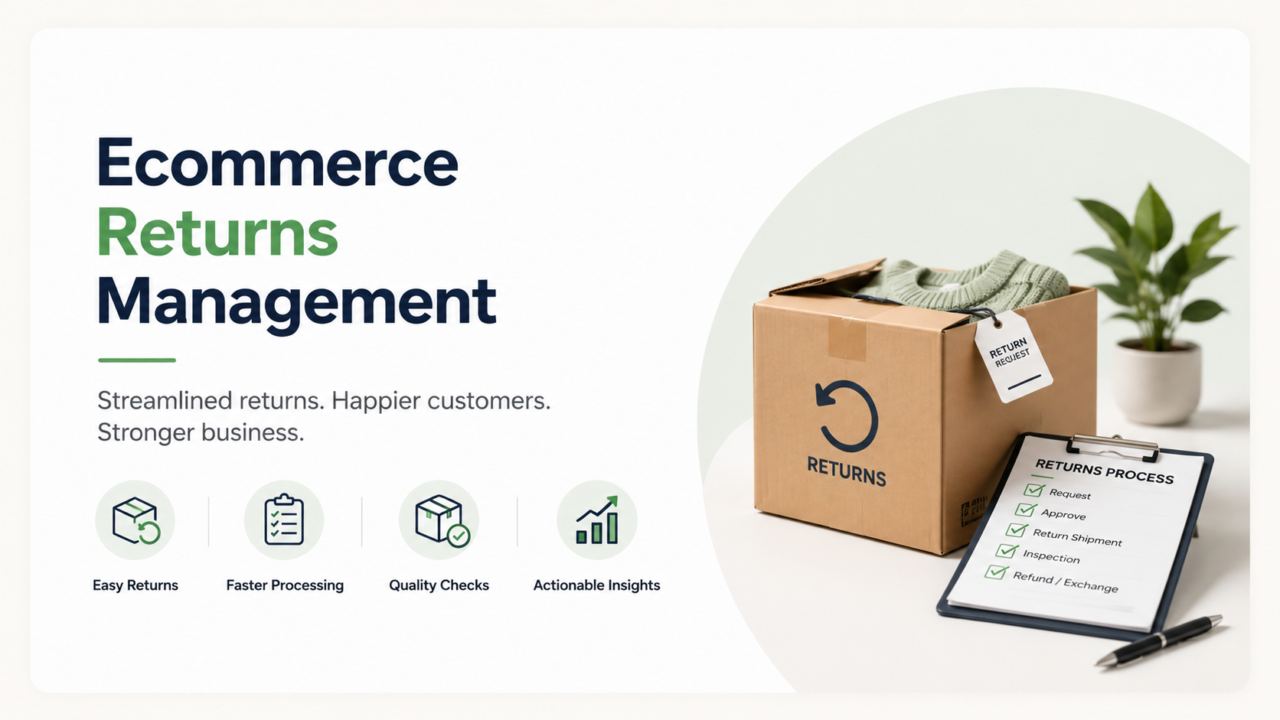
Returns quietly drain your profit. A customer clicks “return,” your team scrambles, the refund goes out, and the product lands in a corner of your warehouse. Multiply that by hundreds of orders a month and you have a real leak in your margin.
Here is the number that should worry you. U.S. retailers expect $849.9 billion in merchandise to come back in 2025, about 15.8% of all sales. Online return rates run even higher at an estimated 19.3%. For some categories like apparel, return rates can hit 40% or more. That means in some stores, almost half of what you sell comes back.
But returns are not just a cost. They are also a loyalty moment. How you handle a return decides whether a customer ever buys from you again.
This guide is the complete playbook for ecommerce returns management. You will learn the real cost of a return, the full RMA workflow, how to set policies that protect margin, how to stop fraud, which KPIs to track, and how a dedicated team can run the whole thing for you. Let us get into it.
Key Takeaways
- Ecommerce returns management is the full system for handling, tracking, and recovering value from returned products.
- Online return rates hit about 19.3% in 2025, and apparel can run far higher.
- The all-in cost of a return is often 20% to 30% of the order value, sometimes more.
- A clear RMA process, smart policies, and fast refunds protect both margin and customer experience.
- About 9% of all returns are now fraudulent, so brands need rules without punishing good buyers.
- A dedicated embedded team can own your entire returns workflow so you stop losing money to chaos.
What Is Ecommerce Returns Management?
Ecommerce returns management is the end-to-end process of handling products customers send back. It starts the moment a shopper asks for a return and ends when you refund, exchange, restock, or dispose of the item.
It is far more than shipping a product back. A complete returns system covers five connected parts:
- Policy: what can be returned, how long buyers have, and on what terms
- Reverse logistics: how the item travels back to your warehouse
- Inspection and grading: checking each item and scoring its condition
- Routing and disposition: deciding where the product goes next
- Recovery and data: refunds, exchanges, store credit, resale, and the lessons you pull from each return
Run it well and returns become a normal, controlled part of your business. Run it badly and they drain cash, mess up your inventory, and push buyers away.
Why Returns Matter More Than Ever for D2C Brands
Returns used to be a quiet back-office task. Not anymore. For a scaling D2C brand, returns are both a margin risk and a loyalty driver at the same time.
Look at what the data shows:
- 76% to 82% of consumers say free returns shape where they shop.
- 67% of consumers say one bad return experience would stop them from buying again.
- Gen Z shoppers average 7.7 online returns a year, the most of any generation.
So returns hit you from two sides. A messy process costs real money to run, and it quietly kills repeat purchases. For brands trying to grow, that combination is dangerous. The brands that win treat returns as part of the product, not as an afterthought.
The True Cost of a Return (It Is Bigger Than the Refund)
The refund is the most visible cost of a return. It is rarely the biggest. When you add everything up, the full cost of a return often lands between 20% and 30% of the order value. For medium and large U.S. brands, studies put it near 21% of order value. For apparel, it can reach 66% of the product price once you count every step.
Here is what really goes into the cost of a single return:
- Reverse shipping – whoever pays for the return label, often you ($8 to $12 on a typical order)
- Receiving and inspection labor – someone opens the box and checks the item ($4 to $6)
- Restocking labor – resellable items have to go back in the right bin ($2 to $3)
- Product depreciation – even undamaged items lose value and cannot be sold as “new”
- Disposal cost – damaged items cost money to write off or recycle
- Customer service time – answering “where is my refund” emails and resolving disputes
- Processor fees – card processors usually keep the original transaction fee on a refund
- Lost repurchase – a bad return experience lowers customer lifetime value
A simple example. A $100 order with a $45 gross margin looks healthy. Then a return comes in. Return shipping eats $10, inspection eats $5, restocking eats $3, and the item now resells at a discount. That “healthy” margin is mostly gone. This is why returns need a real system, not guesswork.
There is also a hidden cost: speed. The longer a returned item sits before inspection, the less you can recover. Electronics resold quickly can keep 80% to 90% of their value. After 60 days, that drops sharply as newer models launch. Slow returns are expensive returns.
What Is an RMA and Why It Matters
An RMA, or Return Merchandise Authorization, is the approval and tracking ID you give a customer before they send an item back. Think of it as a ticket for every return.
A good RMA record tells your team three things:
- Which order the return belongs to
- The reason the customer is returning the item
- What should happen to the product when it arrives
Without RMAs, returns show up at your warehouse with no paper trail. Staff have no idea which order a box belongs to or what to do with it. These “mystery boxes” pile up, slow everything down, and create refund disputes.
With RMAs, every package has a clear path from request to refund. Your team scans the RMA the moment a box arrives, confirms the SKU, and routes it to the right lane.
AcquireX operator tip: Make the RMA the single source of truth for every return. If a return is not in the RMA system, it does not get refunded. This one rule stops most “lost return” arguments before they start and protects you from a common fraud trick.
The Complete 7-Step Returns Workflow
A strong returns program is not a policy page. It is a repeatable workflow every team member follows the same way. We call our version the RETURN Method, and it maps to seven clear steps.
Step 1: Customer Initiates the Return (Request)
The shopper starts a return through a self-serve portal, not a back-and-forth email. The system creates an RMA record and runs automated checks on order date, product eligibility, and basic fraud signals.
This first step matters more than most brands think. Any friction here, like a confusing form or a slow reply, can send the customer to a competitor next time. Make it fast and clear.
Step 2: Approve, Deny, or Offer an Alternative (Evaluate)
This is your fraud and policy gate. Set automated rules so simple, honest returns get approved instantly while risky ones get flagged. You can:
- Approve instantly when order, product, and timing fit your policy
- Deny when the request is clearly outside the window or rules
- Offer an alternative like store credit or a replacement when the reason points to a defect
Set exceptions for your best customers. For example, auto-approve returns for buyers with five or more past orders, and send orders over $500 to a quick manual review. Speed for good customers, friction only for risky ones.
Step 3: Generate the Label and Packing Instructions (Track)
Approved RMAs trigger a prepaid label and clear packing instructions. Add simple visuals or a short checklist for fragile items so they come back in resale-ready condition. This is also where the system can decide to issue a returnless refund for very low-value items (more on that below).
Step 4: Item Received and Scanned (Unpack)
The item arrives at your warehouse or return center. Your team scans the RMA right away to confirm it is the expected SKU and quantity, then routes it to the correct inspection lane.
Keeping this scan mandatory prevents mystery boxes and gives customer service real-time visibility for “where is my refund” questions.
Step 5: Inspection and Grading
Create a simple grading framework so every associate makes the same call every time:
- Grade A: Resale-ready. Looks new, works, packaging intact.
- Grade B: Refurbish or repackage. Minor cosmetic or packaging issues, fully functional.
- Grade C: Secondary channel. Works but not fit for full price; send to outlet or liquidation.
- Grade D: Disposal or recycling. Cannot be safely resold or repaired at reasonable cost.
Consistent grading is where margin is won or lost. An item wrongly tossed as “damaged” is money gone. An item correctly graded “like new” recovers full value. Standardized grading also gives you clean data on which products come back broken.
Step 6: Restock or Route Decision
Based on the grade, the item goes somewhere clear:
- Grade A goes back into saleable stock, and your inventory system updates in real time
- Grade B and C follow set refurbishment or liquidation paths
- Grade D is logged and moved to waste or recycling
Summarize return reasons by SKU and share them with your merchandising team. A spike in “color not as expected” is a product page problem, not a warehouse problem.
Step 7: Refund, Exchange, or Credit (Notify and Refund)
Issue the refund automatically once inspection is done and the item is graded. Create exchanges for size, color, or replacement requests so you keep the revenue. Offer store credit as a faster option for loyal buyers.
If returns pile up and bottleneck, split your receiving into two lines: one for new inbound inventory and one for returns. That simple change keeps new stock flowing while returns get processed.
How to Build a Returns Policy That Converts and Protects Margin
Your return policy sits right between customer experience and financial protection. Too strict and you lose sales. Too generous and you invite abuse. The trick is knowing which levers to pull and when.
Free Returns
Free returns are close to table stakes now, since most shoppers factor them into where they buy. But offering them with no rules opens the door to bracketing and abuse. The answer is not to kill free returns. It is to pair them with better product pages and exchange incentives that cut the number of returns you process in the first place.
Return Windows
Most brands default to 30 days because it feels standard. You have more options:
- Short windows (14 to 21 days): Lower abuse risk and better recovery value, good for electronics
- Standard window (30 days): Balanced for most categories
- Extended windows (60 to 90 days): Good for high-ticket items with low return rates, and signals confidence
Shorter windows usually mean better recovery value, because items come back while they still hold resale value.
Restocking Fees
Restocking fees help offset labor and shipping on bulky or costly items like furniture and appliances. If a $200 chair costs you $35 to ship out, $35 to ship back, and $10 to inspect, a 10% to 20% restocking fee recovers part of that loss. Just do not apply restocking fees to apparel. Shoppers expect free clothing returns, and fees there increase churn.
Returnless Refunds
Sometimes the cheapest move is letting the customer keep the item. A returnless refund means you refund without asking for the product back. It sounds wasteful, but for low-value items it is often the smart call.
Use returnless refunds when:
- Return shipping plus labor costs more than the product is worth
- The item cannot be resold (personalized goods, opened hygiene products)
- You want to reward a loyal customer who reported a real issue
If you sell a $12 phone case and the return label costs $8, a returnless refund saves you the shipping, the labor, and the risk of getting back something you cannot resell.
Seasonal Policy Adjustments
The holiday rush creates a January returns flood that can swamp your warehouse. Plan ahead:
- Extend windows so November gifts stay returnable through January
- Push exchanges over refunds during peak season to protect revenue
- Use returnless refunds for cheap accessories to avoid warehouse pileups
- Prepare support scripts for gift returns (“I did not buy this myself”)
How to Cut Returns Before They Happen
The best return is the one that never happens. Most brands focus on processing returns faster. The bigger win is preventing them. Most returns come from one thing: the product was not what the customer expected.
Fix Your Product Pages
A large share of returns are expectation gaps you can close on the product page:
- Detailed size charts with model measurements and fit notes (“runs small”)
- “What’s included” sections that list every accessory and part
- Natural light photos instead of heavily edited studio shots
- 360-degree views and product videos showing the item from every angle
- Customer reviews tagged with fit like “true to size” or “runs large”
Any SKU with a return rate above 15% to 20% deserves a product page audit. Return rates often drop fast once the page shows accurate sizing and real photos.
Map Return Reasons to Fixes
Use return reason data to fix the root cause, not just the symptom:
| Return Reason | Product Page Fix | Why It Works |
|---|---|---|
| Wrong size or poor fit | Size charts, model measurements, fit notes, review tags | Helps shoppers pick the right size, cuts bracketing |
| Color or material mismatch | Daylight photos, close-ups, fabric details | Closes the gap from staged or edited images |
| Missing features or parts | “What’s included” and “What’s not included” sections | Stops returns from wrong expectations |
| Quality concerns | Transparency on materials, testing, durability | Sets honest expectations before purchase |
Tackle Bracketing
Bracketing is when shoppers buy several sizes or colors planning to return most. More than half of Gen Z shoppers admit to it. You will not stop it fully, but you can reduce it with fit finder tools, lifestyle photos with model specs (“model is 5’10” wearing a medium”), and clear use cases (“best for indoor use only”). Better guidance means buyers pick right the first time.
Returns Fraud: A Growing Threat for Online Brands
Returns fraud is rising fast, and online brands are a prime target. About 9% of all returns are now fraudulent. The hard part is stopping fraud without punishing the honest customers who make up the other 91%.
Common fraud tactics retailers report:
- Overstated return quantities (reported by 71% of retailers)
- Empty-box or “box of rocks” returns (65%)
- Counterfeit or decoy items (64%)
- Wardrobing, where a buyer wears an item once then returns it
To fight this, 85% of retailers now use AI to spot fraud patterns. But technology is only half the answer. The other half is process discipline.
How to reduce fraud without hurting good customers:
- Require an RMA so no return gets refunded without a record
- Inspect before refunding on higher-value items, so empty boxes get caught
- Flag repeat returners with strange patterns, like constant high-value returns
- Score by behavior, giving trusted customers fast lanes and risky accounts a closer look
- Photograph questionable returns at inspection to settle disputes
The goal is simple: keep honest returns smooth and put friction only where the data says there is risk.
Returns Strategy by Business Size
Returns management looks different depending on your stage. Match your effort to your volume.
Early-Stage Brands
If you ship under a few hundred orders a month, keep it lean. Use a simple return form, a clear policy page, a basic grading rule (resell or do not), and manual refund approvals. Track return reasons in a spreadsheet. Focus your energy on fixing the product pages that cause the most returns.
Scaling Brands
As volume grows, manual breaks down. This is when you add a self-serve portal, automated RMA approvals, exchange-first flows, and real-time inventory sync. You also need real KPI tracking and someone who owns returns as a job, not a side task. This is the stage where most brands feel the pain and where a dedicated team makes the biggest difference.
Enterprise Brands
At high volume, returns become a network problem. You optimize across multiple warehouses, 3PL contracts, and carrier rates. Routing logic decides which warehouse and freight account handles each return. Standardized grading feeds resale and liquidation strategy. The cost per return drops sharply with the right automation, since manual handling can cost $10 to $15 per return in labor versus under $2 when automated.
Who Owns Returns Inside Your Business?
Returns touch four teams, and confusion between them is where the process breaks. Here is a simple ownership model:
- Customer support owns the customer experience: the portal, communication, and refund updates
- Operations and warehouse own receiving, inspection, grading, and restocking
- Finance owns refund accounting, fees, and the true cost reporting
- Merchandising owns acting on return reason data to fix products and listings
When no one clearly owns a step, returns stall. The fix is to assign each step to one team and make the handoffs clear.
Returns KPIs Every D2C Brand Should Track
You cannot fix what you do not measure. Track these numbers monthly and set alert thresholds so problems surface early:
| KPI | Why It Matters | Healthy Target |
|---|---|---|
| Return rate by product | Spots problem SKUs and sizing issues | 15% to 25% apparel, under 10% non-apparel |
| Time to refund | Drives support volume and chargebacks | Under 72 hours from receipt |
| Restock rate | Shows how much inventory you recover | Over 70% resellable |
| Repeat return rate | Flags fraud and serial returners | Single-digit % of returners |
| Cost per return | Reveals the true price of each return | Trending down over time |
| Exchange vs. refund rate | Measures how much revenue you keep | Exchange rate rising |
| Return reason mix | Tells you what product or copy to fix | No single reason over 40% |
Watch the patterns. If “time to refund” creeps up, your support tickets and chargebacks will follow. If one SKU’s return rate spikes, the product or its listing is the problem.
How AcquireX Helps You Manage Ecommerce Returns
Most brands try to run returns with a stretched-thin team and a patchwork of tools. It works until volume grows. Then refunds slow down, inventory drifts, and reviews start mentioning “slow returns.” That is the moment growth stalls.
AcquireX is not an agency and not a freelancer. We build a dedicated team that works inside your business and owns your returns process end to end. You stop managing the chaos. We own the execution. You focus on growth.
Here is what that looks like in practice:
- We run your full RMA workflow so every return has a clear path and nothing gets lost.
- We handle the customer side, sending fast updates and quick refunds that protect your reviews and repeat sales. This connects directly to our customer service management for ecommerce work.
- We standardize inspection and grading so you recover the most value from every returned item.
- We connect returns to inventory so your stock counts stay accurate, backed by our supply chain management team.
- We fix the product pages driving your returns, supported by our catalog management services.
- We track returns KPIs and report on cost per return, restock rate, and reason mix so you always know where margin is leaking.
This is the dedicated embedded team model. Real ownership, real accountability, and one team that treats your returns like their own P&L.
Stop letting returns quietly drain your margin. Talk to AcquireX and put a dedicated team on your returns process.
Frequently Asked Questions
What is ecommerce returns management?
Ecommerce returns management is the full system a brand uses to handle product returns. It covers the return request, reverse logistics, inspection and grading, routing, and the final refund, exchange, or resale. A strong system protects margin and keeps customers happy.
What is the average ecommerce return rate?
Online return rates are estimated at about 19.3% in 2025, higher than the overall retail return rate of 15.8%. Apparel and footwear run much higher, often 40% or more. A safe rule is to expect roughly 1 in 5 online products to come back, and more in fashion.
What is an RMA in ecommerce?
An RMA, or Return Merchandise Authorization, is the approval and tracking number a brand gives a customer before they return an item. It links the return to the original order and tells the warehouse what to do with the product when it arrives.
How much does it cost to process a return?
The all-in cost of a return is usually 20% to 30% of the order value. For medium and large U.S. brands, it lands near 21% of order value. For apparel it can reach 66% of the product price once you count shipping, labor, restocking, depreciation, and disposal.
How can D2C brands reduce returns without losing sales?
Improve product pages with accurate size charts and real photos, offer exchanges before refunds, track return reasons by SKU, and use behavior-based policies. Most returns come from expectation gaps you can close on the product page before the customer ever buys.
What is a returnless refund and when should I use one?
A returnless refund means you refund the customer without asking for the item back. Use it when return shipping and labor cost more than the product, when the item cannot be resold, or when you want to keep a loyal customer happy over a low-value issue.
How common is returns fraud?
About 9% of all returns are now fraudulent. Common methods include empty-box returns, overstated quantities, and counterfeit items. Many retailers use AI plus a strict RMA and inspection process to detect and reduce fraud without slowing down honest customers.
What returns KPIs should I track?
Track return rate by product, time to refund, restock rate, repeat return rate, cost per return, exchange vs. refund rate, and return reason mix. These numbers show where you are losing margin and which products or listings need fixing.
How does AcquireX help with returns management?
AcquireX builds a dedicated embedded team that owns your returns process end to end. We run the RMA workflow, handle customer updates and refunds, standardize grading, connect returns to inventory and product listings, and track returns KPIs, so you stop losing margin to chaos and can focus on growth.