Short answer: If you ship under 500 orders a month, handle it in-house. If you ship over 1,000 and your team is drowning in boxes, move to a 3PL. If you sell a mix of fast movers and custom or fragile products, run a hybrid model. That’s the rule most ecommerce operators wish someone told them on day one.
But the real answer has more layers — and the wrong pick costs you real money every week.
This guide breaks down all three models in plain English. You’ll see the real numbers, the hidden costs, and a simple way to pick the right one for your brand. No fluff. No “it depends.” Just what actually works in 2026.
Why This Decision Is Bigger Than It Looks
Fulfillment is one of the biggest costs in any ecommerce business. For most D2C brands, it eats 10–15% of revenue. At $5M in sales, a 2% gain in fulfillment efficiency is worth $100,000 a year — more than most marketing tweaks can deliver.
Pick the wrong model and you burn cash, ship late, and lose repeat buyers. Pick the right one and you free up your team to focus on growth — like better catalog management, smarter marketplace listings, and stronger customer service.
Here’s the part most guides skip: the best model changes as you grow. A 3PL that saves money at 300 orders a day can bleed you dry at 3,000. That’s why this article is built as a decision framework, not a ranking.
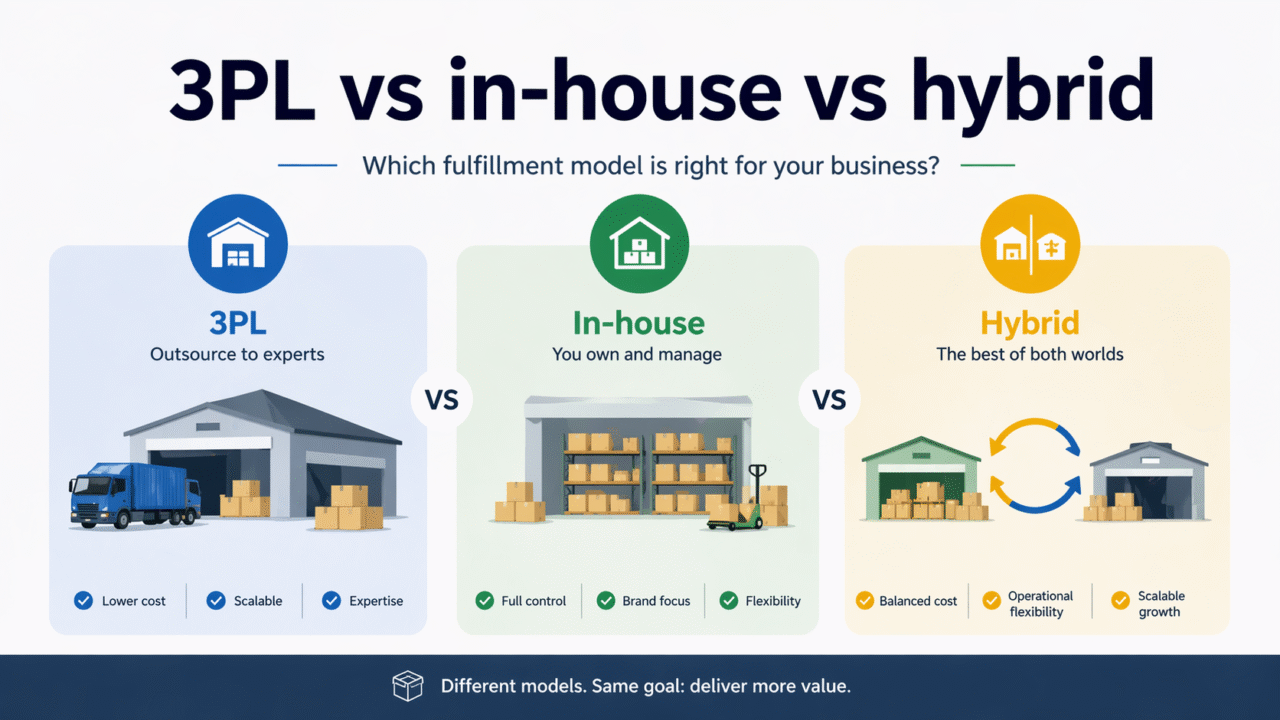
The Three Fulfillment Models — Quick View
Before we go deep, here’s the one-minute version:
- In-house fulfillment: You (or your team) pick, pack, and ship from your own space — a garage, a small warehouse, or your own facility.
- 3PL (third-party logistics): A partner like ShipBob, ShipMonk, or Red Stag stores your stock and ships orders for you.
- Hybrid: You split it. Fast movers go to a 3PL. Custom, fragile, or VIP orders stay in-house.
Model 1: In-House Fulfillment
What it really looks like
An order comes in. You walk to the shelf, grab the item, pack it in a box, print the label, and ship it. That’s in-house fulfillment at its simplest.
At bigger scale, in-house means your own warehouse, your own staff, and your own shipping software. Many indie candle brands, apparel startups, and handmade goods sellers run this way for years.
The real costs nobody talks about
Founders love saying “in-house is cheap.” It’s not. It just feels cheap because the costs hide in your own time and effort.
Here’s what you actually pay:
- Your time: Packing 30 orders takes 2 hours. That’s 2 hours not spent on ads, emails, or growth. At any realistic founder hourly value, it adds up fast.
- Space: A spare bedroom feels free, but a rented warehouse isn’t. Budget $5–$15 per square foot per year in most US cities.
- Supplies: Boxes, tape, mailers, inserts, filler. Plan for $0.50–$1.50 per order.
- Shipping rates: You pay retail unless you get volume discounts. A 3PL usually gets 15–40% better rates because of scale.
- Errors: Wrong items, missing packages, late deliveries — all on you.
When in-house wins
In-house is genuinely the right call when:
- You ship fewer than 500 orders a month.
- Your products are fragile, heavy, or oddly shaped (3PLs charge extra for these).
- Every order needs a handwritten note or custom wrap.
- Your margins are too tight to give up 10–15% to a 3PL.
- Your unboxing is part of the product — think beauty, artisan food, or niche hobby brands.
When in-house breaks
It breaks fast when you hit around 1,000 orders a month. You miss family events because you’re taping boxes. You start shipping wrong items because you’re tired. Your support inbox fills with “where’s my order?” complaints.
That’s the signal. Ignore it and you’ll lose more revenue to bad reviews than you’d ever save on fulfillment. Many brands hit a “growth ceiling” — not from lack of demand, but because operations can’t keep up. This is where smart operators start looking at outsourcing parts of the business to stay lean while growing.
Model 2: 3PL (Third-Party Logistics)
What it really looks like
You send your stock to the 3PL’s warehouse. When an order comes in from your store, the 3PL gets it through an integration. They pick, pack, and ship. You get a tracking number that syncs back to the customer.
You never touch a box. You just watch stock levels and pay invoices.
How 3PL pricing actually works
Most founders think 3PLs charge one flat fee. They don’t. Expect four layers:
- Receiving fee: What they charge to unload and shelve your inventory. Usually $25–$40 per pallet.
- Storage fee: Per pallet, bin, or cubic foot, per month. Typically $10–$50 per pallet per month.
- Pick and pack fee: Per order, plus extra per item. Expect $2.50–$4 for the first item and $0.50–$1 for each extra.
- Shipping: Carrier rates at 15–40% off retail.
All in, expect $5–$9 per order for simple products (not counting the shipping label itself).
When a 3PL wins
- You ship 1,000+ orders a month.
- Your SKUs are simple — standard sizes, stackable, no custom wrap.
- You sell in multiple countries and need regional warehouses.
- You want to offer 2-day shipping without losing your weekends.
- Your team time is better spent on marketing, sourcing, and product.
The catches nobody mentions
Here’s the honest stuff:
- Minimum volume requirements: Most good 3PLs won’t take you seriously under 500 orders a month.
- Lock-in contracts: 6–12 month minimums are common. Read the exit clause.
- Peak season surcharges: Black Friday and Q4 often come with extra fees. Ask upfront.
- Integration gaps: Not every 3PL plays nicely with every platform. Test the integration before committing.
- Brand quality drop: Handwritten thank-you notes? Gone. Most 3PLs can insert a pre-printed card but won’t do custom work without paying extra.
- Transition takes 2–4 months: System setup, inventory transfer, workflow testing, staff training. Plan it during a slow season.
Top 3PLs worth checking in 2026
- ShipBob — Best all-rounder for brands shipping 500–50,000 orders per month.
- ShipMonk — Strong for subscription boxes and brands with lots of SKUs.
- Red Stag Fulfillment — Good for heavy, bulky, or fragile items.
- Amazon MCF — Cheapest for simple, standard products, but limited on brand control.
Model 3: Hybrid Fulfillment
What it really looks like
This is where most profitable 7-figure brands actually land. You split fulfillment into two streams:
- Stream A (3PL): Fast-moving, standard SKUs. The stuff that sells every day.
- Stream B (in-house): Limited editions, custom orders, subscription boxes, VIP kits, influencer seeding, wholesale B2B.
Your order system routes each order to the right place — usually by SKU, tag, or order type.
A real-world example
A mid-size skincare brand doing $4M a year. Their 20 core SKUs (serums, moisturizers, cleansers) ship from a 3PL. Their limited-edition holiday gift sets, press boxes, and wholesale pallet orders ship from a small in-house team of 2 people.
Result: 3PL efficiency on 85% of orders, and full brand control on the 15% that create the social media moments.
When hybrid wins
- You sell both fast movers and slow movers.
- You run frequent product drops or limited editions.
- You do wholesale or B2B alongside D2C.
- You want the 3PL cost savings but can’t give up custom unboxing on launches.
- You ship internationally and want a local warehouse for your home country.
The hidden challenge
Hybrid adds complexity. You’ll need:
- An inventory tool that tracks stock in two locations at once.
- Clear rules for which orders go where.
- One person who owns the in-house side. Without an owner, hybrid slowly collapses into “everything ships from the 3PL” and you lose the brand moment.
Running a hybrid model well is closer to running a small operations team than a simple fulfillment setup. Brands that nail it usually lean on a strong supply chain management backbone to keep both sides in sync.
Side-by-Side: 3PL vs In-House vs Hybrid
| Factor | In-House | 3PL | Hybrid |
|---|---|---|---|
| Best order volume | Under 500/mo | 1,000+/mo | 3,000+/mo |
| Upfront cost | Low | Medium | Medium–High |
| Cost per order | Hidden (your time) | $5–$9 + shipping | Blended |
| Shipping speed | Slower | Fast (2-day possible) | Mixed |
| Brand control | Full | Limited | High |
| Scales past 500 orders/day? | No | Yes | Yes |
| Best for | New brands, fragile/custom | Scaling D2C brands | Multi-SKU, drops, B2B+D2C |
The 4-Step Framework to Pick Your Model
Here’s the simple framework. Run through these four questions:
Step 1: What’s your monthly order volume?
- Under 500? Stay in-house.
- 500–1,000? Start looking at 3PLs. Get three quotes.
- 1,000+? Either move fully or go hybrid.
Step 2: How custom is your unboxing?
- Pre-printed box, pre-printed insert, standard tissue — 3PL is fine.
- Handwritten note, wax seal, custom wrap — stay in-house or go hybrid.
Step 3: How many different SKUs do you ship?
- Under 25 SKUs — 3PL is cheap.
- 25–100 SKUs — 3PL works but storage costs climb.
- 100+ SKUs — pick a 3PL built for high SKU count or go hybrid.
Step 4: Do you run product drops or wholesale on the side?
- Yes — hybrid is your friend.
- No — straight 3PL.
Real Numbers: A Sample Cost Comparison
Let’s put real numbers on this. Imagine a brand shipping 3,000 orders/month at a $55 average order value. Each order weighs 1 lb and ships inside the US.
- In-house per order: ~$8.50 (founder time $3, supplies $1, retail shipping $4.50) = $25,500/month
- 3PL per order: ~$7.50 (pick-pack $3, storage $0.50, discounted shipping $4) = $22,500/month
- Hybrid (80% 3PL, 20% in-house): ~$7.70 per order = $23,100/month
On paper, the 3PL saves $3,000/month. But that doesn’t count the 60+ hours a month the team gets back. At any realistic hourly value, the 3PL win is much bigger than it looks.
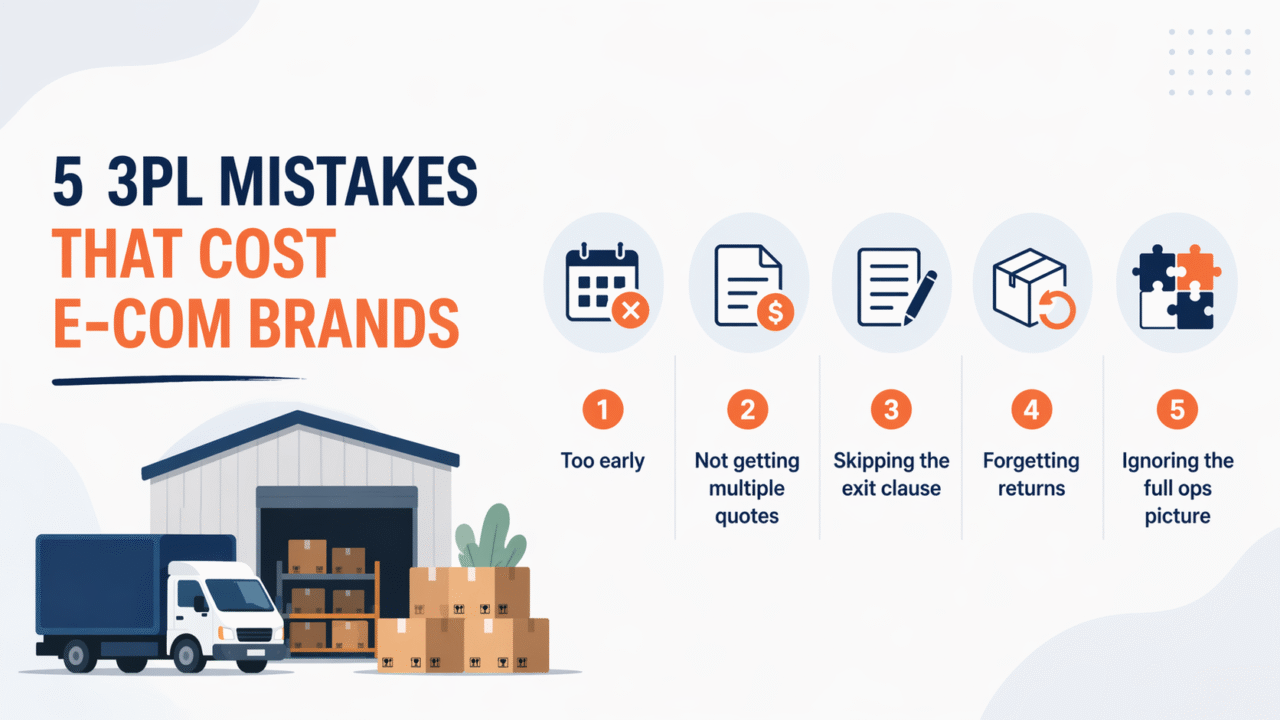
Common Mistakes We See Every Week
- Switching to a 3PL too early. If you’re shipping 10 orders a day, no 3PL will give you decent rates. Wait until you cross 500 orders a month.
- Not getting multiple quotes. 3PL pricing varies wildly. Always get at least three.
- Skipping the exit clause. Getting out of a 3PL is harder than getting in. Read the contract twice.
- Forgetting returns. Who processes returns, at what cost, and how fast? Most founders only ask about outbound.
- Ignoring the full ops picture. Fulfillment is just one piece. Your listings, catalog, customer service, and sourcing all affect your cost per order. Brands that grow fastest treat the whole stack as one system — not one function.
Where Most Brands Actually End Up
Across 100 ecommerce brands doing $1M–$10M a year, the split usually lands around:
- 30% still in-house (mostly founder-led, brand-heavy, lower volume)
- 45% fully on a 3PL
- 25% hybrid
Past $10M, hybrid becomes the default. The reason is simple — scale exposes the weakness of every single model on its own.
And the part that’s often missed: even after you pick a fulfillment model, your cost per order is shaped by everything around it. Clean product data, strong marketplace listings, and responsive customer service all reduce returns, refunds, and replacements — which is where the real savings live. That’s why operators who build an offshore ecommerce team for catalog and support often see bigger margin gains than from the fulfillment switch alone.
Frequently Asked Questions
What’s the minimum order volume for a 3PL to make sense?
Most 3PLs become cost-effective around 500 orders a month. Below that, you’ll either be rejected or pay high minimums. Stick with in-house until you hit this range.
How long does a switch from in-house to 3PL take?
Plan 2–4 months. That covers system setup, inventory transfer, workflow testing, and staff training. Do it during a slow season to avoid disrupting customers.
Can I use a 3PL and still offer custom packaging?
Yes, but it costs extra. Most 3PLs charge $0.50–$2 per order for custom inserts, branded boxes, or special tissue. Complex wrapping like ribbons, wax seals, or handwritten notes is usually not offered — that’s where hybrid comes in.
How do I handle returns with a 3PL?
Good 3PLs handle returns as a standard service. You pay a returns processing fee (usually $2–$5 per return), and the 3PL inspects, restocks, or disposes of items based on your rules. Always negotiate returns terms upfront.
Does a 3PL work for subscription boxes?
Yes, and some are built for it. ShipMonk and Stord both have subscription workflows. The key is letting them handle kitting — they pre-assemble boxes so your monthly ship day doesn’t break the system.
What’s the fastest way to test if a 3PL is right for me?
Ship 30% of your orders through a 3PL for 60 days while keeping 70% in-house. Track cost per order, delivery time, error rate, and customer complaints. If the 3PL wins on three out of four, move more volume over.
How does fulfillment connect to my marketing spend?
Directly. Slow or late shipments hurt reviews, returns climb, and lifetime value drops. Every dollar saved on fulfillment that’s then reinvested in better performance marketing or customer retention tends to compound — while fulfillment chaos quietly leaks that same dollar out the back.
The Bottom Line
There’s no “best” fulfillment model. There’s only the right model for where your brand is right now — and the willingness to change it as you grow.
Start in-house. Move to a 3PL when the volume justifies it. Switch to hybrid when your product mix gets complex. Revisit the decision every 12 months.
And remember — saving $1 per order on fulfillment is good. Building a tighter operations stack around it is better. The brands that win in 2026 aren’t the ones with the cheapest 3PL. They’re the ones who treat fulfillment, catalog, customer service, and marketing as one connected system.
About AcquireX: AcquireX helps D2C and marketplace brands run leaner ecommerce operations through dedicated offshore teams covering catalog management, customer service, marketplace management, performance marketing, and supply chain. Learn more at acquirex.io or get in touch.