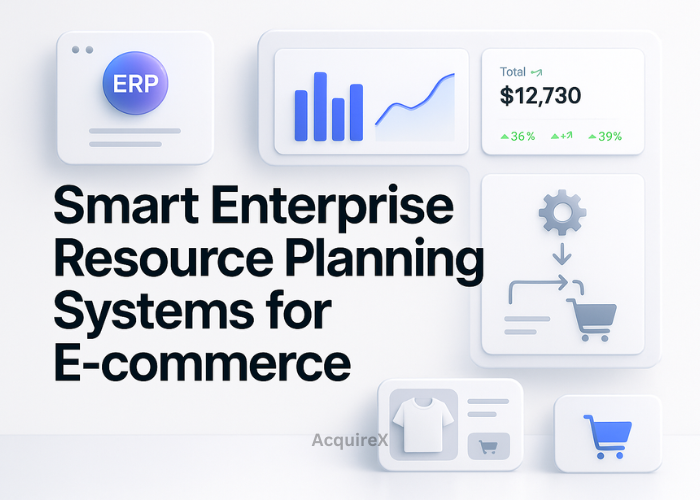
Smart Enterprise Resource Planning Systems for E-commerce are transforming how online businesses operate, manage data, and scale efficiently. In today’s fast-moving digital landscape, e-commerce brands need more than just great products, they need operational intelligence. ERP systems act as the digital backbone, automating complex processes like order management, inventory tracking, and customer service, while unifying data across departments
What Are Enterprise Resource Planning Systems?
Enterprise Resource Planning Systems (ERPs) are integrated platforms that centralize core business functions such as finance, Supply Chain, Human Resources, and customer management into a single system. For e-commerce businesses, this integration ensures smoother workflows, better visibility, and enhanced productivity.
Instead of managing fragmented tools, ERP solutions provide a unified dashboard where business leaders can track performance, identify bottlenecks, and make informed, data-driven decisions. This level of visibility is crucial for scaling e-commerce operations effectively.
Why ERP Systems Are Vital for E-commerce Growth
In the e-commerce industry, agility and accuracy define success. Enterprise Resource Planning Systems enable both by automating key business operations and offering real-time analytics. Let’s explore their key advantages:
1. Unified Data Management
E-commerce platforms handle vast amounts of product, supplier, and transaction data. ERP systems consolidate all this into a single source of truth, ensuring consistency across teams and channels.
2. Inventory and Supply Chain Optimization
ERP tools help maintain optimal inventory levels by automating reordering, stock updates, and fulfillment. This minimizes issues like stockouts or overstocking, which can impact sales and customer satisfaction.
3. Financial Control and Accuracy
For e-commerce businesses dealing with multi-currency transactions and global suppliers, ERP systems streamline financial processes, from billing and tax compliance to expense management and reporting.
4. Improved Customer Experience
By connecting with Customer Relationship Management (CRM) systems, ERPs give e-commerce brands a complete view of customer behavior. This enables better personalization, faster issue resolution, and increased loyalty.
5. Seamless Integration with Online Platforms
Modern ERP software integrates smoothly with platforms like Shopify, WooCommerce, Magento, and BigCommerce, ensuring synchronised product data, order details, and delivery updates.
Key Features of ERP Systems for E-commerce
E-commerce operations demand agility, precision, and real-time decision-making. The most effective Enterprise Resource Planning Systems come equipped with these essential features:
- Real-Time Reporting: Gain instant visibility into orders, revenue, and performance.
- Multi-Channel Management: Manage multiple marketplaces. Amazon, Flipkart, eBay, from one platform.
- Automated Order Fulfillment: Reduce manual intervention through automatic order-to-cash workflows.
- Returns and Refund Handling: Streamline post-purchase processes to boost customer satisfaction.
- Tax and Regulatory Compliance: Automatically apply region-specific tax rules like GST or VAT.
- Scalable Cloud Infrastructure: Easily expand your ERP as your e-commerce operations grow.
Benefits of Implementing ERP in E-commerce
The adoption of Enterprise Resource Planning Systems delivers both immediate and long-term value for e-commerce businesses.
- Improved Productivity: Automation reduces manual work and repetitive tasks.
- Enhanced Scalability: ERPs grow with your business, supporting higher order volumes and product catalogs.
- Operational Cost Savings: By integrating functions, businesses eliminate redundant tools and data errors.
- Stronger Data Security: Cloud-based ERPs offer advanced encryption and access controls.
- Customer Retention: Faster service, accurate orders, and personalized experiences lead to repeat purchases.
Top ERP Systems Used in the E-commerce Industry
Selecting the right ERP platform can determine how effectively your e-commerce business scales. Below are some of the top-rated Enterprise Resource Planning Systems for online retailers:
- NetSuite ERP: A cloud-based system offering integrated financials, CRM, and e-commerce management.
- SAP Business One: Ideal for small to mid-sized e-commerce brands seeking growth flexibility.
- Odoo ERP: An open-source ERP that’s customizable for niche e-commerce needs.
- Microsoft Dynamics 365: Combines ERP and CRM with powerful AI insights.
- Acumatica Cloud ERP: Known for intuitive dashboards and real-time visibility.
For deeper insights, explore the TechTarget ERP Resource Center, a trusted authority in enterprise technology research.
Founders and Establishment Year of ERP Systems
The foundation of Enterprise Resource Planning Systems dates back to the 1960s with the rise of Material Requirements Planning (MRP) systems, designed to optimize manufacturing processes.
The modern ERP concept was formally introduced by Gartner Group in the early 1990s. However, the true pioneers were SAP SE, founded in 1972 by five former IBM engineers in Germany, Dietmar Hopp, Hasso Plattner, Claus Wellenreuther, Klaus Tschira, and Hans-Werner Hector.
Their vision was to integrate all core business processes into a unified digital system, a vision that evolved into today’s sophisticated ERP platforms.
Common Challenges in ERP Implementation
While the advantages of Enterprise Resource Planning Systems are substantial, businesses often encounter challenges during deployment.
- Initial Investment Costs: Enterprise-grade ERP systems require significant setup investment.
- Complex Customization Needs: Adapting ERP modules to fit unique e-commerce processes can take time.
- User Adoption: Training employees to adapt to new systems is critical for success.
- Integration Hurdles: Older or legacy software may not connect seamlessly with modern ERP platforms.
To overcome these issues, businesses should adopt phased rollouts, provide training, and partner with experienced ERP consultants.
The Future of ERP in the E-commerce Space
The future of Enterprise Resource Planning Systems is driven by Artificial Intelligence (AI), Machine Learning (ML), Blockchain, and the Internet of Things (IoT).
AI-enabled ERPs are already analyzing customer data, predicting trends, and automating supply chain decisions. With headless commerce becoming mainstream, future ERP architectures will focus on modularity, allowing businesses to plug in custom tools and APIs as they grow.
By 2030, we can expect ERP systems to evolve into autonomous, data-driven ecosystems capable of making real-time operational decisions without human intervention.
Final Thoughts: ERP as the Growth Engine of Modern E-commerce
In an increasingly competitive digital environment, Enterprise Resource Planning Systems are the strategic foundation every e-commerce business needs. They unify fragmented processes, enhance decision-making, and deliver customer experiences that build loyalty.
For e-commerce companies focused on long-term growth, implementing a smart ERP solution is no longer optional, it’s essential.
FAQ’s
1. What are Enterprise Resource Planning Systems in e-commerce?
Enterprise Resource Planning Systems (ERPs) are integrated software platforms that centralize key business functions, like inventory, finance, and customer management—into a single system to streamline e-commerce operations.
2. How do ERP systems improve e-commerce business performance?
ERP systems enhance efficiency by automating processes, reducing errors, optimising inventory, and providing real-time analytics, enabling e-commerce companies to make data-driven decisions and scale effectively.
3. Which ERP systems are ideal for e-commerce companies?
Top ERP solutions for e-commerce include NetSuite ERP, SAP Business One, Odoo ERP, Microsoft Dynamics 365, and Acumatica Cloud ERP. The best choice depends on your business size, growth goals, and platform integration needs.