

The rapid evolution of AI in eCommerce has transformed how businesses manage product data, visuals, and listings. One of the most impactful innovations is the AI Catalog, a smart system that automates the creation, optimization, and management of product catalogs at scale.
Whether you’re a startup or an enterprise brand, leveraging an AI Catalog can significantly reduce manual effort, improve consistency, and enhance customer experience. In this guide, we explore the top 7 free AI Catalog generator tools in 2026, their features, and how they help eCommerce businesses scale faster.
What is an AI Catalog?
An AI Catalog is a technology-driven solution that uses artificial intelligence to generate, organize, and optimize product listings. It automates tasks like:
- Product description writing
- Image tagging and enhancement
- Attribute extraction
- Category mapping
- SEO optimization
For eCommerce businesses, an AI Catalog ensures accurate, consistent, and scalable product data management. It also enables brands to maintain uniformity across multiple sales channels, which is crucial for building trust and improving brand perception in competitive markets.
Why AI Catalog Tools Matter in eCommerce
Managing thousands of SKUs manually is inefficient and error-prone. An AI Catalog solves this by enabling:
1. Faster Product Listing Creation
AI tools generate high-quality descriptions instantly, reducing time-to-market and enabling faster product launches.
2. Improved SEO Performance
An optimized AI Catalog ensures keyword-rich content that ranks better on search engines and attracts organic traffic.
3. Enhanced Customer Experience
Structured and accurate product data improves navigation, filtering, and conversion rates across platforms.
4. Cost Efficiency
Automation reduces dependency on large content and catalog management teams, lowering operational costs significantly.
Additionally, an AI Catalog helps businesses respond quickly to market trends by updating product information in real time, ensuring customers always see accurate and relevant data.
Top 7 Free AI Catalog Generator Tools in 2026
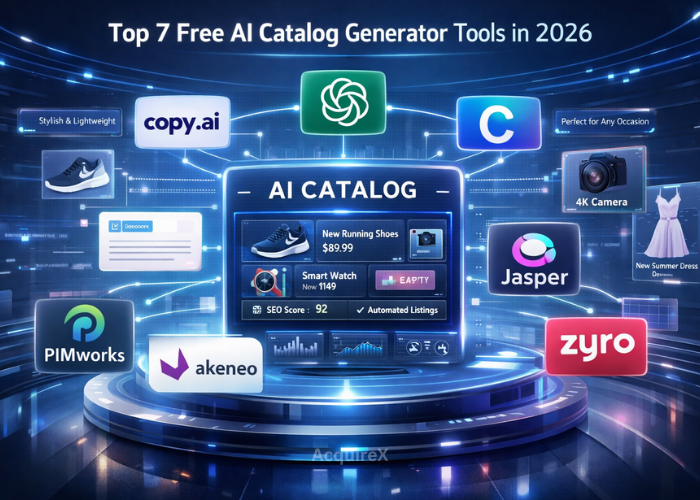
1. Copy.ai Catalog Generator
Best for: AI-powered product descriptions
Copy.ai offers a free plan that helps generate compelling product descriptions for your Artificial intelligence Catalog. It uses advanced NLP models to create engaging and conversion-focused content.
Key Features:
- Automated product descriptions
- Multi-language support
- Custom tone settings
2. ChatGPT (Free Tier)
Best for: Flexible AI Catalog content creation
ChatGPT enables businesses to create detailed product descriptions, FAQs, and catalog content. It’s highly adaptable for building a scalable Artificial intelligence Catalog.
Key Features:
- Custom prompts for catalog generation
- SEO-friendly content creation
- Versatile use cases across eCommerce
3. Canva Magic Write + Catalog Design
Best for: Visual Artificial intelligence Catalog creation
Canva combines AI writing with design tools, allowing users to build visually appealing catalogs that enhance brand identity.
Key Features:
- AI-generated content + design
- Drag-and-drop catalog templates
- Image enhancement tools
4. Jasper AI (Free Trial)
Best for: High-converting catalog copy
Jasper AI helps create persuasive product descriptions tailored for conversions, making it ideal for Artificial intelligence Catalog optimization.
Key Features:
- Conversion-focused copywriting
- Brand voice customization
- AI templates for eCommerce
5. PIMworks (Free Tier)
Best for: Product Information Management
PIMworks enhances your Artificial intelligence Catalog by managing large volumes of product data efficiently and accurately.
Key Features:
- Centralized catalog management
- Data enrichment automation
- Multi-channel publishing
6. Akeneo PIM Community Edition
Best for: Open-source catalog management
Akeneo provides a free, open-source solution to build and manage an Artificial intelligence Catalog with structured product data and scalability.
Key Features:
- Open-source flexibility
- Data quality insights
- Scalable catalog structure
7. Zyro AI Content Generator
Best for: Quick catalog content generation
Zyro offers a simple AI tool for generating product descriptions, making it useful for small businesses starting with an Artificial intelligence Catalog.
Key Features:
- Fast content generation
- Beginner-friendly interface
- Free access
Founders, Teams, and Establishment Year
Understanding the background of these tools helps build trust and credibility:
| Tool | Founder / Company | Year Established |
|---|---|---|
| Copy.ai | Paul Yacoubian & Chris Lu | 2020 |
| ChatGPT | OpenAI Team | 2015 (OpenAI) |
| Canva | Melanie Perkins, Cliff Obrecht, Cameron Adams | 2013 |
| Jasper AI | Dave Rogenmoser | 2021 |
| PIMworks | Informatica (parent ecosystem) | 2015 |
| Akeneo | Frédéric de Gombert | 2013 |
| Zyro | Hostinger Team | 2019 |
How to Choose the Right AI Catalog Tool
Selecting the right AI Catalog tool depends on your business needs:
1. Scale of Operations
Large enterprises should prioritize PIM tools like Akeneo or PIMworks for handling complex product ecosystems.
2. Content Needs
If your focus is content, tools like Copy.ai or Jasper AI are ideal for generating high-quality descriptions.
3. Budget Constraints
Free tools like ChatGPT and Zyro are perfect for startups and small businesses with limited budgets.
4. Design Requirements
For visually rich catalogs, Canva stands out with its intuitive design features.
Choosing the right Artificial intelligence Catalog tool also involves evaluating integration capabilities with your existing eCommerce platforms, such as Shopify or WooCommerce, to ensure seamless operations.
Best Practices for Using an AI Catalog
To maximize the effectiveness of your AI Catalog:
- Use consistent product attributes
- Optimize descriptions with keywords
- Regularly update catalog data
- Combine AI with human review
- Ensure multi-channel compatibility
For deeper insights into structured product data, Refer To This Guide By Google
Additionally, businesses should implement data validation processes to ensure the Artificial intelligence Catalog outputs remain accurate and aligned with brand guidelines. Regular audits can further improve catalog performance and SEO rankings.
AI Catalog Use Cases in eCommerce
1. Marketplace Listings
Automate bulk uploads on platforms like Amazon and Shopify with consistent formatting.
2. Personalized Catalogs
AI Catalog tools create tailored product recommendations based on user behavior.
3. Omnichannel Selling
Maintain consistent product data across websites, mobile apps, and marketplaces.
4. Inventory Synchronization
Real-time updates ensure accurate product availability, reducing overselling risks.
5. Localization and Global Expansion
Artificial intelligence Catalog tools can translate and adapt product content for different regions, helping brands expand globally without large localization teams.
Read All About: How AI Automation is transforming the Future of ecommerce
The Future of AI Catalog in 2026 and Beyond
The future of the AI Catalog is driven by:
- Generative AI for dynamic catalogs
- Voice and visual search integration
- Real-time personalization
- Automated multi-language catalogs
AI Catalog systems are also expected to integrate with augmented reality (AR), allowing customers to visualize products directly from catalogs. This will further enhance engagement and reduce return rates in eCommerce.
Conclusion
An AI Catalog is no longer a luxury, it’s a necessity for modern eCommerce businesses. From automating product listings to improving SEO and enhancing user experience, these tools redefine how catalogs are created and managed.
By leveraging the top free Artificial intelligence Catalog tools in 2026, businesses can streamline operations, reduce costs, and drive higher conversions. Whether you’re just starting or scaling globally, integrating an Artificial intelligence Catalog into your workflow is a strategic move toward sustainable growth.
FAQ’s
1. What is an AI Catalog in eCommerce?
An AI Catalog uses artificial intelligence to create, organize, and optimize product listings, helping businesses manage large product data efficiently.
2. How does an AI Catalog improve product listings?
An Artificial intelligence Catalog generates optimized descriptions, structures attributes, and ensures consistency, improving search rankings and conversions.
3. Are free AI Catalog tools effective for small businesses?
Yes, free Artificial intelligence Catalog tools help startups automate catalog creation, reduce manual work, and scale without high costs.
4. Which industries benefit most from AI Catalog tools?
Industries like fashion, electronics, home decor, and marketplaces benefit most due to large product inventories.
5. Can an AI Catalog improve SEO rankings?
Yes, an Artificial intelligence Catalog boosts SEO with optimized descriptions, structured data, and consistent metadata for better Google rankings.