
Knowledge Process Outsourcing is rapidly becoming one of the most strategic levers for e-commerce brands seeking faster, smarter, and more sustainable growth.
As competition intensifies and operational complexity increases, businesses need more than basic outsourcing, they need advanced, insight-driven support that accelerates decision-making, reduces cost, and enhances customer value. This is exactly what Knowledge Process Outsourcing delivers.
Below is an in-depth, expanded, and highly detailed guide tailored specifically for the e-commerce industry.
What Is Knowledge Process Outsourcing?
Knowledge Process Outsourcing refers to delegating high-value, expertise-driven tasks to specialized external teams. Unlike BPO, which focuses on repetitive or transactional work, KPO handles strategic, analytical, and decision-support functions.
E-commerce companies use Knowledge Process Outsourcing to strengthen areas like product research, competitor analysis, category planning, pricing algorithms, customer insights, financial modeling, and marketplace performance optimization.
Because e-commerce operates in a fast-paced and data-heavy environment, KPO enhances accuracy, efficiency, and business intelligence, without requiring internal teams to scale endlessly.
Read All In Detailed: Wikipedia
Why Knowledge Process Outsourcing Is Transforming E-commerce
E-commerce players face challenges such as managing dynamic pricing, real-time inventory, complex supply chains, and customer expectations for fast delivery and personalized shopping experiences.
Here’s why the shift toward Knowledge Process Outsourcing is accelerating:
- Rising operational costs
- Need for advanced analytics
- Pressure for faster decision-making
- Competitive marketplace saturation
- Shorter product life cycles
- Global customer demand
KPO provides access to experts, technologies, and industry insights that help e-commerce brands solve these challenges faster and at a lower cost.
Top 7 Benefits of Knowledge Process Outsourcing for E-commerce
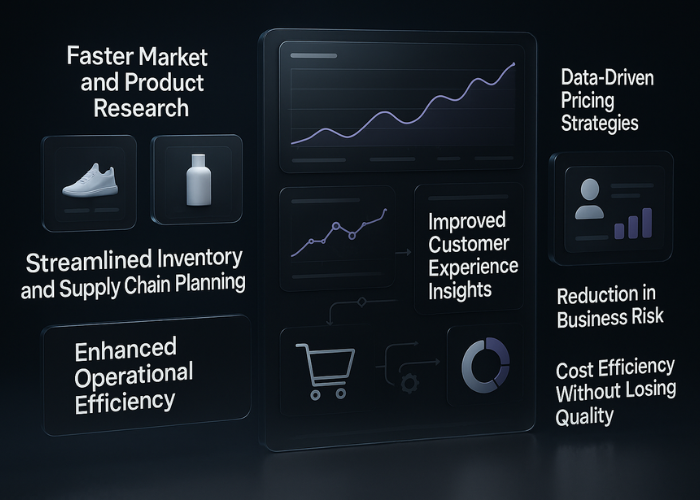
1. Faster Market and Product Research
E-commerce success relies on accurate product research, demand forecasting, competitor price tracking, and trend analysis.
KPO teams use advanced tools and research methodologies to deliver high-quality insights, enabling faster and more confident product launches.
2. Data-Driven Pricing Strategies
Dynamic pricing is essential in marketplaces like Amazon, Flipkart, and Meesho.
Knowledge Process Outsourcing provides e-commerce companies access to pricing experts who analyze:
- competitor movements
- customer buying patterns
- inventory levels
- seasonal demand
This ensures optimal pricing, maximizing conversions and margins.
Read All About: Top 5 Pricing Strategies
3. Streamlined Inventory and Supply Chain Planning
Poor inventory management results in stockouts, overstocking, and loss of revenue.
KPO teams support:
- forecasting
- vendor analytics
- demand planning
- risk analysis
Their insights help brands maintain lean, efficient, and profitable inventory structures.
Read All About: Supply Chain Management and check out our Services
4. Improved Customer Experience Insights
KPO specialists analyze customer behavior using:
- sentiment analytics
- cohort analysis
- buying patterns
- cart abandonment data
This helps brands personalize shopping experiences and reduce churn.
5. Enhanced Operational Efficiency
Knowledge Process Outsourcing reduces internal workload by managing complex analytical tasks such as:
- performance dashboards
- marketing attribution
- marketplace margin breakdowns
- category profitability
This allows e-commerce teams to focus on strategy rather than manual analysis.
6. Reduction in Business Risk
With expert-backed insights, e-commerce companies can anticipate:
- supply chain disruptions
- competitor threats
- product quality risks
- regulatory or compliance needs
This proactive approach helps brands save time, money, and resources.
7. Cost Efficiency Without Losing Quality
Instead of hiring full-time specialists, companies can scale KPO services as needed.
Costs reduce significantly while quality increases because teams are staffed with domain experts.
How to Choose the Right KPO Partner for Your E-commerce Business
Choosing the right Knowledge Process Outsourcing provider is crucial for maximizing ROI and ensuring long-term operational success. Below is an expanded and detailed framework to evaluate and select the ideal KPO partner.
1. Check Industry-Specific Expertise
A good KPO partner must understand:
- marketplace algorithms
- catalog optimization
- logistics efficiency
- e-commerce financial models
- product lifecycle strategies
General outsourcing firms won’t deliver the depth required for e-commerce complexity.
2. Review Technology and Tools
Your KPO provider should use advanced tools such as:
- price intelligence platforms
- analytics dashboards
- forecasting models
- automation tools
- AI-driven decision engines
This ensures accuracy, speed, and continuous improvement.
3. Evaluate Team Capabilities
Ask about:
- years of experience
- certifications
- specialization in e-commerce
- research methodologies
- reporting formats
The more skilled the team, the more actionable the insights.
4. Data Security Compliance
KPO requires handling sensitive information like customer data, marketplace metrics, and financial reports.
Ensure the vendor follows:
- NDAs
- ISO compliance
- GDPR guidelines
- secure cloud storage
This safeguards your brand and customer trust.
5. Scalability and Flexibility
A strong KPO partner grows with your business.
They should offer flexible models such as:
- hourly research
- monthly retainers
- dedicated analyst teams
- on-demand project support
Scalability ensures long-term collaboration and stability.
6. Quality of Reporting and Insights
KPO is not about providing data, it’s about providing actionable insights.
Evaluate their sample reports and dashboards to ensure clarity, visual accuracy, and strategic depth.
7. ROI and Performance Metrics
Ensure the vendor clearly defines:
- KPIs
- timelines
- success metrics
- cost benefits
A data-driven KPO partner should demonstrate measurable ROI within the first few months.
The Right Partner – Offshore, Not Just Hiring— But Delivery of Your Operations With Us
How Knowledge Process Outsourcing Supports E-commerce Scalability
In e-commerce, scaling profitably is more challenging than scaling fast.
As order volumes grow and product categories expand, internal teams struggle to maintain control over operations, analytics, and decision workflows.
Knowledge Process Outsourcing fills these gaps by providing:
- dedicated analytics specialists
- marketplace optimization experts
- catalog research teams
- financial and compliance analysts
- AI-driven operational support
This allows brands to scale without hiring dozens of new employees, making growth more predictable, profitable, and structured.
KPO is especially useful for companies entering new markets, expanding SKUs, or optimizing multi-channel operations.
Conclusion
Knowledge Process Outsourcing has become essential for e-commerce brands aiming to operate smarter, faster, and more profitably.
By leveraging expert insights, advanced analytics, and cost-efficient research support, businesses can accelerate decision-making, improve customer experience, and reduce operational risk.
For companies seeking long-term scalability, KPO isn’t just an outsourcing tactic, it’s a competitive advantage that transforms how e-commerce businesses function in a data-first world.
FAQ’s
1. What is Knowledge Process Outsourcing in e-commerce?
Knowledge Process Outsourcing in e-commerce refers to outsourcing high-value tasks like product research, pricing analysis, customer insights, and market intelligence to specialized expert teams.
2. How does Knowledge Process Outsourcing help e-commerce businesses grow?
KPO provides advanced analytics, faster market research, optimized pricing, and better decision-making support, helping e-commerce companies scale operations and improve profitability.
3. What activities can be outsourced through Knowledge Process Outsourcing?
E-commerce brands outsource tasks such as product trend research, dynamic pricing, competitor analysis, catalog optimization, customer analytics, and financial modeling.
4. Why should e-commerce companies choose KPO instead of regular BPO services?
KPO offers expert-driven insights and strategic functions, while BPO handles basic, repetitive tasks. This makes KPO more suitable for data-heavy e-commerce operations requiring intelligent decision support.
5. How do I choose the right Knowledge Process Outsourcing partner?
Evaluate expertise in e-commerce, analytical capabilities, data security, reporting quality, use of technology tools, and scalability before selecting a KPO partner.