Choosing the wrong ecommerce outsourcing partner is one of the most expensive mistakes an online brand can make. Bad reviews pile up, product pages break, support tickets go unanswered, and customers quietly leave for your competitors.
If you are about to hire an outside team to run parts of your online store, this guide will help you make a smart decision the first time.
At AcquireX, we have worked with ecommerce brands across Shopify, WooCommerce, BigCommerce, and Amazon. We have seen what separates the great ecommerce outsourcing companies from the ones that promise the moon and deliver a mess. This 2026 guide breaks down exactly how to choose an ecommerce outsourcing partner who will actually move your business forward.
What Is Ecommerce Outsourcing
Ecommerce outsourcing means hiring a third-party provider or agency to handle specific tasks inside your online store so your internal team can focus on strategy and growth. Instead of building every function in-house, you rent specialized skills by the hour, project, or monthly retainer.
Common tasks you can outsource to an ecommerce BPO or agency:
- Product listing and catalog management
- Customer support across email, chat, phone, and social media
- Order processing and fulfillment coordination
- SEO and content writing
- Paid ads on Meta, Google, and TikTok
- Shopify, WooCommerce, or BigCommerce store design and development
- Inventory management and supplier coordination
- Graphic design and AI product photography
- Returns, refunds, and reverse logistics
- Data entry, reporting, and analytics
If you cannot name the exact task in one sentence, you are not ready to hire an ecommerce outsourcing company yet. “I need help with my store” is not a scope of work. “I need someone to respond to 80 customer tickets per day within 4 hours” is a real brief.
Types of Ecommerce Outsourcing Partners
Not all ecommerce outsourcing services are built the same. Understanding the type of partner helps you match the right one to your business goals.
Freelancers — a single person, the cheapest option, great for small one-off tasks. Risky for anything ongoing because when they get sick or disappear, your work stops.
Boutique ecommerce agencies — 5 to 30 people, usually specialized in one area like Shopify development or performance marketing. High quality and real accountability at a higher price.
BPO (Business Process Outsourcing) companies — large teams of 100 or more, usually offshore, best for high-volume repetitive work like customer support or data entry. Lower cost per hour, less flexibility. Learn more about how BPO process outsourcing powers ecommerce growth.
Full-service ecommerce agencies — handle strategy, design, development, ads, and content under one roof. More expensive but efficient if you want one partner accountable for everything.
Onshore vs nearshore vs offshore:
- Onshore (same country) — highest cost, best communication, zero timezone issues
- Nearshore (neighboring country) — mid cost, small timezone gap, strong cultural fit
- Offshore (India, Philippines, Eastern Europe) — lowest cost, bigger timezone gap, often excellent technical skills
There is no universal best option. The best ecommerce outsourcing partner is the one that matches your budget, your timezone, and your risk tolerance.
Why Brands Outsource in the First Place
Before you shortlist any vendor, get honest about why you want to outsource. Your reason shapes the type of partner you should pick.
- Cost savings — you cannot afford full-time in-house hires
- Fast scaling — traffic is growing and your in-house team cannot keep up
- Specialized skills — you need SEO, paid ads, or development expertise you do not have
- Freeing founder time — you are drowning in operational work instead of growing the business
- 24/7 coverage — customers message at 2 AM and you need real replies
If your reason is “everyone else is doing it,” stop. That is not a valid reason to hand over part of your business.
9 Things That Actually Matter When Choosing an Ecommerce Outsourcing Partner
1. Real ecommerce experience, not generic digital marketing experience
Ask how many Shopify, WooCommerce, BigCommerce, Amazon, or Magento stores they have worked on in the last 12 months. Vague answers are a red flag. A general marketing agency will learn ecommerce on your budget.
2. Proof you can actually verify
Case studies are nice. Live store URLs and client references are better. Ask: “Can I get on a 10-minute call with one of your current clients?” If they dodge this, walk away. Real agencies have happy clients who will talk.
3. Transparent pricing with no surprise fees
Good partners tell you: “This costs $X per month for Y deliverables, and here is what is not included.” Bad ones say: “It depends, let us jump on another call.” Always get a written scope of work and pricing before you sign.
4. Communication that fits your timezone
If you are in New York and replies come 14 hours later with “Kindly revert,” that will hurt. Agree on response times in writing. Daily standups, weekly reports, and shared Slack channels are all good signs of a mature vendor.
5. A real team, not one freelancer in disguise
Ask who will actually work on your account. Names, roles, and backups when someone is on leave. Many small agencies are actually one founder juggling ten clients at once. For more on building strong remote teams, see how to manage remote IT teams.
6. They ask you hard questions back
A good partner interviews you as much as you interview them. They want to know your margins, your KPIs, your brand voice, and your competitors. If they say yes to everything in the first sales call, they will say yes to chaos later.
7. Data security and legal fundamentals
Your outsourcing partner will touch customer data, payment info, and supplier contracts. Make sure they cover:
- NDA (non-disclosure agreement) signed before any work starts
- GDPR compliance if you sell in Europe
- PCI compliance if they touch payment data
- Password management through tools like 1Password or Bitwarden
- Least-privilege access to your Shopify admin, ad accounts, and databases
8. Modern tools and tech stack
A capable ecommerce outsourcing partner should be fluent in the tools you already use: Shopify, Klaviyo, Gorgias, Zendesk, ClickUp, Slack, Notion, Google Analytics 4, and Meta Business Manager. If they ask “what is Klaviyo?” when you mention email flows, keep looking.
9. A clean exit clause
Start with month-to-month or short contracts. No partner should lock you into a 12-month commitment before they have proven themselves. A confident vendor does not need a long contract to hold you hostage.
Red Flags I Have Personally Seen When Hiring Ecommerce Outsourcing Companies
- Portfolios full of stores that no longer exist or redirect to unrelated domains
- “We worked with [huge brand]” without being able to show what they specifically did
- Account managers who change every month
- No documented process for handoffs, reporting, or escalations
- Promises like “guaranteed #1 Google ranking” or “10x ROAS in 30 days” — nobody can promise this
- High-pressure sales calls that feel like used-car deals
- Refusing to do a small paid trial project
- Typos and grammar mistakes in the proposal itself
- Demanding full upfront payment for ongoing work
- No written service level agreement (SLA)
How Much Does Ecommerce Outsourcing Actually Cost in 2026
Here is a realistic range for what you will pay for ecommerce outsourcing services this year. Prices vary by region and skill level.
- Virtual assistant / data entry — $6 to $15 per hour
- Customer support agent — $8 to $20 per hour
- Shopify developer — $25 to $100 per hour
- SEO content writer — $0.10 to $0.50 per word, or $50 to $150 per article
- Paid ads management — $500 to $5,000+ per month, or 10 to 20% of ad spend
- Full-service agency retainer — $2,000 to $20,000+ per month
- Fractional ecommerce manager or COO — $1,500 to $8,000 per month
Cheaper is not always better. I have seen $5-per-hour virtual assistants cost brands thousands in lost sales because they handled support tickets poorly. I have also seen $100-per-hour developers deliver less than a $30-per-hour one. Judge partners by output, not hourly rate.
In-House vs Outsourced: What to Keep and What to Delegate
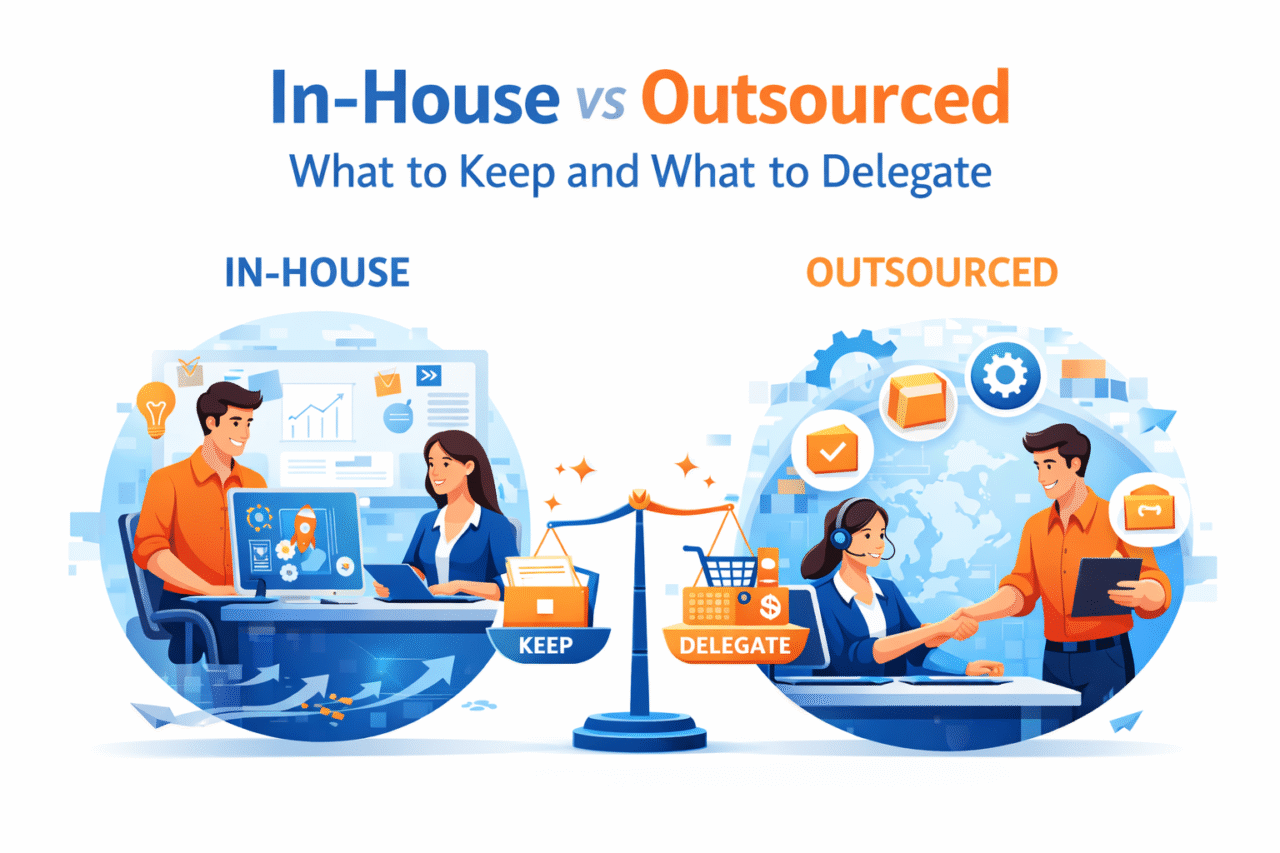
Not every task should be outsourced. Here is the simple rule we recommend:
Keep in-house:
- Strategy and long-term vision
- Brand voice and core messaging
- High-value customer relationships
- Sensitive financial decisions
- Anything that gives you a real competitive advantage
Outsource with confidence:
- Repetitive operational tasks
- Work with clear, measurable outputs
- Skills you do not have and do not need to master
- Night shift or weekend coverage
- High-volume support or data work
If you outsource strategy, you become a puppet for your agency. If you keep everything in-house, you burn out. The sweet spot is in the middle. For more context, check out our guide on sustainable business growth strategies for ecommerce.
The 5-Step Framework to Choose Your Ecommerce Outsourcing Partner
Follow this exact selection process and you will avoid 90% of hiring mistakes.
- Write a one-page brief — scope of work, budget, timeline, KPIs, and your current tech stack
- Shortlist 3 to 5 agencies — from referrals, LinkedIn, and founder communities, not Google ads
- Run a paid trial project — small, 2 to 4 weeks, with real deliverables
- Score them on delivery, communication, and initiative — not just the final output
- Sign month-to-month first — only commit to longer contracts after they have earned it
This framework alone will save you months of pain and thousands of dollars in lost opportunity.
Questions to Ask on the Sales Call
Write these down and ask every single one.
- Who exactly will work on my account daily?
- Show me a client dashboard or weekly report you send.
- What happens if I am unhappy after 30 days?
- What is one thing you would refuse to do even if I paid extra?
- Tell me about a client project that went badly and what you learned.
- How do you store passwords and access credentials?
- What is your average client tenure?
- Can I speak with one current client and one past client?
- Which project management tools do you use?
- What is your guaranteed response time during business hours?
The “bad project” question is the most revealing. Honest agencies have a story ready. Dishonest ones freeze up or claim they have never had a bad project (which is a lie).
Do Not Skip the Paid Trial Project
A 2-week paid trial will teach you more than ten sales calls. In that short window you will learn:
- How fast they actually respond
- How clean and accurate their work is
- Whether they follow instructions or go rogue
- If they ask smart questions or just say “noted”
- How they handle feedback and revision rounds
- Whether the team you met on the pitch call is the same team doing the work
Pay fairly for the trial. Cheap trials attract cheap effort. Budget between $500 and $2,000 for a meaningful trial project that reveals the truth.
How to Onboard Your New Ecommerce Outsourcing Partner
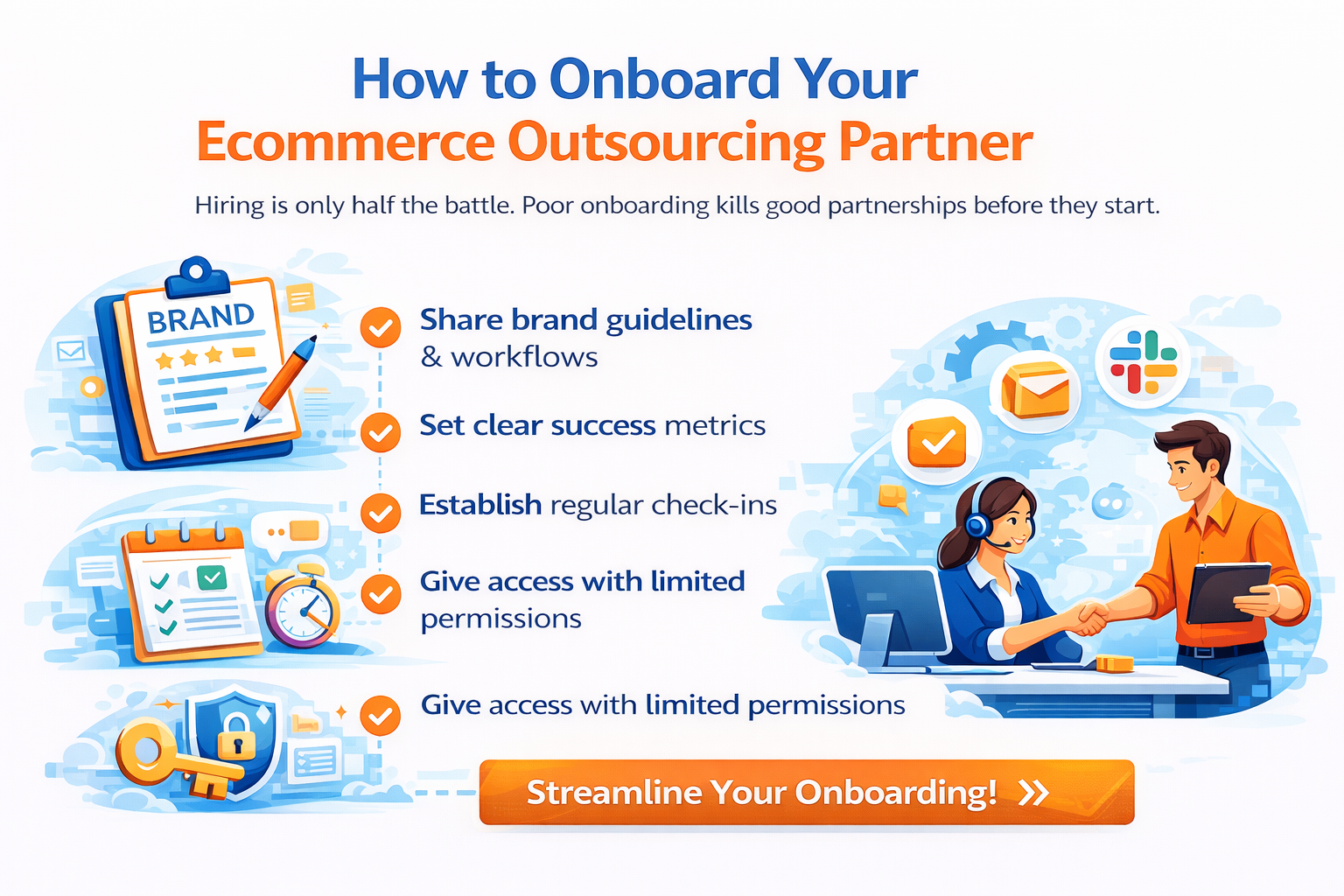
Hiring is only half the battle. Poor onboarding kills good partnerships before they start.
- Create a shared brand doc with guidelines, tone of voice, and examples of good and bad output
- Record Loom videos walking through your store, your processes, and your common problems
- Add them to Slack or your comms platform on day one
- Set weekly check-ins for the first month, then biweekly after that
- Define success metrics upfront — response time, sales lift, traffic growth, conversion rate
- Give access with least privilege — never hand over full admin on day one
- Document everything in a shared Notion or Google Drive
A solid onboarding week saves six months of confusion and rework.
Frequently Asked Questions
What is the difference between ecommerce outsourcing and hiring a freelancer?
Ecommerce outsourcing usually means working with an agency or BPO that has a trained team, documented processes, and backup coverage. A freelancer is one individual. Agencies cost more but offer more reliability and scalability.
How long should my first outsourcing contract be?
Start with a month-to-month agreement or a 2 to 4 week paid trial project. Only sign longer contracts after the partner has proven their quality and communication.
Is offshore ecommerce outsourcing worth it?
Yes, when done carefully. Offshore teams in India, the Philippines, and Eastern Europe often deliver excellent work at lower costs. The main risks are timezone gaps and communication style differences, which can be managed with clear SLAs.
What should I never outsource in my ecommerce business?
Never outsource brand strategy, high-value customer relationships, or anything that gives you a unique competitive edge. Also avoid outsourcing work you do not understand yourself, because you cannot judge quality.
How do I protect my store data when outsourcing?
Sign an NDA, give lowest-permission access, use a password manager, enable two-factor authentication, and immediately remove access when a contract ends.
How much should I budget for ecommerce outsourcing?
For small stores, $500 to $2,000 per month is realistic for one function like support or content. For growing brands, $3,000 to $10,000 per month across multiple functions is common.
What if the outsourcing partnership is not working?
Have an honest one-on-one conversation first. If nothing changes in two weeks, end it using your exit clause. Do not drag bad partnerships along.
Can I hire multiple ecommerce outsourcing partners at once?
Yes, and many brands do. One agency for paid ads, another for SEO content, a VA team for support. Just ensure clear ownership and no overlap between scopes.
Final Thoughts
Your outsourcing partner becomes part of your brand whether you like it or not. A bad customer reply, a typo on a product page, a botched ad campaign — it all has your logo on it, not theirs. Choose slowly. Trial small. Trust only after they have earned it.
The best ecommerce outsourcing partnerships we have seen at AcquireX start with one small project, clear expectations, and a founder who stays involved. The worst ones start with a big retainer, a long contract, and a founder who disappears hoping the agency will handle everything on autopilot.
Your next step: Before you contact a single agency this week, write the one-page brief we mentioned at the start. If you cannot fill it out clearly, no partner on earth can help you. Start there, shortlist three vendors, run a paid trial, and let the work speak for itself.
Ready to scale your online store with a proven team? Get in touch with AcquireX to discuss your ecommerce outsourcing needs.