Scale Shopify Brand 7 to 8 Figures: The Operator Playbook
Table of Contents
Quick answer: Most 7-figure US Shopify brands plateau because their operations break before their marketing does. Vendor sprawl, no metric owners, a stalled product catalog, slow customer support, and US-priced hiring stack up between $1M and $5M. Brands that scale to 8 figures replace these cracks with dedicated, accountable teams that own outcomes — not tasks.
You hit $1M. Then $3M. Then $5M.
Then something weird happens. You spend more on ads. Revenue doesn’t move. Your inbox is on fire. Your team looks busy but nothing ships. You’re running harder to stay in the same place.
If that sounds like you, you’re not broken. You’re stuck in the most predictable trap in DTC ecommerce: the 7-figure operational ceiling. It shows up in almost every US Shopify brand doing $1M to $8M a year. The good news — it’s fixable. The bad news — you can’t fix it by hiring another agency or shipping another creative.
This is the operator playbook for what actually breaks at 7 figures, and what it takes to scale a Shopify brand from 7 to 8 figures in 2026.
TL;DR — What you’ll get from this guide
Why 7-figure DTC brands plateau (with the real CAC and retention math)
The 5 operational cracks that quietly kill $1M–$8M Shopify stores
A 60-day fix-it framework you can run starting Monday
The “8-Figure Operating System” that brands like Bombas, Allbirds, and Gymshark all use
The exact Shopify apps, hires, and partners that move AOV, LTV, and CAC
An FAQ + checklist you can save and share with your team
If you’re a US Shopify founder doing $1M to $10M annually and growth has stalled, this is for you.
Why 7-figure Shopify brands hit the wall
The honest answer: You didn’t reach $3M because your operations were great. You got there because your product was great, and you got lucky with one or two channels. That’s it.
But the unit economics that worked at $1M don’t work at $5M. The math has changed under your feet:
Ecommerce customer acquisition cost is up roughly 40% in the last two years and about 60% higher than five years ago.
Average Shopify CAC is around $318 today, up from $274 a year earlier — a 16% jump across all merchants.
Google Shopping CPCs jumped 33% in 2025 alone, and Meta CPMs hit all-time highs around $22.98 in Q4.
88% of DTC subscription brands reported higher acquisition costs in 2025 than 2024.
In plain English: the same ad budget buys fewer customers, those customers cost more, and the gap has to be made up somewhere. The only three places left are AOV, repeat purchase rate, and operational efficiency — three things 7-figure brands almost always neglect because the founder is too busy putting out fires.
That’s the plateau.
How do I know if my brand has hit the operational ceiling?
You’ve hit the 7-figure operational ceiling if you nod at 3 or more of these:
You’ve added 3+ agencies but blended ROAS is still falling
Customer support tickets are 48+ hours late
Your catalog has product pages from 2022 nobody has touched
You personally approve every creative, every email, every PO
New hires take 4 months to become useful
Nobody can tell you who owns CAC, LTV, or inventory turn
Black Friday gives you a panic attack every September
You’re working 70 hours and revenue is flat
If three or more apply, you don’t have a marketing problem. You have an operations problem dressed up as a marketing problem.
The 5 cracks that break Shopify brands between $1M and $10M
None of these show up in a CAC dashboard. All of them show up in your P&L.
Crack 1: The vendor stack trap
What it is: At $1M, you’re hiring fast. You grab a Meta ads agency, a Klaviyo freelancer, a Shopify dev shop, a creative studio, a CRO consultant, a logistics partner, a 3PL, and a part-time CX rep. By $3M, you have 8+ vendors. None of them talk to each other.
Every vendor is doing their job. But the system has no owner. When CAC moves, nobody can tell you why. The ads agency blames the landing page. The CRO consultant blames the creative. The 3PL blames the SKU file. You’re stuck refereeing instead of building.
The fix: Stop managing vendors. Build a system. You need a dedicated team that owns outcomes, not tasks — one team running creative, ads, CRO, email, and reporting to one number: contribution margin. This is exactly the gap AcquireX’s performance marketing and growth team fills for scaling Shopify brands.
Crack 2: You’re the bottleneck (and you don’t know it)
Quick test: Open Slack right now. Count how many threads say “@founder can you approve?”
That number is your real ceiling.
If every decision ends at your desk, your company can’t grow past how much you can read in a day. Most founders don’t notice until they take a 5-day vacation and the business limps along like a car with a flat tire.
Beardbrand’s founder Eric Bandholz has talked about this exact moment in his own scale to $10M — the day he realized he was the bottleneck was the day he hired his first dedicated operations lead. Same story at Bombas. Same story at Gymshark when Ben Francis stepped out of day-to-day to bring in a CEO.
The fix: Build a decision-rights map. List every recurring decision in the business. Then ask one question for each: Does this actually need me? You’ll find roughly 80% of them don’t. Hand them to clear owners with a budget, a metric, and a deadline. Review outcomes, not work.
Crack 3: Your product catalog is rotting
What it looks like: You launched 40 SKUs over 3 years. The top 10 print money. The bottom 30 are running on:
Product photos from 2022
Description copy you wrote at 2 AM
No A+ content on Amazon
No alt text or structured data
No video
Inventory mismatches between Shopify, Amazon, Walmart, and your 3PL
Title tags that don’t match what customers actually search
Every dead SKU drags your site speed, your SEO, and your conversion rate. Google sees a stale store. Customers see “out of stock” on your bestsellers and bounce.
Why it matters: US retail returns hit $890 billion in 2024 — about 17% of total retail sales. A huge chunk of returns traces back to mismatched product pages, misleading images, and wrong size or spec data. Catalog hygiene is profit margin.
The fix: Your catalog needs a dedicated owner — not a freelancer with a Notion doc. A real catalog management operation audits every SKU monthly, refreshes imagery, syncs inventory across Shopify and marketplaces, and treats your PDPs like a product, not a checklist. For Amazon and Walmart specifically, a dedicated marketplace management team is often the difference between $2M and $5M on those channels.
Crack 4: Customer support is bleeding LTV (and you can’t outspend it)
The retention math every 7-figure founder should know:
A 5% increase in customer retention can drive 25%–95% more profit.
Acquiring a new customer costs 5 to 25 times more than keeping an existing one.
The probability of selling to an existing customer is 60–70%. For a new prospect, it drops to 5–20%.
So if support is broken — slow replies, untrained reps, no script consistency — you’re not just frustrating customers. You’re kneecapping LTV, which is the only thing that lets you outbid competitors on Meta. In a 40%-CAC-inflation world, LTV is the moat.
At 7 figures, support volume explodes. You hire a freelancer. They quit. You hire another. They take 4 weeks to learn your product. Every refund request, shipping question, and angry DM is hurting your repeat purchase rate and your blended MER.
The fix: Treat support like a profit center. You need a trained team running real SLAs, branded scripts, Gorgias or Zendesk macros, and reporting tied to repeat purchase rate. AcquireX’s customer service management team is built for this exact stage. For the metrics that actually predict retention, AcquireX’s deep dive on ecommerce customer support KPIs breaks down the 12 numbers that matter.
Crack 5: US hiring is killing your margins
The math: A mid-level marketer in New York or LA costs you $90K base + benefits + tools + 6 months of ramp. For a $3M brand running at 15% net margin, that’s one hire eating ~20% of your annual profit. If they leave in 12 months, you start over.
So you post on LinkedIn. You interview 40 people. You hire 2. One quits in 90 days. The other takes 6 months to ramp. Meanwhile your competitors are shipping.
The fix: Build offshore — not freelancers, but dedicated, full-time teams. A senior catalog manager, an Amazon PPC specialist, a creative producer, a CX lead — all working your hours, in your tools, embedded in your business. This is the entire model AcquireX is built on — and it’s why a $3M Shopify brand can run an 8-person operations team for roughly the cost of one US hire.
The 8-Figure Operating System: how brands that cross $10M are structured
What do 8-figure Shopify brands do differently? It’s not a hack. It’s a structure. Every brand I’ve seen cross $10M — from Bombas to Allbirds to Gymshark — runs some version of the same operating model.
Here’s the structural shift:
Function
7-Figure Brand
8-Figure Brand
Marketing
2–3 agencies, no central owner
One growth team, one P&L view
Catalog
Founder + VA on Notion
Dedicated catalog ops, monthly audits
Marketplaces
“We’re focused on Shopify”
Active on Amazon, Walmart, marketplace-specific PPC
Owned brief library, in-house design ops, weekly UGC cycle
Decisions
Founder approves everything
Decision rights mapped, founder reviews outcomes
Reporting
8 dashboards, no single number
One P&L view, one north-star metric per team
Notice what’s not on this list: a magic creative, a secret hack, a Shopify app. 8-figure brands beat 7-figure brands at the boring stuff. Boring is the moat.
The 60-day playbook to break the 7-figure ceiling
Forget frameworks. Here’s exactly what to do over the next 60 days.
Week 1: Map your chaos
List every vendor and what they cost per month
List every metric that matters: CAC, blended MER, LTV, repeat purchase rate, AOV, refund rate, ticket response time, contribution margin, inventory turn
Write down who owns each metric — by name
If a metric has no owner, circle it in red
Most founders find half their metrics have no owner. That’s the real work.
Week 2: Cut the vendor sprawl
For every vendor ask: “If I cut this tomorrow, what breaks?”
If nothing breaks — cut it
If something breaks — can one team absorb this plus two other things?
Most brands cut 30% of vendor spend in this exercise without losing output. That cash funds the next step.
Week 3: Plug the AOV and retention leaks
This is the fastest revenue you’ll find. Your traffic and conversion rate are probably fine. Your AOV and repeat rate are bleeding.
Specific Shopify moves that work right now in 2026:
Install a slide cart with free gifts and upsells.Oxify Cart Drawer & Upsells is the cleanest option in 2026 — slide cart upsell, free gifts, BOGO, and post-purchase upsell all in one Built-for-Shopify app. Most brands see an 8–15% AOV lift within 30 days with no dev work.
Set free shipping thresholds $12 above your median AOV — a rule top operators like Bombas and ColourPop use to nudge cart value up without killing conversion.
Add a one-click post-purchase upsell native to Shopify checkout (ReConvert, Zipify OCU, or Oxify’s built-in post-purchase module).
Set up a 60-day win-back Klaviyo flow for customers who haven’t ordered. Bombas runs 11 automated Klaviyo flows — their welcome series alone converts above 9%.
Run a quarterly catalog audit and kill the bottom 20% of SKUs by margin.
If you’re not on Amazon yet — start. Marketplace expansion is the single biggest channel diversification move at the 7-figure stage.
You don’t need another CRO agency for any of this. You need someone whose job is to actually do it. Most founders read 50 newsletters and ship none of it. Pick three bullets above. Ship them this month.
Weeks 4–8: Build the operating system
This is where most founders stop reading. Don’t. The boring work below is where the next $5M lives.
You need three roles owning outcomes, not tasks:
Growth Operator — owns paid + organic + email + CRO + reports on contribution margin per channel
Catalog & Marketplace Operator — owns every SKU across Shopify, Amazon, Walmart, Faire (or your channel mix)
CX & Retention Operator — owns response time, repeat rate, NPS, and LTV
Whether you build these in-house or with a partner like AcquireX, the structure is non-negotiable. No system, no scale.
The Shopify app stack that actually moves the needle in 2026
Most founders waste time chasing tools. These are the ones 8-figure brands actually use:
Yotpo — reviews, loyalty, and SMS in one stack (Bombas, ColourPop)
Reviews and UGC:
Yotpo, Okendo, Junip
CX desk:
Gorgias or Zendesk (not Shopify Inbox at this size)
Marketplace PPC:
Helium 10 + Pacvue for Amazon and Walmart
Profit dashboards:
Triple Whale or Lifetimely — one source of truth for blended MER and LTV
Inventory and POs:
Cogsy or Inventory Planner
Stack discipline matters more than tool choice. If you have 4 analytics tools, you have zero analytics tools — because nobody trusts any of them.
What 8-figure Shopify founders do that 7-figure founders don’t
I’ve talked to dozens of US Shopify founders sitting on either side of the $10M line. The 8-figure ones are not smarter. They don’t have better creative. They don’t have a secret hack.
Here’s what they actually do differently:
One team, one P&L view. Not 8 agencies and 4 dashboards.
Clear owners on every metric. When CAC moves, somebody’s phone rings — and it’s not the founder’s.
A catalog that’s treated like a product. Updated monthly. Alive across every channel.
A support team that knows the brand voice. Not a rotating freelancer in a different timezone.
A founder who isn’t the bottleneck. They review outcomes, not work.
A “buy back time” mindset. Every hire is judged on hours of founder time freed, not just output.
Marketplace presence. Bombas, Allbirds, ColourPop, and Beardbrand all built strong Amazon and retail channels on top of Shopify — they didn’t pick one channel and pray.
That’s it. The boring stuff is the moat.
The honest truth about scaling past $5M
You can keep hiring agencies. You can keep buying courses. You can keep pulling 70-hour weeks.
Or you can build the system.
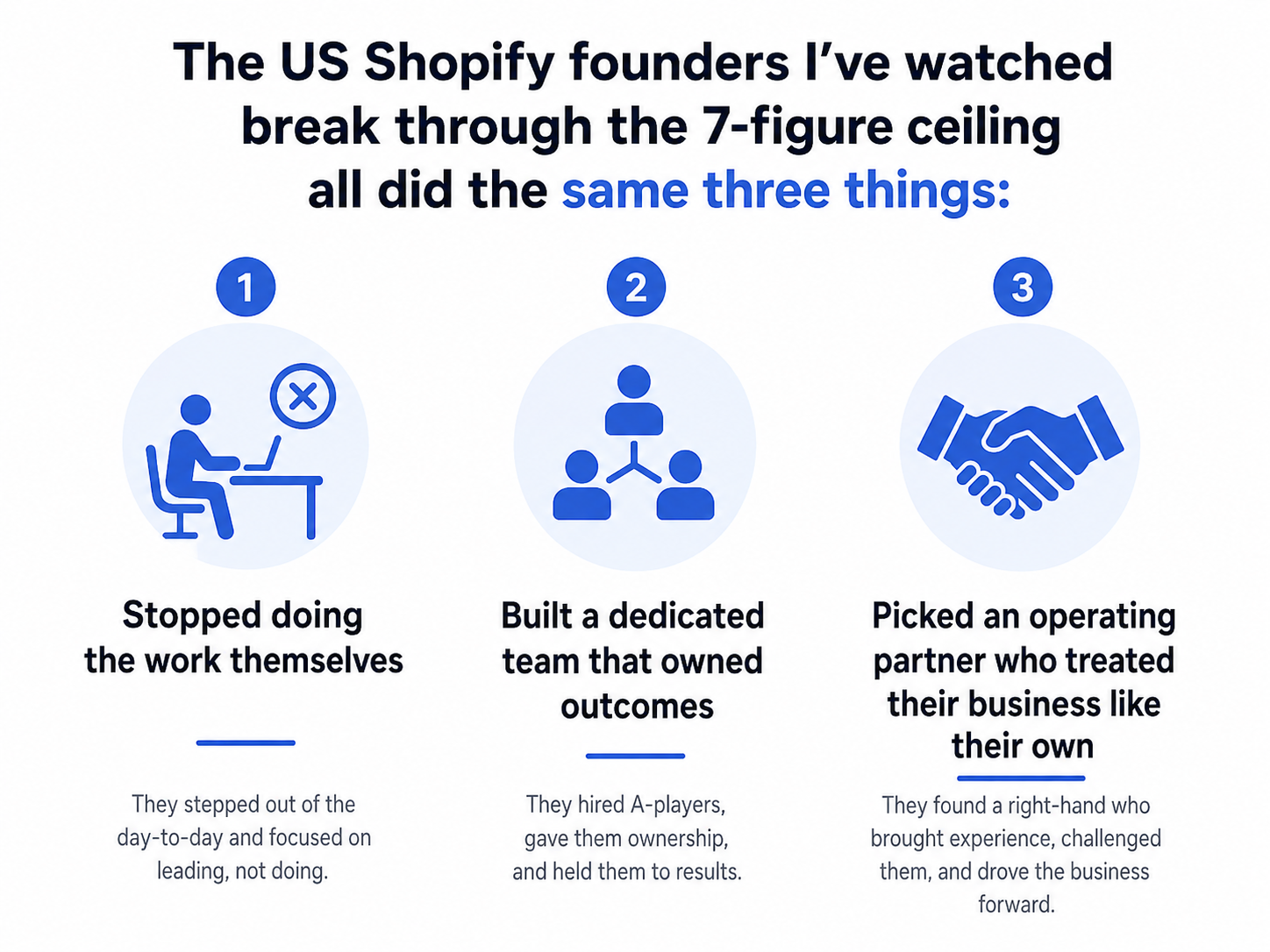
The US Shopify founders I’ve watched break through the 7-figure ceiling all did the same three things:
Stopped doing the work themselves
Built a dedicated team that owned outcomes
Picked an operating partner who treated their business like their own
If you’re stuck somewhere between $1M and $8M and tired of stitching together vendors that don’t move the needle, this is the conversation worth having.
What to do next
If you’ve read this far, you’re either:
A founder feeling all of this in your chest right now, or
Someone about to hire your 9th agency
Don’t hire the 9th agency.
Talk to a team that becomes part of your business. AcquireX builds dedicated offshore ecommerce teams for scaling Shopify brands — covering marketplace management, performance marketing, catalog, CX, supply chain, design, and HR — for less than the fully loaded cost of one US hire.
Book a 30-minute call here. If you’re a fit, we’ll map exactly what to fix in your ops. If you’re not, we’ll tell you what to do anyway.
You didn’t build this brand to be the bottleneck. Let’s go build the system.
FAQs
Why do most Shopify brands plateau at 7 figures?
Most 7-figure Shopify brands plateau because their operations don’t scale with their revenue. They scale on founder energy, not systems. By $3M–$5M, the founder is the bottleneck, vendors don’t talk to each other, the catalog is stale, and nobody owns the key metrics. It’s an operations problem dressed up as a marketing problem.
Is the fix more ad spend?
Almost never. Most stalled 7-figure brands have healthy ROAS on their best creatives — they have broken retention, leaky catalogs, slow support, and rising CAC eating their margins. With ecommerce CAC up roughly 40% in two years, scaling spend without fixing leaks just accelerates the burn. Fix operations first, then scale media.
How long does it take to scale a Shopify brand from 7 to 8 figures?
A clean operations audit takes one week. Cutting vendor sprawl takes another two. Building a real dedicated team takes 30–60 days. Most brands feel revenue impact within one quarter and break the operational ceiling within 12–18 months — assuming they actually do the work.
Why dedicated teams instead of agencies?
Agencies own tasks. Dedicated teams own outcomes. When your CAC moves at 2 AM, an agency is asleep. A dedicated team owns the number and the fix. Dedicated offshore teams also cost a fraction of US in-house hires while delivering full-time accountability.
What size brand is this playbook for?
This is built for US Shopify and DTC brands doing $1M to $10M a year. If you’re below $1M, you don’t need systems yet — you need product-market fit. If you’re above $10M, you probably already have most of this in place.
What’s the difference between scaling to 7 figures vs scaling from 7 to 8 figures?
Scaling to 7 figures rewards speed, scrappiness, and founder hustle. Scaling from 7 to 8 figures rewards systems, ownership, and accountability. The exact behaviors that get you to $1M — do it all yourself, ship fast, hire freelancers — are what trap you at $3M.
What apps should a 7-figure Shopify brand use to lift AOV?
The fastest AOV wins in 2026 come from a slide cart drawer with free gift triggers (Oxify Cart Drawer & Upsells is the cleanest option — slide cart, free gifts, BOGO, post-purchase upsell in one app), one-click post-purchase upsells, and bundle builders. Most brands see an 8–15% AOV lift within 30 days with no dev work.
What percentage of Shopify stores reach 7 figures?
Roughly 1.8% of all Shopify stores ever cross six figures in annual revenue. Seven-figure stores represent an even smaller fraction. The brands that get there share a common pattern — strong unit economics, repeatable acquisition, operational efficiency, and customer retention systems.
Which Shopify brands are good examples of scaling to 8 figures?
Bombas, Allbirds, Gymshark, Beardbrand, ColourPop, and Blenders Eyewear are all frequently cited examples. Each one shifted from founder-led execution to dedicated operating teams, multi-channel presence (Shopify + Amazon + retail), and a metric-owner structure between 7 and 8 figures