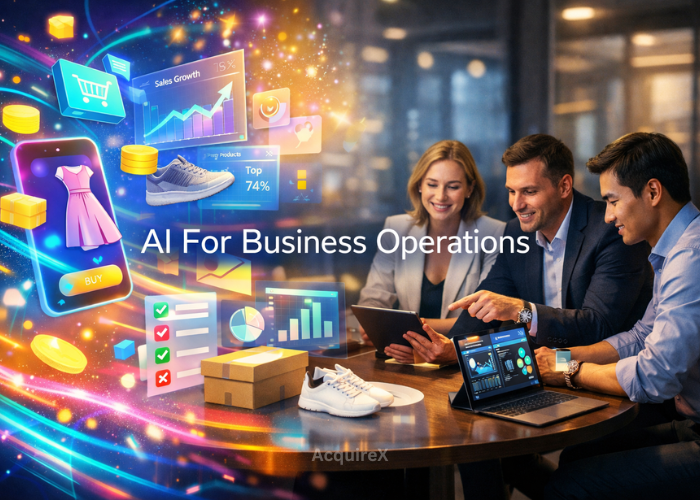
In 2026, artificial intelligence is no longer an experimental technology in e-commerce, it is operational infrastructure. AI For Business Operations is powering smarter supply chains, predictive sales strategies, and automated decision-making systems that directly impact revenue.
For e-commerce founders, operations managers, and researchers, understanding how AI For Business Operations drives growth is essential for staying competitive in global digital markets.
What is AI For Business Operations?
AI For Business Operations refers to the use of artificial intelligence technologies, including machine learning, predictive analytics, and automation, to optimize business processes such as inventory management, customer service, logistics, pricing, and fraud detection.
Unlike basic automation, AI systems learn from data patterns and improve over time. According to McKinsey & Company, companies implementing AI across operations report measurable cost savings and revenue growth.
In e-commerce, this means real-time forecasting, intelligent chatbots, automated workflows, and data-driven pricing models.
Why AI For Business Operations Is Critical for E-commerce in 2026
E-commerce businesses operate in a high-speed, low-margin environment. Small inefficiencies compound quickly.
AI For Business Operations helps businesses:
- Reduce operational costs
- Increase forecasting accuracy
- Automate repetitive tasks
- Improve fulfillment speed
- Enhance customer experience
Search engines prioritize authoritative, experience-driven content. AI adoption aligns with Google’s E-E-A-T principles by improving trust, reliability, and data accuracy across customer touchpoints.
How AI For Business Operations Improves Sales Performance
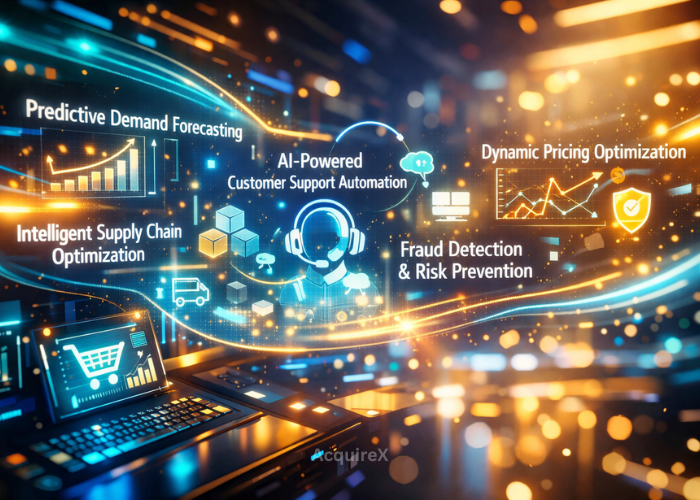
1. Predictive Demand Forecasting
Stockouts and overstocking directly impact revenue.
AI-powered forecasting analyzes historical sales, seasonality, promotions, and external market signals. Platforms from IBM use AI models to help retailers optimize inventory levels.
With AI For Business Operations, brands can maintain optimal stock levels, improve cash flow, and reduce warehousing costs.
Insight:
AI demand forecasting increases inventory accuracy by identifying patterns human analysis may miss.
2. Intelligent Supply Chain Optimization
Global e-commerce sellers rely on multi-vendor and cross-border logistics systems.
AI detects bottlenecks, predicts shipment delays, and suggests alternative fulfillment routes. Marketplaces like Amazon use AI-driven logistics systems to reduce delivery times and enhance seller performance metrics.
AI For Business Operations strengthens supply chain resilience while improving customer satisfaction.
Insight:
AI reduces shipping delays by analyzing logistics data in real time and predicting disruptions before they occur.
3. AI-Powered Customer Support Automation
Customer support directly influences repeat purchases.
AI chatbots powered by natural language processing handle:
- Order tracking
- Returns
- Refund requests
- Product inquiries
Unlike rule-based bots, AI systems continuously improve based on interaction data. This reduces response time and operational costs.
AI For Business Operations ensures 24/7 support scalability without expanding headcount.
4. Dynamic Pricing Optimization
Price sensitivity in e-commerce is high.
AI analyzes competitor pricing, demand fluctuations, and customer behavior to adjust prices dynamically. This ensures competitive positioning while protecting margins.
Businesses implementing AI For Business Operations in pricing strategies report higher average order values and improved profitability.
Insight:
Dynamic pricing powered by AI maximizes revenue by automatically adjusting product prices based on demand and competition.
5. Fraud Detection and Risk Prevention
Online fraud is a significant revenue threat.
AI systems analyze transaction patterns and flag suspicious activities in milliseconds. Compared to manual review systems, AI reduces false declines while improving security.
By strengthening transaction integrity, AI For Business Operations enhances brand trust, a core ranking factor in modern search algorithms.
How AI For Business Operations Supports Data-Driven Decisions
Data alone does not create growth, insights do.
AI-powered analytics platforms transform raw transactional data into predictive intelligence. E-commerce businesses gain visibility into:
- Top-performing SKUs
- Customer lifetime value
- Purchase behavior trends
- Seasonal sales shifts
- Marketing attribution
AI For Business Operations allows sales teams to act proactively rather than reactively.
For deeper insights into performance-driven sales Framework, explore: High-Impact Sales Team Outsourcing to Boost Revenue
Generative Engine Optimization (GEO) & AI Integration
With the rise of AI search tools and conversational engines, businesses must structure content clearly and factually.
AI For Business Operations supports GEO by:
- Providing structured data insights
- Enabling FAQ-based content architecture
- Improving page performance metrics
- Reducing operational friction that impacts UX
Clear answers, bullet points, and structured headings improve discoverability in AI-generated search responses.
Implementation Strategy: How to Start with AI For Business Operations
Step 1: Identify High-Impact Areas
Start with inventory forecasting, customer support, or pricing optimization.
Step 2: Centralize Data
AI systems require clean, unified data sets.
Step 3: Choose Scalable Tools
Enterprise providers such as Microsoft and Google Cloud offer AI-ready infrastructure for operational deployment.
Step 4: Measure ROI
Track KPIs such as operational cost reduction, revenue growth, and fulfillment speed.
Benefits of AI For Business Operations in 2026
- Faster operational decisions
- Reduced manual workload
- Improved profit margins
- Higher customer satisfaction
- Predictive sales planning
- Scalable infrastructure
E-commerce brands that integrate AI into core operations outperform competitors that rely solely on traditional systems.
The Future of AI For Business Operations
By 2026 and beyond, AI will expand into:
- Autonomous warehouse robotics
- Voice-based commerce integration
- AI-driven procurement systems
- Predictive churn analysis
- Real-time omnichannel orchestration
As AI models continue to evolve, businesses that adopt AI For Business Operations strategically will build resilient, scalable growth systems.
Conclusion
AI For Business Operations is transforming e-commerce from reactive management to predictive growth engineering.
It improves efficiency, enhances sales forecasting, automates support, optimizes pricing, and protects revenue from fraud. More importantly, it aligns operational excellence with search engine trust signals and AI-driven discovery.
For e-commerce brands in 2026, AI is not optional, it is foundational.
Those who implement it strategically will lead the next wave of digital commerce growth.
FAQ’s
What is AI For Business Operations in e-commerce?
AI For Business Operations uses AI tools like machine learning and automation to improve inventory, logistics, pricing, and support. According to McKinsey & Company, AI adoption drives measurable cost savings and revenue growth.
How does AI For Business Operations increase revenue?
It boosts revenue through demand forecasting, dynamic pricing, and personalized recommendations. Data-driven insights improve conversions and profit margins.
Is AI For Business Operations suitable for small e-commerce brands?
Yes. Platforms like Google Cloud and Microsoft provide scalable AI solutions. Brands can start small and expand after proving ROI.
What are common implementation challenges?
Key challenges include data silos, integration issues, and skill gaps. A phased rollout with clear KPIs reduces risk.
How does AI For Business Operations support Google E-E-A-T?
AI improves accuracy, security, and user experience. As outlined by Google Search Central, trust and expertise are ranking factors, AI strengthens both.