Summary: Cycle counting is the practice of counting a small, scheduled portion of your inventory every day or week instead of shutting down for one big annual count. Ecommerce teams use ABC classes to count high-value SKUs most often, run blind counts, recount anything outside tolerance and fix the root cause, which keeps stock records accurate enough to sell on every channel without overselling.
If your storefront says you have 40 units and the shelf has 31, you will find out the hard way: a canceled order, an angry customer, a marketplace performance warning or a reorder that arrives too late. Inventory records drift all the time. Pickers grab the wrong variant, returns go back to the shelf without being scanned, receiving records the packing list instead of what is actually in the carton and integrations between Shopify, Amazon and your warehouse lag at the worst possible moment.
Cycle counting is how well-run operations catch that drift early and keep it small. This guide explains how cycle counting works, the methods to choose from, how to set count frequency with ABC classes, a step-by-step procedure your team or 3PL can follow, the formulas for inventory record accuracy and how to turn count variances into process fixes.
What is cycle counting?
Cycle counting is an inventory auditing method in which a subset of SKUs or storage locations is counted on a rotating schedule, so that every item is counted several times a year without stopping operations. A full physical inventory tells you how wrong your records were; cycle counting keeps them from getting wrong in the first place.
Each count compares the physical quantity in a location with the quantity in your system of record. If they match within tolerance, the record is confirmed. If not, the item is recounted, the variance is investigated and the record is adjusted with a documented reason.
How is cycle counting different from a full physical inventory?
| Cycle counting | Full physical inventory | |
|---|---|---|
| What gets counted | A small set of SKUs or locations each day or week | Every SKU in every location at once |
| Frequency | Continuous, on a rolling schedule | Usually once or twice a year |
| Operations impact | Minimal; only the locations being counted are paused | Shipping and receiving often stop for one or more days |
| Error detection | Errors are found within days or weeks of happening | Errors can sit undetected for months |
| Root-cause analysis | Practical, because the cause is recent and traceable | Hard, because months of transactions have passed |
| Best for | Ongoing accuracy, fast-moving catalogs, multi-channel sellers | Year-end snapshots, a new warehouse or a system migration |
Many brands still need a year-end count for their accountant or auditor. A mature cycle counting program often makes that count faster and less painful, and some businesses can reduce or replace the annual count if their auditors accept the cycle count records. Ask your accountant before you drop it.
Why does cycle counting matter so much in ecommerce?
In a physical store, a wrong stock figure usually means a shelf gap. In ecommerce, the stock figure is published to every channel you sell on, so an error becomes an oversell, a cancellation or a missed sale within minutes.
- Fewer oversells and cancellations. Marketplaces such as Amazon and Walmart track seller cancellations and late shipments, and repeated problems can put your account at risk.
- Better reorder decisions. Reorder points and safety stock are only as good as the on-hand number they start from. Our demand forecasting and safety stock guide assumes your on-hand figures are trustworthy; cycle counting is what makes them so.
- Accurate financials. Inventory is often the largest asset on an ecommerce balance sheet. Unrecorded shrinkage quietly inflates gross margin until a year-end count wipes it out in one painful adjustment.
- Accountability with a 3PL. If a third-party warehouse holds your stock, your own count data is how you verify their accuracy and support claims for lost units.
- Faster problem-solving. A variance found this week can usually be traced to a specific order, receipt or return. A variance found next year cannot.
What are the main cycle counting methods?
There is no single best method. Most brands combine a scheduled method, usually ABC, with event-driven counts that catch problems as they happen.
| Method | How it works | Best for | Watch-out |
|---|---|---|---|
| ABC cycle counting | Rank SKUs by value or velocity; count A items most often, C items least | Most ecommerce brands with a long tail of slower SKUs | Classes go stale; re-run the ABC analysis at least quarterly |
| Zone or location-based | Count every location in one aisle or zone, then move to the next | Larger warehouses and 3PL sites | Treats a slow C SKU the same as a best-seller |
| Random sample | Pick a random set of SKU-locations each cycle | Testing overall accuracy without bias | Can miss your most important SKUs for weeks |
| Opportunity-based | Count when a natural trigger happens: a bin hits zero, a reorder point, a return or a putaway | Lean teams that want counts built into daily work | Low-activity SKUs may never be counted, so pair it with a schedule |
| Control group | Count the same small set repeatedly while you build the process | Launching a new program, training counters | Not a long-term method by itself |
| Exception-based | Count SKUs flagged by negative on-hand, a pick short, an oversell or an inventory adjustment | Catching problems fast on high-velocity channels | Purely reactive; it only finds errors that have already caused trouble |
A practical default for a growing brand is ABC scheduled counts plus exception-based counts: the schedule guarantees coverage, and the exceptions catch fast-moving errors before they reach customers.
How do you set cycle count frequency with ABC analysis?
ABC classification ranks your SKUs by how much they matter, usually by annual sales value, units moved or margin contribution, and gives the most important items the most attention. If you have not classified your catalog yet, start with our ABC analysis for inventory management guide, then apply count frequencies like these:
| Class | Typical share of SKUs | Typical share of value or units | Suggested count frequency | Suggested tolerance |
|---|---|---|---|---|
| A | About 10-20% | Most of sales value or movement | Monthly (or weekly for top sellers) | Exact match or very tight, such as ±0-1% |
| B | About 20-30% | A moderate share | Quarterly | Slightly looser, such as ±2% |
| C | About 50-70% | A small share | Twice a year or annually | Looser, such as ±3-5% or a unit/dollar threshold |
The percentages above are common starting points, not rules. Adjust them to your catalog: a brand with 150 SKUs might count every A item weekly, while a brand with 15,000 SKUs might count A items monthly and lean on exception counts for the rest. Also consider moving an item into a higher count class if it is small and easy to lose, frequently mis-picked, expensive or part of many bundles, even if its sales value alone would put it in class C.
How many items should you count per day?
Turn your frequencies into a daily workload with a simple calculation:
Daily counts = (A SKUs × A counts per year + B SKUs × B counts per year + C SKUs × C counts per year) ÷ working days per year
Worked example: a brand has 2,000 SKUs, classified as 300 A items counted 12 times a year, 500 B items counted 4 times a year and 1,200 C items counted twice a year. That is 3,600 + 2,000 + 2,400 = 8,000 counts a year. Over 250 working days, the team needs to count 32 SKU-locations a day. If one counter can handle 40 to 60 locations a day alongside other work, the program needs well under one full-time person.
Count by SKU-location, not just SKU. A SKU stored in a pick face, an overflow pallet and a returns bin has three records that can each be wrong.
What is the step-by-step cycle counting process?
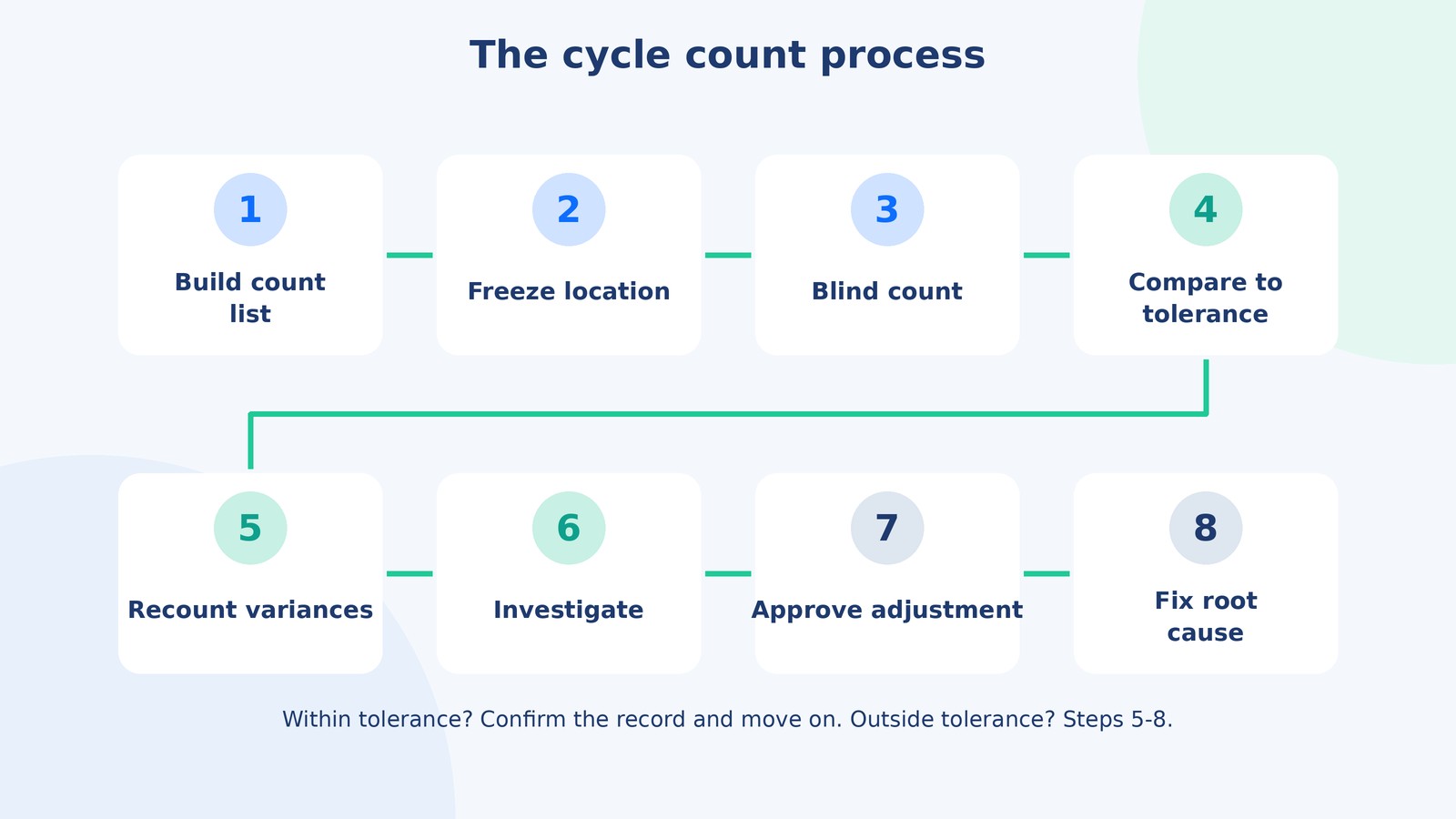
- Define the system of record. Decide which system holds the “true” on-hand quantity, whether that is Shopify, your WMS, an inventory app or your 3PL’s portal. Counting against the wrong system creates phantom variances.
- Classify SKUs and set tolerances. Assign ABC classes, count frequencies and a variance tolerance for each class before you start, so accuracy has a clear definition.
- Generate the count list. Pull the day’s scheduled SKU-locations, then add exception triggers: negative on-hand, recent pick shorts, oversells, items with manual adjustments and locations with recent putaway problems.
- Freeze or time the count. Count when the location is not being picked or replenished, such as before the first wave or after the last, or flag it as locked in the WMS. Counting while orders are being picked from the same bin is the most common cause of false variances.
- Count blind. Counters record what they see without seeing the expected quantity. Showing the system figure invites people to “confirm” it.
- Check the whole location. Look behind, under and inside open cartons, and note any SKU found in the wrong bin.
- Compare against tolerance. Items within tolerance are confirmed. Items outside tolerance go to a recount.
- Recount with a different person. An independent second count separates real variances from counting mistakes.
- Investigate before you adjust. Check recent orders, receipts, transfers and returns for the SKU. Many variances are timing problems, such as an order picked but not yet recorded, rather than real losses.
- Approve and record the adjustment. Adjust the system with a reason code (damage, mis-pick, receiving error, theft, unknown) and approval from someone other than the counter for larger adjustments.
- Fix the cause. Log the root cause and assign a corrective action. Without this step, cycle counting just corrects the same errors forever.
How do you measure inventory accuracy from cycle counts?
There are two common ways to express inventory record accuracy (IRA). Track both, because each hides something the other reveals.
Record (line) accuracy = SKU-locations within tolerance ÷ SKU-locations counted × 100
Example: you count 200 SKU-locations this week and 188 are within tolerance. Record accuracy is 188 ÷ 200 = 94%.
Unit accuracy = (1 − total absolute unit variance ÷ total system units counted) × 100
Example: the system expected 5,000 units across the counted locations, and the absolute variances add up to 75 units. Unit accuracy is (1 − 75 ÷ 5,000) × 100 = 98.5%.
Use absolute variances. If one bin is 20 units over and another is 20 units short, the net variance is zero, but you have two wrong records and probably a putaway problem. You can also weight variances by cost to get a dollar accuracy figure, which is what finance cares about.
What counts as “good” depends on your operation and how strictly you define tolerance. Rather than chasing an industry benchmark, set a target per ABC class, measure it consistently and look for steady improvement. Pay particular attention to A items, where a single wrong record can cause a run of oversells.
Which other cycle count KPIs are worth tracking?
- Schedule adherence: the share of planned counts that actually happened. A program that skips counts during busy weeks loses accuracy exactly when it matters.
- Adjustment value: the net and absolute cost of adjustments per month, by reason code.
- Repeat-variance SKUs: items that fail tolerance in two or more consecutive counts. These point to a process problem, not bad luck.
- Oversell and cancellation rate: the customer-facing outcome that inventory accuracy should improve.
Accurate counts also make your inventory turnover ratio and days of inventory meaningful, because both depend on a reliable average inventory figure.
What causes inventory variances, and how do you fix them?
The real value of cycle counting is the pattern in the variances. Group adjustments by reason code and look for repeats.
| Variance pattern | Likely cause | Fix |
|---|---|---|
| Shortage on a fast mover | Mis-picks, unrecorded damage, theft, oversold bundles | Scan-to-pick verification, damage logging at the pack station, bundle component mapping |
| Overage in one bin, shortage in a nearby bin | Putaway into the wrong location | Scan location barcode at putaway; clear bin labeling |
| Variance in multiples of a case or inner pack | Unit-of-measure confusion at receiving | Define each, inner and case quantities on the SKU and the PO |
| Shortage right after a delivery | Receiving recorded from the packing list instead of the actual count | Count against the ASN or PO at receiving; record short shipments |
| Variance on returned items | Returns restocked without being recorded, or recorded but not restocked | A single returns disposition step with a scan |
| Variance only between systems | Sync lag between Shopify, marketplaces, the WMS or 3PL portal | Pick one system of record and audit the integration |
Receiving is the source of many variances. If goods are received against a clear purchase order with quantities in the right unit of measure, a large class of errors never happens. Our purchase order process guide covers how to receive against the PO and record short shipments. Clean, consistent SKU and variant data also matters, especially for multi-channel sellers; see our SKU management best practices.
How does cycle counting work with a 3PL?
When a third-party logistics provider stores your inventory, you cannot walk the aisles yourself, but you can still run a cycle counting program.
- Put it in the contract. Agree on count frequency by SKU class, the accuracy standard the 3PL must meet, how variances are reported and how lost or damaged units are reimbursed.
- Ask for count reports, not just stock levels. You want the location, counted quantity, expected quantity, variance and reason for each count.
- Request targeted counts. When you see an oversell or a suspicious stock drop on a key SKU, ask for a count of that SKU rather than waiting for the schedule.
- Reconcile systems. Compare the 3PL’s on-hand with Shopify and marketplace inventory regularly. Differences there are often sync problems, not warehouse problems.
If you are still deciding how to run fulfillment, our comparison of 3PL vs. in-house vs. hybrid fulfillment covers the inventory control trade-offs of each model.
Which tools do you need for cycle counting?
You do not need an expensive system to start, but you do need a reliable way to record counts by location.
- Barcode scanners or a phone scanning app reduce keying errors and speed up counts dramatically compared with paper sheets.
- Location labels on every bin and shelf so each count is tied to a specific place.
- An inventory app or WMS with count tasks lets you schedule counts, hide expected quantities for blind counting and record adjustments with reason codes.
- A variance log, even a shared spreadsheet, so adjustments, causes and fixes are recorded in one place and reviewed weekly.
What are the most common cycle counting mistakes?
- Counting live locations. Picks during the count create variances that do not exist.
- Adjusting without recounting. You “fix” a correct record based on one person’s miscount.
- Skipping root-cause analysis. The same SKUs fail every month and the team stops trusting the numbers.
- Letting the schedule slip in peak season. Peak is when errors multiply; scale down counts if you must, but do not stop counting A items.
- Using stale ABC classes. Last year’s best-seller may be this year’s C item, and new launches may need A-level attention.
- Counting SKUs instead of SKU-locations. Overflow and returns locations get missed.
Want accurate inventory without adding headcount?
AcquireX’s supply chain management services give ecommerce brands a dedicated team that sets up ABC classes and count schedules, reviews 3PL count reports, reconciles stock across Shopify and marketplaces, investigates variances and reports inventory accuracy every month, alongside demand planning and replenishment. If purchasing is part of the problem, our procurement and sourcing team can tighten receiving against purchase orders too.
Book a call with AcquireX to review your current inventory accuracy and see where a dedicated team can help.
Key takeaways
- Cycle counting counts a small slice of inventory continuously, so errors are found while they are still small and traceable.
- Use ABC classes to count your most important SKUs most often, and add exception-based counts for oversells, negative stock and pick shorts.
- Count blind, avoid live locations, recount anything outside tolerance and adjust only with a documented reason.
- Measure both record accuracy and unit accuracy using absolute variances, with targets set per ABC class.
- The payoff comes from fixing root causes at receiving, putaway, picking and returns, not from the adjustments themselves.
Frequently asked questions
What is cycle counting in inventory management?
Cycle counting is a method of auditing inventory by counting a small subset of SKUs or locations on a rotating schedule, so every item is counted several times a year without stopping operations. Counts are compared with system records and variances are investigated and corrected.
How often should you cycle count?
A common starting point is monthly for A items, quarterly for B items and once or twice a year for C items, plus extra counts triggered by events like negative stock or oversells. Adjust the schedule to your catalog size and how often errors appear.
What is the formula for inventory record accuracy?
Record accuracy is the number of SKU-locations within tolerance divided by the number counted, times 100. Unit accuracy is one minus the total absolute unit variance divided by the total system units counted, times 100.
What is a blind cycle count?
A blind count is one where the counter does not see the expected system quantity before recording what is physically there. It prevents people from simply confirming the number they expect to see.
Does cycle counting replace an annual physical inventory?
It can, in some businesses, if the program is well documented and your auditors or accountants accept it. Many brands keep a year-end count but find it faster and smaller once cycle counting is running well.
What is the difference between cycle counting and spot checks?
Cycle counting is planned and systematic, with a schedule that covers every SKU over time. A spot check is an ad hoc count of a single item, usually because something looks wrong. Exception-based counts formalize spot checks inside a cycle counting program.
Should you cycle count during peak season?
Yes, at least for A items. Peak season has the most transactions and the most opportunities for errors, and oversells are most costly then. You can pause C-item counts temporarily if labor is tight.
How do you cycle count inventory stored at a 3PL?
Agree on count frequency, accuracy standards and variance reporting in your 3PL contract, request detailed count reports, ask for targeted counts on key SKUs when something looks off and regularly reconcile the 3PL’s on-hand with your store and marketplace inventory.