Most B2B teams do not have a lead problem. They have a follow up problem.
You can double your traffic, buy a better tool, and hire another marketer. If a lead still sits in a shared inbox until tomorrow, none of it matters. The buyer already talked to someone else.
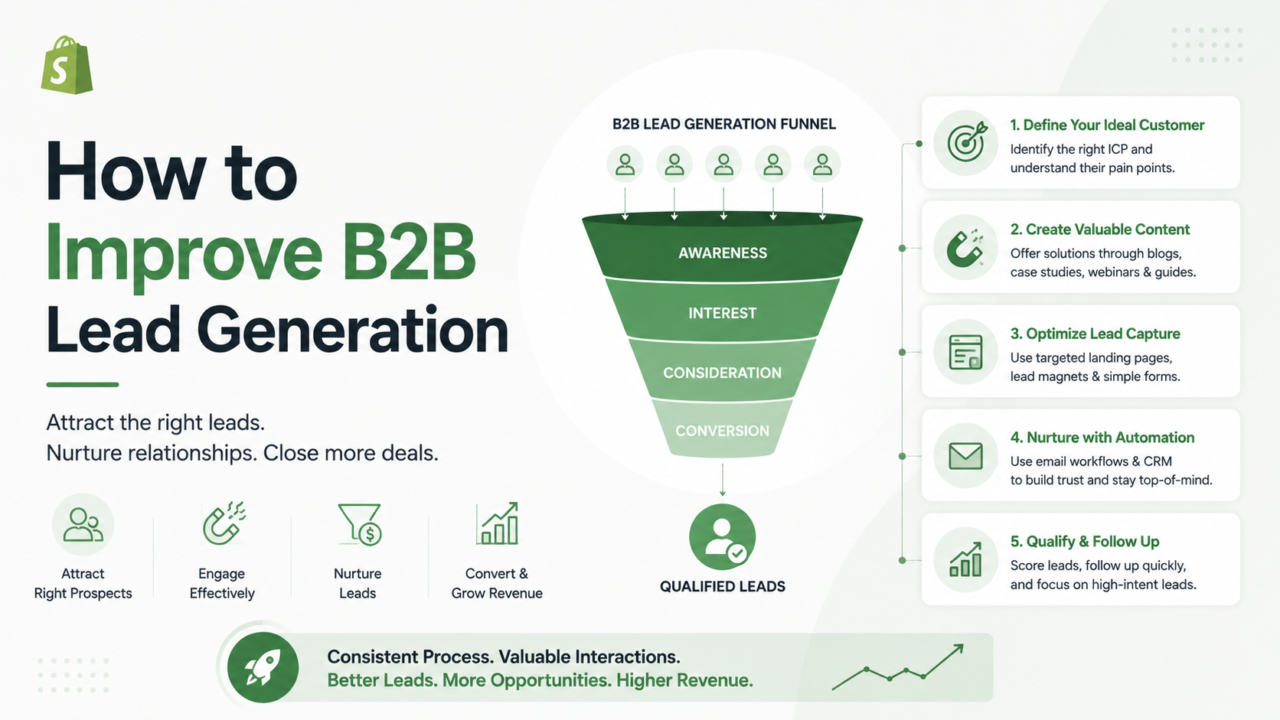
To improve B2B lead generation, fix the leaks before you add spend. Narrow your buyer, replace “Contact Us” with a named offer, let your content do the qualifying, show up where demand forms (including AI search), nurture the buyers who are not ready, and respond to inbound leads in minutes.
That six step system is the ENGINE Framework. This guide walks through all of it, with the funnel math to prove why the last step pays for the other five.
We also fact checked the top ranking articles for this keyword. One of the most repeated statistics in B2B lead generation is fake. We traced it. More on that below.
The Numbers in This Guide
| What you will get | The number |
|---|---|
| Steps in the ENGINE Framework | 6 |
| Common lead leaks to audit | 7 |
| Cost per closed deal, before fixing follow up | $1,667 |
| Cost per closed deal, after fixing follow up | $1,190 |
| Reduction in cost per deal | 29% |
| Extra annual contract value unlocked per month | $43,200 |
| Zombie stats we traced and debunked | 3 |
| Extra ad budget required | $0 |
Quick Answer: How Do You Improve B2B Lead Generation?
Do these six things, in this order:
- Pick one buyer and one problem. Broad targeting produces junk leads that eat your sales team’s day.
- Replace “Contact Us” with a named offer. Give buyers a specific reason to raise a hand.
- Give proof before you ask. Let your content qualify people before they ever book a call.
- Intercept demand where it forms. In 2026 that includes ChatGPT, Perplexity, and Google AI Overviews, not just blue links.
- Nurture the buyers who are not ready. Most of your market is not buying this quarter.
- Follow up in minutes, not days. This single fix usually beats every other lever you have.
Order matters. Fixing follow up before you fix targeting just means you respond faster to the wrong people.
What B2B Lead Generation Actually Means in 2026
B2B lead generation is the process of finding businesses that have a problem you solve, getting them to identify themselves, and moving them into a real sales conversation.
That is it. Everything else is tactics.
Two words get mixed up constantly, and the confusion costs money.
| Demand generation | Lead generation | |
|---|---|---|
| Goal | Make people want the thing | Get people to raise a hand |
| Looks like | Podcasts, LinkedIn posts, teardowns, events | Gated guides, demo requests, calculators, calls |
| Measured by | Branded search, direct traffic, reach | Leads, qualified leads, pipeline |
| Timeline | 6 to 18 months | Weeks to months |
| Common mistake | Expecting leads next month | Running it with no demand behind it |
You need both. Lead generation without demand generation is just interrupting strangers. Demand generation without lead generation is a fan club that never buys.
Lead Types, Explained Simply
| Term | What it actually means | Typical trigger |
|---|---|---|
| Lead | Anyone who gave you contact details | Downloaded anything |
| MQL | Marketing says this person looks like a buyer | Fits your profile, took a real action |
| SQL | Sales agrees and is working the deal | Had a conversation, has a problem and a budget |
| PQL | Someone using your product and hitting a limit | Free trial, usage cap, feature wall |
| Opportunity | A real deal with a number and a date | Proposal sent |
Most teams argue about the labels. Almost nobody agrees on the definition of an SQL in writing. Write it down this week. It ends more sales and marketing fights than any dashboard ever will.
Why B2B Lead Generation Actually Breaks
Ask ten founders why lead gen is failing and nine say the same thing: “we need more leads.”
Almost never true.
Look closer and you find the pipeline leaking in seven predictable places. Fixing leaks costs nothing. Buying more leads costs money every month, forever.
The Lead Leak Audit
Run this against your own funnel this week. Be honest. Score each one from 0 to 3.
| # | Leak | What it looks like in real life | What it quietly costs you |
|---|---|---|---|
| 1 | Slow follow up | A form fill sits unread until tomorrow morning | Most of these people never reply again |
| 2 | No owner | Leads land in a shared inbox, everyone assumes someone else has it | Leads die and nobody is at fault |
| 3 | Weak offer | Your only call to action is “Contact Us” | Only buyers who were already sold ever click |
| 4 | Wrong buyer | You target “ecommerce brands” instead of a specific segment | Sales burns hours on people who will never buy |
| 5 | No nurture | You email a lead twice, get no reply, delete them | You lose buyers who were simply not ready yet |
| 6 | Single threading | You only know one person at the account | The deal dies when your champion leaves |
| 7 | No feedback loop | Sales never tells marketing which leads were junk | You keep paying to attract the wrong people |
Scoring: 0 means fixed, 3 means broken. If your total is above 10, adding traffic will not help. You will just leak faster.
The Five Minute Test
Do this today. It takes five minutes and it will probably ruin your afternoon.
- Open your CRM or form tool.
- Pull the last 20 inbound leads.
- Note the timestamp they came in.
- Note the timestamp of your first real reply. Not the auto responder. The human one.
- Calculate the median gap.
Most teams believe their answer is “about an hour.” Most teams are wrong by a factor of ten.
That gap is your single biggest, cheapest, fastest fix. And it is why the last letter of ENGINE matters more than the first five.
The uncomfortable truth: most B2B lead generation problems are execution problems, not idea problems. Everybody knows they should respond fast. Very few teams have someone whose actual job is to do that, every hour, every day.
Ideas are free. Execution is the product.
Fact Check: Three Statistics You Should Stop Quoting
We fetched and read the pages currently ranking for this keyword. Several of them repeat statistics that do not hold up.
This matters more than it used to. Google’s helpful content guidance rewards first hand verification, and AI tools increasingly cite pages that source their numbers properly. Copying a zombie stat is now a ranking risk, not just an accuracy one.
Zombie Stat 1: “Marketing automation drives a 451% increase in qualified leads”
This one appears in at least two top ranking articles for this keyword. We traced it.
| Step in the chain | What we found |
|---|---|
| A 2026 ranking article | Repeats “451% increase in qualified leads” |
| The link it cites | A PDF hosted on a marketing agency’s website |
| What that PDF actually is | A one page infographic, published in 2015 |
| The infographic’s own sourcing | A single line listing five organizations. No study name, no year, no sample size, no methodology, no link |
| The named originator | The Annuitas Group. No publicly accessible study supports the figure |
So the chain is: 2026 article → 2015 agency infographic → an unnamed study nobody can read.
A second top ranking article repeats the same 451% figure and cites it to a reference list that includes other vendor blogs.
What to do instead: if you want to make the case for automation, use your own before and after numbers. One honest internal chart beats a decade old infographic every time.
Zombie Stat 2: “Nurtured leads produce 50% more sales ready leads at 33% lower cost”
Widely repeated. It traces back to Forrester research from well over a decade ago, and the original study is not publicly accessible. The direction is probably right. The precision is theatre.
Zombie Stat 3: “Only 3% of your market is buying right now”
You will see 3%, 5%, and 10% quoted with equal confidence, usually with no source at all. The underlying idea is sound and important: most of your market is not in the market today. But quoting a precise percentage you cannot source is exactly the behavior that gets a page demoted.
Say this instead: “At any given time, most of your buyers are not ready to buy. Plan for that.”
Same insight. Zero risk.
The Buyer Changed. Most Funnels Did Not.
Two findings from Gartner’s B2B Buying Journey research explain why the old playbook keeps failing:
- A typical buying group for a complex B2B purchase includes six to ten decision makers.
- Buyers spend only about 17% of the total buying journey meeting with potential suppliers. Split across several vendors, any one seller may get around 5% or 6% of the buyer’s time.
Read that again. You get roughly one twentieth of the buyer’s attention, and you are selling to a committee, not a person.
Three things follow:
- Your content must sell when you are not in the room. Because most of the time, you are not in the room.
- One champion is not enough. If your only contact is a marketing manager and the CFO has never heard your name, the deal stalls in procurement.
- The buying group needs internal ammunition. Your champion has to sell you to four other people using materials you gave them. Most vendors give them a deck. Give them a one page business case with the numbers filled in.
This is why “get more leads” is the wrong goal. The right goal is to be the vendor a buying group already trusts before anyone fills out a form.
The ENGINE Framework
Six steps. Each has an owner, a deadline, and a number attached. That is what makes it a system instead of a wish.
| Letter | Step | The one question it answers | Owner |
|---|---|---|---|
| E | Entry point | Who exactly are we for? | Founder or Head of Growth |
| N | Named offer | Why would they raise a hand? | Marketing |
| G | Give proof | Why should they believe us? | Marketing and Sales |
| I | Intercept demand | Where will they find us? | Growth and SEO |
| N | Nurture | What if they are not ready? | Marketing Ops |
| E | Execute follow up | What happens in the first 15 minutes? | Sales |
If any row has no name in the Owner column, that step will not happen. That is not cynicism. It is just how work works.
E: Entry Point (One Buyer, One Problem)
Broad targeting feels safe. It is not. It spreads your budget across people who will never buy, and it fills your sales team’s calendar with meetings that go nowhere.
Build your profile from evidence, not opinion.
- List your best five customers. Not your biggest. Your best. Fast to close, easy to serve, low churn, good margin.
- Find what they share. Company size, revenue band, tech stack, headcount, growth stage, and the specific trigger that made them buy.
- Write one sentence. “We help [very specific company] fix [very specific problem] so they can [very specific outcome].”
- Cut everything else from your targeting for 90 days.
Example:
| Weak | Strong |
|---|---|
| “We help ecommerce brands grow.” | “We help US D2C brands doing $2M to $20M a year cut cost per order by running catalog, ads, and support with one dedicated team.” |
The second one repels the wrong people on purpose. That is a feature, not a bug.
The ICP Scorecard
Score every account before you spend a dollar on it.
| Signal | Points |
|---|---|
| Revenue inside your target band | +15 |
| Industry match | +10 |
| Decision maker title | +15 |
| Based in your target market (US) | +10 |
| Uses a platform you integrate with | +10 |
| Hiring for a role that signals the pain | +10 |
| Recently raised funding or expanded | +10 |
| Company is a competitor | -50 |
| Free email domain, no company site | -20 |
Rule: 60 points or more, sales works it. Below 60, it goes to nurture. No exceptions, no “but this one feels good.”
Test your profile: if your ideal customer profile does not make you slightly nervous about how narrow it is, it is not narrow enough.
N: Named Offer (Kill “Contact Us”)
“Contact Us” asks the buyer to do the work. They have to guess what happens next, how long it takes, and whether it turns into a pitch.
A named offer removes the guessing.
| Vague ask | Named offer |
|---|---|
| Contact Us | Get a free 20 minute margin teardown of your top 10 SKUs |
| Book a Demo | See your 3 biggest ad waste leaks in a 15 minute screen share |
| Learn More | Download the 12 point marketplace account health checklist |
| Request Pricing | Get a costed staffing plan for your next 90 days |
| Subscribe | Get the 5 minute Monday memo on US ecommerce ops |
Four rules for an offer that converts:
- Name the outcome, not the activity.
- Name the time cost. “20 minutes” beats “a call.”
- Name what they keep, even if they never buy.
- Make it useful on its own. If a buyer would happily take it and ghost you, it is a good offer.
Match the Offer to the Stage
One offer is not enough. Buyers arrive at different temperatures.
| Buyer stage | What they are thinking | Offer that works | What does not work |
|---|---|---|---|
| Problem aware | “Our costs feel high” | Benchmark report, calculator, teardown | Demo request |
| Solution aware | “Maybe we outsource this” | Comparison guide, cost model, checklist | Newsletter signup |
| Vendor aware | “Who should we shortlist?” | Scoped audit, sample plan, references | Another blog post |
| Ready | “Send me a price” | Costed proposal, pilot, trial | A nurture email |
Yes, some people will take the value and leave. Good. The ones who stay were the ones worth talking to.
G: Give Proof Before You Ask
Your content should do the qualifying for you. By the time someone books a call, they should already believe you can do the job.
The Proof Hierarchy
Not all proof is equal. This is roughly the order of what actually moves B2B buyers.
| Rank | Proof type | Why it works | Effort |
|---|---|---|---|
| 1 | Numbers with the math shown | Impossible to fake, easy to check | Medium |
| 2 | A public teardown of a real problem | Shows how you think, not what you claim | Medium |
| 3 | A named, repeatable method | Buyers trust process over talent | Low |
| 4 | Named case studies with real figures | Third party validation | High |
| 5 | A failure you admit and explain | Builds more trust than another win story | Low |
| 6 | Reviews and references | Social proof for the committee | Low |
| 7 | Logos on a page | Weak on its own, useful as backup | Low |
Do this: “We moved cost per order from $14.20 to $9.60 in 90 days. Here is the line item breakdown.”
Not this: “We are an industry leading, end to end solutions partner.”
The first one is quotable, checkable, and citable. The second one is wallpaper.
For more on connecting content to demand, read our guide to B2B digital marketing strategies.
I: Intercept Demand Where It Forms
Demand does not start on your website. It starts the moment a buyer realizes they have a problem. Your job is to be standing there when it happens.
Channel Comparison
| Channel | Buyer intent | Time to first lead | Effort to run | Typical US CPL range |
|---|---|---|---|---|
| SEO and content | High | 3 to 6 months | High | $30 to $150 |
| AI search citation | Very high | 3 to 9 months | Medium | Near zero marginal |
| Google Search ads | Very high | Days | Medium | $80 to $400 |
| LinkedIn ads | Medium | Days | Medium | $150 to $600 |
| Cold email | Low to medium | 2 to 6 weeks | High | $50 to $250 |
| LinkedIn outbound | Medium | 2 to 6 weeks | High | $60 to $300 |
| Webinars and events | High | Weeks | High | $100 to $500 |
| Review sites and directories | Very high | Weeks | Low | $75 to $350 |
| Partners and referrals | Very high | Months | Low | Often the cheapest |
| Communities and peer groups | Medium to high | Months | Medium | Near zero marginal |
Important: those cost ranges are operator observed ranges for US B2B, not published benchmarks. Use them as a starting hypothesis, then replace them with your own numbers inside 60 days. That is the whole point of tracking.
The pattern most teams miss: the cheapest channels (partners, referrals, communities, AI citation) are also the slowest to build. The fastest channels (paid) are the most expensive and stop the moment you stop paying. Run both. Fund the slow ones with the profit from the fast ones.
For suppliers and B2B sellers, also read our breakdown of B2B online marketplaces.
How to Get Cited by AI Search (The New Lead Channel)
This is the part most B2B teams are still ignoring. It will not stay that way for long.
Buyers now open ChatGPT, Perplexity, or Gemini and type “best partner for managing Amazon and Shopify operations for a US brand.” The tool returns a shortlist. If you are not on it, you were never in the running, and you will never see it in your analytics.
Traditional SEO gets you a blue link. AI search gets you named in the answer. Those are different games.
What actually gets a page cited:
| Do this | Why it works |
|---|---|
| Answer the question in the first 100 words | AI tools extract the direct answer, not your warm up paragraph |
| Use headings phrased as real questions | “How much does it cost” beats “Our pricing philosophy” |
| Put specific numbers on the page | Tools quote what is quotable. Vague pages get skipped |
| Use tables | Structured data is far easier to lift and cite than prose |
| Name your method or framework | A named framework is far easier to attribute than generic advice |
| Write self contained paragraphs | Each one should make sense pulled out of context, because it will be |
| Cite your own sources properly | Pages that source their claims get trusted and reused |
| Keep it crawlable without JavaScript | If content only renders after a script loads, some crawlers never see it |
| Publish comparison and “best for” content | These are exactly the questions buyers ask AI tools |
Track it like a real channel. Once a month, ask ChatGPT, Perplexity, and Gemini the five questions your buyers ask. Log whether you appear, and who appears instead. That log is your new rank tracker.
One warning: AI tools reward accuracy and punish nothing faster than a claim they cannot verify. This is exactly why the fact check section above matters. Copying a fake statistic does not just make you wrong. It makes you unciteable.
N: Nurture the Buyers Who Are Not Ready
At any given moment, most of your market is not buying. They have a contract, a budget cycle, or bigger fires.
If your only two states are “buy now” or “delete,” you throw away most of your pipeline.
Segment by Why They Said No
Different objections need different sequences. “Send them the newsletter” is not a strategy.
| Why they said no | What to send | When to come back |
|---|---|---|
| No budget | Cost models, cheaper starting scope, ROI math | Next budget planning cycle |
| Already have a vendor | Switching guides, teardowns, comparison content | 60 days before their renewal |
| Bad timing | Useful updates, nothing salesy | The date they named. Actually diarize it |
| Not convinced | Case studies, references, a small paid pilot | 30 days, with new proof |
| Wrong person | Ask for a warm intro to the right one | Immediately |
| Went dark | One honest breakup email | 90 days |
Rules for nurture that actually works:
- Set a real next date. Contract renewal month. Budget planning month. End of peak season. Put it in the CRM.
- Send something useful, not a check in. Nobody replies to “just circling back.” People do reply to “here is what changed in Amazon’s fee structure this quarter.”
- Stay in front of them for 6 to 18 months. B2B cycles are long. Patience is a strategy, not a failure.
- Make the door easy to reopen. One line, no pressure: “Worth a look now, or should I check back in Q3?”
The brands that win B2B are not the ones with the best pitch. They are the ones the buyer already knew about when the budget finally unlocked.
Automation makes this cheap to run. See benefits of automated lead generation and our roundup of sales automation tools.
E: Execute Follow Up in Minutes
This is the step that pays for the other five.
Research published in Harvard Business Review by James B. Oldroyd, Kristina McElheran, and David Elkington (March 2011) found that firms trying to contact a lead within one hour were roughly seven times more likely to have a meaningful conversation with a key decision maker than firms that waited just one hour longer. Their core conclusion still holds: most companies do not respond anywhere near fast enough.
Nothing about human attention has gotten slower since 2011.
The Response Time Decay
| Reply time | What usually happens |
|---|---|
| Under 5 minutes | You are often the first and sometimes the only call they take |
| Under 1 hour | You are still very much in the conversation |
| Same day | You are one of several vendors in a row |
| Next day | The buyer has usually moved on or gone cold |
| Two days or more | You are doing archaeology, not sales |
The Follow Up System
| Element | The rule | Why it fails without this |
|---|---|---|
| Ownership | One named person per lead source. Not a team | Shared inboxes are where leads go to die |
| SLA | First human touch within 15 minutes in business hours | Without a written number, it drifts back to two days inside a month |
| Routing | Automatic, rules based, no human triage | Every manual handoff adds hours |
| Channels | Call, then email, then LinkedIn | One email and a shrug is not follow up |
| Cadence | 6 to 8 touches over 2 weeks | Most replies come after touch 3 |
| Measurement | Track median first response time weekly | What you do not measure, drifts |
| Escalation | If nobody touches a lead in 60 minutes, it pages someone | Systems need a fail safe |
The Cadence That Works
| Day | Touch | Channel |
|---|---|---|
| 0 (within 15 min) | Call, then a specific email if no answer | Phone, email |
| 0 | Connection request with a one line note | |
| 2 | Send the thing they asked for, plus one insight | |
| 4 | Short value message. No “just checking in” | LinkedIn or email |
| 7 | Call again, different time of day | Phone |
| 10 | Send a relevant teardown or case study | |
| 14 | Honest breakup email with a door left open |
Where this breaks in real life: not because the team is bad, but because the person responsible for follow up is also running ads, fixing the site, and answering support tickets. Speed does not survive being someone’s fifth priority. It needs dedicated capacity.
The Math: Why Speed Beats Spend
Here is the part almost no article on this topic shows you. We checked. Of the four top ranking competitor pages we pulled, none of them contain a single worked funnel calculation. None of them mention cost per closed deal. None of them mention payback period.
So here it is. Real numbers, real math. Run it against your own funnel.
The Baseline
| Metric | Value |
|---|---|
| Monthly lead gen spend | $20,000 |
| Monthly website visits | 12,000 |
| Visit to lead rate | 2% |
| Leads per month | 240 |
| Cost per lead | $83 |
| Lead to sales qualified rate | 25% |
| Sales qualified leads | 60 |
| Cost per qualified lead | $333 |
| Close rate | 20% |
| Closed deals per month | 12 |
| Cost per closed deal | $1,667 |
| Average contract value | $9,000 |
| Gross margin | 60% |
| Monthly gross profit per customer | $450 |
| Payback period | 3.7 months |
Option A: Double the Budget
The founder says “let’s spend more.”
| Metric | Before | After |
|---|---|---|
| Monthly spend | $20,000 | $40,000 |
| Leads | 240 | 480 |
| Closed deals | 12 | 24 |
| Cost per closed deal | $1,667 | $1,667 |
| Payback period | 3.7 months | 3.7 months |
You bought growth. You did not build leverage. Efficiency did not move a single point. And the moment you turn the spend off, it all stops.
Option B: Fix Follow Up Instead
Same spend. Same traffic. You just fix response times and lift lead to qualified from 25% to 35%.
| Metric | Before | After |
|---|---|---|
| Monthly spend | $20,000 | $20,000 |
| Leads | 240 | 240 |
| Lead to qualified rate | 25% | 35% |
| Sales qualified leads | 60 | 84 |
| Cost per qualified lead | $333 | $238 |
| Closed deals | 12 | 16.8 |
| Cost per closed deal | $1,667 | $1,190 |
| Payback period | 3.7 months | 2.6 months |
Result: 4.8 extra deals a month. Zero extra spend. Cost per deal down 29%. At a $9,000 average contract value, that is $43,200 of new annual contract value every month you were leaving on the table.
Option C: Fix the Offer Too
Now add a named offer that lifts visit to lead from 2% to 3%.
| Metric | Baseline | Option A (double spend) | Option C (fix offer + follow up) |
|---|---|---|---|
| Monthly spend | $20,000 | $40,000 | $20,000 |
| Leads | 240 | 480 | 360 |
| Cost per lead | $83 | $83 | $56 |
| Qualified leads | 60 | 120 | 126 |
| Closed deals | 12 | 24 | 25.2 |
| Cost per closed deal | $1,667 | $1,667 | $794 |
| Payback period | 3.7 months | 3.7 months | 1.8 months |
Read that last column again.
Fixing two conversion rates at $20,000 a month produced more deals than doubling the budget to $40,000.
Same outcome. Half the money. Every month, forever.
Where Your Leverage Actually Lives
Not all improvements are equal. Here is what a small change in each variable is worth, from the same baseline.
| Change | Deals per month | Extra deals | Extra ACV per month | Extra cost |
|---|---|---|---|---|
| Baseline | 12.0 | 0 | 0 | 0 |
| 10% more traffic | 13.2 | +1.2 | +$10,800 | Ad spend |
| SQL to close: 20% to 21% | 12.6 | +0.6 | +$5,400 | Sales training |
| Lead to SQL: 25% to 26% | 12.5 | +0.5 | +$4,320 | Faster follow up |
| Visit to lead: 2% to 3% | 18.0 | +6.0 | +$54,000 | A rewritten page |
| Double the ad budget | 24.0 | +12.0 | +$108,000 | +$20,000/month |
The non obvious insight: the earliest conversion rate in your funnel has the most leverage, because it multiplies everything downstream. Moving visit to lead from 2% to 3% sounds like a rounding error. It is a 50% lift, and it is usually the cheapest thing on this list to fix.
Most teams optimize the end of the funnel because that is where sales lives. The money is at the front.
Do this before your next budget meeting: run these three tables on your own numbers. Then walk into the meeting with the leak, not the ask.
Lead Scoring That Sales Will Actually Use
Most lead scoring models die because they are too complicated. Keep it to one page.
Fit Score (max 50)
| Signal | Points |
|---|---|
| Revenue inside target band | +15 |
| Decision maker title | +15 |
| Industry match | +10 |
| In your target market (US) | +10 |
Behavior Score (max 50)
| Signal | Points |
|---|---|
| Requested your named offer | +20 |
| Visited the pricing page | +15 |
| Attended a webinar or watched a demo | +10 |
| Opened 3 or more emails | +5 |
| Downloaded a top of funnel guide only | +3 |
Penalties
| Signal | Points |
|---|---|
| Competitor domain | -50 |
| Student or job seeker title | -20 |
| Free email domain, no company site | -10 |
| No activity in 60 days | -15 |
What Happens at Each Score
| Score | Action | Response time |
|---|---|---|
| 70 and above | Sales calls, immediately | Within 15 minutes |
| 40 to 69 | Nurture track, sales reviews weekly | Within 24 hours |
| Below 40 | Automated nurture only | No human touch yet |
One rule that makes this work: sales must be able to reject a score, in writing, with a reason. That rejection reason is your feedback loop. Without it, marketing keeps optimizing for the wrong signal and nobody finds out for six months.
Inbound vs Outbound: Stop Picking Sides
| Inbound | Outbound | |
|---|---|---|
| Who you reach | Buyers who know they have a problem | Buyers who do not know yet |
| Intent | High | Low to medium |
| Speed to first lead | Slow (months) | Fast (weeks) |
| Cost over time | Falls, then compounds | Stays flat or rises |
| What kills it | Impatience | Bad targeting |
| Scales by | Publishing and ranking | Adding headcount |
| Best for | Categories buyers search for | New categories nobody searches for |
The honest answer: if buyers are already searching for what you do, inbound wins on economics and you should fund it first. If nobody knows your category exists, outbound is the only way to create demand and you should fund that first.
Most healthy B2B pipelines run both. Inbound harvests existing intent. Outbound creates new intent. Neither one is a strategy on its own.
For the outbound side, see our guide to inside sales strategy techniques.
The Metrics That Actually Matter
Most B2B dashboards track vanity. Track these instead.
| Metric | What it really tells you | Healthy direction | Where to look first if it is bad |
|---|---|---|---|
| Median first response time | Whether your system works at all | Minutes, not hours | Ownership and routing |
| Visit to lead rate | Whether your offer is any good | Rising | Offer and landing page |
| Lead to qualified rate | Whether you are attracting the right people | Rising | Targeting and lead source |
| Qualified to close rate | Whether your sales story lands | Stable or rising | Proof and pricing |
| Cost per closed deal | Whether growth is actually profitable | Falling | The whole funnel |
| Payback period | How fast you can safely reinvest | Under 12 months | Margin and contract value |
| Pipeline by source | Which channels deserve more money | Diversified | Attribution |
| SQL rejection reasons | Where marketing and sales disagree | Shrinking list | Your ICP definition |
Track the last one and you will fix more problems than any tool will.
Deeper reading: sales KPIs worth tracking and how to optimize your sales funnel for conversions.
Your Stack (Categories, Not Brands)
We are deliberately not giving you a list of 30 tools. Tools are not the bottleneck. Ownership is.
Here is what you actually need, by category.
| Category | What it must do | When you need it |
|---|---|---|
| CRM | Hold the truth about every deal | Day one |
| Form and routing | Capture, score, and assign in seconds | Day one |
| Alerting | Ping a human the second a hot lead lands | Day one |
| Email sequencing | Run nurture without a person clicking send | Month one |
| Enrichment | Fill in company data so scoring works | Month two |
| Call and meeting booking | Remove friction from the last step | Month one |
| Analytics | Show pipeline by source, honestly | Month two |
| Intent data | Tell you who is looking before they call | Once the basics work |
The trap: buying an intent data platform while your median first response time is 19 hours. That is a very expensive way to be slow.
Fix the basics. Then buy the toys. More on this in our post on removing pipeline bottlenecks with automation.
Your First 90 Days
Do not try to fix everything at once. Do these in order.
Days 1 to 30: Find and Stop the Leak
| Week | Do this | Measure |
|---|---|---|
| 1 | Run the Lead Leak Audit. Run the Five Minute Test | Median first response time |
| 1 | Ask sales which leads were junk last month, and why | Rejection reasons |
| 2 | Assign one named owner per lead source | Owner exists: yes or no |
| 2 | Write the first response SLA. Put it where everyone sees it | SLA published |
| 3 | Set up automatic routing, alerting, and escalation | Time to assignment |
| 4 | Write your ICP in one sentence. Build the scorecard | ICP documented |
Days 31 to 60: Fix the Front of the Funnel
| Week | Do this | Measure |
|---|---|---|
| 5 | Replace “Contact Us” with one named offer | Visit to lead rate |
| 6 | Rewrite your top landing page. Answer in the first 100 words | Bounce and conversion |
| 7 | Build the lead scoring model. Get sales to sign off in writing | Score to close correlation |
| 8 | Segment last year’s lost leads by objection | Nurture list built |
Days 61 to 90: Build the Compounding Engine
| Week | Do this | Measure |
|---|---|---|
| 9 | Write 4 useful nurture emails. Not check ins | Reply rate |
| 10 | Publish one teardown with real numbers | Time on page, citations |
| 11 | Optimize your top 3 pages for AI citation | Appearances in AI answers |
| 12 | Rerun the full funnel math. Compare to day 1 | Cost per closed deal |
Then repeat monthly. Lead generation is not a campaign. It is a machine you maintain.
Common Mistakes That Quietly Kill B2B Lead Gen
| Mistake | Why it feels right | What it actually does |
|---|---|---|
| Chasing more traffic first | Traffic is easy to buy | Leaks faster, costs more |
| Gating everything | “Leads!” | Kills reach and trust, fills CRM with junk |
| Gating nothing | “Be generous!” | No hand raisers, no pipeline |
| One offer for everyone | Simpler | Converts only the already sold |
| Buying a list | Fast | Damages your domain and your brand |
| Copying a competitor’s stats | Everyone does it | Now you are also wrong, and unciteable |
| Adding tools before owners | Feels like progress | Faster chaos |
| Measuring MQLs as the goal | Easy to hit | Marketing wins, revenue does not |
| Killing a channel at 60 days | “It is not working” | You quit right before SEO compounds |
Build the Team, Not Just the Campaign
Here is what usually happens after a founder reads an article like this one.
They agree with all of it. They write it on a whiteboard. Then week three arrives, a shipment gets stuck, a listing gets suppressed, an ad account gets flagged, and the 15 minute SLA quietly dies. Nobody decided to kill it. It just lost to whatever was on fire that day.
That is not a discipline problem. It is a capacity problem.
| Option | What you get | What breaks |
|---|---|---|
| Do it yourself | Full control | It loses to firefighting by week three |
| Hire in house | Dedicated attention | Slow to hire, expensive, one skill set |
| Freelancers | Cheap, flexible | You become the project manager |
| Traditional agency | Deliverables | Tasks get delivered. Outcomes do not |
| Dedicated embedded team | Owns the number | Requires real onboarding upfront |
Vendors and freelancers do not solve the capacity problem, because they deliver tasks, not outcomes. You still end up as the project manager, chasing five people who each own one slice while nobody owns the result.
A dedicated team does solve it. Not an agency you brief. A team embedded in your business, sitting inside your tools, owning the number.
At AcquireX, that is the entire model. We build dedicated offshore ecommerce teams for US brands and run the functions end to end: sales enablement and account growth, performance marketing, catalog, marketplace, supply chain, and customer service. Same team, every day, accountable for the outcome instead of the ticket.
You keep the strategy. We run the machine.
FAQs
What is the fastest way to improve B2B lead generation?
Cut your first response time. Most teams take hours or days to reply to an inbound lead. Getting to a first human touch within 15 minutes usually lifts qualified lead rates more than any new channel, tool, or budget increase, and it costs nothing extra. Run the Five Minute Test on your last 20 leads and you will probably find your real median is ten times worse than you think.
How many leads does a B2B business actually need?
Work backwards from revenue, not forwards from traffic. If you need 12 deals a month, you close 20% of qualified leads, and you qualify 25% of raw leads, you need 240 leads a month. Change any one of those rates and the number of leads you need changes with it. Improving the rates is almost always cheaper than buying more leads.
Is outbound or inbound better for B2B lead generation?
Neither wins alone. Inbound reaches buyers who already know they have a problem, so intent is high but it takes months to build. Outbound reaches buyers who do not know yet, so it works faster but costs more per lead. If buyers already search for what you do, fund inbound first. If your category is new, fund outbound first. Most healthy pipelines run both.
How long does B2B lead generation take to work?
Follow up fixes show results in weeks. Offer and targeting changes usually show up in 30 to 60 days. Content and search take 3 to 6 months to compound, and AI citation visibility follows search. Anyone promising faster is selling you a list, not a system.
What is a good cost per lead in B2B?
There is no universal number, and anyone who gives you one is guessing. What matters is cost per closed deal against your average contract value and gross margin. A $400 lead is cheap if it closes a $50,000 contract. An $80 lead is expensive if it never closes at all. Track cost per closed deal and payback period instead.
How do I get my brand recommended by ChatGPT or Perplexity?
Publish pages that answer specific buyer questions directly in the first 100 words, include concrete numbers, use tables, name your methods, source your claims properly, and make sure your content is crawlable without JavaScript. Then test monthly by asking those tools the questions your buyers ask, and log whether you appear. Treat it like a channel, because it is one.
Why are my leads low quality?
Almost always one of three things. Your targeting is too broad, so the wrong people find you. Your offer is too generic, so people who are not really buyers still convert. Or sales and marketing have never written down what a qualified lead actually is. Fix the definition first. It is free.
Should I gate my content?
Gate the things a buyer would only want if they have the problem: calculators, audits, cost models, templates. Leave everything else open. Gating a blog post gets you a fake email address. Gating a margin teardown gets you a buyer.
How many follow up touches does it take?
Plan for 6 to 8 touches over about two weeks, across phone, email, and LinkedIn. Most teams stop after two. Most replies come after the third. The gap between those two facts is where a lot of pipeline goes to die.
Should I hire in house or use a dedicated team?
Hire in house when the work is core strategy and you can keep that person fully loaded. Use a dedicated team when the work is continuous execution, needs several skill sets, and keeps losing to firefighting. Follow up, nurture, reporting, and content production almost always fall into the second bucket.
Is cold email still worth it in 2026?
Yes, if the targeting is tight and the volume is low. No, if you bought a list and you are blasting 5,000 people a week. Deliverability now punishes volume and rewards relevance. Twenty genuinely researched emails beat two thousand generic ones, and they will not burn your domain.
What is the single biggest mistake in B2B lead generation?
Buying more traffic before fixing the funnel. It is the most expensive way to make an existing problem bigger, and it is the first thing almost everyone does.
The Bottom Line
Better B2B lead generation is rarely about more leads.
It is about a narrow buyer, a named offer, proof that sells without you, visibility where demand forms, patience with buyers who are not ready, and follow up measured in minutes.
That is the ENGINE Framework. Six steps, one owner each, numbers attached.
And the math is not subtle. Fixing two conversion rates at $20,000 a month beat doubling the budget to $40,000. Same result, half the money, every month, forever.
The only thing standing between you and that number is somebody whose actual job is to run it every single day.
Ready to stop managing vendors and start running a system? Book a 30 minute strategy call. We will run the Lead Leak Audit with you live, put your real numbers into the funnel math, and show you exactly what a dedicated team would own from day one.