Quick answer: Ecommerce procurement and sourcing is the work of finding, vetting, contracting and managing the suppliers who make your products. To cut COGS without sacrificing quality, optimize total landed cost rather than unit price, lock quality into written specs and golden samples, inspect before you pay the balance, negotiate terms as hard as price, and diversify suppliers for your critical SKUs.
Most ecommerce brands treat procurement as an afterthought: a founder emails a factory, haggles over a unit price, wires a deposit and hopes the container arrives on time. That works at 50 orders a day. At 500, it quietly becomes the single biggest drag on gross margin. Every dollar you remove from cost of goods sold drops straight to contribution margin, and unlike ad spend, it compounds on every unit you sell for as long as the product lives.
This guide is written for operators who own the P&L of a DTC or marketplace brand. It covers the full procurement cycle: how to build a cost baseline, how to source and vet suppliers, how to negotiate the levers that actually move COGS, how to run purchase orders and quality control, how to model landed cost and risk, and how to staff all of it with a dedicated team instead of a stretched founder.
What is ecommerce procurement and sourcing?
Sourcing is the strategic half: deciding what to buy, where to buy it and from whom. It includes market research, supplier discovery, sampling, factory vetting and contract negotiation. Procurement is the operational half: turning that decision into purchase orders, managing production timelines, inspecting goods, coordinating freight and paying invoices.
In ecommerce the two are inseparable, because your product is your brand. A bad batch does not just cost you the units; it costs you reviews, return processing, customer service hours and marketplace account health. That is why the goal is never the lowest price. The goal is the lowest total cost for a product that meets your quality bar every single time.
Procurement vs. sourcing vs. supply chain: how do they differ?
| Function | Core question | Typical activities | Key metric |
|---|---|---|---|
| Sourcing | Who should make this, and on what terms? | Supplier discovery, RFQs, sampling, audits, negotiation | Landed cost per unit, supplier scorecard |
| Procurement | How do we buy it reliably? | POs, production follow-up, QC, payments, documentation | On-time in-full (OTIF), defect rate |
| Supply chain | How do we get it to the customer? | Forecasting, freight, warehousing, fulfillment | Inventory turns, stockout rate |
Procurement sits in the middle. If you want to see how it connects downstream to freight, warehousing and fulfillment, our ecommerce supply chain management services page explains how the two functions hand off to each other.
Why does unit price mislead you? Start with a true COGS baseline
The supplier quote is only the first line of your real cost. A product quoted at $6.00 FOB can easily land in your warehouse well above that once freight, duties, inspection, packaging changes and defect losses are added. Comparing suppliers on unit price alone is the most common and most expensive sourcing mistake in ecommerce.
Before you negotiate anything, build a SKU-level baseline that includes every cost required to make the product sellable:
- Supplier unit cost at your actual order quantity, not the quote for a volume you never hit.
- Packaging, labeling and inserts, including retail boxes, polybags, barcodes and FNSKU labels for Amazon.
- Tooling and mold costs, amortized over the realistic lifetime volume of the SKU.
- Inbound freight and insurance, allocated by volume or weight, whichever drives your freight bill.
- Duties, tariffs, customs brokerage and port fees based on the correct HS code and country of origin.
- Quality control costs: third-party inspections, lab testing and certifications.
- Defect and rework losses, using each supplier’s historical defect rate.
- Currency and payment costs: FX spreads, wire fees and the cash cost of deposits.
- Inventory carrying cost driven by MOQ and lead time.
We cover the mechanics in detail in our guide to calculating landed cost and true COGS for imported products. The short version: once you have a landed cost per SKU, sort your catalog by annual COGS spend (units × landed cost). The top 20% of SKUs by spend is almost always where 80% of your savings opportunity lives. Negotiate those first.
How do you find and vet the right ecommerce suppliers?
Good sourcing starts with a clear specification, not a supplier search. Write down materials, dimensions, tolerances, finishes, packaging, compliance requirements and acceptable defect levels before you contact anyone. A vague brief invites vague quotes that cannot be compared.
Where should you look for suppliers?
- B2B marketplaces such as Alibaba, Global Sources, IndiaMART and Made-in-China are fast for discovery but full of trading companies presenting as factories.
- Trade shows like the Canton Fair let you inspect samples and meet owners in person.
- Industry directories and referrals from non-competing brands often surface the most reliable partners.
- Sourcing agents in-country can shortlist and audit factories, but clarify whether they are paid by you or take a commission from the factory.
- Domestic and nearshore manufacturers trade a higher unit price for shorter lead times, lower MOQs and less working capital tied up in transit.
What should a supplier vetting checklist include?
- Identity: Is this a factory or a trading company? Check the business license, export license and whether the address matches a production facility.
- Capacity: Can they handle your peak volume, not just your first order? Ask for line capacity and current utilization.
- Quality system: Do they have documented incoming, in-process and final inspection? Certifications such as ISO 9001 are a signal, not a guarantee.
- Compliance: Can they provide test reports for your market (for example CPSIA for US children’s products, or REACH for the EU)?
- Sample-to-production consistency: A beautiful sample followed by a degraded bulk run is the classic failure. Require a pre-production sample from the actual production line.
- Pricing logic: Can they explain their cost breakdown? Suppliers who cannot explain a price usually cannot hold it.
- Communication and exception handling: How fast and how honestly do they respond when something goes wrong during sampling?
- References and audit: Request references from current Western or Indian brand customers and commission a third-party factory audit for any supplier above a meaningful spend threshold.
Always run a small paid pilot order before committing volume. Treat it as a test of the whole process, from PO acknowledgment to packing quality, not just the product.
Which negotiation levers actually lower COGS?
Asking a supplier to “lower the price” is the weakest possible negotiation. Factories have real costs in materials, labor and overhead; squeezing margin alone pushes them to cut corners you will not see until the reviews arrive. The better approach is to remove cost from the system and share the savings.
| Lever | How it lowers COGS | Quality risk | Best for |
|---|---|---|---|
| Volume commitments with flexible ranges | Better price tiers in exchange for predictable demand | Low | Proven, steady sellers |
| Forecast sharing | Lets the factory buy materials and plan lines efficiently | Low | Any repeat SKU |
| Payment terms | Reduces cash cost; moving from 50/50 deposit to 30/70 frees working capital | None | Established relationships |
| Packaging and carton optimization | Smaller, lighter cartons cut freight and fulfillment fees | Low if drop-tested | Bulky or light-but-large items |
| Variant and component consolidation | Fewer changeovers and shared components reduce setup waste | Low | Wide variant catalogs |
| Value engineering | Redesigns that remove cost customers do not value | Medium; test carefully | Mature products |
| Direct component sourcing | Removes the factory’s handling markup on key inputs | Medium; you own component risk | Component-heavy goods |
| Competitive quotes | Market benchmarking keeps incumbents honest | High if switching on price alone | Commodity-like SKUs |
How should you prepare for a supplier negotiation?
- Know your target cost. Work backward from selling price, marketplace fees, fulfillment and target contribution margin to the maximum landed cost you can accept.
- Get at least two or three comparable quotes on the same specification, normalized to the same Incoterm.
- Trade, never concede. Every ask should be paired with something the supplier values: a longer commitment, a faster payment, a simpler spec or a larger first order.
- Negotiate on facts. Tie price reviews to raw material indices and wage changes so reviews become routine rather than adversarial.
- Put it in writing. Price validity, quality standards, defect remedies, lead times and penalties belong in a supply agreement, not a chat thread.
A practical rhythm is a scheduled cost review once or twice a year with each strategic supplier. It is far easier to agree small, evidence-based adjustments regularly than to fight one big battle when margins are already under pressure.
How do you manage purchase orders without losing control?
Most sourcing savings are lost not at the negotiating table but in execution: late POs, unclear specs, missed inspections and surprise air freight. A disciplined PO process protects the price you negotiated.
- Forecast-driven PO creation. Order quantities should come from a demand forecast, lead times and safety stock targets, not gut feel. Our guide to demand forecasting and safety stock for ecommerce walks through the math.
- Complete PO documentation. Every PO should reference the approved spec version, golden sample, packaging artwork, labeling, Incoterm, delivery date and payment terms.
- Written acknowledgment. Require the supplier to confirm the PO, price and ship date in writing within a set number of days.
- Production milestones. Track material arrival, production start, inline inspection and final inspection dates. Escalate the moment a milestone slips.
- Three-way match. Before paying the balance, match the PO, the inspection report and the commercial invoice and packing list.
- Freight booking and documentation. Book space early in peak season and check that HS codes, origin and values on shipping documents are correct.
- Receiving and reconciliation. Count and spot-check on arrival, log discrepancies and claim credits immediately.
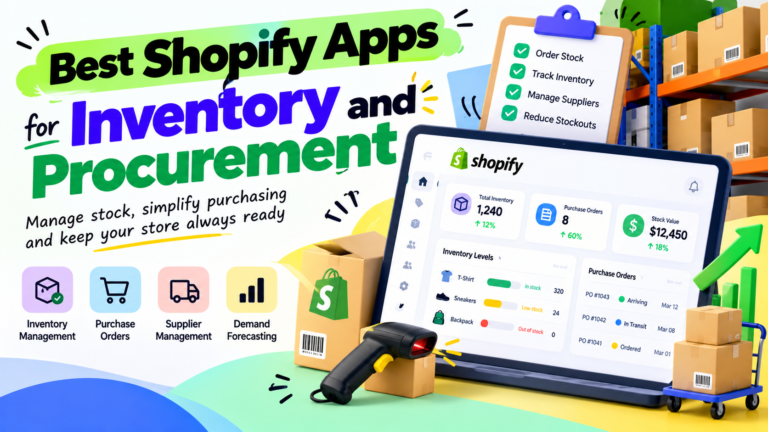
Tooling helps. Inventory and purchasing apps can automate reorder points and PO generation; we compared the leading options in the best Shopify apps for inventory and procurement. But software only records decisions. Someone still has to chase the factory, read the inspection report and decide whether to ship.
How do you keep quality high while cutting cost?
Quality is not the opposite of cost reduction; it is a cost line. Defects show up as returns, replacements, refunds, one-star reviews, customer service tickets and, on marketplaces, account health warnings. A supplier with a slightly higher unit price and a much lower defect rate is often the cheaper supplier.
What does a practical ecommerce QC program look like?
- Specification sheet: Measurable requirements for every critical attribute, with photos of acceptable and unacceptable examples.
- Golden sample: A signed, sealed approved sample held by both you and the factory as the reference for every production run.
- Pre-production check: Verify raw materials and components before production starts, when changes are cheap.
- During-production inspection: For large or new orders, catch systematic problems while there is time to fix them.
- Pre-shipment inspection (PSI): Random sampling of finished goods using AQL tables from ISO 2859-1 or ANSI/ASQ Z1.4, with defect limits you set for critical, major and minor defects.
- Balance payment tied to PSI pass: Your strongest leverage is the unpaid balance. Do not release it until goods pass inspection.
- Closed-loop feedback: Feed return reasons and review complaints back to the supplier as corrective action requests.
That last point is where most brands break down. Return and review data usually sits with the customer service team while supplier conversations sit with whoever placed the PO. Linking them is one of the highest-return moves in procurement. Our article on reducing return rates and recovering margin shows how to categorize return reasons so they become actionable supplier feedback.
How do Incoterms change your landed cost and risk?
Incoterms (the International Chamber of Commerce’s Incoterms 2020 rules) define where cost and risk transfer from seller to buyer. The same product can look cheap or expensive depending on which term the quote uses, so normalize every quote before comparing.
| Incoterm | Supplier handles | You handle | When it fits |
|---|---|---|---|
| EXW (Ex Works) | Goods ready at factory | Everything from pickup onward, including export clearance | Rarely ideal; export formalities are hard to manage remotely |
| FOB (Free On Board) | Origin transport, export clearance, loading onto the vessel | Ocean freight, insurance, import clearance, duties, delivery | The common default for sea freight; gives you freight control |
| CIF (Cost, Insurance, Freight) | Freight and minimum insurance to destination port | Destination charges, duties, delivery | Convenient, but freight markups and destination fees can hide cost |
| DDP (Delivered Duty Paid) | Everything to your door, including duties | Unloading | Simple for small brands; ask for a transparent cost breakdown |
A useful tactic is to ask suppliers to quote two Incoterms, typically FOB and DDP. The gap between them tells you what the supplier charges for logistics and whether your own forwarder can beat it.
How do you reduce supplier risk without raising COGS?
Single-sourcing a hero SKU is a bet that nothing goes wrong at one factory, in one region, on one shipping lane. Tariff changes, port congestion, factory closures and quality drift have all hit ecommerce brands hard in recent years. Diversification is insurance, and like insurance it has a cost, so apply it where the downside is largest.
- Segment suppliers by risk and spend. Strategic suppliers for hero SKUs get dual-sourcing plans and deeper relationships; transactional suppliers get competitive bidding.
- Qualify a backup before you need it. A second supplier that has passed sampling and a pilot order can be activated in weeks rather than months.
- Split volume deliberately. An 80/20 split keeps the primary supplier’s pricing while keeping the backup warm.
- Diversify geography. Combining sources across countries such as China, Vietnam, India or nearshore partners reduces exposure to any single tariff regime or disruption.
- Model scenarios. Compare suppliers on a base case and a disruption case. Supplier A may win on average while Supplier B wins when things go wrong.
- Protect IP. Use NNN agreements where relevant, register trademarks in manufacturing countries and split critical components across suppliers if needed.
Which procurement KPIs should ecommerce brands track?
| KPI | What it tells you |
|---|---|
| Landed cost per unit (by SKU) | Your true COGS and the baseline for every savings claim |
| Realized savings vs. baseline | Whether negotiated savings actually reached the P&L |
| Defect rate / PSI pass rate | Supplier quality consistency over time |
| On-time in-full (OTIF) | Supplier reliability and stockout risk |
| Lead time and lead-time variability | How much safety stock you need to carry |
| Supplier concentration | Share of COGS spend with your largest supplier |
| Return rate attributable to product quality | The hidden cost of cheap sourcing |
| Days payable outstanding | How well payment terms support cash flow |
Review these monthly in a simple supplier scorecard that weights cost, quality, delivery and responsiveness. Share the scorecard with suppliers; the best ones want to know where they stand.
Should you run procurement in-house, use an agent, or build a dedicated offshore team?
Procurement is labor-intensive. Supplier follow-ups, PO tracking, inspection scheduling, document checks and cost analysis add up to a full-time job long before most brands hire for it. Here is how the main options compare:
| Model | Strengths | Weaknesses |
|---|---|---|
| Founder or ops lead does it | Full context, no added headcount | Does not scale; time pulled from growth; follow-ups slip |
| In-house procurement hire (US/UK/EU) | Dedicated owner, strong alignment | High cost; one person rarely covers sourcing, QC coordination and analysis |
| Commission-based sourcing agent | On-the-ground presence in manufacturing regions | Incentives can favor the factory; limited visibility into your P&L |
| Dedicated embedded offshore team | Full-time specialists working inside your tools, at a fraction of onshore cost, with time-zone coverage of supplier hours | Needs clear processes and a defined decision-making owner on your side |
The embedded model works well because procurement rewards persistence and detail more than any single heroic negotiation. A dedicated team can follow up with suppliers during Asian business hours, maintain landed cost models, schedule inspections, reconcile invoices and surface savings opportunities every week. If you are weighing the time-zone question, see how overlap models for managing offshore teams keep work moving without late-night calls.
How AcquireX runs procurement and sourcing for ecommerce brands
AcquireX provides brands with a dedicated, embedded team based in Pune, India, that owns ecommerce functions end to end. Our ecommerce procurement and sourcing services cover the full cycle described in this guide:
- Supplier discovery and vetting, including RFQs, sample management and audit coordination.
- Landed cost modeling at SKU level, so every decision is made on true COGS.
- Negotiation support built on cost breakdowns, competitive benchmarks and scheduled cost reviews.
- PO management from creation and acknowledgment through production milestones and shipping documents.
- Quality control coordination, from golden samples to pre-shipment inspections and corrective action requests.
- Supplier diversification and risk planning for your highest-revenue SKUs.
Because the same team can also support supply chain, catalog and customer service functions, return data and inventory signals flow back into procurement decisions instead of sitting in separate silos.
Want to see where your COGS is leaking? Book a call with AcquireX and we will walk through your top SKUs, current suppliers and landed cost to identify the fastest savings opportunities.
A 90-day plan to cut COGS without sacrificing quality
- Days 1-30: Baseline. Build landed cost per SKU, rank SKUs by annual COGS spend, collect defect and return data by supplier, and document current specs and terms.
- Days 31-60: Source and negotiate. Issue RFQs for the top-spend SKUs, request cost breakdowns from incumbents, test packaging and carton changes, and propose term improvements tied to forecasts or commitments.
- Days 61-90: Lock in and protect. Sign updated supply agreements, introduce pre-shipment inspections tied to balance payments, qualify one backup supplier for your top hero SKU, and launch a monthly supplier scorecard.
Frequently asked questions
What is the difference between procurement and sourcing in ecommerce?
Sourcing is the strategic process of choosing suppliers and negotiating terms. Procurement is the operational process of placing purchase orders, managing production and quality control, coordinating freight and paying suppliers. Ecommerce brands need both to control COGS.
How can an ecommerce brand reduce COGS without lowering quality?
Focus on total landed cost rather than unit price. Use volume commitments, forecast sharing, better payment terms, packaging optimization and variant consolidation, while protecting quality with written specs, golden samples and pre-shipment inspections tied to the balance payment.
What should be included in landed cost?
Landed cost includes the supplier unit price, packaging and labeling, amortized tooling, freight and insurance, duties and customs fees, inspection and testing, defect losses, currency and payment costs, and inventory carrying cost driven by MOQ and lead time.
How do I know if a supplier is a factory or a trading company?
Check the business license scope, verify the address is a production facility, request factory floor video or a third-party audit, and ask detailed questions about production lines and capacity. Trading companies are not always bad, but you should know who actually makes your product.
What is a pre-shipment inspection and is it worth it?
A pre-shipment inspection is a random sample check of finished goods before they leave the factory, typically using AQL sampling standards. For most ecommerce brands it is worth it, because fixing defects at the factory is far cheaper than handling returns, refunds and negative reviews later.
Should I use more than one supplier for the same product?
For hero SKUs that drive a large share of revenue, yes. Qualifying a backup supplier and splitting a small share of volume reduces the risk of stockouts from quality issues, disruptions or tariff changes. For low-volume SKUs, the added cost may not be justified.
Which Incoterm is best for ecommerce imports?
FOB is a common default because it gives you control of ocean freight while the supplier handles export clearance. DDP is simpler for small brands but can hide logistics markups. Asking for quotes on two Incoterms lets you compare true costs.
Can an offshore team really manage procurement for a US or UK brand?
Yes. A dedicated offshore procurement team can follow up with suppliers during their business hours, maintain landed cost models, manage POs and coordinate inspections, while your internal owner retains final approval on suppliers, pricing and contracts.