Your factory invoice says $1.40. Your bank says something else.
That gap is where most imported product brands lose money. Not in ads. Not in discounts. In a spreadsheet cell that was never updated after the freight bill arrived.
Most brands price off the supplier quote. Then they wait 60 days for the forwarder invoice, 30 more for the broker, and by then the product is already selling at a margin nobody checked. The store looks healthy. The bank account does not.
This guide shows you how to build a real landed cost per unit, then push past it into true COGS. You get a worked example with real USD math, three freight allocation methods compared side by side, and a framework you can run this week.
Quick Answer
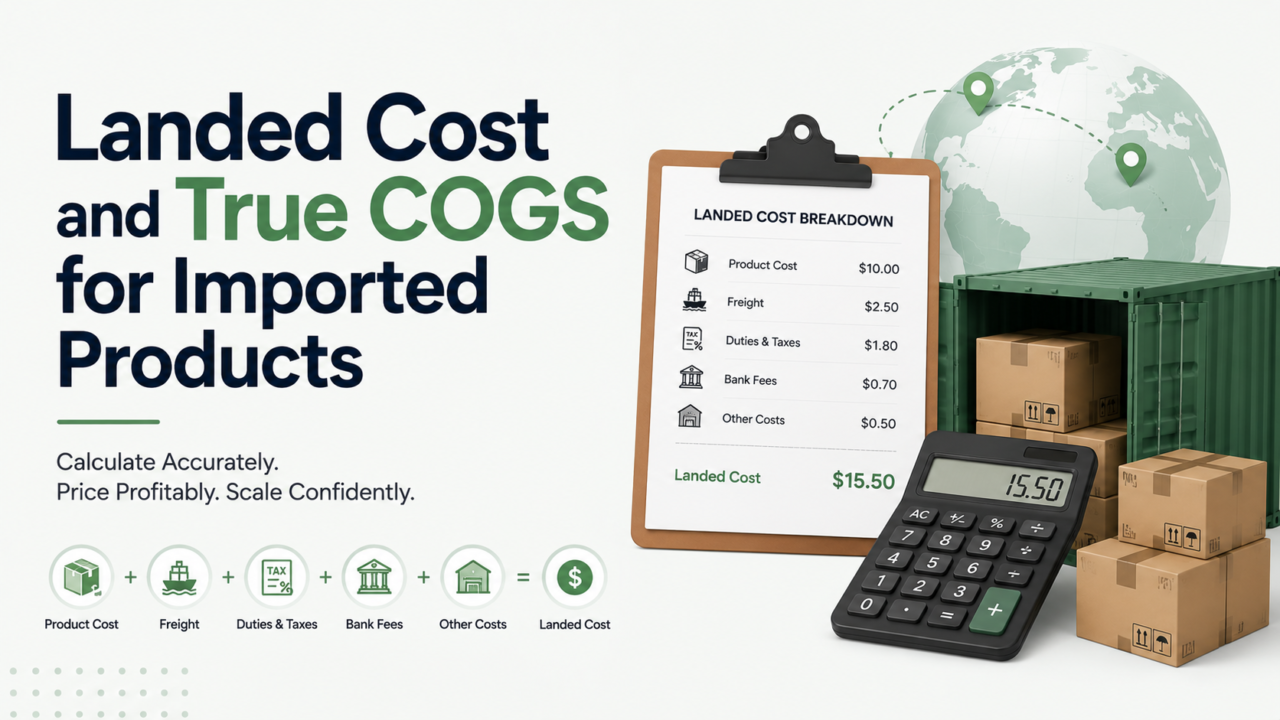
Landed cost is the total cost to get one unit from the factory floor onto your warehouse shelf. It includes the product price, freight, duty, customs fees, insurance, drayage, and receiving labor.
True COGS goes one step further. It adds what happens to that unit after it lands: defects, shrinkage, storage, and the cost of cash tied up in inventory.
The formula:
Landed Cost Per Unit = Factory Price + Allocated Freight + Duty + Customs Fees + Insurance + Drayage + Receiving
True COGS Per Unit = Landed Cost / (1 – Defect Rate) + Storage + Carrying Cost
Key Takeaways
- Factory price is usually 60% to 80% of your real unit cost, not 100%.
- The single biggest error is allocating freight by unit count instead of weight or volume.
- The US de minimis exemption ended on August 29, 2025. Every commercial import now pays duty, no matter how small.
- MPF and HMF are separate from duty and land on the same entry. Most brands forget both.
- Recalculate landed cost when the actual invoices arrive, not just when you place the PO.
What Is Landed Cost?
Landed cost is what a single unit actually costs you by the time it is sitting in your warehouse, unpacked, counted, and ready to pick.
Think of it as the difference between the sticker price of a car and the drive-away price. The sticker gets you excited. The drive-away number is what leaves your account.
For imported goods, landed cost pulls in:
- The price you paid the factory
- Ocean or air freight, plus origin and destination charges
- Import duty and any tariffs
- Government user fees like MPF and HMF
- Customs broker fees, ISF filing, and your customs bond
- Cargo insurance
- Drayage from the port to your warehouse or 3PL
- Receiving and putaway labor
Leave any one of these out and your margin calculation is wrong from the start.
What Is the Difference Between Landed Cost and COGS?
People swap these terms all the time. They are not the same thing.
| Term | What It Answers | When You Use It |
|---|---|---|
| Factory price | What did the supplier charge? | Negotiating with vendors |
| Landed cost | What did this unit cost to get on my shelf? | Pricing, supplier comparison, reorder calls |
| True COGS | What did each sellable unit really cost me? | Margin reporting, profit forecasting |
| Accounting COGS | What did the units I sold this month cost? | Income statement and taxes |
Here is the short version:
- Factory price is a quote.
- Landed cost is what you paid to acquire the inventory.
- True COGS is landed cost adjusted for the units you can actually sell.
- Accounting COGS is a period number for your P&L.
Use landed cost when you price. Use true COGS when you report. Confusing them is the quietest way to lose money on a product you think is winning.
What Is the Difference Between FOB Price and Landed Cost?
This is where supplier comparisons go wrong most often.
FOB price is what your supplier quotes once the goods are loaded at the origin port. It is a clean number, easy to compare, and almost useless on its own.
Landed cost is FOB plus everything after it: freight, duty, fees, insurance, drayage, and receiving.
Here is why the gap matters. Two suppliers quote you:
- Supplier 1: $9.00 FOB, made in a country with a 3% duty rate, ships in tight cartons
- Supplier 2: $8.20 FOB, made in a country with a 12% duty rate, bulky packaging
Supplier 2 looks $0.80 cheaper. After duty and the extra container space, it usually is not. The only way to know is to run both to landed.
Ask every supplier for the same three things before you compare: FOB price, carton dimensions and weight, and the HTS code. Without those, you cannot build a landed number, and you are comparing quotes instead of costs. Our guide to ecommerce procurement and sourcing covers how to structure those requests.
Our guide to strategic sourcing methods goes deeper on running this as a repeatable process.
Why Does Landed Cost Matter More in 2026?
Two things changed, and both raised the floor on import costs.
1. De minimis is gone.
For years, shipments under $800 entered the US duty free under Section 321. That is over.
Executive Order 14324, signed July 30, 2025, suspended duty free de minimis treatment for all countries, regardless of origin, on goods valued at $800 or less. It took effect at 12:01 a.m. on August 29, 2025.
Those goods now have to be entered using a proper entry type in the Automated Commercial Environment, according to the Federal Register implementation notice.
Congress went further. The One Big Beautiful Bill Act terminates the exemption outright, effective July 1, 2027.
What this means for you: any model built on small parcel imports skipping duty is broken. Rebuild it.
2. Government fees are easy to miss and add up fast.
According to CBP guidance, the Merchandise Processing Fee on formal entries is 0.3464% of the value of the goods, excluding duty, freight, and insurance. For fiscal year 2026 it cannot fall below $33.58 or rise above $651.50 per entry.
The Harbor Maintenance Fee is a separate charge of 0.125% of cargo value. It applies only to cargo arriving by ocean, and it has no floor or cap.
Small numbers. But they are per entry, and they stack with duty.
What Is the CRATE Framework for Landed Cost?
Most guides stop when the pallet hits your dock. That is a mistake. Cost keeps moving after arrival.
We use a five-step method called CRATE. It runs from the factory gate all the way through the cost of holding stock.
C: Cost at the factory gate The unit price on the commercial invoice. Nothing else. This is your baseline, not your cost.
R: Rates, duty, and fees Your HTS classification drives your duty rate. Add MPF, HMF if you ship by ocean, plus broker, ISF, and bond fees.
A: Allocate freight correctly Split shared shipment costs across SKUs using the right driver. This is where most spreadsheets break.
T: Terminal to warehouse Drayage, chassis fees, detention, and 3PL receiving labor. These land weeks after the freight invoice.
E: Erosion after arrival Defects, damaged units, shrinkage, storage, and the cost of cash sitting in a box. This is the step almost nobody runs.
Steps C through T give you landed cost. Adding E gives you true COGS.
How Do You Calculate Landed Cost Step by Step?
Here is a real mixed container. One shipment, three SKUs, from Vietnam to a US 3PL.
The shipment
| SKU | Product | Units | Factory Price | Goods Value | Weight |
|---|---|---|---|---|---|
| A | Ceramic mug | 4,000 | $2.10 | $8,400 | 2,000 kg |
| B | Cotton tote | 6,000 | $1.40 | $8,400 | 900 kg |
| C | Cast iron pan | 1,000 | $9.00 | $9,000 | 2,000 kg |
| Total | 11,000 | $25,800 | 4,900 kg |
The shared costs
| Line Item | Amount |
|---|---|
| Ocean freight, all in | $4,200 |
| Marine insurance | $130 |
| Broker, ISF, bond | $385 |
| Drayage to 3PL | $650 |
| 3PL receiving | $420 |
| MPF (0.3464% of $25,800) | $89.37 |
| HMF (0.125% of $25,800) | $32.25 |
| Shared pool total | $5,906.62 |
Duty is charged per SKU, not shared
Duty rates depend on your HTS code. These are illustrative:
- Mugs at 6.0%: $8,400 x 0.06 = $504
- Totes at 8.5%: $8,400 x 0.085 = $714
- Pans at 3.0%: $9,000 x 0.03 = $270
Total duty: $1,488
Total shipment landed cost: $33,194.62
Goods were $25,800. Getting them here cost another $7,394.62. That is 28.7% on top of the invoice.
How Should You Allocate Freight Across SKUs?
This is the step that decides whether your per-unit numbers are useful or fiction.
You have $5,906.62 of shared cost to spread. There are three common ways to do it, and they give very different answers.
Method 1: Split evenly per unit $5,906.62 / 11,000 units = $0.537 per unit
Method 2: Split by goods value Each SKU takes a share based on its dollar value.
Method 3: Split by weight Each SKU takes a share based on its kilograms.
Same shipment, three answers:
| SKU | Per Unit Method | By Value | By Weight |
|---|---|---|---|
| A: Mug | $2.76 | $2.71 | $2.83 |
| B: Tote | $2.06 | $1.84 | $1.70 |
| C: Pan | $9.81 | $11.33 | $11.68 |
Look at the tote. It costs $1.70 or $2.06 depending only on which method you picked. That is a 21% swing on a product with a thin margin to begin with.
Look at the pan. Nearly $2 of difference per unit.
Which method is right?
- Weight or volume for ocean and air freight. Carriers charge you by weight and space, so your allocation should match.
- Goods value for duty, MPF, HMF, and insurance. These are charged as a percentage of value, so value is the correct driver.
- Per unit only for costs that are truly per unit, like receiving labor or labeling.
The clean way is to split the pool by cost type and use a different driver for each. Most brands use one driver for everything. That is how a light, cheap SKU ends up subsidizing a heavy, expensive one.
In our example, allocating per unit makes the pan look $1.87 cheaper than it is. If you price off that number, you sell every pan at a loss you cannot see.
What Does True COGS Add on Top?
Landed cost assumes every unit that arrives can be sold. It cannot.
Take the tote at $1.70 landed, allocated by weight.
Step 1: Adjust for defects 3% of the totes arrive stained or misprinted. You can sell 5,820, not 6,000.
- Total tote cost: 6,000 x $1.70 = $10,200
- Divided by sellable units: $10,200 / 5,820 = $1.753
Step 2: Add storage Average 75 days at your 3PL, roughly $0.04 per unit.
- $1.753 + $0.04 = $1.793
Step 3: Add carrying cost Your cash is locked up for about 90 days. At an 11% annual cost of capital:
- $1.793 x 0.11 x (90 / 365) = $0.049
- $1.793 + $0.049 = $1.842
True COGS: $1.84 against a $1.40 factory price.
That is 31% higher than the number in your PO. If you were pricing at a 3x markup off $1.40, you thought you had 67% gross margin. You have closer to 56%. Before ads. Before returns.
Pair this with your contribution margin math and your cost per order and you finally see the real picture.
What Costs Do Brands Forget Most Often?
From auditing import cost models, these are the lines that go missing:
- Detention and demurrage. Containers sitting at the port past free time. Can run hundreds per day.
- Chassis fees. Charged separately from drayage in many US ports.
- Customs bond premium. Annual continuous bond cost, spread across shipments.
- Sample and tooling costs. Real spend that belongs in the first production run.
- Inspection fees. Third party QC at the factory before shipping.
- Wire and FX fees. Bank charges plus the spread on currency conversion.
- Rework and relabeling. Fixing barcode or compliance issues after arrival.
- Prep for marketplaces. Poly bagging, FNSKU labels, and bundling for FBA.
- Freight variance. The gap between your quoted rate and the final invoice.
That last one deserves its own point.
Why Should You Recalculate After the Invoices Land?
Most brands calculate landed cost once, at PO time, using quotes.
Quotes are estimates, and freight invoices arrive 30 to 60 days later without matching them. Duty gets adjusted after entry, and accessorial charges appear that nobody quoted.
Run a simple two-pass system:
Pass 1: At PO Use quoted rates. This gives you a working number for pricing and cash planning.
Pass 2: At invoice close Once every invoice for that shipment is in, rebuild the number with actuals. Compare against Pass 1.
If your variance is consistently over 5%, your quotes are wrong and your pricing is drifting. Fix the estimate, not just the spreadsheet.
Keep a variance log by shipment. After three or four containers you will know your true freight uplift as a percentage, and your Pass 1 estimates get much sharper.
Build a landed cost factor
Once you have that history, turn it into a multiplier you can use on the spot.
If your last four shipments landed at an average of 1.29 times factory price, your landed cost factor is 1.29. A new SKU quoted at $6.40 FOB gives you a working estimate of $8.26 before you have booked a single container.
Keep separate factors for heavy goods and light goods. One blended number hides the difference that matters most.
How Do You Use Landed Cost to Make Better Decisions?
The number is only useful if it changes what you do. Here is where it should:
Supplier selection Never compare suppliers on unit price. A factory that is $0.20 cheaper per unit but sits in a higher tariff country can lose that advantage instantly. Compare landed, always. This is core procurement and sourcing discipline, not a finance exercise. A supplier scorecard makes landed cost one of the weighted criteria, alongside quality and on-time delivery.
Order quantity Fixed costs like brokerage, bond, and MPF spread across whatever you order. Larger orders lower per-unit landed cost. But they raise carrying cost and stockout risk, and your fulfillment model changes how much that storage actually costs. Balance it against your demand forecast and safety stock plan.
Pricing Set your floor price off true COGS, not factory price. Then layer in fulfillment, ads, and returns to find your real contribution. Our ecommerce pricing strategies guide covers what to do with that floor.
SKU pruning Some SKUs are heavy, low value, and quietly unprofitable once freight is allocated by weight. Landed cost exposes them. Cut them.
Freight mode Air looks expensive per kilo but frees up cash faster. Run both scenarios through your carrying cost math before defaulting to ocean.
Channel strategy A SKU can be profitable on your DTC site and lose money on a marketplace once referral fees stack on top of true COGS. Check both, especially if you run marketplace channels alongside your own store. Then sanity check the result against your LTV to CAC ratio.
What Should You Build This Week?
You do not need software to start. You need one clean sheet and a habit.
- Pick your top 10 SKUs by revenue. Not all of them. Start where the money is.
- Pull the last full shipment for each. You need every invoice: factory, forwarder, broker, drayage, 3PL.
- Build the shared cost pool. List every charge that covered multiple SKUs.
- Split the pool by driver. Weight for freight. Value for duty and fees. Units for labor.
- Add duty per SKU. Check the HTS code for each product. Verify with your broker.
- Apply your defect rate. Use real receiving reports, not a guess.
- Add storage and carrying cost. Days on hand times your cost of capital.
- Compare to what your system says. The gap is your blind spot.
Then set a recurring task: rerun this every time a container closes out.
Who Owns Landed Cost Inside Your Business?
This is the part most brands get wrong structurally.
Landed cost sits between three separate functions. Procurement negotiates the factory price, logistics books the freight, and finance records the invoice. Nobody owns the number from beginning to end.
So it never gets built.
The fix is not another tool. Our supply chain management guide covers the wider system, but the specific fix here is one person whose job is to close the loop on every shipment: track the PO, chase the invoices, rebuild the number, and push the update into your pricing sheet and inventory system.
At most growing brands, that role does not exist. The founder does it badly at 11pm, or it does not happen.
This is exactly the kind of work a dedicated supply chain and procurement operator handles as a standing process, not a fire drill. Not a vendor you email. Someone inside your operation who owns the number.
Common Questions About Landed Cost
Do I need a landed cost per market if I sell internationally?
Yes. Duty rates, taxes, and freight all change by destination. If you are selling internationally through Shopify Markets, build a separate landed number for each market you ship from rather than reusing your US figure.
Does landed cost include shipping to the customer?
No. Landed cost stops when the product is on your shelf and ready to pick. Outbound shipping to your customer is a fulfillment cost, and it belongs in your contribution margin calculation, not your COGS.
Is landed cost the same as landed price?
In practice, most operators use the terms interchangeably. Both refer to the full per-unit cost of getting a product to your facility. If a vendor uses the term, ask exactly which line items they include before you compare numbers.
How do Incoterms change my landed cost?
Incoterms decide who pays which leg, not whether the cost exists. Under EXW you pay almost everything from the factory door. Under DDP the supplier covers freight and duty, but that cost is baked into their unit price. The total is similar. Only the line items move. The ICC Incoterms 2020 rules define exactly where responsibility transfers.
Do tariffs count as part of landed cost?
Yes. Section 301, Section 232, and any antidumping or countervailing duties all belong in landed cost. They are charged on the entered value alongside your regular duty rate. Check current rates through CBP duty rate guidance.
How often should I recalculate landed cost?
Rebuild it every time a shipment closes out and all invoices are in. Review your standing estimates quarterly. If freight rates or tariff rates move sharply, rebuild immediately rather than waiting for the next container.
Can I still use the $800 de minimis exemption?
No. It was suspended for all countries on August 29, 2025, and repeal takes full effect July 1, 2027. Any commercial import now requires a formal or informal entry and pays applicable duty regardless of value.
The Bottom Line
Your factory invoice is a starting number, not a cost. The real number sits somewhere 25% to 40% higher once freight, duty, fees, defects, and carrying cost are in.
Brands that price off the invoice price grow revenue and shrink profit at the same time. Brands that price off true COGS know exactly which SKU is carrying the business and which one is quietly draining it.
Run CRATE on your top 10 SKUs this week. The number will surprise you. It usually does.
If closing the loop on every shipment is not happening because nobody owns it, that is a staffing problem, not a spreadsheet problem. AcquireX builds dedicated offshore supply chain and procurement teams that own landed cost as a standing process: tracking POs, reconciling invoices, and pushing updated numbers into your pricing before margin leaks.