Quick answer: To reduce WISMO (“Where is my order?”) tickets, fix the causes rather than answering faster. Give an honest delivery promise at checkout, close the silent gap between order and first carrier scan, send proactive shipping and exception alerts, offer a branded self-service tracking page, and automate the questions that remain in your helpdesk.
Most guides on WISMO are written by tracking-software vendors, so they usually end with “install our notification app.” Notifications matter, but they only fix part of the problem. A large share of order-status tickets starts before a parcel ever moves: a warehouse that packs a day late, a label that sits unscanned, a backorder nobody told the customer about, or a delivery promise that was never realistic. This playbook treats WISMO as what it really is, an operations problem that shows up in your support inbox, and walks through how to measure it, where it comes from, which fixes to prioritize, and how to run the work week to week.
What is WISMO, and why does it matter so much?
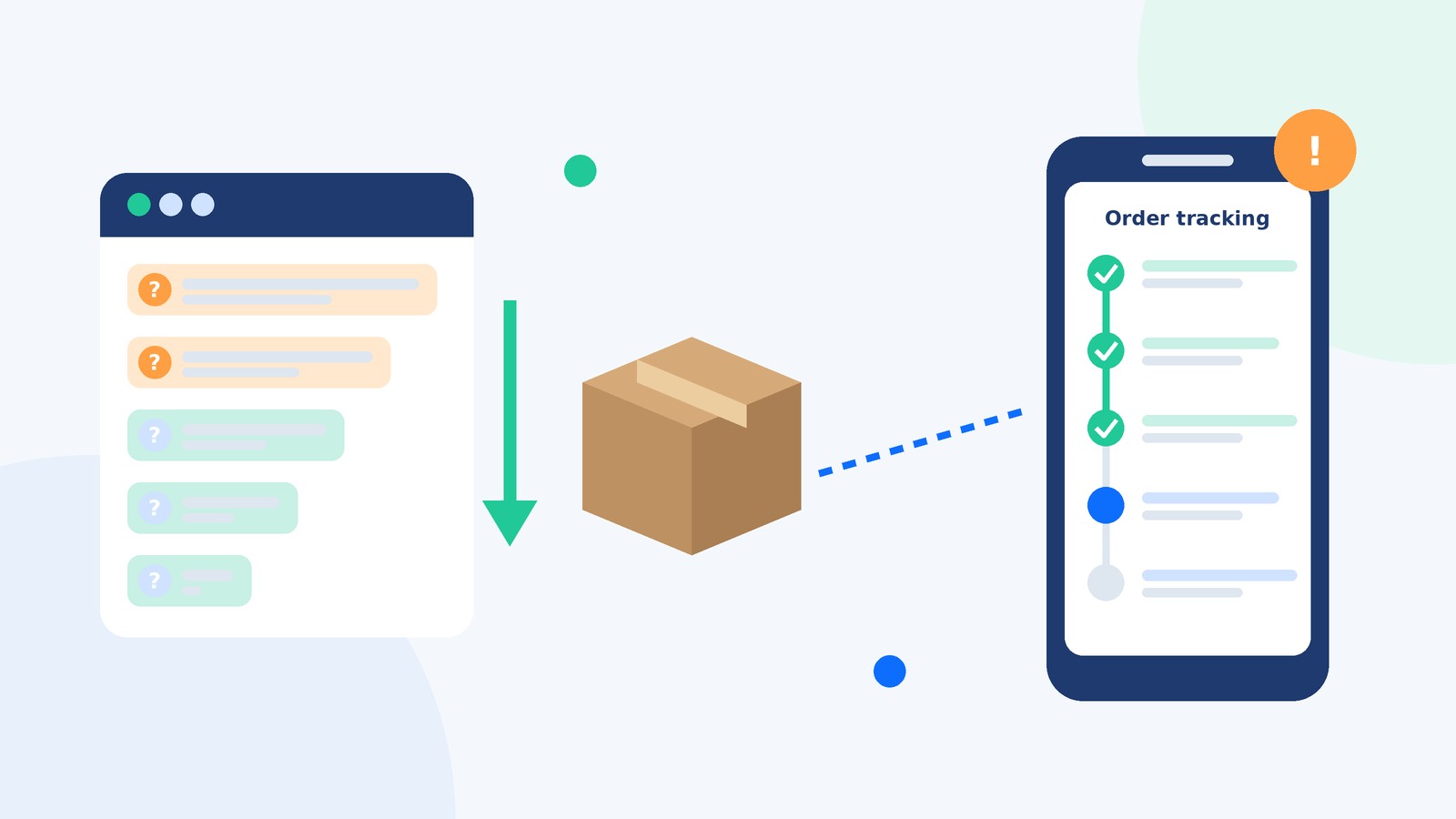
WISMO stands for “Where is my order?” It covers every contact a customer makes to ask about order status, shipping, tracking or delivery timing, whether it arrives by email, chat, phone, social DM or a marketplace message. “Has my order shipped?”, “My tracking hasn’t moved in three days” and “It says delivered but I don’t have it” are all WISMO.
It matters because of volume. Fulfillment provider Radial estimates that WISMO drives 25-35% of retail contact center interactions and can spike to 50% during peak. Every one of those contacts is a question your systems already had the answer to. That makes WISMO the most preventable category of support work in ecommerce, and one of the clearest signals of how well your post-purchase experience is running.
The cost is not only agent time. WISMO tickets crowd the queue, so customers with real problems (damaged items, wrong products, failed payments) wait longer. Anxious customers who cannot get an answer open card disputes for “item not received,” and they are less likely to buy again. A useful way to think about it: every WISMO ticket is a customer telling you that your post-purchase communication failed them at a specific moment.
What actually causes WISMO tickets?
Customers ask where their order is when the information they have does not match what they expected. That mismatch has a small number of root causes, and each needs a different fix.
- A vague or optimistic delivery promise. “Ships soon” or “3-5 days” without saying whether that means processing or transit creates questions on day four.
- Pre-shipment silence. The order confirmation arrives, then nothing for one or two days while the order waits to be picked, packed and labeled.
- Label created, not scanned. The shipping email goes out when the label prints, but the carrier has not picked the parcel up yet. The tracking page shows the same status for days and looks stuck.
- Stalled or confusing transit scans. Carrier codes such as “exception,” “in transit, arriving late” or repeated facility scans mean nothing to most shoppers.
- Backorders, preorders and split shipments. One item arrives, the rest do not, and nobody explained why.
- Delivered but not received. The carrier marks the parcel delivered, but the customer cannot find it.
- Notifications that never land. Shipping emails go to spam or promotions tabs, customers mistype their email address, or the SMS opt-in was never captured.
- International and customs delays. Cross-border parcels sit in customs, and duties or tax questions come up at the door.
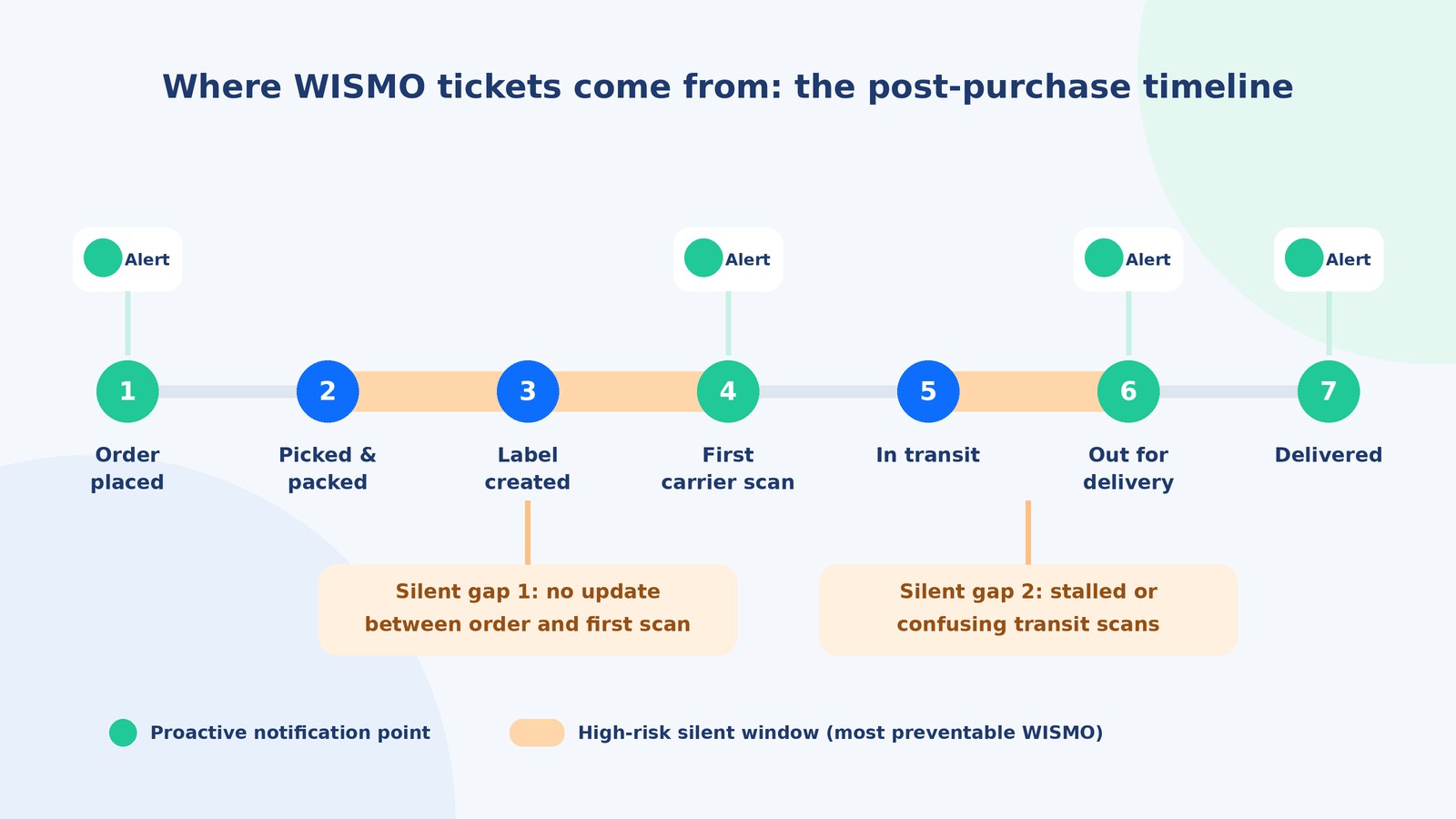
Map those causes onto the post-purchase timeline and two “silent windows” stand out: the gap between order placement and the first carrier scan, and stretches in transit when scans stall or read like jargon. Most preventable WISMO lives in those two windows.
How do you measure WISMO before trying to fix it?
You cannot reduce what you cannot see. Before changing anything, spend two weeks measuring. Three numbers matter most.
- WISMO rate: WISMO contacts ÷ orders shipped in the same period. This normalizes for order volume, so you can compare a quiet month with a sale month.
- WISMO share of tickets: WISMO contacts ÷ all support contacts. This shows how much of your team’s capacity it consumes.
- Repeat WISMO contacts: customers who asked about the same order more than once. A high repeat rate means your first answer is not resolving the worry.
Then tag every WISMO ticket with a sub-reason, because “WISMO” alone tells you nothing about what to fix. A simple taxonomy works well:
| WISMO sub-tag | What the customer is really asking | Usual root cause | Who owns the fix |
|---|---|---|---|
| Not shipped yet | “Did you forget my order?” | Processing time, fulfillment backlog, unclear promise | Ops / 3PL |
| Label created, no movement | “Is it stuck?” | Carrier pickup lag, shipping email sent too early | Ops / 3PL |
| In transit, normal | “When exactly will it arrive?” | No ETA, confusing carrier page | CX / ecommerce |
| Delayed or exception | “Something went wrong, what now?” | Carrier exception, weather, address issue | CX + ops |
| Partial / backorder | “Where is the rest of my order?” | Split shipment or stockout not explained | Ops + CX |
| Delivered, not received | “It says delivered but it isn’t here.” | Misdelivery, theft, early scan | CX + finance |
| Can’t find tracking | “Where is my tracking link?” | Deliverability, poor email design | Ecommerce / marketing |
Also cut the data by days since order, carrier and service level, warehouse or 3PL, and domestic versus international. Patterns appear quickly: one carrier service that generates most “stuck” tickets, or a spike every Monday because weekend orders sit until the warehouse opens. For the wider set of support metrics worth tracking next to WISMO, see our guide to ecommerce customer support KPIs that predict retention.
How do you reduce WISMO tickets? A 9-step playbook
Work through these in order. The early steps remove the causes; the later steps make the remaining tickets cheap and fast to resolve.
1. Is your delivery promise honest and specific?
WISMO often starts at checkout. Show an estimated delivery date or date range instead of “3-5 business days,” state your order cutoff time, and separate processing time from transit time. If your warehouse ships the next business day, say so. A slightly longer, accurate promise generates fewer tickets than a short one you miss.
In the US, this is also a compliance issue. The FTC’s Mail, Internet, or Telephone Order Merchandise Rule requires sellers to have a reasonable basis for any shipping time they state, or to ship within 30 days if they state none. The FTC’s guidance specifically notes that if you say you ship within 48 hours “most of the time,” you will be held to shipping, or sending a delay notice, within 48 hours every time.
2. Have you closed the gap between order and first scan?
This is the window the notification-app guides usually skip. Fix it on both sides:
- Set a fulfillment SLA and enforce it. Agree a ship-by time with your warehouse or 3PL (for example, orders before the cutoff leave the same day) and review the on-time ship rate weekly. If you are deciding whether to keep fulfillment in-house, our 3PL vs in-house vs hybrid fulfillment comparison covers how each model affects speed and control.
- Tell customers what happens before shipping. The order confirmation should say when the order will ship, not just that it was received. For longer processing times, add a “your order is being packed” update.
- Watch “label created, no scan.” Run a daily report of labels older than one business day with no carrier acceptance scan. Those parcels were never picked up, were left on a dock, or were mis-sorted. Chase them before customers notice.
3. Are you sending the right proactive notifications?
Proactive updates answer the question before it is asked. A core sequence covers most of the journey:
| Notification | Trigger | Best channel | Must include |
|---|---|---|---|
| Order confirmed | Order placed | Order summary, expected ship date, delivery estimate | |
| Shipped | First carrier scan (not label print) | Email, optional SMS | Carrier, tracking link to your branded page, ETA |
| Delay or exception | Carrier exception or no scan within your threshold | Email + SMS | Plain-language reason, new ETA, what you are doing, how to get help |
| Out for delivery | Carrier “out for delivery” event | SMS or push | Delivery today, address on file, delivery instructions link |
| Delivered | Carrier delivered event | Delivery time and location, what to do if not found |
Two details make a big difference. First, trigger the “shipped” message on the carrier’s first scan, or word it as “label created, your parcel will be handed to the carrier,” so customers are not staring at a frozen tracking page. Second, rewrite carrier statuses in plain language. “Exception” should become “Your parcel was delayed at the carrier’s depot. Here is the new estimate.” If you plan to send updates by text, get consent and quiet-hour rules right; our guide to SMS marketing compliance for D2C brands explains the essentials.
4. Do customers have a self-service tracking page they trust?
Send every tracking link to a branded page on your own site rather than the carrier’s page. A good tracking page shows the order contents, a plain-language status, the current ETA, a timeline that includes your own milestones (packed, handed to carrier), and clear links for help and for reporting a problem. Make it reachable from the order confirmation, the account area and a “Track my order” link in the site footer and help center.
On Shopify, the order status page can be extended with apps through the checkout and accounts editor, and Shopify’s documentation lists apps that customize the thank you and order status pages as available on the Basic plan and higher.
5. Do you detect problems and tell customers first?
The most valuable WISMO ticket is the one you pre-empt during a real delay. Set exception rules that trigger an outreach or a proactive message, such as:
- no carrier scan for a set number of business days while in transit (set the threshold per carrier and service),
- a carrier exception, address problem or return-to-sender event,
- the ETA passing without a delivered scan,
- regional disruption such as severe weather affecting a hub.
Route these into a daily “at-risk orders” queue owned by a named person. A message that says “We noticed your parcel stopped moving, we’ve opened a trace with the carrier and we’ll update you by Thursday” turns a likely complaint into trust.
6. Are backorders, preorders and split shipments handled explicitly?
Partial shipments create some of the most frustrated WISMO contacts because customers think items are missing. Say “This order will arrive in two parcels” in the shipping email, show both parcels on the tracking page, and state preorder ship dates on the product page, in the cart and in the confirmation.
When you cannot ship on time, US sellers have specific duties under the FTC rule: you must seek the customer’s consent to the delay and offer the option to cancel for a prompt refund, and the FTC guide says posting a delay notice only on the order-status page is not enough on its own if the customer may not see it in time. The same guide states that the seller, not the fulfillment house or drop shipper, is liable for violations caused by its fulfillment partner. That is one more reason to monitor your 3PL’s ship times closely.
7. Have you automated the questions that still come in?
Even with good prevention, some customers will still ask. Make those contacts cheap:
- Order lookup in chat and the help center. Let customers enter an order number and email to see live status without an agent.
- Helpdesk integration. Your helpdesk should show order, fulfillment and tracking data next to the ticket so agents never switch tabs. Our Gorgias vs Zendesk vs Re:amaze comparison covers how the main Shopify helpdesks handle this.
- Auto-tagging and macros. Detect WISMO intent automatically, apply the sub-tag, and suggest the right macro filled with the order’s live tracking variables.
- AI answers grounded in order data. A chatbot that reads live order status can resolve routine questions instantly, but only if it is connected to real data and hands off to a human on exceptions, delivered-not-received claims and angry customers.
8. Do you have a clear policy for “delivered but not received”?
These are the costliest WISMO tickets because they can become refunds, reshipments or chargebacks. Write one policy and apply it consistently: ask the customer to check with neighbors and around the property, wait a short defined window (carriers sometimes scan delivered before the actual drop-off), check the carrier’s proof of delivery, open a carrier claim, and then decide on reship or refund based on order value and customer history. Keep evidence such as tracking history and delivery photos, because it matters if the customer disputes the charge. Our chargeback management guide for D2C brands covers how to fight and prevent “item not received” disputes.
9. Are you ready for peak season?
WISMO spikes when carrier networks are under pressure and order volume jumps at the same time. Before peak, pad delivery promises, publish holiday shipping cutoff dates, pre-write delay and exception messages, increase exception monitoring to twice a day, and add support coverage for the weeks after big sale events, when most “where is it?” contacts arrive.
Which WISMO fixes give the most impact for the effort?
If you can only do a few things this month, use this comparison to choose. Impact depends on which sub-tags dominate your WISMO, so read it alongside your own tagged data.
| Fix | Root cause it addresses | Effort | Typical owner | Prioritize when |
|---|---|---|---|---|
| Accurate delivery estimate at checkout | Vague or optimistic promise | Low-medium | Ecommerce | “Not shipped yet” and “when will it arrive” tickets dominate |
| Fulfillment SLA + unscanned-label report | Pre-shipment silence, pickup lag | Medium | Ops / 3PL | Tickets cluster in the first 3 days after order |
| Core notification sequence | No proactive updates | Low | Ecommerce / CX | You only send order and shipping confirmations today |
| Branded tracking page | Confusing carrier pages, lost links | Low-medium | Ecommerce | Many “can’t find tracking” and “what does this status mean” tickets |
| Exception monitoring queue | Delays customers discover first | Medium | CX + ops | High repeat contacts and angry delay tickets |
| Split shipment and backorder messaging | Partial orders unexplained | Low | Ops + CX | You sell bundles, preorders or ship from multiple locations |
| Helpdesk order integration + macros | Slow, manual lookups | Low | CX | Agents switch tools to answer each ticket |
| Delivered-not-received policy | Inconsistent refunds, disputes | Low | CX + finance | Reships, refunds or chargebacks are rising |
What should a good WISMO reply look like?
When a ticket does come in, the reply should end the worry in one message. A strong WISMO reply has four parts: the current status in plain language, the expected delivery date, what you are doing if something is wrong, and when the customer will hear from you next. Here are three macro skeletons you can adapt.
In transit, on time: “Hi {first name}, your order {order number} is with {carrier} and moving normally. It’s currently expected on {ETA}. You can follow it live here: {tracking page link}. If it hasn’t arrived by {ETA + 1 business day}, reply to this email and we’ll step in right away.”
Stalled tracking: “Hi {first name}, thanks for flagging this. Your parcel hasn’t had a carrier update since {last scan date}, so we’ve opened a trace with {carrier} today. We’ll update you by {date} either way, and if it doesn’t turn up we’ll {reship / refund} it for you at no cost.”
Delivered, not received: “Hi {first name}, sorry about this. The carrier shows delivery on {date} at {location detail}. Sometimes parcels are scanned slightly early or left with a neighbor or in a safe place, so please check those spots. If it’s still missing by {date}, reply here and we’ll open a claim and sort out a replacement or refund.”
Store these as macros with live variables, keep them in your support SOPs, and review the wording every quarter against the tickets that still come back.
Is WISMO a support problem or an operations problem?
Both, and that is why it persists. Support sees the tickets, but the causes sit with operations, the 3PL, the ecommerce team and sometimes marketing. Give WISMO a single owner, usually the head of CX or ecommerce operations, and run a short weekly review with everyone who controls a cause:
- Support brings WISMO rate, sub-tag breakdown and example tickets.
- Operations or the 3PL brings on-time ship rate, unscanned labels and carrier exceptions.
- Ecommerce owns the checkout promise, tracking page and notification templates.
- Marketing checks email deliverability and SMS opt-in capture on the shipping flows.
The review should end with one or two specific fixes and a named owner each week. When WISMO is reviewed this way, the support inbox becomes an early-warning system for fulfillment problems instead of a cost center.
Should you handle WISMO in-house, with tools only, or with a dedicated team?
Tools prevent and deflect tickets, but someone still has to monitor exceptions, chase carriers, handle claims and keep the macros current. Here is how the three common models compare.
| Model | Strengths | Weaknesses | Best for |
|---|---|---|---|
| In-house support team | Close to the product and brand, direct access to ops | Expensive to staff for peaks and extended hours; WISMO crowds out complex work | Low order volume or very high-touch products |
| Tools and automation only | Fast deflection, scales with order volume | Nobody owns exceptions, carrier traces or root-cause fixes; bots fail on edge cases | Simple catalogs with reliable domestic shipping |
| Dedicated outsourced CX team + tools | Coverage across time zones, consistent exception handling, weekly root-cause reporting, flexible for peak | Needs good onboarding, SOPs and access to your systems | Growing brands with rising order volume, multiple carriers or marketplaces |
If you are weighing the outsourced route, our guide to ecommerce customer service outsourcing covers how to structure the team, the SLAs and the handoff so it protects margin rather than just answering tickets.
Want WISMO handled end to end?
AcquireX’s customer service management for ecommerce gives you a trained, dedicated support team that works inside your helpdesk and store: tagging WISMO by root cause, running the daily at-risk orders queue, chasing carriers and 3PLs, handling delivered-not-received claims, maintaining your macros and notification copy, and reporting the WISMO rate to you every week with the fixes that will lower it.
Book a call with AcquireX to see how much of your support volume is preventable and what it would take to cut it.
What does a 30-day plan to cut WISMO look like?
- Week 1, measure. Add WISMO sub-tags to your helpdesk, tag every order-status ticket, and calculate your baseline WISMO rate, share and repeat-contact rate.
- Week 2, fix the promise and the first gap. Update checkout and product-page delivery estimates, add the expected ship date to order confirmations, and start the daily unscanned-label report with your warehouse or 3PL.
- Week 3, communicate. Launch the core notification sequence with plain-language status copy, point every tracking link to a branded tracking page, and add a “Track my order” link to the footer and help center.
- Week 4, automate and own. Connect order data to your helpdesk, publish the three macros, set exception rules for the at-risk queue, write the delivered-not-received policy, and hold the first weekly WISMO review.
At the end of the month, compare your WISMO rate and sub-tag mix to the baseline. The sub-tags that did not move tell you exactly where to focus next.
Frequently asked questions
What does WISMO stand for?
WISMO stands for “Where is my order?” It describes any customer contact asking about order status, shipping, tracking or delivery timing, across email, chat, phone, social media and marketplace messages.
What is a good WISMO rate for an ecommerce store?
There is no universal benchmark because it depends on your carriers, shipping speed, product type and how much you sell internationally. Calculate your own WISMO rate as WISMO contacts divided by orders shipped, then aim to reduce it month over month and track it separately for peak periods.
What is the fastest way to reduce WISMO tickets?
The quickest wins are usually an accurate delivery estimate at checkout, a shipping notification triggered by the first carrier scan, plain-language delay alerts, and a branded tracking page linked from every message. Together they remove the most common reasons customers ask.
Why do customers contact support when they already have a tracking number?
Usually because the tracking page has not updated, the carrier status is confusing, or the delivery date has passed. Customers want reassurance and an explanation, not just raw scans. Plain-language status and proactive delay messages solve most of these contacts.
Should the shipping confirmation be sent when the label is created?
Ideally it should be sent at the carrier’s first acceptance scan. If your platform sends it when the label prints, change the wording to explain that the parcel will be handed to the carrier soon, so customers do not think a frozen tracking page means a lost order.
Can a chatbot handle WISMO questions?
Yes, if it is connected to live order and tracking data. A chatbot can answer routine “where is it” questions instantly, but it should hand off to a human for exceptions, delivered-not-received claims, partial orders and upset customers.
What do US sellers have to do when an order will ship late?
Under the FTC’s Mail, Internet, or Telephone Order Merchandise Rule, sellers must seek the customer’s consent to the delay and offer the option to cancel for a prompt refund. If you state no shipping time, you are expected to ship within 30 days. Check the FTC’s business guide for the full requirements.
Is it worth outsourcing WISMO and order-status support?
It often is for growing brands, because order-status work is high-volume, rules-based and spikes around sales and holidays. A dedicated outsourced team can cover extended hours, run exception monitoring and report on root causes, while your in-house team focuses on complex issues and fixes.