You scaled to $1M. Then $5M. Then $10M.
And somewhere in between, your inbox broke.
Refund requests pile up. “Where is my order?” emails flood your team. Your founder Slack has a #customer-complaints channel nobody opens before coffee.
Here’s the part nobody says out loud: most US D2C brands don’t have a product problem. They have a support problem. The fix isn’t another $24/hour hire in Austin. It’s a system.
This guide covers everything you need to outsource customer support for ecommerce the right way in 2026 — real costs by region, the top 7 providers ranked, the CSAT myth keeping founders stuck, the hybrid AI + human model that’s winning, KPI benchmarks, compliance requirements, and the 30-day migration plan that doesn’t crash your CSAT.
If you are still deciding how to structure the team itself (channels, SLAs, helpdesk ownership and in-house vs BPO vs dedicated), start with our guide to ecommerce customer service outsourcing. If “where is my order?” emails are your biggest pain, our playbook on how to reduce WISMO tickets shows how to cut them at the source.
The stat that sets up everything: A McKinsey report on customer care found that companies using trained offshore CX teams see CSAT scores rise by 15–25%, with up to a 30% reduction in Average Handle Time, and support costs dropping nearly 50%. AcquireX
Trained offshore. Higher CSAT. Lower costs. Read that again
What Is Ecommerce Customer Support Outsourcing?
Ecommerce customer support outsourcing is the practice of hiring an external team — offshore, nearshore, or onshore — to handle customer inquiries, returns, order issues, complaints, and pre-purchase questions on behalf of an online brand.
It comes in three flavors:
- BPO seats — Generic call center agents juggling multiple brands
- Dedicated team — Agents trained on your brand alone, working only on your account
- Hybrid (AI + human) — AI handles tier-1 tickets, humans handle tier-2
The best model for US D2C brands in 2026 is the hybrid dedicated model — AI deflects 60–70% of routine tickets, and a dedicated offshore team handles the rest under US-side QA oversight.
Why US D2C Brands Are Outsourcing Customer Support in 2026
Three things changed in the last 24 months:
- Ticket volume exploded. Shoppers expect replies in minutes, not hours. Salesforce found that 73% now expect the same experience across every channel — email, chat, social, or phone.
- AI got good. Tier-1 tickets (WISMO, returns, FAQs) can now be automated with 60–80% accuracy.
- Offshore talent matured. The Philippines, India, and LATAM now have ecommerce-specialized agents fluent in US English with deep Shopify and Gorgias experience.
The result? 60% of online retailers now at least partially outsource fulfillment and customer support, with global ecommerce sales projected to hit $6.88 trillion in 2026.
Outsourcing customer support for ecommerce isn’t a backup plan anymore. It’s the playbook.
The “Offshore = Bad CX” Myth Is Officially Dead
Most founders still believe:
- Offshore agents read robotic scripts
- US in-house is the only path to high CSAT
- Outsourcing kills brand voice
All three are wrong in 2026.
Here’s what’s true: bad CX doesn’t come from offshore. It comes from vendors. Pick a 200-brand BPO call center where one agent juggles 8 client accounts, and your CSAT tanks. Pick a dedicated team trained on your brand alone, and CSAT climbs.
India’s BPO sector historically faced 50% annual attrition, improved to 30–35% in 2025–2026 — with first-year attrition rates running as high as 69–73%.
That’s a vendor problem. Not an offshore problem.
The brands winning at outsourced ecommerce customer service in 2026 don’t pick the cheapest seat. They pick a dedicated team that owns one outcome: your CSAT score.
How Much Does It Cost to Outsource Customer Support for Ecommerce?
This is where most founders get tricked by the pitch deck. Let’s break the real math.
Cost by Region (Hourly Agent Rates, 2026)
| Region | Hourly Rate | Best For | CSAT Impact |
|---|---|---|---|
| Philippines | $6–$14/hr | Email, chat, voice. Strong English, ecommerce-trained | High (with dedicated model) |
| India | $7–$16/hr | Email, chat, technical support, Shopify dev | High (with US-side QA) |
| LATAM (Colombia, Mexico) | $12–$18/hr | Voice, bilingual EN/ES, US timezone | Highest offshore option |
| Caribbean (Jamaica) | $12–$18/hr | Voice, native English, US timezone | High |
| Eastern Europe | $12–$22/hr | Multilingual EU support | High |
| US Onshore | $25–$42/hr | Premium, regulated industries | High (premium cost) |
In-House vs Outsourced Cost Comparison (5-Agent Team)
| Model | Annual Cost | Setup Time | CSAT Year 1 | Best For |
|---|---|---|---|---|
| In-house US team | $350K–$530K | 2–3 months | Stable, expensive | $0–$2M brands |
| Per-hour offshore BPO | $80K–$150K | 2–4 weeks | Often drops 10–20% | Cost-only plays |
| Per-ticket BPO | $60K–$120K | 2–4 weeks | Drops fast | Avoid for D2C |
| Dedicated offshore team | $100K–$215K | 3–6 weeks | Rises 15–25% (McKinsey) | $2M–$50M D2C |
| Hybrid (AI + dedicated) | $70K–$180K | 4–8 weeks | Highest CSAT + lowest cost | $5M+ growth-stage |
Cost by Ticket Volume Tier
| Monthly Ticket Volume | Recommended Setup | Estimated Monthly Cost |
|---|---|---|
| < 500 tickets | 1 VA, in-house tools | $800–$2,000 |
| 500–2,000 tickets | 2–3 dedicated agents + AI tier-1 | $4,500–$9,000 |
| 2,000–5,000 tickets | 5–7 agents + AI + QA lead | $10,000–$18,000 |
| 5,000–15,000 tickets | 10–15 agents + full hybrid stack | $22,000–$45,000 |
| 15,000+ tickets | 20+ agents, 24/7, multilingual | $50,000+ |
A 5-agent in-house US team runs $350K–$530K per year, while the same team outsourced runs $100K–$215K. That’s a 60% cut, before benefits, attrition, HR time, or office costs.
The 4 Pricing Models You’ll See (and Which to Avoid)
1. Per-Hour Pricing
Outsourced support typically runs $8 to $42 per hour, based on agent availability rather than output. Sounds cheap. Until the agent is idle for 4 hours and you still pay full price.
2. Per-Ticket Pricing
Per-ticket pricing usually runs $1–$7 per resolved ticket — and tempts BPOs to split each ticket into several or close them fast without solving the actual problem. You save dollars. You lose customers.
3. Per-Agent (Dedicated Seat) Pricing
Flat monthly fee per dedicated agent. This is the model that works for D2C. Fixed cost, dedicated focus, clear accountability.
4. Performance-Based (Pay-Per-Resolution)
You only pay when a ticket is resolved with a positive CSAT. Pricing starts from $1.25/resolution. Newest model. Best if you can find a partner that offers it.
The Hidden Fees Nobody Mentions
- Setup fees: $500 to $5,000 one-time — some providers waive this for annual contracts
- QA fees (sometimes called “team lead” fees)
- Software license pass-throughs (Gorgias, Zendesk, etc.)
- Holiday and weekend surcharges
- Multilingual premiums (20–40% extra per language)
- Training time — do you pay for the 2–4 weeks of onboarding?
- Minimum commitments (most BPOs lock you for 6–12 months)
That “$15/hour deal” easily becomes $28 once these stack up.
Top 7 Providers to Outsource Customer Support for Ecommerce (2026)
Here’s the honest ranked list. I’ve grouped them by what they’re actually best at — not by pitch deck quality.
1. AcquireX — Best for D2C Brands Wanting Dedicated Offshore Teams
- Model: Dedicated team, embedded into your brand
- Locations: India + Philippines
- Pricing: Per-agent monthly (no per-ticket trap)
- Best for: US D2C brands at $2M–$50M scaling without operational chaos
- Differentiator: Not an agency. Not a BPO. Builds offshore teams that act like in-house — ownership over execution
2. Helpware CX — Best for Mid-Market Multichannel Brands
- Model: Boutique BPO with omnichannel coverage
- Locations: USA, Honduras, Philippines, Romania, Germany
- Pricing: Custom; calculator available
- Best for: Brands $10M+ needing voice, chat, email, social across regions
3. Peak Support — Best for Mission-Driven D2C Brands
- Model: Mid-market BPO acquired by Ubiquity
- Locations: Philippines, US
- Pricing: Custom; quality-first positioning
- Best for: D2C brands prioritizing QA scores and agent tenure
4. SupportNinja — Best for Fast-Scaling Ecommerce
- Model: Dedicated offshore + omnichannel
- Locations: Philippines
- Pricing: Custom per program
- Best for: CPG and retail brands scaling 30%+ year-over-year
5. Crescendo.ai — Best for AI-First Hybrid Support
- Model: AI agents + human reps, pay-per-resolution
- Locations: Global
- Pricing: Starts at $1.25/resolution
- Best for: Brands wanting maximum AI deflection with human fallback
6. SupportYourApp — Best for SaaS-Adjacent Ecommerce
- Model: Concierge-style BPO
- Locations: Ukraine, Poland, Philippines
- Pricing: Custom
- Best for: Tech-heavy ecommerce (smart home, wearables, etc.)
7. LTVplus — Best for Revenue-Focused CX
- Model: Dedicated agents focused on lifetime value
- Locations: Global
- Pricing: Custom, by program
- Best for: Brands wanting CX + cart abandonment recovery in one team
How to Choose Between These 7
If you’re under $5M and need dedicated focus → AcquireX or LTVplus If you’re $10M+ and need omnichannel scale → Helpware or SupportNinja If you want AI-first → Crescendo If you’re mission-driven → Peak Support If you sell complex tech products → SupportYourApp
The Hybrid Model That’s Winning in 2026
Smart D2C brands aren’t picking AI vs human, or US vs offshore. They’re stacking three layers.
Layer 1: AI Handles Tier-1 (60–70% of Ticket Volume)
Modern AI platforms resolve 65–80% of tier-1 tickets — order tracking, returns, FAQs, business hours — without any human intervention.
This is the “where’s my order?” tax. Automate it. Done.
What tier-1 looks like in ecommerce:
- WISMO (“Where is my order?”)
- Return policy questions
- Size/fit/spec questions
- Business hours
- Shipping cutoffs
- Discount code troubleshooting
Layer 2: Dedicated Offshore Team Handles Tier-2 (The 30% That Needs Humans)
This is where trained agents win:
- Refund judgment calls
- Pre-purchase questions ($$$ — these are sales conversations disguised as support)
- Escalations and complaints
- Product education and recommendations
- VIP customer touch
- Chargeback disputes
Layer 3: Onshore QA and Escalation Lead
Someone on US hours reviewing transcripts weekly. Catching tone issues. Flagging policy gaps. Owning the CSAT number.
This is the part most brands skip. It’s also why their CSAT tanks.
The math on a hybrid stack for a brand doing 3,000 tickets/month:
- Pure in-house US: ~$45,000/month
- Pure offshore BPO: ~$12,000/month (with CSAT risk)
- Hybrid (AI + dedicated offshore + US QA): ~$8,500/month + higher CSAT than in-house
That’s not a discount. That’s a different operating model.
For a deeper view, read How D2C Brands Cut Operational Costs by 40% with Offshore Teams.
Real Case Study: How a $3M D2C Skincare Brand Cut Support Cost 67% and Lifted CSAT to 92%
Based on industry benchmarks and patterns seen across D2C brands at this scale:
The Brand
- US-based D2C skincare, $3M annual revenue
- 4,200 tickets/month average
- 7,800 tickets/month at peak (Q4 + spring)
- 3 in-house US support agents at $58K/year each
The Problem (Month 0)
- Total CX cost: $228,000/year (salaries + benefits + tools)
- CSAT: 78%
- First Response Time: 14 hours
- Founder spending 8+ hours/week on escalations
- Q4 always broke the team — 2024 saw a 22% CSAT drop in November
The Migration (Months 1–2)
- Documented top 25 ticket types into a 22-page SOP
- Onboarded 4 dedicated Philippines agents + 1 US QA lead
- Deployed Gorgias AI for tier-1 automation
- Set CSAT and FRT targets in writing
The Results (Month 6)
| Metric | Before | After | Change |
|---|---|---|---|
| Annual CX cost | $228,000 | $74,400 | -67% |
| CSAT | 78% | 92% | +14 pts |
| First Response Time | 14 hrs | 38 min | -95% |
| AI deflection rate | 0% | 62% | +62% |
| Founder hours/week | 8 hrs | 0.5 hr | -94% |
| Q4 CSAT | 56% (2024) | 89% (2025) | +33 pts |
Year 1 savings: $153,600. CSAT lift: 14 points. Founder time recovered: 390 hours.
That’s the math hundreds of D2C brands run every quarter when they outsource customer support for ecommerce correctly.
The 8 KPIs You Must Track (With 2026 Benchmarks)
If you can’t measure it, you can’t outsource it. Here are the metrics that actually predict CSAT and revenue.
1. CSAT (Customer Satisfaction Score)
- 2026 benchmark: Ecommerce averages around 80; aim for 85%+
- Why it matters: Direct predictor of repeat purchase
2. First Response Time (FRT)
- 2026 benchmark: Under 1 hour (email), under 1 minute (chat)
- Why it matters: Sets the tone for the entire interaction
3. First Contact Resolution (FCR)
- 2026 benchmark: SQM Group puts the average FCR at 70%, top performers reach 85%
- Why it matters: FCR is the strongest single predictor of CSAT
4. Average Handle Time (AHT)
- 2026 benchmark: 4–7 minutes for voice; rushing AHT tanks FCR and CSAT
- Why it matters: Operational cost driver — but don’t optimize alone
5. Customer Effort Score (CES)
- 2026 benchmark: 96% of high-effort customers become disloyal
- Why it matters: Predicts churn better than CSAT
6. Ticket Volume per Agent
- 2026 benchmark: 40–60 tickets/day (mixed channels)
- Why it matters: Capacity planning + cost per ticket
7. Cost Per Ticket
- 2026 benchmark: $2.70–$5.60 per ticket for ecommerce
- Why it matters: True ROI metric
8. AI Deflection Rate
- 2026 benchmark: 40–65% for mature D2C brands
- Why it matters: Determines your hybrid model ROI
The Channels You Must Cover in 2026
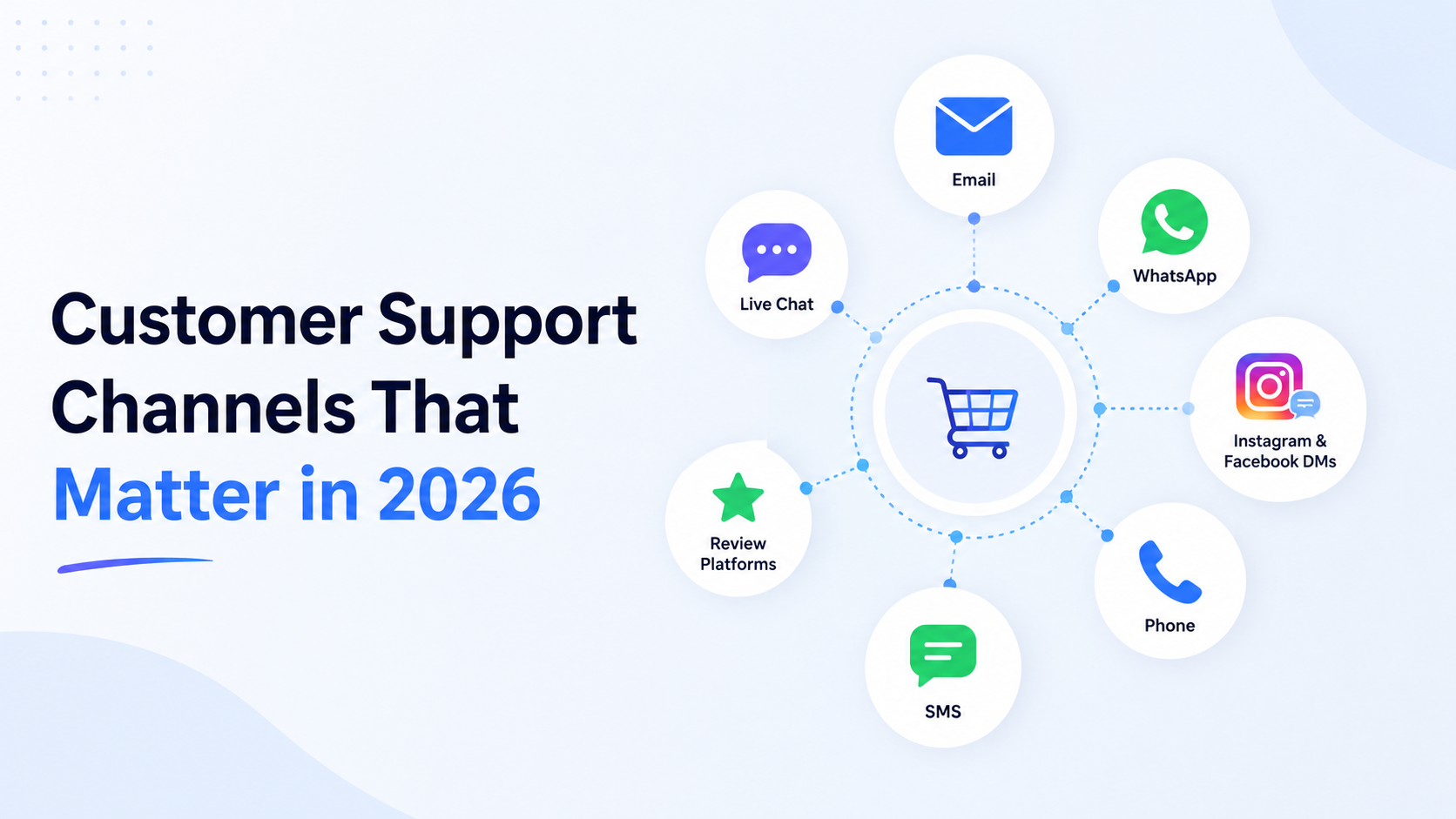
Outsourcing customer support for ecommerce isn’t just email anymore. Channel mix matters.
- Email — Highest volume. Best for refunds, complex issues.
- Live chat — Highest CSAT channel (~87% average). Critical for pre-purchase.
- WhatsApp — Massive in DTC. Conversion rates 3–5x email.
- Instagram & Facebook DMs — Where Gen Z complains publicly. Speed = brand protection.
- Phone — 71% of Gen Z customers say live phone calls are the quickest way to solve customer service issues. Counterintuitive but real.
- SMS — Best for order updates and proactive support.
- Review platforms (Trustpilot, Google) — Reputation defense.
Pick the top 3 your customers actually use. Don’t try to be everywhere on day one.
Best Helpdesk Tools for Outsourced Ecommerce Support
Your outsourcing partner is only as good as the stack they work in. Top tools for 2026:
For Shopify-native D2C brands:
- Gorgias — The deepest Shopify integration for DTC brands. Ticket-based pricing. Watch Q4 cost spikes
- Re:amaze — A practical, affordable starting point for small ecommerce stores
For multi-channel/marketplace sellers:
- eDesk — 300+ native marketplace integrations
- Zendesk — Maximum customization for enterprises with IT resources
For budget-conscious teams:
- Freshdesk — Free tier for up to 10 agents
- Help Scout — Best for SMBs who want simplicity
Choose the stack based on volume, channel mix, and where you sell. Your outsourcing partner should already be certified on it — not learning on your dime.
Compliance & Security Requirements (Non-Negotiable in 2026)
If you handle payments, EU customer data, or health-adjacent products, your CX partner must meet specific standards. Skip this and one breach destroys the brand.
PCI DSS (Payment Card Industry Data Security Standard)
- Required if: Your agents touch any payment data (refunds, chargebacks, payment fixes)
- What to ask: “Are you PCI DSS Level 1 certified? Show me the AOC (Attestation of Compliance).”
SOC 2 Type II
- Required if: You’re a brand selling into US enterprise customers or preparing for an exit
- What to ask: “When was your last SOC 2 Type II audit, and can you share the report?”
GDPR (General Data Protection Regulation)
- Required if: You sell to any EU customer
- What to ask: “Where is customer data stored, who has access, and how do you handle data subject requests?”
HIPAA (Health Insurance Portability and Accountability Act)
- Required if: You sell supplements, health/wellness, medical-adjacent
- What to ask: “Are your agents HIPAA-trained, and do you have BAAs (Business Associate Agreements) in place?”
ISO 27001
- Nice to have: Indicates mature information security management
- What to ask: “What’s your data retention policy and breach notification SLA?”
Any reputable CX outsourcing partner can answer these in writing within 24 hours. If they can’t, that’s the answer.
How CX Outsourcing Differs by Industry
Not every D2C brand needs the same support stack. Here’s the breakdown.
Beauty & Skincare
- Common tickets: Shade matching, ingredient questions, sample requests
- Critical channel: Live chat (pre-purchase)
- Compliance: Allergen/ingredient disclosures
- Watch out for: Sensitive return scenarios (used product, allergic reactions)
Supplements & Wellness
- Common tickets: Dosage, drug interactions, subscription pauses
- Critical channel: Email + phone (older demographic)
- Compliance: HIPAA-adjacent, FDA disclaimer compliance
- Watch out for: Health claims — agents need scripts they cannot deviate from
Apparel & Fashion
- Common tickets: Sizing, returns, exchange logistics
- Critical channel: WhatsApp + Instagram DM
- Compliance: Standard PCI
- Watch out for: Return rate is 25–40%. Returns workflow is the entire ballgame.
Electronics & Smart Home
- Common tickets: Setup, troubleshooting, warranty claims
- Critical channel: Phone + screen share
- Compliance: Product safety, recall management
- Watch out for: Tier-2 agents need technical training that takes 4–6 weeks
Subscription Boxes
- Common tickets: Skip month, swap items, cancellation, address changes
- Critical channel: Email + SMS
- Compliance: Automatic renewal laws (California, NY)
- Watch out for: Cancellation flow is your retention bottleneck
Furniture & Home Goods
- Common tickets: Delivery delays, damaged items, assembly
- Critical channel: Phone + email with photos
- Compliance: Standard
- Watch out for: AHT is naturally higher — don’t compress it
When to Outsource, When to Stay In-House
Use this as a fast filter.
Stay In-House If:
- You’re under $500K/year in revenue
- You handle <50 tickets/week
- Your founder still reads every email (fine — for now)
- You sell extremely technical products requiring deep R&D involvement
Move to a Hybrid Model If:
- You’re doing $2M–$50M/year
- Support volume is growing 30%+ per quarter
- Your team spends >10 hours/week on tickets AI could close
- Peak seasons (BFCM) break your team
- CSAT is dropping while ticket volume rises
Go Full Dedicated Team If:
- You’re $10M+ with predictable volume
- You need 24/7 coverage without burning out US staff
- You’re expanding into new markets or SKUs
- You’re prepping for an exit and want clean ops
Still deciding between a VA and a full team? Read Ecommerce Virtual Assistant vs Dedicated Team and Dedicated Ecommerce Team vs Agency.
How to Survive BFCM and Seasonal Peaks Without Hiring 20 People
Peak season is where bad outsourcing partners get exposed.
The math: A brand doing 1,500 tickets/month in regular months hits 3,500–4,500 tickets in November. If your team can’t scale 2.5x in 30 days, your CSAT will crash and you’ll lose loyal customers in your highest-revenue window.
What a real outsourcing partner gives you for BFCM:
- Elastic scaling: Pre-trained bench agents who step in within 7 days
- Pre-peak SOP refresh: Updated for holiday returns, gift cards, shipping cutoffs
- AI volume offload: Bumped from 60% to 75% deflection during peak
- Daily war-room standups: CSAT, FRT, abandonment tracked hourly
- Weekend coverage without 2x rate surprises
A vendor will tell you “we’ll handle it.” A dedicated partner will show you the staffing plan in October.
The 30-Day Migration Plan That Doesn’t Break Your CSAT
If you’re moving to outsourced customer support, don’t “launch” it. Migrate it.
Here’s the 30-day plan we run with D2C brands:
Week 1: Document Everything
- Top 20 ticket types and resolutions
- Refund/return policy in plain English
- Brand voice rules (do you use “Hey!” or “Hi”?)
- Escalation tree — who decides what
- 50 anonymized real tickets as training data
Week 2: Train the Team
- 2 agents minimum, shadowing your current support
- Daily roleplay on real tickets
- Product walkthroughs — agents should use your hero SKU
- Helpdesk + Shopify admin training
- CSAT and brand voice scoring rubric
Week 3: Live With a Safety Net
- Agents handle 30% of volume
- Every ticket reviewed before sending (first 5 days)
- Daily 15-min standup with US owner
- CSAT tracked daily
Week 4: Scale to Full Handoff
- 100% of tier-1 volume on the team
- QA scoring weekly (15% of tickets sampled)
- CSAT, FCR, FRT all tracked
- Monthly business review locked in
The 7 Questions to Ask Before Signing With Any CX Partner
Stop asking “How much per hour?”
Start asking these:
- Who owns my CSAT number on your side, and what’s their bonus tied to?
- What’s your agent retention rate at month 12?
- Can I interview the agents before they go live on my account?
- How do you train on a new SKU or campaign launch?
- Who reviews tickets weekly — and what does that report look like?
- How do you scale for BFCM? Show me the staffing plan template.
- What’s your AI deflection rate, and which platform do you run it on?
If a partner can’t answer those in plain English, you don’t have a partner. You have a vendor. Walk.
Common Mistakes Brands Make When Outsourcing CX
- Picking the cheapest hourly rate — You get the cheapest agent. Math is brutal.
- Skipping the SOP doc — “They’ll figure it out” is how CSAT dies in week 2.
- No internal CX owner — Outsourcing isn’t abandoning. You still need one person owning it.
- No QA process — Without weekly reviews, quality drifts in 30 days.
- Hiring during BFCM — Train in September, not November.
- Choosing a 200-brand BPO — Your brand becomes ticket #847 in their queue.
- Locking into 12-month contracts day one — Start with a 90-day pilot.
- Ignoring compliance gaps — One PCI breach destroys 5 years of brand equity.
FAQs About Outsourcing Customer Support for Ecommerce
Is it safe to outsource customer support for my D2C brand?
Yes — if you pick a dedicated team, not a generic BPO. Trained offshore teams improve CSAT by 15–25% according to McKinsey. The risk isn’t offshore. The risk is vendors who treat your brand as one of many. AcquireX
How much does outsourcing customer support cost for ecommerce?
For a 5-agent dedicated offshore team, expect $100K–$215K/year, compared to $350K–$530K for an in-house US team. Hybrid AI + offshore models run as low as $70K–$180K with higher CSAT than pure in-house.
What’s the cheapest country to outsource ecommerce customer support?
The Philippines and India are cheapest at $6–$16/hour. LATAM (Colombia, Mexico) costs $12–$18/hour but offers US timezone overlap. The “cheapest” usually isn’t the best value — dedicated team quality matters more than location.
Will outsourcing hurt my CSAT?
Done wrong, yes. Done right, CSAT rises. Brands hitting 90%+ CSAT after outsourcing share three things: dedicated agents (not shared), strong SOP documentation, and weekly QA with a US-side owner.
How long does it take to set up outsourced customer support?
A proper migration takes 3–4 weeks. Week 1 is documentation, week 2 is training, week 3 is live with a safety net, week 4 is full handoff. Skip any week and your CSAT crashes.
Should I outsource customer support if I’m under $1M in revenue?
No. Keep it in-house or hire one VA. Outsourcing makes sense at $2M+ when ticket volume justifies a dedicated team.
Can outsourced agents really learn my brand voice?
Yes, if you train them properly. 2–4 weeks of onboarding with brand voice rubrics, real ticket roleplay, and weekly QA scoring builds an agent who sounds like your in-house team within 60 days.
What’s the difference between a BPO and a dedicated team?
A BPO sells you seats — agents who juggle 5–10 brands. A dedicated team sells you outcomes — agents who only work on your brand, trained on your products, owned by a single account lead. CSAT differs by 20+ points between the two.
Should I outsource all channels or just email?
Start with email (highest volume, easiest to train on). Layer chat in month 2. Add WhatsApp/social in month 3. Voice last — it’s the hardest to outsource well.
How does AI fit into outsourced ecommerce customer support in 2026?
AI handles 60–80% of tier-1 tickets (WISMO, returns, FAQs). Humans handle the 20–40% requiring judgment, empathy, or sales. Brands stacking both win on cost and CSAT.
What KPIs should I hold my outsourcing partner accountable to?
CSAT, FCR, FRT, AHT, and CES. Lock these into the contract with monthly reviews. If the partner won’t commit to numbers, they’re a vendor — not a partner.
What compliance certifications matter most?
PCI DSS (payments), SOC 2 Type II (enterprise/exit prep), GDPR (EU customers), HIPAA (health/supplements). Ask for documentation, not verbal confirmation.
How do I outsource customer support without losing control of my brand voice?
Three things: a detailed brand voice rubric, weekly QA scoring on tone, and a US-side owner who reviews and coaches. Brand voice drift is the #1 outsourcing failure — but it’s 100% preventable.
Should I use AI chatbots or human agents for ecommerce customer support?
Both. AI handles 60–70% (tier-1: WISMO, returns, FAQs). Humans handle 30–40% (tier-2: refunds, escalations, sales conversations). Pure AI is too rigid. Pure human is too expensive. The hybrid stack wins on every metric.
The Bottom Line
Outsourcing customer support for ecommerce isn’t about saving money. It’s about buying back your team’s calendar so you can build the brand instead of babysit the inbox.
The brands that win in 2026 aren’t the ones who hired the cheapest BPO or the most expensive US agent. They’re the ones who built a dedicated, accountable, trained team that treats CX like a growth lever, not a cost center.
Stop managing vendors. Build a system.
Ready to Outsource Customer Support the Right Way?
AcquireX builds dedicated offshore customer support teams for US D2C and ecommerce brands — trained on your products, your tone, and your policies. No vendor seats. No 200-brand call centers. Just a team that owns the outcome.
You focus on growth. We handle execution.