You drop your price to win the Amazon Buy Box. A competitor charging two dollars more wins it anyway. Sound familiar?
Here is the truth most sellers miss. Price is just one signal Amazon looks at. It is not the whole game. Sellers with strong metrics win the Featured Offer at higher prices every single day.
This guide shows you how to win the Buy Box and hold it, without gutting your margins. You get the real factors Amazon weighs, a simple framework called the ANCHOR Method, two worked examples, and the honest version of how the algorithm works, with no made-up numbers.
Key Takeaways
- The Buy Box is now officially called the Featured Offer. Most sellers still say Buy Box.
- Industry estimates put 80% to 90% of Amazon sales through this box. Amazon has never confirmed an exact number.
- Amazon compares landed price (item plus shipping), not the sticker price.
- Lowest price does not win. Best overall value wins.
- Strong account health lets you hold the box at a higher price and keep your margin.
- Amazon does not publish how it weighs each factor. Anyone quoting exact percentages is guessing.
- Research backs this: a Northeastern University study found about 60% of smart-pricing sellers won the box while priced above the lowest offer.
- Use the ANCHOR Method: Account health, Never run out, Compete on landed price, Hand to FBA, Optimize speed, Reputation.
What is the Amazon Buy Box (now the Featured Offer)?
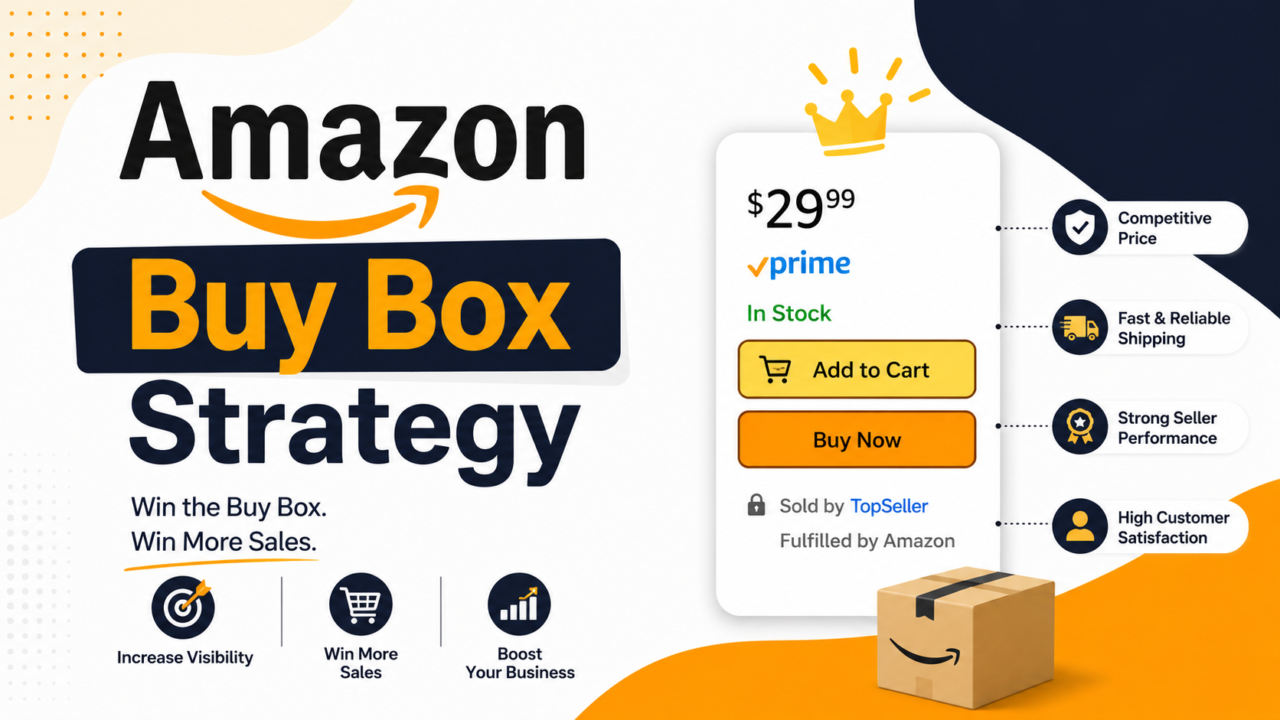
The Amazon Buy Box is the box on a product page with the “Add to Cart” and “Buy Now” buttons. When a shopper clicks buy, the order goes to whichever seller holds that box.
Amazon renamed it the “Featured Offer” in 2023. The job is the same. One spot. One winner at a time. Every other seller gets pushed to a small “See All Buying Options” link that most people never click.
Why it matters so much:
- Many sellers can list the same product. Only the box holder gets the easy sale.
- Industry estimates say 80% to 90% of Amazon purchases happen through the box. Treat that as a strong signal, not a hard fact, since Amazon does not publish the number.
- Most Amazon shopping now happens on phones. On mobile, only the winning seller shows up front. If you are not featured, most buyers never see you.
So losing the box is not a small dip. It can wipe out most of your sales on that listing.
How does the Buy Box rotate and get shared?
Amazon does not hand the box to one seller forever. It rotates the Featured Offer between qualified sellers. On a busy listing, the holder can change many times a day, sometimes by the minute.
The rotation is not random. Amazon gives a bigger share to sellers who score better on price, fulfillment, speed, and performance. So “winning” is really about winning the biggest share over time, not holding the box every second.
What this means for you:
- Two strong sellers can split the same box. Your job is to grab the larger slice.
- A short slip in any metric can drop your share fast. The system has no memory of past wins.
- Steady performance beats a one-time price cut, because the box keeps re-checking who deserves it.
Who is eligible for the Buy Box?
Before you can win the box, you have to qualify. Eligibility and winning are two different things. Many sellers can be eligible. Only one wins at a time.
To be eligible, you need:
- A Professional seller account. Individual accounts never qualify.
- New or like-new condition. Used items compete in a separate box.
- Enough inventory. Out of stock removes you from the box right away.
- A track record. New sellers often need a few months of clean sales history before they enter the rotation. Plan for two to six months.
- A healthy account. No active policy strikes or suspensions.
- Note: a few categories, like Books, follow different rules.
FBA listings are automatically eligible, since Amazon handles the shipping.
Your account health is the gate. Here are the metrics that matter, the limit Amazon sets, and where you actually want to be.
| Metric | Amazon’s limit | Where you want to be |
|---|---|---|
| Order Defect Rate (ODR) | Under 1% | Under 0.5% |
| Cancellation rate (FBM) | Under 2.5% | Under 1% |
| Late shipment rate (FBM) | Under 4% | Under 2% |
| Valid tracking rate (FBM) | Above 95% | 98% or higher |
| On-time delivery rate (FBM) | Above 90% | 97% or higher |
One key detail most guides skip: cancellation rate, late shipment rate, valid tracking, and on-time delivery apply only to orders you ship yourself (FBM). With FBA, Amazon handles these for you and scores them near perfect. ODR applies to everyone, but FBA shrinks your risk on the rest.
If your ODR goes over 1%, you can lose Buy Box eligibility for up to 60 days. That is why account health comes before any pricing move.
Why does chasing the lowest price backfire?
Chasing the lowest price backfires because Amazon rewards value, not just a small number. You can be the cheapest and still lose. You can also win at a higher price when your account is strong.
Here is the trap. You cut your price to grab the box. A competitor with better metrics takes it right back at a higher price. Now you are cheaper and losing. You gave up margin for nothing.
Two facts change how you should price.
Amazon compares landed price, not the sticker. Landed price is the item price plus shipping. A low sticker with high shipping can lose to a higher sticker with free shipping, because the buyer pays more in total.
You do not need to be the lowest. You need to be close. Sellers who track this closely find you usually need to be within about 5% of the lowest qualified offer to rotate into the box. This is a working rule of thumb from seller data, not an official Amazon rule. Get inside that window with strong metrics, and you win without being the cheapest.
The research backs this up
This is not just opinion. A landmark Northeastern University study of Amazon’s marketplace found that sellers using smart pricing often win the box even when their price is higher than the cheapest offer. About 60% of those sellers were priced above the lowest offer and still won.
The lead researcher put it plainly: a seller with 99% positive feedback can charge a meaningfully higher price than a seller with 95% feedback and still take the box. Strong metrics buy you room to price higher.
The study is the foundational research on this, and its finding has only gotten stronger since, because Amazon now puts even more weight on speed and service. The lesson holds: good operations let you win at a better price.
Worked example 1: the cost of racing to the bottom
Say you sell a product for $30. Here is a rough breakdown for a small, standard-size FBA item.
Holding at $30:
- Sale price: $30.00
- Cost of goods: $18.00
- Amazon referral fee (15%): $4.50
- FBA fulfillment fee (approx): $5.00
- Your profit: $2.50 per unit
Now you drop to $27.99 to “win” on price.
Dropping to $27.99:
- Sale price: $27.99
- Cost of goods: $18.00
- Referral fee (15%): $4.20
- FBA fee (approx): $5.00
- Your profit: $0.79 per unit
You just cut your profit by about 68% to win a price war you might still lose. (Fees change with size and weight, so treat these as round numbers.)
The smarter move? Tighten your metrics so you can hold the box at $30 and keep the $2.50.
A real example: how landed price and metrics pick the winner
Here is how the box gets decided when several sellers compete on one listing. Three sellers, same product, around $38.
| Seller | Item price | Shipping | Landed price | ODR | Delivery | Result |
|---|---|---|---|---|---|---|
| You | $38.00 | Free (FBA) | $38.00 | 0.4% | 1 day | Wins the box |
| Rival 1 | $39.50 | Free (FBA) | $39.50 | 0.9% | 2 days | At the 5% edge, rotates in sometimes |
| Rival 2 | $35.99 | $5.99 | $41.98 | 0.5% | 3 days | Loses, highest landed price |
Read what just happened:
- Rival 2 has the lowest sticker ($35.99) and still loses. Add $5.99 shipping and the landed price jumps to $41.98, the highest of the three. Slow 3-day delivery does not help.
- You win at $38, even though your sticker is not the lowest. You have the lowest landed price, the best ODR, and the fastest delivery.
- Rival 1 sits at the edge. At $39.50, the landed price is about 3.9% above yours, inside the rough 5% window, so this seller rotates in now and then but does not hold a big share.
The takeaway: track landed price, not sticker price. Then keep your metrics tight so you can sit at the top of the window and still win.
What does Amazon actually look at?
Amazon looks at a mix of price, fulfillment, speed, and seller performance. It does not share the exact recipe, and it weighs factors differently by product category. That honesty matters, because anyone quoting you exact percentages is guessing.
Here are the factors that decide your share, once you are eligible.
| Factor | What it means | Why it matters |
|---|---|---|
| Landed price | Item price plus shipping | Amazon compares total cost to the buyer |
| Fulfillment method | FBA, Seller Fulfilled Prime, or FBM | FBA and SFP score high on trust and speed |
| Delivery speed | How fast the item arrives | Faster can beat a lower price |
| Order Defect Rate (ODR) | Bad orders as a share of total | Keep it under 1%, aim under 0.5% |
| Cancellation and late shipment | Orders you cancel or ship late | FBM only; keep both low |
| Valid tracking | Orders with working tracking | FBM only; keep above 95% |
| Seller feedback | Your star rating and reviews | Higher rating wins ties |
| Inventory depth | How many units you hold | More stock signals you can meet demand |
| Sales velocity | How fast the listing sells | Steady sales support a bigger share |
The clear trend in the last couple of years: delivery speed and customer experience now matter more relative to raw price. Fast FBM and Seller Fulfilled Prime sellers can beat slower competitors even at a higher price. But Amazon still does not reveal how heavily it weighs each factor. Treat the list as a checklist, not a formula. When your share drops, find which item slipped and fix that one first.
Three Buy Box myths that cost sellers money
These three beliefs sound smart and quietly burn your margins. Drop them.
Myth 1: The lowest price always wins. It does not. A seller with strong metrics, FBA, and fast shipping routinely wins at a higher price. Price is one factor, not the deciding one.
Myth 2: Undercut by a set percent and you are guaranteed the box. There is no magic number. The box weighs too many factors for any “drop X% to win” formula to hold. Chasing it just starts a price war that hurts everyone.
Myth 3: Once you own the box, price stops mattering. Wrong. Shoppers still compare your product to substitutes, and a price that drifts too high can trigger Buy Box suppression (more on that below). The box is never “locked in.”
When a tool or a blog hands you an exact algorithm weight or a guaranteed price formula, be skeptical. Amazon does not publish those numbers, and the sellers who win long term build operations, not shortcuts.
The ANCHOR Method: how to win and hold the Buy Box
The ANCHOR Method is a simple way to win the Featured Offer on strength, not just price. Anchor means hold. Each letter is a lever that helps you keep your share without a price war.
A: Account health first. Your metrics are your ticket to play. Keep ODR under 1%, cancellations under 2.5%, and late shipments under 4%. Fix these before you touch price. A weak account loses the box no matter how low you go.
N: Never run out of stock. Out of stock equals out of the box. Set reorder points with a safety buffer. Hold extra stock before big events like Prime Day and Q4. Deep inventory also tells Amazon you can handle demand.
C: Compete on landed price, not the sticker. Set a floor price (your cost plus minimum margin) and a ceiling price. Never sell below the floor. Stay inside the roughly 5% window of the lowest qualified offer. Price smart, not desperate.
H: Hand fulfillment to FBA (or fast FBM). FBA gives you automatic eligibility and strong speed scores. If you stay FBM, aim for Seller Fulfilled Prime and quick handling. Slow shipping is the fastest way to lose to an FBA seller. As a rough rule sellers often cite, an FBA offer can sit about 10% to 15% above an FBM offer and still win, because Amazon trusts the fulfillment.
O: Optimize delivery speed. Speed can beat price. Cut your handling time. Ship same day or next day when you can. Put working tracking on every order so your valid tracking rate stays high.
R: Reputation through feedback and service. Reply to buyer messages within 24 hours. Keep returns low with clear listings and solid packaging. A higher star rating helps you win ties and hold the box at a better price.
Run all six together. That is how you build a position that does not collapse the moment a competitor drops a dime.
Own your listing if you can
One more lever, and it is a big one for brands. If you sell your own brand, enroll in Amazon Brand Registry. It gives you more control over your listing and tools to report sellers who list against you without permission.
When unauthorized sellers pile onto your listing with low prices, they steal your box share and drag everyone into a price war. If you are the only seller on the listing, you win the box by default. For brand owners, protecting the listing is one of the cleanest ways to hold the box. Clean, accurate listings also help, so it pays to follow an Amazon listing optimization checklist.
How do you set price guardrails so you stop the race to the bottom?
You set price guardrails by giving every SKU a floor and a ceiling. The floor protects your margin. The ceiling keeps you competitive. Your price moves inside that band and never outside it.
Here is a simple way to set them:
- Floor price: cost of goods, plus Amazon fees, plus your minimum acceptable profit. Never go below this. Ever.
- Ceiling price: the highest price the market will bear while you still win a fair share of the box.
- Target window: stay within about 5% of the lowest qualified offer when your metrics are strong.
Quick example. Your floor on a product is $26. The lowest qualified competitor sits at $25.50. Your metrics are excellent. You can often hold the box at $26, or even a touch higher, because Amazon trusts your delivery and service more. You keep your margin and your share.
If you cannot win inside your guardrails, that is a signal. It usually means a metric needs work, not that your price needs to drop. (More on this in our guide to ecommerce pricing strategies.)
What is Buy Box suppression (and how do you fix it)?
Buy Box suppression is when Amazon removes the Featured Offer from a listing entirely. No seller wins it. The “Add to Cart” button is replaced by “See All Buying Options,” and shoppers have to click through to buy. Sales usually drop hard.
This is different from losing the box to another seller. With suppression, Amazon decided no offer is good enough to feature.
Common causes:
- Your price is too high. Amazon checks your price against its own reference price and against other stores. Price above that line and the box can vanish, even if you are the only seller.
- Weak metrics across all offers. If every competing seller has poor performance, Amazon may pull the box.
- Listing problems. Errors or quality issues on the product page can trigger it.
How to fix it:
- Lower your price to a fair market level, in line with Amazon’s reference price.
- Clean up the listing. Fix errors, images, and content.
- Improve the account health metrics above.
If your whole account took a hit and listings went dark, that is a deeper problem. Here is how to handle marketplace account recovery.
Why a repricer alone will not save you
A repricer alone will not save you because it controls one lever: price. The Buy Box is decided by many. A tool that races your price down can hand you a hollow win: less margin, and a position that still flips the moment a stronger seller shows up.
Think of a repricer as a knob, not a strategy. It is useful, but it cannot:
- Fix a high Order Defect Rate
- Speed up your shipping
- Keep you in stock
- Improve your feedback score
- Protect your account health
- Clear a suppressed listing
Those take real operations work. Someone has to watch the metrics daily, react to stockouts, handle returns, answer buyers, and keep the account clean. That is the part most sellers underrate. It is also why your fulfillment model and your SKU and inventory health matter as much as your price.
The strongest Amazon brands stop juggling tools and build a system instead. They treat the Buy Box as the output of good operations, not a button to press. When pricing, fulfillment, inventory, and service all run tight, the box follows. That is the heart of real Amazon marketplace management. <h2 id=”lose”>What should you do when you lose the Buy Box?</h2>
When you lose the Buy Box, work through a quick checklist before you ever cut your price. Most losses trace back to a metric or a stock issue, not price.
Run this check:
- Are you in stock? Out of stock removes you instantly. Restock first.
- Did the box get suppressed? If you see “See All Buying Options” and no winner, that is suppression, not a lost race. Check your price against the market.
- Did a metric slip? Check ODR, cancellations, late shipments, and tracking in your Account Health dashboard.
- Is your landed price competitive? Compare total price, not just the item price.
- Did shipping slow down? A slower delivery promise can cost you the box.
- New competitor? A stronger seller may have entered. Check their fulfillment and feedback.
- Account health flag? Past issues can linger even after your account shows “Healthy.”
Fix the weakest link. If everything checks out and you still lose, give it time. Amazon rebuilds trust through fresh sales history.
A final note on profit. Winning the box means nothing if the sale loses money. Watch your true profit per order, not just revenue. Our breakdown of ACoS vs TACoS shows how to keep ad spend from eating your margin while you fight for the box.
Frequently Asked Questions
Is the Buy Box the same as the Featured Offer?
Yes. Amazon renamed the Buy Box to the Featured Offer in 2023. The function is identical. It is the “Add to Cart” spot that one seller wins at a time. Most sellers and tools still call it the Buy Box.
What percent of Amazon sales go through the Buy Box?
Industry estimates put it between 80% and 90%. Amazon has not confirmed an official number, so treat it as a strong signal rather than a hard stat. The point holds: most buyers purchase through the box.
Can a new seller win the Buy Box?
Yes, but not on day one. You need a Professional account, healthy metrics, and usually two to six months of clean sales history before you enter the rotation. Selling through FBA can speed up eligibility.
Can I win the Buy Box without the lowest price?
Yes. Sellers with strong account health, FBA fulfillment, and fast shipping often win at a higher price than weaker competitors. A Northeastern University study even found about 60% of smart-pricing sellers won the box while priced above the lowest offer. Lowest price is one factor, not the deciding one.
Do FBA sellers always win the Buy Box?
No. FBA gives automatic eligibility and a speed edge, but a strong FBM or Seller Fulfilled Prime seller with great metrics and fast shipping can still win, sometimes at a higher price.
What is Buy Box suppression?
It is when Amazon removes the Featured Offer from a listing entirely, so no seller wins it. Shoppers see “See All Buying Options” instead of “Add to Cart.” It usually means the price is above Amazon’s reference price, or the listing or metrics need work.
How fast does the Buy Box change?
It can rotate many times a day. Amazon shares the box among qualified sellers based on price, buyer location, and performance. That is why steady metrics matter more than a one-time price drop.
Can you beat Amazon when Amazon sells the same item?
Sometimes. Amazon as a seller is tough to beat on its own listings, but it is not automatic. If Amazon runs low on stock, or your metrics, price, and speed are strong, you can still take a share of the box. Stop renting the Buy Box. Build a system that holds it.
Winning the Featured Offer once is easy. Holding it without burning margin is the hard part. That takes daily work across pricing, inventory, fulfillment, and account health.
That is exactly what a dedicated marketplace team does. Instead of you juggling repricers and dashboards, AcquireX builds an embedded team that runs your Amazon operation end to end, so the Buy Box becomes a result of tight execution, not a daily fire drill.
Talk to our marketplace team and turn the Buy Box into a system you own, not a button you chase.