Summary: Ecommerce design and creative management is the operating system behind every product image, PDP, ad creative, landing page, and email a brand ships. Scaling it means one intake, standard briefs, a design system, production tracks by complexity, named approvers, a single asset library, and performance feedback loops, run by a dedicated team that owns the outcome.
Most ecommerce brands do not have a design problem. They have a design operations problem. The talent exists, the tools exist, and the ideas exist, but the work arrives through Slack messages, half-written briefs, and last-minute requests from three different teams. The result is predictable: off-brand ads, PDPs that look different on Amazon than on Shopify, launches that slip because hero images were not ready, and a designer who spends more time chasing feedback than designing.
This guide covers how to manage ecommerce creative at scale: what the function actually includes, how to structure the workflow, how a design system keeps hundreds of assets on-brand, which metrics matter, and when it makes sense to hand the whole function to a dedicated, embedded design team.
What Is Ecommerce Design and Creative Management?
Ecommerce design and creative management is the discipline of planning, producing, approving, distributing, and improving every visual asset a store needs to sell. It sits between brand strategy (what the brand should look and feel like) and execution (the individual designer opening Figma or Photoshop). Its job is to make creative output predictable: the right asset, in the right format, on the right channel, on time, every time.
Unlike a brand agency that delivers a campaign and leaves, ecommerce creative is continuous and high-volume. A single new SKU can require a white-background hero, several gallery images, an infographic, a size or dimension graphic, lifestyle shots, marketplace-specific crops, an A+ or rich content module, ad variants for multiple placements, and an email or homepage banner. Multiply that across a catalog and a calendar of promotions, and creative becomes an operations function as much as an artistic one.
Which assets does ecommerce creative management cover?
- Product imagery: hero images, gallery sets, retouching, color correction, background removal, infographics, scale and dimension graphics, lifestyle and in-use imagery, and 360 or short video.
- PDP and marketplace content: product detail page layouts, Amazon A+ and Premium A+ modules, brand stores, Walmart and other marketplace rich media, and comparison charts.
- Performance ad creative: static and video ads for Meta, Google, TikTok, Pinterest, and Amazon Sponsored Brands and Display, plus the iterations needed for testing.
- Landing pages and site design: campaign landing pages, collection pages, homepage modules, promotional banners, and conversion-focused page sections.
- Lifecycle creative: email templates, SMS imagery, push notifications, and loyalty or subscription assets.
- Brand and system assets: the design system itself: typography, color, components, icon sets, photography direction, templates, and usage rules.
Why Does Ecommerce Creative Break as Brands Scale?
Creative usually breaks at the same moment growth accelerates. A brand adds a second marketplace, increases paid spend, launches a new product line, or expands internationally, and the number of assets required jumps far faster than headcount. The common failure points are consistent across categories:
- No single intake: requests come from marketing, marketplace, retention, and founders through different channels, so priorities collide and nothing is visible.
- Weak briefs: designers receive “make an ad for the sale” instead of an objective, audience, channel specs, key message, and proof points. Revision rounds multiply.
- No design system: every asset is designed from scratch, so fonts, colors, and claim styles drift across channels.
- Unclear approvals: five people comment, nobody decides, and feedback contradicts itself.
- Scattered files: final assets live in personal drives and chat threads, so teams recreate work that already exists or publish outdated versions.
- No performance loop: creative is judged on taste rather than on click-through, conversion, or return rate, so winning patterns are never systematized.
The key insight: adding more designers to a broken process produces more off-brand assets faster, not better creative. The fix is the system first, then capacity.
How Do You Build a Scalable Ecommerce Creative Workflow?
A scalable creative workflow moves every request through the same stages: intake, brief, production, review, approval, delivery, and performance feedback. The stages can be named anything; what matters is that everyone knows the route and nothing skips it.
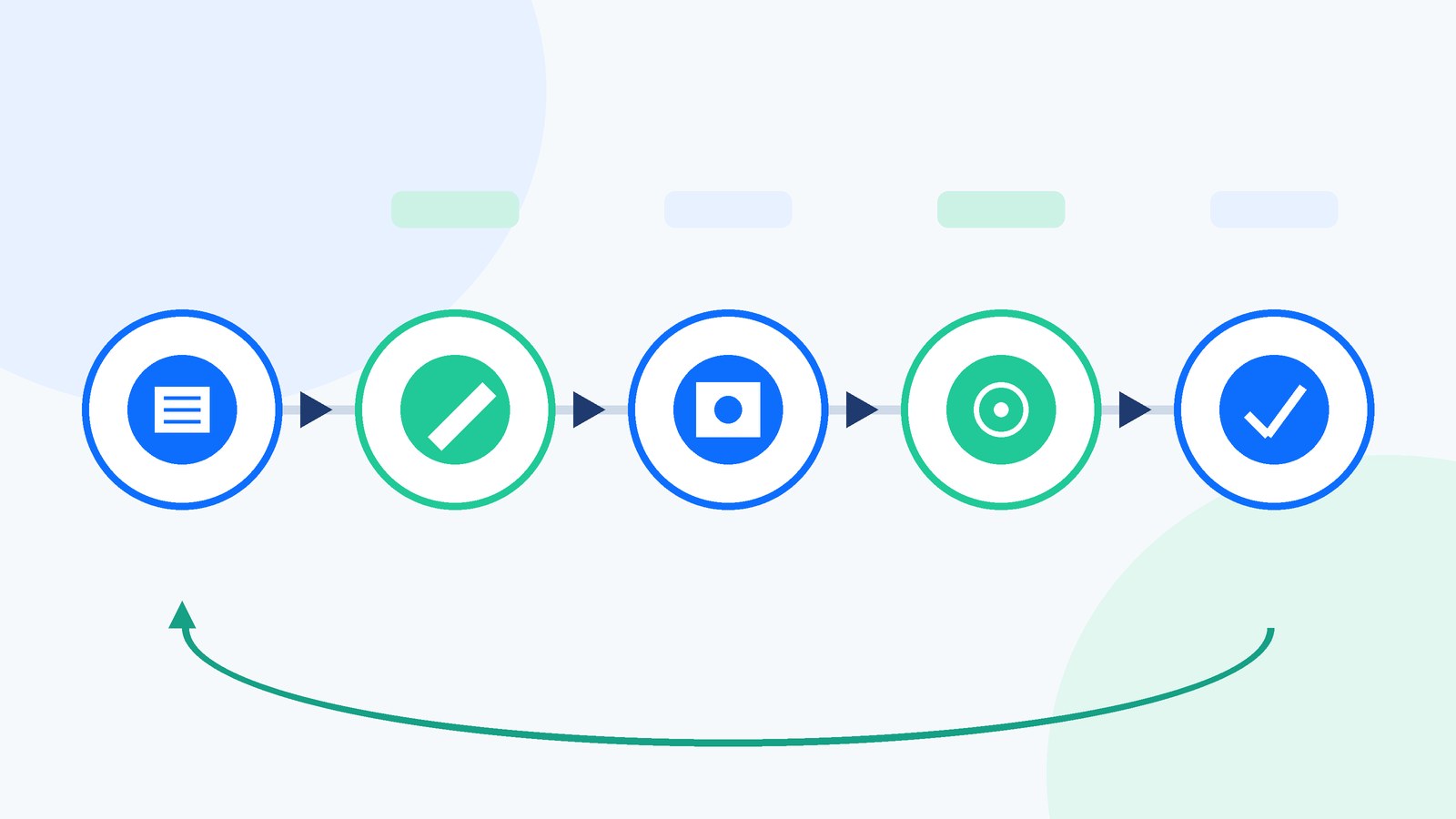
Step 1: Create one intake channel for every creative request
Every request, whether from the founder, the performance marketer, or the marketplace manager, enters through one form or board in a tool such as Asana, Monday.com, ClickUp, Jira, Airtable, or Notion. The form captures the asset type, channel, deadline, business objective, and owner. Requests that do not come through intake do not get worked on. That one rule removes most of the chaos.
Step 2: Standardize the creative brief
A good ecommerce brief answers seven questions: What is the asset for? Which channel and exact specs? Who is the audience? What is the single key message? What proof supports it (reviews, features, certifications, guarantees)? Which mandatory elements apply (logo, legal copy, marketplace rules)? How will success be measured? Add a validation gate: if a brief is incomplete, it goes back to the requester before a designer touches it.
Step 3: Define production tracks by complexity
Not all creative deserves the same process. Separating work into tracks protects quality on high-stakes work and speed on repeatable work:
| Track | Typical assets | Process | Suggested turnaround |
|---|---|---|---|
| Template / batch | Catalog image edits, resizes, marketplace crops, price-drop banners | Template-driven, single QC check | Same day to 2 business days |
| Standard | Ad variants, email designs, infographics, PDP refreshes | Brief, design, one review round, approval | 2 to 5 business days |
| Bespoke / hero | Launch campaigns, A+ Premium, landing pages, brand refresh | Concept stage, multiple reviews, stakeholder sign-off | 1 to 4 weeks |
Turnaround targets should be set by each brand based on team capacity; the point is that every asset type has a published service level so requesters can plan.
Step 4: Build review gates and name the approver
Use two kinds of review. A QC review checks objective rules: correct specs, accurate product color and details, legible text on mobile, approved claims, correct logo usage, and marketplace compliance. A creative approval is a single named decision-maker per asset type who says yes or no. Collect feedback in one proofing tool (Figma comments, Frame.io for video, or your project tool) instead of email and chat.
Step 5: Deliver into a single source of truth
Final assets go to one digital asset library (a DAM such as Bynder, Frontify, Canto, or Dash, or a disciplined Google Drive or Dropbox structure for smaller brands) with consistent naming: brand, SKU, channel, asset type, dimension, version, and date. Master files and channel exports are stored together so anyone can find the latest approved version.
Step 6: Close the loop with performance data
Creative management is not finished when an asset is published. Pull ad performance (hook rate, click-through rate, cost per acquisition), PDP conversion rate, and marketplace session-to-order data back into the creative team monthly. Tag assets by concept, format, and message so you can see which patterns win, then feed those learnings into the next round of briefs.
What Is an Ecommerce Design System and Why Does It Matter?
An ecommerce design system is the reusable set of rules, components, and templates that makes every asset recognizably on-brand, no matter who designs it. It is the single biggest lever for scaling creative without losing consistency.
A practical ecommerce design system includes:
- Foundations: color palette with accessible contrast pairs, typography scale, spacing, grid, and corner and shadow styles.
- Photography direction: lighting, angles, backgrounds, props, model casting, and retouching standards so product images look like one family.
- Components: badges, price tags, benefit icons, review stars, comparison tables, CTA buttons, and callout styles.
- Channel templates: Amazon gallery and A+ module templates, Shopify section designs, ad templates per placement and aspect ratio (1:1, 4:5, 9:16, 16:9), email modules, and banner sizes.
- Copy and claims rules: approved claims, prohibited words, disclaimer formats, and tone of voice.
- Governance: who can change the system, how new components are proposed, and how often the system is reviewed.
Brands that invest in a design system tend to find that template and standard-track work becomes faster and cheaper, which frees senior designers for the high-impact concept work that actually moves conversion.
How Should You Manage Product Imagery and PDP Design?
The product detail page is where the sale is won or lost, and imagery does most of the selling because shoppers cannot touch the product. Strong PDP creative answers the shopper’s questions visually, in the order they ask them.
What should a high-converting PDP image stack include?
- Hero image: clean, accurate, and compliant with each channel’s main-image rules (Amazon, for example, requires a pure white background for the main image in most categories).
- Key benefit infographic: the top three reasons to buy, shown with icons and minimal text that remains legible on a phone.
- Scale and dimensions: the product in a hand, on a body, or next to a familiar object.
- Detail and material shots: close-ups of texture, finish, stitching, ingredients, or components.
- Lifestyle or in-use imagery: the product solving the problem in a realistic setting.
- Comparison or “what’s included”: variants, bundles, or how it compares with alternatives.
- Social proof or guarantee: reviews, certifications, warranty, or return policy where channel rules allow.
- Video: a short demonstration where the channel supports it.
Imagery and product data have to agree. If the image shows four colors and the listing has three variants, returns and complaints follow. That is why creative and ecommerce catalog management should be run as one connected workflow, with SKU-level asset tracking. On Amazon, enhanced content follows the same logic; our guide to Amazon A+ content covers how to structure modules that convert.
Page performance matters too. Heavy, uncompressed images slow product pages, so the creative team should export to agreed file sizes and formats. See how image weight, apps, and scripts affect conversion in our breakdown of Shopify store speed and conversion rate.
How Do You Scale Ad Creative Without Burning Out Your Team?
Paid social and search platforms increasingly reward creative volume and variety, because algorithmic targeting uses creative signals to find audiences. That turns ad creative into a production line: concepts, variations, and refreshes every week. The way to scale it is modular creative.
- Separate concepts from variants: a concept is a new angle (problem/solution, testimonial, comparison, founder story, offer). Variants change one element: hook, headline, visual, format, or CTA.
- Design in components: build ads from reusable layers (product cutout, background, headline block, proof block, CTA) so new variants take minutes, not hours.
- Produce every aspect ratio from one master: design once, adapt to 1:1, 4:5, 9:16, and 16:9 with safe zones planned in advance.
- Run a testing cadence: agree a weekly or biweekly number of new concepts and variants with the performance team, and retire fatigued creative on data, not opinion.
- Use UGC deliberately: creator content often outperforms polished studio work on social; the creative team edits, captions, and brands it. Our UGC ads creative testing framework shows how to structure it.
Creative and media buying should sit in the same weekly meeting. When designers see which hooks and formats win, the next batch improves. This is the core idea behind effective performance marketing for ecommerce: media efficiency is capped by creative quality.
How Do You Design Landing Pages That Convert Paid Traffic?
Sending paid traffic to a generic homepage wastes the work done in the ad. Campaign landing pages should continue the ad’s promise with message match: same offer, same visual language, same hook. A conversion-focused landing page template typically includes a headline that restates the ad’s promise, a hero visual of the product in use, three to five benefit blocks, social proof, objection handling (shipping, returns, sizing, ingredients), a clear offer, and a repeated CTA. Build these as reusable sections in your theme or page builder so the creative team can launch a new page in hours, then A/B test one variable at a time.
In-House vs Agency vs Freelancers vs Dedicated Offshore Team: Which Is Best?
There is no universal answer, but each model has a clear profile. The comparison below summarizes the trade-offs most ecommerce brands weigh.
| Factor | In-house team | Creative agency | Freelancers / marketplaces | Design subscription | Dedicated embedded offshore team |
|---|---|---|---|---|---|
| Cost structure | Highest fixed cost (salaries, benefits, tools) | High retainers or project fees | Low per task, variable | Flat monthly fee | Predictable monthly cost, typically well below equivalent local hires |
| Brand knowledge | Deep | Moderate, shared across clients | Low, resets per person | Moderate, rotating designers | Deep: same people, working only on your brand |
| Volume and speed | Limited by headcount | Good for campaigns, slower for daily work | Inconsistent | Good for queue-based tasks | High, with daily capacity you control |
| Ecommerce specialization | Depends on hires | Varies widely | Varies widely | Often generalist | Ecommerce-specific (PDPs, marketplaces, ads) |
| Process ownership | You build it | Agency process, not yours | You manage everything | Their queue | Team runs the creative ops system for you |
| Integration with other functions | Strong | Weak | Weak | Weak | Strong, especially when marketing, catalog, and marketplace teams sit alongside |
For most growing brands, the deciding factor is not hourly cost but ownership. Freelancers and subscriptions deliver tasks; someone on your side still has to run intake, briefs, QC, and the asset library. A dedicated embedded team owns the system as well as the output.
How Does a Dedicated Design Management Team Work?
At AcquireX, our ecommerce design management services give brands a dedicated, embedded design team based in Pune, India that works inside your tools, follows your brand system, and owns creative operations end to end. Instead of handing off tickets to a black box, you get named designers and a creative lead who join your Slack, project board, and weekly performance reviews.
A typical engagement covers:
- Creative operations setup: intake form, brief templates, production tracks, review gates, naming conventions, and asset library structure.
- Design system build or cleanup: foundations, components, and channel templates for Shopify, Amazon, Walmart, and paid platforms.
- Product imagery and PDP design: retouching, infographics, gallery stacks, A+ content, and brand stores.
- Performance ad creative: concepts, variants, and resizes on a fixed testing cadence with your media buyers.
- Landing pages, email, and site design: campaign pages, homepage modules, and lifecycle templates.
- Reporting: a monthly dashboard of output, on-time delivery, revision rounds, and creative performance learnings.
Because AcquireX also runs performance marketing, marketplace management, and catalog management, the design team can sit next to the people who use the assets. Briefs start from what has to convert, not from a blank page. If you are evaluating this model for the first time, our guide to ecommerce outsourcing with a dedicated offshore team explains how embedded teams are structured, including how overlap hours and handoffs keep creative moving across time zones.
Ready to fix your creative bottleneck? Book a call with AcquireX and we will review your current creative workflow and show you what a dedicated design team would own in the first 90 days.
Which Metrics Should You Track for Ecommerce Creative Operations?
Track two families of metrics: operational health (is the machine running well?) and creative impact (is the output driving revenue?).
Operational metrics
- Request volume and output: assets requested vs delivered per week or month.
- On-time delivery rate: percentage of assets delivered within the agreed service level.
- Average revision rounds: a proxy for brief quality and alignment.
- First-pass approval rate: share of assets approved without changes.
- Cycle time: brief approved to final delivered, by track.
- Cost per asset or per SKU: total creative cost divided by output.
- QC failure rate: assets rejected for spec, accuracy, or compliance errors.
Impact metrics
- Ad creative: thumb-stop or hook rate, click-through rate, cost per acquisition, and creative lifespan before fatigue.
- PDP and marketplace: conversion rate (unit session percentage on Amazon), add-to-cart rate, and image-related return reasons.
- Landing pages and email: conversion rate, bounce rate, and click rate by template.
Review both sets monthly. Operational metrics tell you whether to fix process or add capacity; impact metrics tell you what to make more of.
How Should You Use AI in Ecommerce Design?
Generative AI tools can speed up background generation, lifestyle scene extension, retouching, resizing, copy variants, and concept exploration. They do not remove the need for creative management; they increase it. Set clear governance before scaling AI output:
- Product accuracy first: never allow AI to alter the product’s shape, color, label, or included components. Every AI-assisted asset gets a human QC check against the real product.
- Disclosure and platform rules: follow each marketplace’s and ad platform’s current policies on synthetic imagery and claims.
- Rights and licensing: confirm the commercial usage terms of each tool and keep source files.
- Track AI rejection rate: how often AI-assisted assets fail QC tells you where the tools help and where they waste time.
The winning pattern is AI for speed on the template and batch tracks, with designers spending the saved time on concepts and brand-defining hero work.
What Does a 90-Day Creative Operations Roadmap Look Like?
- Days 1 to 30: Audit and foundations. Inventory existing assets, map all request sources, document brand rules, set up intake and brief templates, and fix the asset library structure.
- Days 31 to 60: System and templates. Build the design system foundations and channel templates, launch production tracks with published turnaround times, and name approvers per asset type.
- Days 61 to 90: Scale and measure. Run a fixed ad creative testing cadence, refresh top-selling PDPs, launch the monthly creative dashboard, and use learnings to update briefs and templates.
Frequently Asked Questions
What is the difference between creative operations and creative project management?
Creative project management moves individual projects from request to delivery. Creative operations is the whole system around it: intake, prioritization, brand governance, design systems, capacity planning, asset management, and performance feedback. A project manager works inside the system; creative operations designs and runs it.
How many designers does an ecommerce brand need?
It depends on SKU count, number of channels, launch frequency, and ad testing volume. Start by measuring monthly asset demand by track, then size the team to the standard and bespoke work, using templates and AI-assisted tools to absorb batch work. Many brands start with one or two dedicated designers plus a creative lead and scale from there.
Should product photography be in-house or outsourced?
Photography often works best as a hybrid: studio shoots handled by a specialist partner for new launches, and editing, retouching, infographics, and channel adaptations handled by an ongoing design team that knows your brand rules and catalog.
What tools does an ecommerce design team need?
At minimum: a design tool (Figma, Adobe Creative Cloud, or Canva for templated work), a project and intake tool (Asana, Monday.com, ClickUp, Jira, or Airtable), a proofing workflow, and a structured asset library or DAM. Add capacity planning and advanced DAM features as volume grows.
How do you keep creative on-brand across Amazon, Shopify, and social?
Use one design system with channel-specific templates, a single asset library with master files, a QC checklist that includes brand rules and channel specs, and one named approver per asset type. Consistency comes from the system, not from individual designers’ memory.
How fast can a dedicated offshore design team start?
With an embedded model, onboarding typically starts with access to your brand assets, tools, and current requests, followed by a creative audit. Teams can usually begin on batch and standard-track work early while the design system and templates are built in parallel.
How do you measure the ROI of creative management?
Compare cost per asset, on-time delivery, and revision rounds before and after, then connect creative changes to business outcomes: ad CPA and CTR for new creative, conversion rate for refreshed PDPs and landing pages, and fewer image-related returns or complaints.
Is outsourcing design to India safe for brand quality?
Quality depends on the model, not the location. A dedicated team that works only on your brand, follows your design system, uses your tools, and has clear review gates delivers consistent work. The risk comes from rotating, anonymous freelancers with no process ownership.
The Bottom Line
Scaling ecommerce creative is not about producing more assets; it is about producing the right assets predictably. Build one intake, standard briefs, a design system, production tracks, named approvers, a single asset library, and a performance feedback loop. Then add the capacity to run it every day. If you want a team that owns that system for you, explore AcquireX design management or talk to our team about building your dedicated creative function.