Quick answer: A minimum order quantity (MOQ) is the smallest order a supplier will accept. Before you accept one, convert it into months of inventory cover, calculate the true cost per unit including holding and per-order costs, and check the cash it ties up. If it fails, negotiate with staggered deliveries, a higher unit price, or fewer SKU variations.
MOQ is one of the first numbers you see on any supplier quote, and one of the most misread. Most guides explain what it means and list a few negotiation tips. This one goes further: it gives you a buyer-side method for deciding whether a specific MOQ is worth accepting, a worked example that compares price tiers on true cost, a ready-to-use negotiation message, and the mistakes that quietly turn a bulk discount into dead stock.
What is a minimum order quantity (MOQ)?
A minimum order quantity is the smallest amount of a product a supplier is willing to produce or sell in one order. It can be stated in units (500 pieces per SKU), in value ($5,000 per order), or in a production unit such as meters of fabric, kilograms of resin, or one full print run.
For ecommerce brands, MOQ matters because it decides three things at once: how much cash you lock into inventory, how long that inventory will sit before it sells, and what unit cost you can build your pricing on. A low unit price at a high MOQ is not automatically a good deal. It is only a good deal if you can sell the stock in time.
Why do suppliers set MOQs?
Suppliers are not being difficult when they set a minimum. Every production run carries fixed costs that do not change much whether they make 100 units or 1,000. Common drivers include:
- Setup and changeover: configuring machines, molds, screens, or a production line for your item.
- Raw material minimums: the supplier’s own vendors sell fabric, packaging, or components in minimum lots.
- Custom work: printed packaging, custom colors, private-label branding, or a unique mold.
- Admin and quality control: sampling, inspection, paperwork, and export handling per order.
- Capacity planning: small orders interrupt longer, more profitable runs.
Understanding which driver sits behind a specific MOQ is the key to negotiating it. If the minimum is set by a raw material lot, switching to a stock material may cut it. If it is set by setup cost, paying a little more per unit may be enough.
What types of MOQ will you see on supplier quotes?
| MOQ type | How it is stated | What to check |
|---|---|---|
| Per SKU | 500 units per item | Whether variants count separately or together |
| Per color or size | 300 units per color | Whether you can mix sizes within one color |
| Per order value | $3,000 minimum per PO | Whether mixing SKUs helps you reach it |
| Per material lot | One roll of fabric, one batch | Whether a stock material avoids the lot minimum |
| Per custom component | 5,000 printed boxes | Whether plain or generic packaging lowers it |
| Price-break tiers | $9.00 at 500, $8.20 at 1,000 | The true cost at each tier, not just unit price |
Read the quote carefully. A supplier who says “MOQ 500” may mean 500 per SKU, 500 per color, or 500 across the whole order. That difference can change your required purchase by several times.
How do you decide whether to accept a supplier’s MOQ?
Treat every MOQ as a question you answer with your own numbers. A simple five-step test works for most ecommerce SKUs.
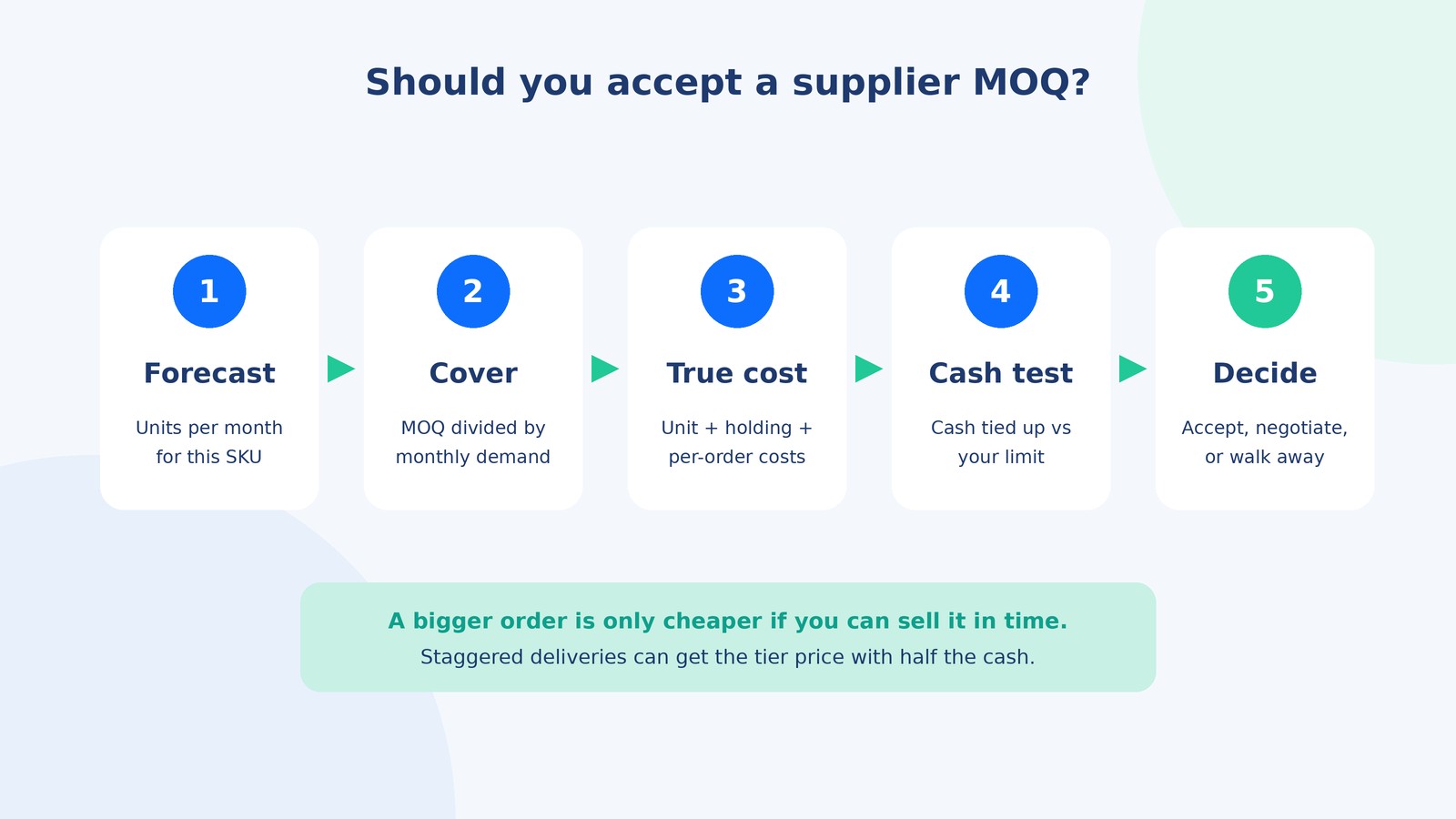
Step 1: Forecast monthly demand for the SKU
Use your sales history for an existing product, or a conservative estimate for a new one. If you sell across Shopify, Amazon, and wholesale, forecast the combined demand, because one purchase order supplies all channels. For a deeper method, see our guide to demand forecasting and safety stock for ecommerce.
Step 2: Convert the MOQ into months of cover
Months of cover = MOQ divided by forecast monthly demand. This is the single most useful translation of an MOQ, because it turns an abstract unit count into the time your cash will sit on a shelf. A 1,000-unit MOQ on a SKU that sells 250 units a month is four months of stock before you can reorder.
Step 3: Calculate the true cost per unit
The unit price on the quote is only part of the cost. Add the holding cost of storing stock while it sells, and the fixed cost of placing each order, such as freight minimums, inspection, and duties brokerage. Our guide to landed cost and true COGS for imported products covers the freight and duty side in detail.
Step 4: Run the cash test
Multiply the order quantity by the unit price to see how much cash the order ties up, then compare it to your inventory budget and to the other SKUs competing for the same money. Cash locked in slow stock is cash you cannot spend on ads or on the products that are already selling.
Step 5: Accept, negotiate, or walk away
If the MOQ fits your months-of-cover limit and your cash budget, accept it and pick the tier with the lowest true cost. If it fails either test, negotiate. If negotiation fails and the product is unproven, walking away or finding a supplier with stock items is usually the better decision.
What does a worked MOQ example look like?
The numbers below are an illustrative example, not industry benchmarks. Use your own costs when you run this for a real SKU.
A supplier quotes a product with an MOQ of 500 units and three price tiers: $9.00 at 500 units, $8.20 at 1,000 units, and $7.60 at 2,000 units. The brand forecasts 250 units of sales per month. Each purchase order also carries about $600 of fixed costs (freight minimum, inspection, and brokerage), and the brand estimates holding cost at 2% of inventory value per month.
Holding cost for each order is calculated on average inventory, which is half the order quantity, over the months it takes to sell through.
| Order quantity | 500 units | 1,000 units | 2,000 units |
|---|---|---|---|
| Unit price | $9.00 | $8.20 | $7.60 |
| Months of cover | 2 | 4 | 8 |
| Cash tied up | $4,500 | $8,200 | $15,200 |
| Holding cost per unit | $0.18 | $0.33 | $0.61 |
| Fixed order cost per unit | $1.20 | $0.60 | $0.30 |
| True cost per unit | $10.38 | $9.13 | $8.51 |
On true cost, the 2,000-unit tier still wins. But it ties up more than three times the cash of the smallest order and puts eight months of stock on the shelf. If the brand’s policy is no more than six months of cover for this kind of product, the largest tier fails the test even though it looks cheapest.
Now suppose the brand negotiates the $7.60 price for a 2,000-unit commitment delivered in two lots of 1,000. Each lot carries its own $600 order cost, so fixed cost rises to $0.60 per unit. Holding cost falls to about $0.30 per unit, because only 1,000 units sit in stock at a time. The true cost lands at about $8.50 per unit, almost identical to the single big order, with roughly half the cash tied up at any one time and four months of cover per delivery.
That is the core lesson: the best MOQ outcome is usually not the biggest tier, but the biggest tier’s price on the smallest delivery you can negotiate.
How is MOQ different from EOQ and reorder point?
These three numbers are often confused, but they answer different questions.
| Term | Who sets it | Question it answers |
|---|---|---|
| MOQ (minimum order quantity) | The supplier | What is the least I am allowed to buy? |
| EOQ (economic order quantity) | You | What order size minimizes my ordering plus holding cost? |
| Reorder point | You | At what stock level should I place the next order? |
| Safety stock | You | How much buffer protects me from demand or lead-time surprises? |
The classic EOQ formula is the square root of (2 × annual demand × cost per order) divided by annual holding cost per unit. Using the example above, annual demand is 3,000 units, cost per order is $600, and annual holding cost at the $7.60 price is about $1.82 per unit, which gives an EOQ of roughly 1,400 units.
The rule is simple: you order the larger of your EOQ and the supplier’s MOQ. When the MOQ is far above your EOQ, you are being pushed into overstock, and that gap is your negotiation case. When your EOQ is above the MOQ, the minimum is not a real constraint. To see how order size affects how fast stock moves, read our guide to the inventory turnover ratio for ecommerce.
How do you negotiate a lower MOQ with suppliers?
Negotiation works best when you offer the supplier something that addresses the cost driver behind their minimum. Here are the levers, ranked roughly by how often they work.
| Lever | What you offer | When it works best |
|---|---|---|
| Higher unit price | Pay more per unit for a smaller run | Setup cost drives the MOQ |
| Staggered deliveries | Commit to the full volume, receive in batches | The supplier wants a volume commitment |
| Volume plan | A 6 to 12 month forecast with scheduled POs | You have sales history to back it up |
| Fewer variations | Fewer colors, sizes, or packaging versions | MOQ is per color or per variant |
| Stock materials | Use materials the supplier already holds | Raw material lots drive the MOQ |
| Generic packaging first | Plain packaging for a first run, custom later | Printed packaging has its own high minimum |
| Pay a setup fee | A one-time mold or setup charge | Custom tooling drives the MOQ |
| Better payment terms | A larger deposit or faster payment | The supplier is cash-sensitive |
| Order consolidation | Combine orders through a sourcing agent | You buy small volumes across many items |
What should you say when asking for a lower MOQ?
A short, specific message gets a better response than a generic request for “lower minimums.” Here is a template you can adapt:
Thanks for the quote on [product]. We’d like to start a long-term relationship, but 1,000 units is more than four months of our current sales. Could you do either of these: (1) 500 units at a slightly higher unit price for the first order, or (2) a 2,000-unit commitment at your $7.60 tier, delivered in two shipments of 1,000 about four months apart? We can share our sales forecast and pay the deposit on confirmation.
This works because it shows you understand their economics, gives them two options to say yes to, and offers forecasts and payment certainty in return.
How do you test a new product when the MOQ is too high?
For unproven products, the goal is to learn whether it sells before committing to a full run. Options include paying for a sample batch at a premium, choosing an existing catalog item from the supplier with your branding added later, launching with one color or size, or running a pre-order campaign to validate demand before you place the order.
How should you set your own MOQ if you sell wholesale?
If you sell to retailers or B2B buyers, you need an MOQ of your own. A practical starting point is:
Starting MOQ = fixed cost per wholesale order ÷ contribution margin per unit.
For example, if picking, packing, and admin for one wholesale order cost $30 and each unit contributes $3 after variable costs, your floor is 10 units. Round that up to your case-pack size, then check it against how much your buyers typically order. If good customers keep stopping just short of the threshold, the MOQ may be too high. Our guide to contribution margin for ecommerce explains how to calculate the margin side properly.
What are the most common MOQ mistakes?
- Comparing tiers on unit price only. Holding and per-order costs change the answer, and so does the risk of unsold stock.
- Ignoring months of cover. A cheap tier that equals a year of stock is a cash problem, not a discount.
- Not asking what the MOQ applies to. Per SKU, per color, and per order are very different commitments.
- Adding variants too early. Every new color or size can multiply the minimum before you know what sells.
- Negotiating on price alone. Delivery schedules, materials, payment terms, and packaging are often easier levers.
- Not tracking supplier performance. A low MOQ from an unreliable supplier costs more in stockouts and defects. Use a supplier scorecard to compare vendors on quality, lead time, and flexibility.
- Treating the MOQ as permanent. As your volume and history grow, revisit terms at least once a year.
When does it make sense to outsource MOQ negotiation and purchasing?
MOQ decisions sit at the center of procurement: supplier discovery, quote comparison, forecasting, negotiation, purchase orders, and follow-up on production and delivery. For a growing brand with dozens of SKUs and several suppliers, that work quickly becomes a part-time job that founders squeeze between marketing and operations.
AcquireX’s procurement and sourcing services give ecommerce brands a dedicated offshore team that compares supplier terms, builds the demand forecasts suppliers want to see, negotiates MOQs, price tiers, and staggered deliveries, and runs the day-to-day purchase-order workflow. Paired with our supply chain management team, that means fewer overstocks, fewer stockouts, and more cash available for growth. You can see how this fits a broader operating model in our guide to ecommerce procurement and sourcing.
Want a second opinion on a supplier quote or a stubborn MOQ? Book a call with AcquireX and we’ll walk through your SKUs, your supplier terms, and where a dedicated procurement team could save you cash.
Key takeaways
- A minimum order quantity is the smallest order a supplier will accept, stated in units, value, or a production lot.
- Translate every MOQ into months of cover and cash tied up before you accept it.
- Compare price tiers on true cost per unit, including holding and per-order costs, not unit price alone.
- Order the larger of your EOQ and the supplier’s MOQ, and negotiate when the MOQ is far above your EOQ.
- The strongest negotiation levers are staggered deliveries, a higher unit price for small runs, fewer variants, and stock materials.
Frequently asked questions
What does MOQ mean?
MOQ stands for minimum order quantity: the smallest number of units, or the smallest order value, a supplier will accept for a single purchase order. Below that amount, the supplier either declines the order or charges a surcharge to cover setup and handling costs.
Why do suppliers set minimum order quantities?
Suppliers set MOQs to cover the fixed cost of each production run, such as machine setup, raw material minimums, labor, and admin. Spreading those costs across enough units is what makes the order profitable for them, which is why the MOQ often falls when you can reduce their setup work.
Is MOQ negotiable?
Usually, yes. Most MOQs have some room, especially for stock materials and standard colors. The best levers are accepting a higher unit price, committing to staggered deliveries or a longer-term volume plan, consolidating SKUs, and choosing materials the supplier already keeps in stock.
How do I calculate my own MOQ as a seller?
A simple floor is your fixed cost per order divided by the contribution margin per unit. If processing a wholesale order costs $30 and each unit contributes $3, your floor is 10 units. Then round to case-pack sizes and check it against what your buyers actually order.
What is the difference between MOQ and EOQ?
MOQ is a constraint set by the supplier: the least you are allowed to buy. EOQ, or economic order quantity, is the order size that minimizes your own combined ordering and holding costs. You order the larger of the two, and if the MOQ is far above your EOQ, that is your negotiation signal.
How many months of inventory should an MOQ cover?
There is no universal number. Set a maximum months-of-cover limit by product type: tighter for new, seasonal, or trend-driven SKUs, and looser for proven evergreen products with long shelf life. If an MOQ pushes you past your limit, negotiate or test the product another way.
What should I do if I cannot meet a supplier’s MOQ?
Ask for a sample or trial run at a higher price, split the MOQ across colors or sizes, request staggered deliveries, combine orders through a sourcing agent, or look for a supplier that already stocks a similar item. Walking away is better than tying up cash in stock you cannot sell.
Can an outsourced procurement team help lower MOQs?
Yes. A procurement team that sources across many suppliers can compare MOQ terms, prepare demand forecasts suppliers trust, negotiate tiered and staggered terms, and run the ongoing purchase-order work. That combination is often what gets a smaller brand terms usually reserved for larger buyers.