Summary: The purchase order process is the controlled path from “we need inventory” to “we paid the right amount for what actually arrived.” For an ecommerce brand it runs in nine steps: identify the need, raise a requisition, approve it, issue the PO, get supplier confirmation, track the inbound shipment, receive and inspect, three-way match the PO, receipt and invoice, then pay and close.
Most ecommerce brands start buying inventory with a WhatsApp message, a spreadsheet and a wire transfer. That works for the first few production runs. Then the catalog grows, a second factory comes on board, a 3PL starts receiving the goods and the finance person discovers that nobody can say for certain whether last month’s invoice matched what was ordered.
A clear purchase order process fixes that. It is not paperwork for its own sake. It is how you stop paying for short shipments, catch price creep before it eats your margin, keep inventory records accurate and give your planners reliable lead-time data. This guide walks through every step, shows what a PO should contain, explains three-way matching with examples and gives you the controls and KPIs to run purchasing at scale.
What is a purchase order?
A purchase order (PO) is a document a buyer sends to a supplier that lists the items, quantities, agreed prices, delivery details and payment terms for an order. Once the supplier accepts it, the PO becomes the commercial agreement that every later step, including receiving and payment, is checked against.
A PO is different from an invoice. The PO comes from you and says what you agreed to buy. The invoice comes from the supplier and says what they want to be paid. Keeping those two documents separate, and comparing them, is the core idea behind the whole process.
The PO process sits inside the wider procurement function, which also covers supplier discovery, negotiation and strategic sourcing. If you are still building that foundation, start with our guide to ecommerce procurement and sourcing, then come back here for the transactional workflow.
Which documents are involved in the purchase order process?
Several documents move between your team, the supplier and your warehouse. Knowing which one is binding, and which is just information, prevents most disputes.
| Document | Who creates it | What it says | Is it binding? |
|---|---|---|---|
| Purchase requisition | Internal requester (buyer, ops or inventory planner) | “We need this, here is why and roughly what it costs” | No, internal request only |
| Request for quotation (RFQ) | Buyer | “Please quote price, MOQ and lead time for these items” | No |
| Purchase order (PO) | Buyer, after approval | “We will buy these items, at these prices, on these terms” | Yes, once the supplier accepts it |
| Order acknowledgment | Supplier | “We accept the PO” (or “we accept with these changes”) | Confirms the agreement |
| Advance ship notice (ASN) / packing list | Supplier or forwarder | “This is what is in the shipment and when it ships” | No, informational |
| Goods received note (GRN) / receipt | Warehouse or 3PL | “This is what actually arrived and was accepted” | Evidence for payment |
| Supplier invoice | Supplier | “This is what you owe us” | Request for payment |
What are the steps in the purchase order process?
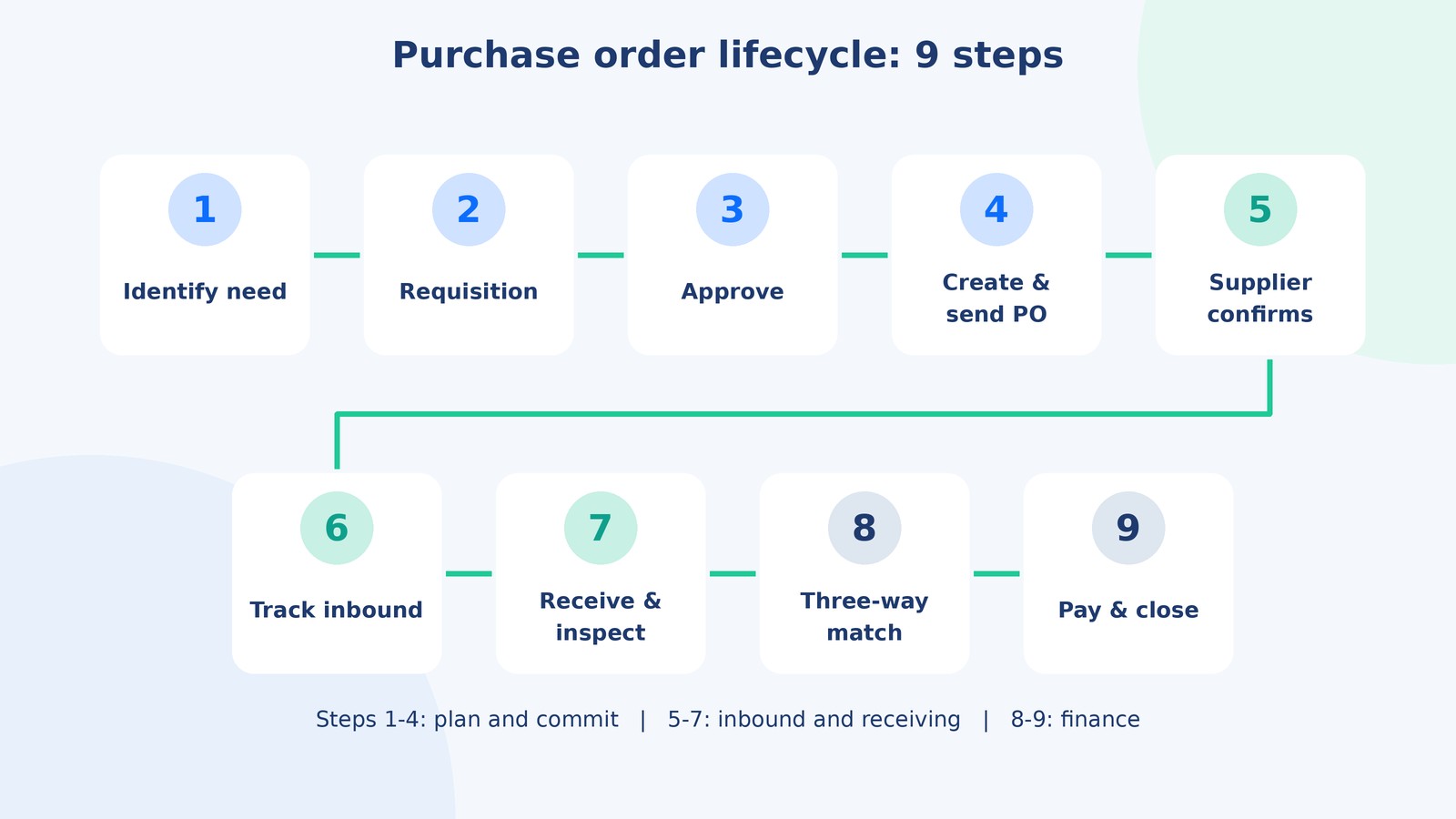
1. Identify the need from data, not gut feel
A good PO starts with a reason. In ecommerce that reason is usually a reorder signal: projected stock-out date, forecasted demand for a launch or promotion, or a planned stock build before peak. Use your sell-through, lead time and safety stock to decide when to buy. Our guide to demand forecasting and safety stock shows how to calculate reorder points, and ABC analysis helps you decide which SKUs deserve the most planning attention.
Write down what triggered the buy. When a PO is questioned later, “the reorder report showed 21 days of cover against a 45-day lead time” is a far better answer than “it felt low.”
2. Raise a purchase requisition
The requisition is an internal request. It should state the items, estimated quantity and cost, the budget or cost center, the needed-by date and the reason. In a small brand this can be a simple form or a draft PO; what matters is that the request is recorded before anyone commits money.
3. Get quotes and approval
For repeat buys from an established supplier, the price list or contract may already define the price. For new items, new suppliers or large orders, request quotes covering unit price, minimum order quantity, lead time, payment terms and Incoterms. Compare quotes on total landed cost rather than unit price alone, because freight, duty and payment terms can reverse the ranking. Our article on landed cost and true COGS explains how to calculate it.
Approval should follow clear thresholds. A common pattern is that a buyer can approve routine reorders within an agreed budget, while new suppliers, new SKUs or orders above a set value need sign-off from the founder or finance lead.
4. Create and send the purchase order
Generate the PO from your system with a unique PO number, then send it to the supplier through the channel you agreed: email PDF, supplier portal or EDI for larger retail and wholesale partners. Always ask the supplier to quote the PO number on every packing list, ASN and invoice. That one habit makes matching dramatically easier.
5. Get supplier confirmation
Do not treat a PO as confirmed until the supplier acknowledges it in writing. If they change anything, such as a later ship date, a substituted material or a new price, update the PO through a formal change order so the PO always reflects the real agreement. A PO that no longer matches reality will fail every later check.
6. Track production and the inbound shipment
Record deposit payments against the PO, set milestones (production start, pre-shipment inspection, ship date, arrival) and chase exceptions early. For imported goods, track the booking with your freight forwarder and make sure the commercial invoice, packing list and PO quantities agree before the goods leave the factory. A delay you hear about at the factory gate is a scheduling problem; a delay you discover when the container fails to arrive is a stock-out.
7. Receive and inspect the goods
Your warehouse or 3PL counts what arrived, checks it against the PO or ASN and records a receipt line by line. Damaged, wrong or out-of-spec units should be recorded as rejected, not silently added to stock. Partial deliveries are normal; record what arrived and leave the remaining quantity open on the PO.
If you sell on Shopify, the admin now supports this directly. According to the Shopify Help Center, you create a purchase order under Products > Purchase orders, mark it as Ordered, then create a linked inventory transfer to receive items, where each line can be accepted, rejected or canceled and partial shipments stay in progress until every unit is accounted for.
8. Run the three-way match
Before paying, compare the PO, the receipt and the supplier invoice. If quantity, price and terms agree within your tolerance, the invoice is approved. If not, it goes into an exception queue. This step is explained in detail in the next section because it is where most of the money is protected.
9. Pay, record and close the PO
Pay according to the PO terms, apply any deposit already paid, and post the cost to inventory so your COGS is accurate. When every line has been received, invoiced and paid, or formally canceled, close the PO. Closed POs become your history for spend analysis, lead-time tracking and supplier reviews.
What should a purchase order include?
Every field on a PO exists to prevent a specific type of dispute. Use this as a checklist when you build or audit your PO template.
| PO field | Why it matters | Common mistake |
|---|---|---|
| PO number | Unique reference that links the PO, shipments, receipts and invoices | Reusing numbers or letting suppliers invoice without one |
| Supplier legal name and address | Matches the vendor record in accounting | Paying a trading name that differs from the bank account holder |
| Ship-to and bill-to | Tells the supplier which warehouse or 3PL receives | Sending goods to the office instead of the 3PL |
| SKU, supplier part number, description | Removes ambiguity between similar variants | Using only your internal SKU, which the factory does not recognize |
| Quantity and unit of measure | Prevents case-vs-unit confusion | Ordering “10” when you meant 10 cases of 24 |
| Unit price and currency | Basis for the price match at invoice time | Leaving currency off a cross-border PO |
| Incoterms and freight terms | Defines who pays and owns risk in transit | Assuming FOB means the same thing to both sides |
| Requested ship and delivery dates | Lets you track supplier on-time performance | “ASAP,” which cannot be measured |
| Payment terms | Drives cash flow and deposit timing | Not recording deposits, so the balance is overpaid |
| Packaging, labeling and QC requirements | Avoids receiving chargebacks and relabeling costs | Not stating carton labels or barcode requirements for FBA or a 3PL |
Tip: include your packaging and labeling requirements on the PO itself, not in a separate email. If you send goods to Amazon FBA or a 3PL, mislabeled cartons can lead to receiving delays and extra fees, and the PO is your evidence of what the supplier agreed to.
How does three-way matching work?
Three-way matching compares three records before you release payment: the purchase order (what you ordered), the goods receipt (what arrived and was accepted) and the supplier invoice (what you are being billed). You pay for what the receipt shows, at the price the PO agreed, and every difference is resolved on purpose.
Match at the line level, not the invoice total. Totals can agree by coincidence while individual lines are wrong, for example one SKU short and another over-billed.
| Check | Compare | Example variance | Typical action |
|---|---|---|---|
| Quantity | PO quantity vs. received (accepted) quantity vs. invoiced quantity | Invoice bills 1,000 units, receipt shows 960 accepted | Pay for 960, request a credit note for 40 or keep the line open for a backorder |
| Unit price | PO unit price vs. invoice unit price | PO says $4.10, invoice says $4.35 | Hold the line; buyer confirms with supplier or approves a documented price change |
| Item | PO SKU/part number vs. receipt vs. invoice line | Supplier shipped the blue variant instead of black | Reject or accept as substitute with buyer approval and a revised PO |
| Charges | Freight, duty, tooling or surcharges on the invoice vs. PO terms | Unexpected rush freight line | Pay only if the PO or a written change order allows it |
| Terms | Invoice payment terms vs. PO terms | Invoice says due on receipt, PO says net 30 | Schedule payment to the PO terms |
What is a matching tolerance?
A tolerance is the small variance you will accept automatically, such as a rounding difference or a quantity variance within an agreed overage allowance. Set tolerances deliberately and keep them tight. A tolerance that is too loose quietly approves price increases; one that is too tight floods your team with exceptions over cents.
Two-way vs. three-way vs. four-way matching
Two-way matching compares only the PO and the invoice, which suits services and subscriptions where there is nothing to receive. Three-way matching adds the receipt and is the right default for physical inventory. Four-way matching adds an inspection or quality record, which is worth it for regulated products, high-value goods or categories with frequent quality issues.
How do you handle freight and duty invoices?
Freight forwarders, customs brokers and carriers often invoice separately and later than the supplier. Match these to the shipment or container they relate to, then allocate the cost to the SKUs in that shipment so your landed cost and margins stay accurate. Do not force them through the goods PO.
Purchase order process for Shopify and Amazon sellers: what is different?
- Multiple receiving points. One PO might be split between your 3PL, an Amazon FBA inbound shipment and a retail partner. Record each destination and receipt separately so each portion can be matched.
- Deposits and balance payments. Overseas factories often require a deposit before production and the balance before shipment. Record both against the PO so the final invoice is not overpaid.
- Prepayment before receipt. When you pay the balance before goods arrive, you cannot complete a true three-way match until receiving. Track these as prepaid open POs and reconcile once the receipt posts, claiming credits for shortages or defects.
- Variant-heavy catalogs. Apparel and accessories brands order many sizes and colors per style. Use supplier part numbers on every line, and check that the receipt counts by variant rather than by style.
- Dropship and made-to-order. When the supplier ships direct to customers, the “receipt” is the supplier’s shipment confirmation with tracking. Match invoices against confirmed shipments, not against the customer orders you sent.
Which controls keep the purchase order process clean?
- No PO, no pay. Inventory invoices without a valid PO number go back to the supplier or into review. This is the single most effective control for a growing brand.
- Separate duties. The person who approves a PO should not be the only person who records the receipt and releases payment. In a small team, at least require a second person for supplier bank detail changes.
- Verify bank detail changes by phone. Use a phone number already on file, never one from the email requesting the change.
- Approval thresholds in writing. Document who can approve what, and review the thresholds as order sizes grow.
- Formal change orders. Every change to price, quantity or date after the PO is sent gets a revised PO version.
- Weekly open-PO review. Walk through overdue POs, partial receipts and unmatched invoices every week so nothing ages quietly.
Which purchase order KPIs should ecommerce teams track?
- Supplier on-time in-full (OTIF): the share of PO lines delivered by the confirmed date at the full quantity.
- Actual vs. quoted lead time: the gap that tells you whether your reorder points are realistic.
- First-pass match rate: the share of invoices that match without manual intervention. A falling rate points to template, supplier or receiving problems.
- Purchase price variance (PPV): the difference between the PO price and the price actually invoiced or paid.
- Receiving discrepancy rate: how often receipts differ from the PO or ASN, by supplier.
- PO cycle time: time from requisition to approved PO; long cycle times push you into rush freight.
These numbers feed straight into supplier reviews. Our supplier scorecard guide shows how to turn OTIF, quality and price variance into a quarterly rating that guides who gets more volume.
Which tool should you use to manage purchase orders?
There is no single right tool. The right setup depends on order volume, number of suppliers and whether finance and inventory live in the same system.
| Approach | Best for | Strengths | Watch-outs |
|---|---|---|---|
| Spreadsheet + email | Very small catalogs, a handful of suppliers | Free, flexible, fast to start | No approvals or audit trail, version chaos, manual matching |
| Shopify admin purchase orders | Shopify brands that want POs next to inventory | Records supplier, cost and terms; linked transfers handle partial receiving | Light on approval workflows and invoice matching |
| Inventory / PO apps | Growing multi-channel sellers | Reorder suggestions, supplier portals, landed cost, receiving | Another system to sync with accounting |
| Accounting or AP tools with PO matching | Brands with a finance team or outsourced bookkeeping | Bill matching and approval rules at the payment step | Weaker on inventory planning |
| ERP | Complex, multi-entity or high-volume operations | Single source of truth for purchasing, inventory and finance | Cost, implementation time and process discipline required |
Whatever you choose, the process matters more than the software. A disciplined team with a good spreadsheet will outperform a messy team with an ERP. Pick the simplest tool that gives you unique PO numbers, approvals, line-level receiving and a record of matches.
What are the most common purchase order mistakes?
- Placing orders outside the system. A “quick” order over chat has no PO to match against.
- Paying from the PO instead of the receipt. You end up paying for short shipments.
- Not updating the PO after supplier changes. Every later match fails, so people start ignoring exceptions.
- Ignoring units of measure. Cases, inner packs and units get confused, especially across languages.
- Leaving POs open forever. Old open lines distort your inbound inventory and make planning unreliable.
- Treating freight and duty as overhead. Your product margins look better than they are.
Want purchasing run for you, end to end?
AcquireX’s procurement and sourcing services give ecommerce brands a dedicated team that builds your PO templates and approval rules, places and tracks purchase orders, chases suppliers, reconciles receipts and invoices and reports OTIF and price variance every month. Pair it with our supply chain management services for demand planning and inbound logistics, and your team stops firefighting stock issues.
Book a call with AcquireX to map your current purchasing workflow and see where a dedicated team can take work off your plate.
Key takeaways
- A purchase order is the commercial agreement every later step is checked against, so it must be complete and kept up to date.
- The process has nine steps: need, requisition, approval, PO, confirmation, tracking, receiving, three-way match, and payment and closure.
- Three-way matching means paying for what was received, at the price agreed, with every variance resolved deliberately.
- “No PO, no pay,” separation of duties and weekly open-PO reviews are the controls that matter most.
- Track OTIF, lead-time accuracy, first-pass match rate and purchase price variance to manage suppliers with data.
Frequently asked questions
What is the purchase order process?
The purchase order process is the workflow a business uses to buy goods: identify a need, raise a requisition, approve it, issue a purchase order, get supplier confirmation, receive and inspect the goods, match the PO, receipt and invoice, then pay and close the order.
What is the difference between a purchase requisition and a purchase order?
A purchase requisition is an internal request to buy something and creates no obligation to a supplier. A purchase order is the external document sent to the supplier after approval, and once accepted it becomes the agreement for price, quantity and terms.
Is a purchase order legally binding?
A purchase order generally becomes a binding contract once the supplier accepts it, for example by acknowledging it or shipping the goods. The exact position depends on your terms and the applicable law, so have your standard PO terms reviewed by a lawyer.
What is three-way matching in accounts payable?
Three-way matching compares the purchase order, the goods receipt and the supplier invoice before payment. If quantities, prices and terms agree within tolerance, the invoice is approved; any difference is investigated and resolved before money leaves the business.
Do small ecommerce brands need purchase orders?
Yes, once you buy inventory regularly or from more than one supplier. Even a simple numbered PO in a spreadsheet gives you a record of what was agreed, which protects you against short shipments, price changes and disputes.
Can you create purchase orders in Shopify?
Yes. The Shopify admin includes purchase orders under Products > Purchase orders. You record the supplier, items, costs and terms, mark the PO as Ordered and then receive the goods through a linked inventory transfer that supports partial receipts.
What happens if the supplier ships fewer units than ordered?
Record the actual quantity received, pay only for the units accepted and either keep the remaining quantity open as a backorder or cancel it and request a credit note for anything already invoiced or prepaid.
How long should a purchase order stay open?
Until every line is received, invoiced and paid or formally canceled. Review open POs weekly and close or cancel stale lines, because old open quantities distort inbound inventory and reorder planning.