A pre-shipment inspection is a quality check on a finished order before it leaves the factory, usually done when production is complete and at least 80% is packed. An inspector pulls a random sample sized by an AQL table, checks it against your spec, packaging and labels, and gives a pass or fail. You get the result while you still hold the balance payment.
Key takeaways
- Book the inspection for when goods are 100% made and at least 80% packed. Earlier than that, you are running a different check.
- The sample size comes from the AQL table, not from a guess. A 5,000-unit order at General Level II means 200 units inspected.
- Write your own checklist. The inspector can only fail what you told them to look for.
- Tie the inspection to money. Make passing a condition of the balance payment in the purchase order.
- A pass is about the sample, not a promise that every unit is perfect. Track returns afterwards and feed them back into the next checklist.
Most of the quality problems we clean up for ecommerce brands were visible in the factory. A batch of water bottles with lids that leak when tipped. Cartons printed with the wrong FNSKU. Hoodies where the XL tag was sewn into the medium. In each case, the goods sat in a warehouse in Shenzhen or Tiruppur for a few days before shipping, and nobody opened a carton. By the time customers found the problem, the brand had paid in full, paid freight and duty, and paid for the returns.
A pre-shipment inspection costs a few hundred dollars and a day of planning. This guide covers how our sourcing team books them for clients: when to schedule, how the AQL numbers work, what to put on the checklist, and what to do when the report comes back red.
What does a pre-shipment inspection actually check?
It checks five things: quantity, workmanship, measurements and function, packing and labels, and anything specific to your product, such as a drop test or a fabric weight. Each one is compared against documents you send before the visit, so the report is only as good as your spec.
In practice, an inspector on a typical consumer-goods PSI will:
- Count. Confirm how many units are finished and how many are packed, by SKU and color, against your purchase order.
- Draw a random sample from packed export cartons. Good inspectors pick the cartons themselves and refuse a pile the factory has set aside.
- Check workmanship on every sampled unit and log each defect as critical, major or minor.
- Measure and test. Dimensions, weight, color against the approved sample, and function tests: zips, lids, switches, assembly, battery charging, whatever applies.
- Check packing and labeling. Carton marks, unit barcodes, warning labels, country of origin, polybag suffocation warnings, inner pack counts, and a carton drop test for fragile goods.
- Report. Photos of every defect, counts against the accept and reject numbers, and an overall pass, fail or pending.
If you sell on Amazon, step five matters more than most brands think. A unit barcode that does not scan, or a carton label in the wrong place, turns into receiving problems at the fulfillment center. Put Amazon’s prep and labeling needs on the checklist as their own line items, the same way you would a stitching standard.
When should you book a pre-shipment inspection?
Book it for the day production is fully finished and at least 80% of the order is in export cartons, with a few working days left before the container is booked. That timing lets the inspector check real packing while leaving the factory time to fix anything that fails.
The 80% threshold is widely used. ClearToLoad’s explanation of how a PSI works uses the same threshold, as do the other inspection guides we checked. If the factory says goods are ready but only half are packed, the inspector may abort the visit and you still pay for the day.
Two habits that save us a lot of grief:
- Get readiness in writing. Ask the supplier for a message, two or three days before the date, that states units finished and units packed per SKU. Forward it to the inspection company.
- Leave a buffer before loading. We plan for at least three to five working days between inspection and the vessel cut-off. A fail with no buffer forces a bad choice: ship known defects or miss the boat.
The PSI is one of several checks you can run on an order. Here is how they compare:
| Inspection | When it happens | Question it answers | Use it when |
|---|---|---|---|
| Pre-production check | Before mass production starts | Are the materials, components and approved sample right? | New supplier, new product, or a material change |
| During-production check (DUPRO) | Early in the run, once the line is producing | Are defects showing up while there is still time to fix them? | Large orders, long lead times, or a factory with a shaky history |
| Pre-shipment inspection (PSI / FRI) | Production 100% complete, at least 80% packed | Is this finished lot good enough to ship and pay for? | Almost every order from an overseas factory |
| Container loading check | While the container or truck is loaded | Are the right cartons, in the right count, going into the box? | High-value orders, mixed SKUs, or past short-shipments |
For most of our clients, the PSI is the default on every overseas order, and the other three are added based on risk. A first order with a new factory gets a pre-production check too. A reorder of a stable SKU from a supplier with a clean record might get a PSI only.
How does AQL sampling work in a pre-shipment inspection?
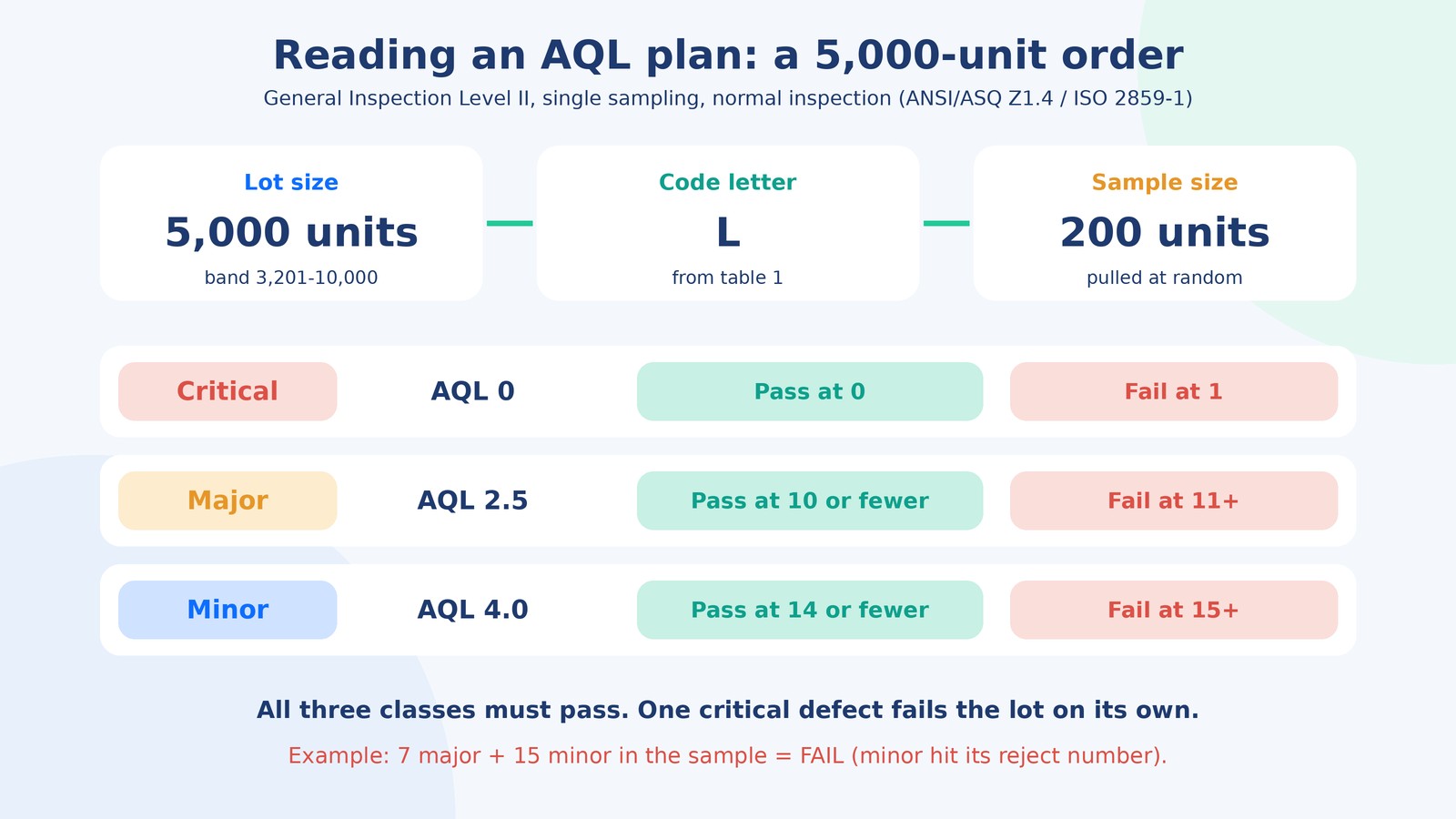
AQL sampling tells the inspector how many units to check and how many defects of each type are allowed before the order fails. You pick an inspection level and an AQL for each defect class; the order quantity and the tables in ANSI/ASQ Z1.4 or its international twin ISO 2859-1 do the rest.
The steps are always the same:
- Find your lot size (the order quantity being inspected) in the first table, under your inspection level. General Inspection Level II is the normal default.
- That gives you a code letter. The code letter gives you the sample size.
- For each defect class, read across to your AQL to get the accept number (most defects allowed to pass) and reject number (fewest that fail).
- All classes must pass. Count each defective unit once, at its most serious defect.
For the common setting of zero critical, AQL 2.5 major and AQL 4.0 minor at General Level II, the numbers for typical ecommerce order sizes are:
| Order size (lot) | Code letter | Units inspected | Major, AQL 2.5 (pass / fail) | Minor, AQL 4.0 (pass / fail) |
|---|---|---|---|---|
| 501 to 1,200 | J | 80 | 5 / 6 | 7 / 8 |
| 1,201 to 3,200 | K | 125 | 7 / 8 | 10 / 11 |
| 3,201 to 10,000 | L | 200 | 10 / 11 | 14 / 15 |
| 10,001 to 35,000 | M | 315 | 14 / 15 | 21 / 22 |
Single sampling, normal inspection. Figures match the published Level II tables, for example GQC’s ANSI/ASQ Z1.4 sampling tables and the full single sampling table at AQLchart. For very small lots the tables use arrows that move you to a different plan, so check the full table rather than guessing.
Worked example: 5,000 phone cases
A client orders 5,000 phone cases across four colors. The lot falls in the 3,201 to 10,000 band, so the code letter is L and the inspector checks 200 cases, spread across all four colors.
- The inspector finds no critical defects, 7 major defects (cases where the button cut-out is misaligned) and 15 minor defects (light scuffs on the inside).
- Major passes: 7 is under the accept number of 10.
- Minor fails: 15 hits the reject number for AQL 4.0.
- Result: the lot fails, even though nothing dangerous was found.
Here is where judgment comes in. Scuffs inside a phone case are not something most buyers notice. You could accept the lot with a written concession, or ask the factory to sort and wipe the stock. What you should not do is quietly ignore the result. Write down the decision and the reason, because the same supplier will ask for the same concession next time.
What does AQL 2.5 actually mean?
AQL 2.5 does not mean your order is allowed to be 2.5% defective, and it does not mean the order is 2.5% defective. It describes how the sampling plan behaves across many lots. The sample tells you whether this lot is likely acceptable. It does not prove every unit is fine. Packsel’s guide to booking AQL inspections makes the same point, and it is the most common misunderstanding we hear from founders.
Should you use a tighter or looser AQL?
Tighten it for products where a defect means a refund, a safety issue or an expensive return. Loosen it only for cheap, low-risk items. Premium skincare packaging, electronics and baby products often justify AQL 1.5 for major defects. Promotional freebies can sit at 4.0 or 6.5. Whatever you choose, write it into the purchase order so the factory knows the standard before they start.
How do you classify defects as critical, major or minor?
Decide the class by asking what the customer would do: get hurt or report you (critical), return it or complain (major), or keep it without much fuss (minor). Then list your real examples on the checklist, because inspectors will otherwise use their own defaults.
| Class | What it means | Ecommerce examples | Usual limit |
|---|---|---|---|
| Critical | Could hurt someone, breaks a legal or safety rule, or makes the product unsellable | Sharp edge on a kids’ toy, missing warning label, wrong voltage plug, mould | Zero. One found fails the lot |
| Major | Customer would likely return it or leave a bad review | Zip that sticks, wrong color, lid that does not seal, scratched display surface, wrong barcode on the unit | AQL 2.5 is the common default |
| Minor | Off-spec, but most customers would keep it | Loose thread, small cosmetic mark on a hidden face, slightly off-center print on the inner box | AQL 4.0 is the common default |
The examples are where brands save money. If a wrong color shade is a deal-breaker for your customers, list it as major. If you have seen returns for a specific issue, such as a bottle cap that cracks, add it by name. Your returns management data is the best source for this list, because it shows what customers actually send back.
What should be on a pre-shipment inspection checklist?
A good checklist lists exactly what to measure, test and photograph for this product, with tolerances, plus the packing and labeling rules for each sales channel. Send it with the purchase order, approved sample photos, and label artwork at least two working days before the visit.
The template our team starts from:
- Order details: PO number, SKUs, colors and sizes, quantities per SKU, factory address and contact.
- Reference: photos of the approved golden sample from every side, or the sealed sample itself if the factory holds one.
- Measurements: key dimensions and weight, each with a tolerance (for example, length 250 mm plus or minus 3 mm).
- Function tests: what to test and how many units, such as “open and close the zip 10 times on every sampled unit” or “fill with water, invert for 60 seconds, check for leaks.”
- Visual standards: viewing distance and lighting for cosmetic checks, plus which faces of the product count as visible.
- Defect list: your critical, major and minor examples, written out.
- Packaging: retail box condition, inserts, manual, polybag and suffocation warning, units per inner and master carton, carton dimensions and weight.
- Labels and barcodes: scan test on unit barcodes, FNSKU or UPC matches the SKU, carton marks, country of origin, and any required warnings for your market.
- Carton tests: drop test for fragile goods, and a check that master cartons meet your 3PL or marketplace weight limits.
- Photos you want: defects, packed cartons, shipping marks, and a pallet or carton count shot.
This document pays off twice. It also becomes the basis of your supplier scorecard, because every inspection gives you a pass or fail and a defect count you can track by factory over time.
Who pays for a pre-shipment inspection, and how much does it cost?
The buyer normally books and pays for the first inspection, and most inspection firms charge per inspector per day. A good purchase order then makes the supplier pay for any re-inspection after a fail, since the extra visit is caused by their defects.
Prices vary by country, city and product. As one published example, ClearToLoad lists pre-shipment inspections in India from US$199 per man-day. Rates differ between firms, and some charge travel for remote factories, so get a quote that lists every line. A simple product with one SKU usually fits in one day. Many SKUs, heavy function testing or lab tests can stretch it.
Compare that to what one bad container costs you. You have paid the balance, freight, duty and storage, and now you face returns, refunds, reviews and maybe a marketplace listing problem. If you work out the full landed cost of an imported order, the inspection fee is usually a small fraction of one percent of what is at risk.
Your choices for who does the inspection look like this:
| Option | Typical cost | Independence | Best fit |
|---|---|---|---|
| Factory’s own QC report | Free | Low: the seller is grading its own work | Long-trusted suppliers on repeat, low-risk SKUs, alongside spot checks |
| Your sourcing agent | Often bundled into the agent’s fee | Medium: depends on whether the agent is also paid by the factory | Brands already using an agent for sourcing and follow-up |
| Third-party inspection company | Usually priced per inspector per day, plus travel in some regions | High: paid only by you, reports to you | New suppliers, new products, regulated or high-value goods |
| Your own team visiting | Travel and staff time | High, but hard to scale | First orders with a strategic supplier, or when you need to see the line yourself |
How do you tie the inspection to your purchase order and payment?
Write the inspection into the purchase order: who inspects, which AQL and checklist apply, that a pass is required before the balance is paid, and that the supplier pays for re-inspection after a fail. Without these lines, a failed report is just an opinion the factory can argue with.
The clauses we add to client POs:
- “Goods will be inspected by a buyer-nominated third party before shipment, at General Inspection Level II, AQL 0 / 2.5 / 4.0 (critical / major / minor), against the attached checklist.”
- “Balance payment is released only after a passed inspection report, or written buyer acceptance of a failed report.”
- “If an inspection fails, the supplier will rework or replace defective goods and pay for re-inspection.”
- “The supplier will give the inspector access to all finished and packed goods and allow random carton selection.”
This is why the deposit and balance split matters so much. If you have already paid in full, all you have after a fail is goodwill. Our guide to the purchase order process for ecommerce covers how to set up these terms and match them to the inspection report before payment goes out.
What happens if a pre-shipment inspection fails?
Read the report, decide whether the defects matter to your customers, then pick one of four paths: reject and rework, sort the lot, accept with a concession, or cancel. In most cases the factory reworks or sorts the goods and you book a re-inspection before paying.
- Rework and re-inspect. The default for real defects. The factory fixes or replaces the affected units, then the inspector returns. Ask for the rework plan in writing.
- Sort the full lot. If defects are easy to spot, the factory checks every unit and pulls the bad ones. Ask for the count of rejected units so you know how big the problem really was.
- Accept with a concession. For defects your customers will not notice. Negotiate a discount, extra spare units, or a credit on the next order, and put it in writing.
- Cancel or refuse shipment. For critical defects you cannot fix, or a factory that will not cooperate. This is where an unpaid balance protects you.
Whatever you choose, ask the supplier for a root cause, not only a fix. A failed inspection that ends with “we will be more careful” usually repeats on the next order. One that ends with “we changed the zip supplier and added a final zip test on the line” usually does not.
Is a pre-shipment inspection worth it for small orders?
Usually yes for first orders, new products, and anything you will sell on Amazon, even at a few hundred units. The fee is fixed per day while the order value is small, so the cost is proportionally higher, but a bad first batch can kill a new product’s reviews in a week.
Where we tell clients to skip or reduce it:
- Small reorders of a stable SKU from a supplier with a long run of passed inspections. Switch to inspecting every second or third order, and keep checking returns.
- Very low-value items where a sorting check at your 3PL on arrival costs less than a factory visit.
- Orders where the factory will not let a third party in. That is not a reason to skip the check. It is a reason to question the supplier.
Small orders often come with high minimum order quantities negotiated down. If you pushed the factory hard on MOQ, it is even more important to check the result, because a small, unprofitable order is the one a factory is most tempted to rush.
Can an offshore team manage inspections for you?
Yes. Booking, briefing, reading reports and chasing rework are coordination jobs, and a dedicated sourcing team in the supplier’s time zone handles them well. The inspector is on site; the team’s job is to make sure the visit happens at the right time, against the right checklist, with a clear decision afterwards.
In our procurement and sourcing service, that work looks like this: we build and update the checklist for each SKU, confirm factory readiness in writing, book the inspector, review the report the same day it lands, push the factory on rework, and hold the balance payment until the result is clean. Over time, the inspection history feeds supplier reviews and decides where the next order goes. It sits alongside the rest of our ecommerce procurement and sourcing work, from finding suppliers to negotiating cost.
Shipping your next order from an overseas factory? We can write the inspection checklist, book the visit and read the report before your balance goes out.
Book a call with AcquireX and tell us what you are producing. We will show you what we would check first.
Frequently asked questions
What is a pre-shipment inspection?
A pre-shipment inspection is a quality check on a finished order before it leaves the factory. An inspector checks a random sample for quantity, workmanship, function, packing and labels against your specification, then reports pass or fail so you can decide whether to pay and ship.
Is a pre-shipment inspection the same as a final random inspection?
Yes. Final random inspection (FRI) is another name for the same check. Both happen when production is complete and most of the order is packed, and both use random AQL sampling.
How long does a pre-shipment inspection take?
A simple product with one or two SKUs usually takes one inspector one day on site. Orders with many SKUs, large samples or detailed function tests can take longer. Ask your inspection firm when the report will arrive, so you can plan the decision around it.
What AQL should I use for consumer products?
The common default is zero critical defects, AQL 2.5 for major and AQL 4.0 for minor, at General Inspection Level II. Use a tighter major AQL, such as 1.5, for electronics, baby products or premium goods where defects lead to costly returns.
How many units are checked in a pre-shipment inspection?
It depends on the order size and inspection level. At General Level II, an order of 1,000 units means 80 inspected, 3,000 units means 125, and 5,000 units means 200.
Does passing a pre-shipment inspection guarantee zero defects?
No. A pass means the sample met your accept numbers. Some defective units can still be in the lot. Keep tracking returns and reviews after delivery, and add new defect types to the checklist.
Can I inspect goods myself instead of hiring a company?
You can if you or your team can be at the factory and follow the same sampling rules. Many brands use third-party inspectors because they are local, cost less than travel, and are independent of the supplier.
Is a pre-shipment inspection the same as lab testing?
No. An inspection checks workmanship, function and packing against your spec on site. Lab testing checks things like chemical content or safety standards in a lab. Regulated products, such as children’s items, often need lab testing as well.