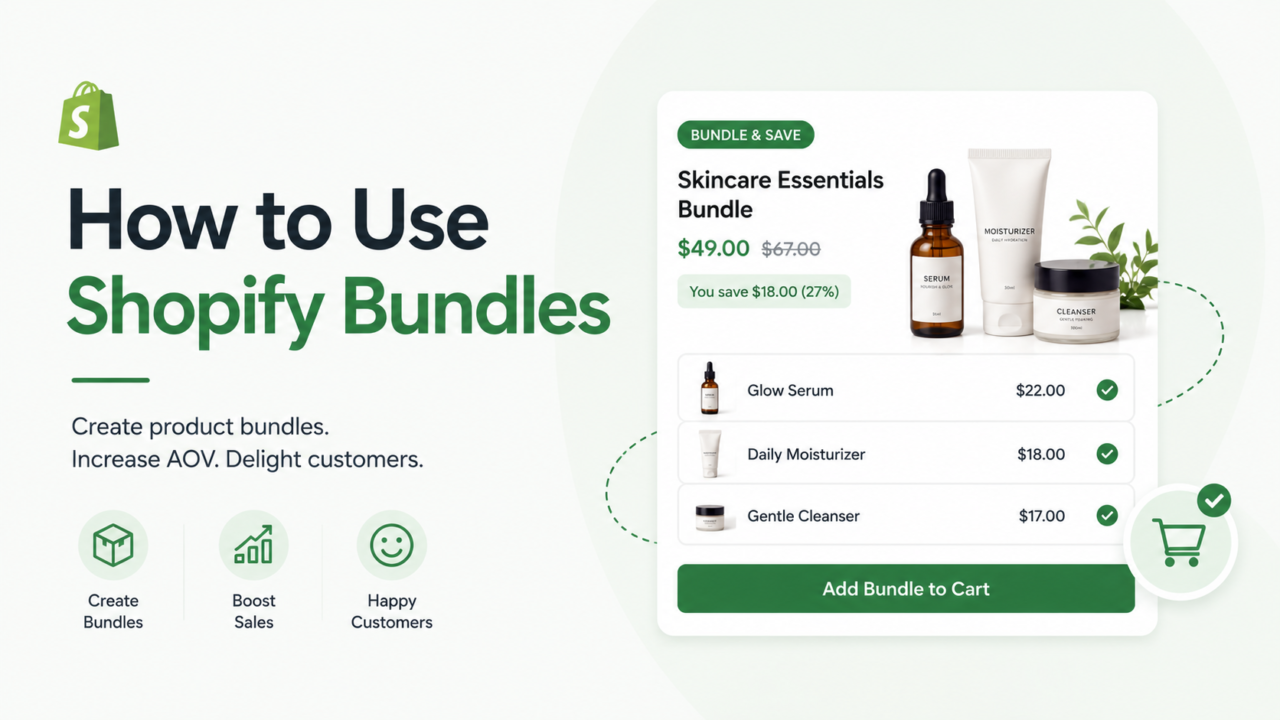
Quick Answer: Shopify bundles raise average order value in four steps. Pick pairs your order data already proves. Price them to protect your margin. Place them where shoppers are ready to buy. Check the numbers every 30 days. Random bundles rarely move AOV. Bundles built on real data do.
Key Takeaways
- The global average order value across all industries sits near $145, based on Shopify’s own 2026 benchmark data.
- A bundle only counts as a win if it raises AOV without wiping out your margin. Check both numbers, not just one.
- Shopify’s free Bundles app builds fixed bundles and multipacks with no coding and no paid third-party tool.
- The three spots that move AOV the most are the product page, the cart, and the post-purchase thank you page.
- Kill a bundle if it does not lift AOV or hurts margin after 30 days of real order data.
Your store gets traffic. People check out. But your average order value has not moved in months.
Bundling fixes this faster than almost any other lever, if you build it the right way. Most stores skip straight to “let’s bundle our best sellers” and wonder why AOV barely moves.
This guide walks through the LIFT Method. It is a simple four-step system for picking, pricing, placing, and tracking Shopify bundles that actually change your AOV number. No app installs required. No guessing. Just the math and the placement that make bundles work.
What Is a Shopify Bundle?
A Shopify bundle is a set of products sold together, usually at one combined price that is lower than buying each item on its own.
Shopify’s own definition backs this up. Shopify says its native bundle feature exists to “increase your average order value.” It does this by offering better product curation and a built-in discount.
Here is the part most guides skip. You do not need to pay for a third-party app to build one. Shopify’s own free Bundles app creates fixed bundles and multipacks straight from your store admin. It syncs inventory in real time. That means you will not oversell a bundle after one item runs out.
A bundle is not the same as a cross-sell or an add-on, even though the terms get mixed up. A cross-sell pairs your product with something from a different category. An add-on is an extra, like a warranty. A bundle groups two or more products under one combined offer, usually at one price.
Behind the scenes, a bundle needs its own SKU. That SKU is not a real product on its own. It is a container that holds two or more items so they check out as one line. Getting this right in your catalog setup matters as much as picking a good discount.
That matters for how you think about this project. The app is not the hard part. The hard part is picking the right pairs. Then pricing them so you still make money. Then putting them where shoppers actually see them. That is the real work, and it is what the rest of this guide covers.
Want a full breakdown of every bundle type, like pure, mixed, discount, and subscription bundles? AcquireX covers that in detail here: Shopify Product Bundle: Best Ways to Increase Revenue. This guide sticks to one job. Using bundles to move your AOV number, with real math behind every step.
Why Bundles Move AOV When You Build Them Right
Bundling works on a simple idea. A customer who was about to spend $40 sees a way to get $55 worth of stuff for $48. Many take the deal.
Here is what that does to your store, beyond the obvious:
- It raises order size without raising ad spend. You already paid to get that shopper to your site. A bundle turns one visit into a bigger order for close to zero extra marketing cost.
- It clears slow-moving stock. Pairing a strong seller with a slower one moves inventory that would otherwise sit on the shelf.
- It cuts decision fatigue. A curated set is an easier “yes” than five separate product decisions. Camping brand BioLite uses this idea well. It bundles a camp stove with the accessories needed to cook a full meal. The customer does not have to research and assemble the kit alone.
- It protects your fulfillment cost per order. Shipping two or three items in one box almost always costs less per item than shipping them separately. Check your numbers in Cost Per Order in Ecommerce before you decide how deep to discount.
You may see a stat floating around that claims a huge share of Amazon’s revenue comes from product recommendations, often credited to McKinsey. We checked this claim against the original source. It does not hold up in the form people quote it. We are leaving it out. The mechanics above already explain why bundles work, and they do not need a shaky stat to back them up.
Bundling vs. Kitting: A Quick Clarification
A bundle and a kit are not the same thing, and this matters if you use a fulfillment partner.
- A bundle ships as-is. The items sit side by side in one order. No extra assembly needed.
- A kit needs a person to physically combine or prep parts before it ships.
Most Shopify bundles are the first kind. If your bundle needs real assembly, treat it as a kitting project instead, and price the extra labor into your margin math. Compare your fulfillment options in 3PL vs. In-House vs. Hybrid Fulfillment before you decide who does that work.
The LIFT Method: A 4-Step Framework
LIFT stands for List, Install, Feature, Track. Each step has one job.
| Step | What You Do | Why It Works |
|---|---|---|
| List | Pull your real “bought together” pairs from order data | Removes guesswork about what belongs in a bundle |
| Install | Price the bundle against your contribution margin, not just the sticker price | Keeps the bundle profitable, not just popular |
| Feature | Place the bundle at three specific high-intent moments | Catches shoppers exactly when they are ready to add more to cart |
| Track | Review AOV and margin per bundle every 30 days | Kills bundles that look good but do not actually move the number |
L: List Your Real Pairs
Skip the guessing. Shopify Reports (under Analytics) shows you which products customers already buy in the same order. Start there.
Look for:
- Products with a high “bought together” frequency in your order history
- A hero product paired with a low-attach-rate accessory that needs a push
- Items that naturally run out at the same time, so restocking them together makes sense to the customer
Sustainable kitchen brand Food Huggers builds bundles this way. It lets real order history point out which of its silicone covers, containers, and bags customers already buy together, then packages those exact combinations.
Avoid pairing products just because they are both “popular.” Two best sellers bundled together often steal sales from each other instead of adding new revenue. The customer would likely have bought both anyway.
I: Install Pricing That Protects Margin
This is the step most stores get wrong. A bundle that feels like a great deal to the customer but erodes your margin is not a win, even if AOV goes up.
Before you set a bundle price:
- Add up the full contribution margin of each item in the bundle, not just the revenue.
- Set a discount that still leaves you profitable per order. A 10 to 20 percent bundle discount is a common starting point. The right number depends on your margin, not on what competitors charge.
- Run the math through Contribution Margin for Ecommerce before you publish the bundle, not after.
A bundle discount should feel generous to the shopper and still be comfortable on your spreadsheet. If it cannot do both, the pairing or the discount needs to change, not your margin target.
F: Feature Bundles at 3 High-Intent Spots
A great bundle that nobody sees does nothing for AOV. Placement decides whether the LIFT Method actually lifts anything.
- The product page. Show the bundle as an upgrade option right where the shopper is already deciding to buy.
- The cart. Shoppers about to check out are the easiest sell for one more item. But cart friction can undo your work here. Review Reduce Abandoned Cart Rate to keep the extra step from causing drop-off.
- The post-purchase page. Right after checkout, a shopper just proved they will spend money. That makes them a strong pick for a one-click bundle offer before the thank you page loads. See Post-Purchase Cross-Sell for the mechanics.
If you only have time for one placement, start with the product page. It reaches every shopper, not just the ones who make it to checkout.
T: Track and Trim Every 30 Days
A bundle is not “set and forget.” Review each one monthly against two numbers:
- Blended AOV impact. Did orders with the bundle actually raise your store-wide average? Or did the bundle just replace sales you would have made anyway?
- Margin per order. Did the discount eat into profit more than the bigger basket made up for?
If a bundle fails both checks after 30 days, cut it. Keeping a bundle live out of habit is the top reason bundle programs stop working after a strong first month.
Let’s Run the Numbers
Here is a simple, worked example so you can see exactly how the math plays out. These are illustrative numbers, not a claimed industry average, so you can swap in your own store’s figures.
Starting point:
- Monthly orders: 2,000
- Current average order value: $58
- Current monthly revenue: 2,000 x $58 = $116,000
After launching a 3-item bundle priced at $72:
- The same 3 items cost $86 bought separately. That is a real deal for the shopper.
- 20 percent of shoppers (400 orders) choose the bundle instead of their usual order.
- The other 80 percent (1,600 orders) keep spending at the normal $58 average.
The new math:
- Orders without the bundle: 1,600 x $58 = $92,800
- Orders with the bundle: 400 x $72 = $28,800
- New total revenue: $92,800 + $28,800 = $121,600
- New AOV: $121,600 ÷ 2,000 orders = $60.80
That is a $2.80 lift per order. That is roughly a 5 percent increase in AOV, from one well-placed bundle. Run this same formula, Total Revenue divided by Number of Orders, on your own numbers before and after launch to see your real lift.
The Free Shipping Threshold Trick
One of the fastest ways to make a bundle sell itself is to price it just above your free shipping threshold.
Here is how it works. Say your free shipping cutoff is $75. Price your bundle at $79. Now the shopper has two reasons to buy instead of one. They get a deal on the bundle. They also unlock free shipping in the same click.
Order minimums are already one of the best ways to raise AOV on their own. Pairing that tactic with a bundle makes both levers stronger.
When NOT to Bundle
Bundling is not the right move for every product or every store. Skip it, or proceed carefully, when:
- Margins are already thin. If an item barely clears profit at full price, a bundle discount can push it into a loss.
- The products have a high return rate. Bundled orders are more complicated to process as returns. Check Ecommerce Returns Management before bundling anything with a return rate above your store average.
- You cannot keep inventory in sync. A bundle that oversells one component breaks trust fast. Make sure your setup matches the guidance in Shopify Inventory Management: Tools & Tips.
- You are mixing digital and physical products. Merchant reviews of Shopify’s own Bundles app describe checkout errors when digital and physical items sit in one bundle. Test this combination with care. Or keep digital and physical bundles separate before you launch at scale.
3 Mistakes That Quietly Kill Bundle AOV
- Measuring the wrong AOV. Looking only at the AOV of orders with the bundle hides the real picture. Check your store-wide blended AOV instead. That is the number that shows if the bundle is actually helping.
- Discounting on gut feel. Picking a round number like “20% off” without checking it against contribution margin is risky. This is how a popular bundle can quietly lose money.
- Launching and forgetting. A bundle that was a hit in month one can fade fast. Products go out of season. Competitors match the offer. Without the Track step, nobody notices until revenue has already dipped.
How AcquireX Handles Bundle Execution
Picking the pairs, running the margin math, and getting bundles live in the right spots takes ongoing attention, not a one-time setup.
This is execution work, not a strategy deck. AcquireX embeds directly into your catalog and marketing operations. We build, test, and manage bundles as part of the day-to-day work, not a project that gets revisited once a quarter. That means someone is watching the 30-day numbers. And someone is killing what does not work, instead of letting a bundle sit untouched for six months.
See how this fits into ongoing catalog work in Catalog Management Services for Ecommerce. Or see how bundle promotion connects to paid and organic growth in Performance Marketing & Growth.
FAQ
What is a good average order value for a Shopify store?
It depends on your category. Shopify’s 2026 data puts the global average near $145. Luxury and jewelry often run above $300. Apparel runs between $40 and $170. Beauty and personal care runs between $15 and $90. Compare your AOV to your own category, not the global number.
Do I need a paid app to create bundles on Shopify?
No. Shopify’s own free Bundles app builds fixed bundles and multipacks directly from your admin, with real-time inventory sync and no coding required.
How much should I discount a Shopify bundle?
Enough to feel like a real deal to the shopper. But not so much that it drops below your target contribution margin. A 10 to 20 percent discount is a common starting point. The right number comes from your own margin math, not a fixed rule.
Where should I place bundles for the biggest AOV lift?
Start on the product page, since it reaches every visitor. Add the cart and the post-purchase page next, since both catch shoppers who have already decided to buy.
Can I bundle digital and physical products together on Shopify?
Proceed carefully. Merchant reviews of Shopify’s native Bundles app report checkout errors when digital and physical items are mixed in one bundle. Test this setup before launching it broadly.
How often should I review a bundle’s performance?
Check blended AOV and margin every 30 days. Cut any bundle that fails to lift AOV or that hurts margin once you have a full month of real order data.