Quick answer: Ecommerce sales enablement gives the people and systems that touch customers the content, tools, data and processes to convert visitors, grow order value and win repeat purchases. For DTC brands it powers pre-sale chat, lifecycle messaging and retention; for B2B ecommerce it adds account management, reorders and expansion. Measure it on conversion, average order value, repeat rate and customer lifetime value.
Most sales enablement guides are written for SaaS companies with field sales reps, long deal cycles and quota-carrying account executives. Ecommerce is different. Much of the “selling” happens on product pages, in chat windows, in post-purchase emails and in reorder flows. Yet growing ecommerce brands, especially those with wholesale, B2B or high-consideration products, increasingly have humans in the loop too: live-chat advisors, inside sales reps handling bulk quotes, account managers for wholesale buyers, and customer service agents who can save or lose a repeat customer in one reply.
This guide adapts sales enablement to ecommerce. It covers what enablement means for DTC and B2B stores, the content and playbooks that move each stage of the customer lifecycle, account growth and retention programmes, the tools and processes that hold it together, how to structure the team, and which metrics prove it is working.
What is sales enablement in ecommerce?
Ecommerce sales enablement is the system that equips everyone who influences a purchase, whether a person or an automated flow, with the right information at the right moment to turn traffic into first orders and first orders into repeat revenue. It combines four building blocks:
- Content: product knowledge, comparison guides, objection-handling scripts, sizing and compatibility answers, case studies and B2B sales collateral.
- Tools: CRM, helpdesk, live chat, email and SMS platforms, B2B ordering portals and analytics.
- Process: playbooks for each lifecycle stage, lead routing, follow-up cadences, account reviews and handoffs between marketing, sales and service.
- People: trained chat advisors, inside sales reps, account managers and service agents who know the catalogue and the customer.
In SaaS, enablement mostly serves sales reps. In ecommerce, it serves a wider group: the storefront itself, lifecycle marketing, customer service and, for B2B or high-ticket brands, a sales and account management team.
Why does sales enablement matter for ecommerce brands?
Acquisition costs keep rising on most paid channels, so profit increasingly depends on what happens after the click. Sales enablement improves the economics of every visitor you already pay for.
- Higher conversion on existing traffic: visitors who get fast, accurate answers to pre-purchase questions are more likely to buy.
- Larger orders: trained advisors and well-placed recommendations raise average order value through relevant bundles and add-ons.
- More repeat purchases: structured post-purchase and reorder programmes turn one-time buyers into customers with real lifetime value.
- Consistent messaging: every channel, from product page to support reply to sales email, tells the same story about your products.
- Better LTV to CAC: enablement raises the value side of the ratio that decides how much you can afford to spend on acquisition. See our guide to the LTV to CAC ratio for ecommerce for how to calculate it properly.
How is DTC sales enablement different from B2B ecommerce sales enablement?
The principles are the same, but the buyer, the order and the sales motion are different. Most brands that sell both need two playbooks.
| Dimension | DTC ecommerce | B2B ecommerce and wholesale |
|---|---|---|
| Buyer | Individual consumer, fast decisions | Business buyer, often several stakeholders |
| Main sales touchpoints | Product pages, live chat, email and SMS, support | Sales reps, quotes, ordering portal, account managers |
| Order pattern | Smaller orders, emotional and convenience triggers | Larger, recurring orders, contract or tiered pricing |
| Key enablement content | Product guides, comparisons, reviews, chat macros, size and use advice | Catalogues, price sheets, spec sheets, case studies, onboarding guides |
| Growth lever | Repeat purchase rate, subscriptions, loyalty | Account expansion, reorder frequency, share of wallet |
| Core metrics | Conversion rate, AOV, repeat rate, LTV | Reorder rate, account revenue growth, win rate, net revenue retention |
What content does an ecommerce sales enablement programme need?
Content is the foundation of enablement. Organise it by lifecycle stage, so every person and flow knows what to use when. Build it from real customer questions found in chat logs, support tickets, reviews and sales calls, not from guesses.
Pre-purchase: help the shopper decide
- Product knowledge base: features, materials, compatibility, care, warranty
- Comparison guides between your own products and against common alternatives
- Objection-handling answers for price, shipping time, returns and quality concerns
- Live-chat macros that are accurate but can be personalised
- For B2B: line sheets, price tiers, minimum order rules, sample policies, spec sheets
Purchase: reduce friction and grow the basket
- Bundle and add-on recommendations with the reason they belong together
- Checkout-assist scripts for payment, shipping and discount questions
- For B2B: quote templates, approval workflows and payment-term explanations
Post-purchase: create the second order
- Onboarding and how-to-use content that helps customers succeed with the product
- Replenishment reminders timed to real usage cycles
- Cross-sell sequences based on what the customer actually bought; our guide to ecommerce email marketing flows covers the core automations
- Review and referral requests sent at the moment of satisfaction
Retention and expansion: grow the account
- Loyalty and VIP programme scripts and benefits explanations
- Win-back offers and messaging for lapsing customers
- For B2B: quarterly business review templates, new-product introductions, reorder reports
Give every asset an owner, a last-reviewed date and a usage metric. Retire content that is not used or does not help close.
How do you turn first-time buyers into repeat revenue?
Repeat revenue is where ecommerce enablement pays off most. The second purchase is the hardest one to win, so design the first 60 to 90 days of the customer relationship deliberately.
- Deliver the first experience flawlessly. Accurate listings, fast shipping updates and proactive service reduce regret and returns.
- Teach customers to get value. Usage tips and setup guidance increase satisfaction and reduce “it didn’t work for me” churn.
- Time the next offer to the product cycle. A replenishment reminder or complementary product works best when it matches real usage.
- Make reordering effortless. One-click reorder, subscriptions and saved carts remove friction.
- Use service conversations as sales moments. A support agent who resolves an issue and then recommends the right accessory is doing enablement.
- Reward loyalty meaningfully. Benefits that matter to your best customers, not just points; see our ecommerce loyalty program guide.
For a full playbook on the second order, read how to turn first-time buyers into repeat customers.
How does account growth work for B2B and wholesale ecommerce?
For brands that sell to retailers, distributors, offices or other businesses, the biggest growth opportunity usually sits inside accounts you already have. Account growth has three levers: buy more of the same (volume and frequency), buy more lines (cross-sell into your catalogue), and buy in more places (new locations, departments or buyers within the same customer).
A practical account growth process
- Segment accounts by revenue, growth potential and health, and give each priority account a named owner.
- Map whitespace: which product lines each account buys and which relevant lines they do not.
- Watch reorder signals: overdue reorders, shrinking order sizes or a change in buyer are early warnings.
- Run regular account reviews focused on the customer’s goals: sell-through, stock levels, new launches.
- Make self-service easy through a B2B portal with account pricing and quick reorder, while routing larger opportunities to a rep.
- Follow up consistently. Most account growth is lost to forgotten follow-ups, not to competitors.
This is exactly where a dedicated team helps. AcquireX’s sales enablement and account growth service plugs a trained sales team into your business to manage follow-ups, upsell and cross-sell, CRM hygiene and account reporting across D2C, marketplace and B2B channels, working as an extension of your own team.
Which tools does ecommerce sales enablement require?
Tools should serve the process, not the other way round. Most brands already own much of what they need and simply under-use it.
| Tool category | Role in enablement | What to configure |
|---|---|---|
| CRM | Single view of customers and accounts, pipeline, follow-ups | Purchase history sync, account owners, tasks, deal stages for B2B |
| Helpdesk and live chat | Pre-sale and post-sale conversations | Macros, order lookup, tagging of sales opportunities, revenue attribution |
| Email and SMS platform | Lifecycle automation at scale | Welcome, post-purchase, replenishment, win-back, VIP segments |
| Knowledge base or content hub | Single source of truth for product and sales content | Owners, review dates, search, version control |
| B2B ordering portal | Self-service wholesale ordering | Account pricing, quick reorder, payment terms, rep routing |
| Analytics and BI | Measurement of enablement impact | Cohort repeat rates, AOV by channel, chat conversion, account growth |
If your team is copying orders into the CRM by hand or chasing follow-ups from memory, automate those steps before adding headcount.
What processes make sales enablement work day to day?
- Lifecycle playbooks: written steps for each stage, with triggers, owner, message and channel.
- Lead and opportunity routing: rules for when a chat, a quote request or a large cart is passed to a person.
- Service-to-sales handoff: a simple way for support agents to flag upsell or B2B opportunities.
- Follow-up cadences: how many touches, how far apart and on which channels, especially for quotes and lapsing accounts.
- Weekly enablement review: top questions, lost-sale reasons, content gaps and new launches.
- Quarterly content audit: keep, update or retire every asset based on use and impact.
- Sales and marketing alignment: shared definitions of a qualified lead, a repeat customer and an at-risk account.
How should you structure an ecommerce sales enablement team?
Team structure depends on your sales motion. Start lean and add roles as volume justifies.
| Role | Responsibilities | When you need it |
|---|---|---|
| Enablement or sales operations lead | Owns playbooks, content, tools, training and reporting | Once more than a few people touch customers |
| Live-chat and pre-sales advisors | Answer product questions, guide purchases, recommend bundles | High-consideration or technical products |
| Inside sales representative | Handles quotes, bulk orders, inbound B2B leads | Wholesale, corporate gifting or bulk demand |
| Account manager | Grows and retains priority B2B accounts | Recurring wholesale or retail accounts |
| CRM and lifecycle specialist | Builds segments, automations and reports | As email, SMS and CRM complexity grows |
| Customer service agents (enablement-trained) | Resolve issues and spot sales opportunities | Always; they speak to more customers than anyone |
Many brands combine a small in-house leader with a dedicated offshore team for chat, inside sales, CRM upkeep and account follow-ups. Before deciding, compare the options in our guide to sales team outsourcing costs and benefits.
How do you train an ecommerce sales team?
- Product immersion first: every person should be able to explain the top products, their differences and their limits.
- Customer and persona training: who buys, why, and what objections they raise.
- Role-play real conversations: use actual chat transcripts and sales calls, good and bad.
- Certification before going live: a short test on products, policies and tools.
- Weekly coaching: review a sample of conversations against a simple quality scorecard.
- Launch briefs: a one-page brief and short training for every new product or promotion.
Which metrics prove ecommerce sales enablement is working?
Measure enablement on revenue outcomes, supported by activity and adoption metrics that explain the results.
| Metric type | Examples |
|---|---|
| Conversion | Site conversion rate, chat-assisted conversion rate, quote-to-order rate |
| Order value | Average order value, attach rate of add-ons and bundles |
| Retention | Repeat purchase rate, time to second order, subscription retention, churn |
| Account growth (B2B) | Revenue per account, reorder frequency, product lines per account, net revenue retention |
| Lifetime value | Customer lifetime value by cohort, LTV to CAC ratio |
| Team and content | Response time, follow-up completion, content usage, ramp time for new hires |
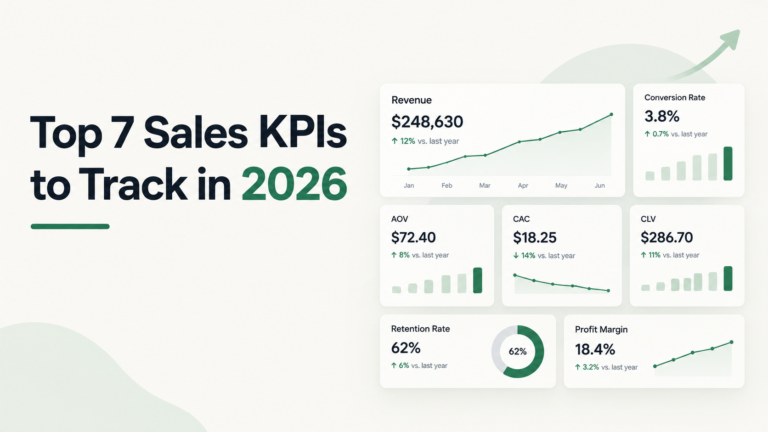
For formulas and benchmarks to set targets, see our list of sales KPIs to track.
What are common ecommerce sales enablement mistakes?
- Copying a SaaS enablement model built for field sales instead of designing for chat, lifecycle and accounts.
- Producing content nobody uses because it was not built from real customer questions.
- Treating customer service as a cost centre rather than a revenue touchpoint.
- Buying tools before defining the process they should support.
- Measuring activity (emails sent, calls made) instead of repeat revenue and account growth.
- No owner for follow-ups, so quotes and reorders quietly lapse.
How do you launch a sales enablement programme in 90 days?
Days 1 to 30: diagnose
Audit conversion, AOV, repeat rate and account revenue trends. Mine chat logs, tickets and reviews for the top questions and objections. Map current content and tools. Pick one stage to fix first, usually the one with the biggest drop-off.
Days 31 to 60: build
Create the core content for that stage, write the playbook, configure the CRM and helpdesk, and train the team. For B2B, segment accounts and assign owners.
Days 61 to 90: run and measure
Go live, review weekly, coach on real conversations and track the agreed metrics. Then expand to the next lifecycle stage.
What is the bottom line on ecommerce sales enablement?
Ecommerce sales enablement turns paid traffic into profitable, repeat revenue by giving every customer touchpoint, from product page to chat to account manager, the right content, tools, process and training. Start with the biggest drop-off in your customer lifecycle, build from real customer questions, measure on repeat revenue and account growth, and add people where conversations drive sales.
Want a sales team that owns follow-ups, upsells and account growth for you? Explore AcquireX’s sales enablement and account growth services, or book a call and we will review your funnel, identify where revenue is leaking and show how a dedicated team in Pune would plug it.
Frequently asked questions
What does sales enablement mean for an online store?
For an online store, sales enablement means equipping product pages, chat advisors, lifecycle emails, support agents and any sales reps with the content, tools and processes they need to convert visitors and win repeat orders. It connects marketing, sales and service around the customer lifecycle.
Do DTC brands need sales enablement if they have no sales team?
Yes. DTC brands still sell through chat, email, SMS and customer service. Enablement makes those touchpoints accurate and persuasive, with consistent product knowledge, objection handling and post-purchase playbooks, even if no one carries a sales quota.
What is the difference between sales enablement and sales operations?
Sales enablement focuses on equipping people with content, training and playbooks so they sell more effectively. Sales operations focuses on the systems, data, territories and reporting that run the sales function. In smaller ecommerce teams, one person often owns both.
Which tools are essential for ecommerce sales enablement?
The essentials are a CRM with purchase history, a helpdesk with live chat, an email and SMS platform for lifecycle automation, a knowledge base for product content, and analytics for cohort and account reporting. B2B sellers also need an ordering portal with account pricing.
How do you measure the ROI of sales enablement in ecommerce?
Track changes in conversion rate, average order value, repeat purchase rate, customer lifetime value and, for B2B, revenue per account and reorder frequency. Compare cohorts or periods before and after enablement changes, and weigh the gain against content, tool and team costs.
How does customer service support sales enablement?
Customer service agents talk to more customers than anyone else. When trained on products and given clear guidance, they can save at-risk orders, recommend the right add-ons and flag B2B or bulk opportunities, turning support into a revenue touchpoint.
Can sales enablement be outsourced?
Yes. Many brands keep strategy and pricing in-house and use a dedicated outsourced team for chat sales, inside sales, CRM management, follow-ups and account reporting. The key is a team that works only on your brand, inside your tools, against agreed revenue metrics.
How long does it take to see results from sales enablement?
Quick wins such as better chat answers and follow-up discipline can show up within weeks. Repeat purchase and account growth improvements take longer because they depend on customer buying cycles, so measure them over several months by cohort.