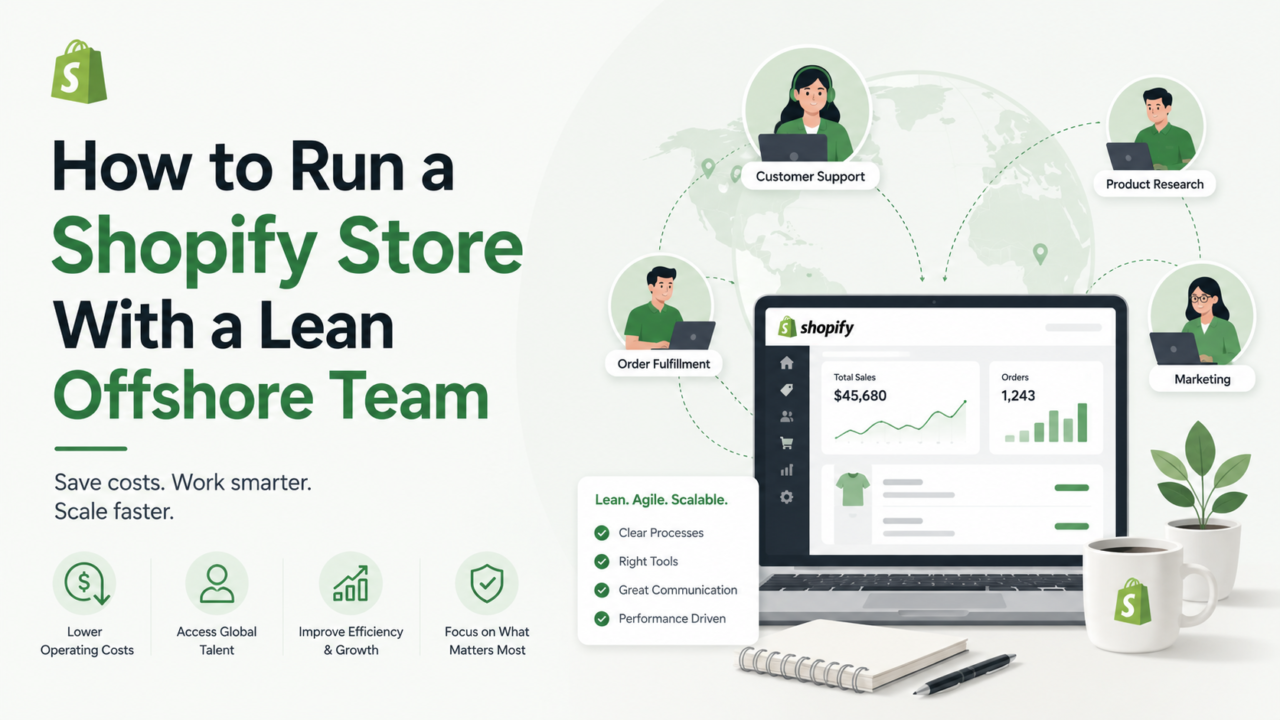
You don’t need 12 people to run a great Shopify store. You need the right 4.
Most founders think a “lean team” means doing everything themselves. It doesn’t. A lean offshore team is small, focused, and built around the jobs that actually move revenue. Support answered fast. Orders shipped on time. A catalog that doesn’t rot. Ads checked daily, not monthly.
This guide gives you the exact four roles, what each one owns, the real cost math, and a daily rhythm that works across time zones. No fluff.
Quick Answer
How many people does it take to run a Shopify store with a lean offshore team? Four. A Store Operator, a Customer Support Rep, a Catalog Specialist, and an Ads Specialist. We call it the SCAN Model. For most brands doing $30K to $150K a month, those four seats cover the whole operation.
Table of Contents
- What “Lean” Actually Means
- The SCAN Model: Your 4 Core Seats
- What This Actually Costs (Real Math)
- How to Split the Workday Across Time Zones
- The Tool Stack That Keeps It Simple
- A Real Week, Broken Down
- What to Keep In-House
- Common Mistakes
- Your 30-Day Rollout Plan
- FAQs
What “Lean” Actually Means (It’s Not “Cheap”)
Lean does not mean underpaid or undertrained. Lean means no waste.
A lean offshore team has:
- One person per critical job, not five people half-covering everything
- Clear ownership, so nothing falls between two people who both assumed the other had it
- A short daily rhythm instead of long weekly meetings
- Tools that talk to each other, not five spreadsheets that don’t
If your “team” is one overworked assistant doing support, ads, and catalog updates all at once, that’s not lean. That’s understaffed. There’s a real difference between a virtual assistant and a dedicated team, and most founders learn it the expensive way.
Lean is a small team where every seat has a real job.
The SCAN Model: Your 4 Core Seats
SCAN is how we structure lean offshore teams for Shopify brands. Four seats. Four owners. Nothing overlapping.
- S = Store Operator
- C = Customer Support
- A = Assets (catalog and content)
- N = Numbers (ads and analytics)
It also works as a verb. Every day, someone should be scanning each of those four areas. Here’s how each seat breaks down.
S: Store Operator
This person is your day-to-day glue. They check orders. They fix inventory mismatches. They update product pages and manage discount codes. They catch anything broken on the site before a customer finds it first.
What they own:
- Daily order and fulfillment checks
- Inventory sync between your warehouse and Shopify
- Product page edits and price updates
- Basic troubleshooting when the storefront breaks
Inventory is where this seat pays for itself. Overselling a SKU costs you a refund, a bad review, and a customer. If your stock counts drift, start with the basics of Shopify inventory management and give one person permanent ownership of it. Shopify’s own guide to inventory management is a solid primer for setting the baseline.
C: Customer Support
Support is the seat brands underpay the most. And they regret it fastest. A slow reply to a shipping question turns into a chargeback. A cold reply turns a five star review into a one star review.
What they own:
- Email and chat replies, ideally under a 2 hour window during business hours
- Return and refund handling based on your written policy
- Flagging repeat complaints back to you before they become a pattern you missed
Support is not a cost center. It’s a retention channel, and Shopify’s own research on the benefits of good customer service backs that up. Track the support KPIs that actually predict retention instead of just counting closed tickets. If you’re weighing whether to hand this off, here’s a deeper look at outsourcing ecommerce customer support.
A: Assets (Catalog and Content)
Your catalog is either quietly making you money or quietly costing you money. Bad titles hurt. Missing alt text hurts. Thin descriptions and stale images hurt too. All of it drags down conversion rate and search visibility at the same time.
What they own:
- Product titles, descriptions, and SEO metadata
- Image and alt text updates
- Bundle and cross-sell copy on product pages
- Keeping the catalog clean as you add SKUs
Most stores have a slow catalog leak they’ve never measured. Catalog enrichment is one of the cheapest conversion levers you own, because you’re improving pages that already get traffic.
N: Numbers (Ads and Analytics)
Someone needs to open your ad account every single day, not once a week. Small daily adjustments beat big monthly overhauls.
What they own:
- Daily spend and ROAS checks across Meta and Google
- Pausing losing ads before they burn budget
- Weekly reporting in plain numbers, not jargon
This seat should also watch the leaks downstream of the click. A great ad that lands on a page with a high cart abandonment rate is just an expensive way to lose money.
That’s four people. Not twelve. Not two. Four, each with one job they’re actually good at.
What This Actually Costs (Real Math)
Here’s the part most articles skip. They talk about “cost savings” and never show a single number.
Below is a planning model, not a price list. Use your own quotes. But the shape of the math holds up across most brands.
The setup: four seats, covering store ops, support, catalog, and ads.
| Model | Typical monthly range | What you actually get |
|---|---|---|
| 4 US in-house hires | Highest cost by a wide margin | Full control, but salaries plus payroll taxes, benefits, software seats, and PTO coverage. Slow to hire, slow to replace. |
| 3 to 4 agencies | High and fragmented | Each agency owns a slice. Nobody owns the outcome. You become the project manager. |
| 4 freelancers | Looks cheapest | No coverage when someone disappears. No shared context. You re-explain everything, constantly. |
| 1 dedicated offshore team | Meaningfully lower than US in-house | One team, one point of accountability, overnight coverage built in. |
Two things worth understanding before you compare quotes.
1. Salary is not the real number. A US hire’s true cost includes payroll taxes, benefits, equipment, software seats, and the cost of covering them when they’re out. The real US labor costs for D2C brands are usually well above the number on the offer letter.
2. The hidden cost is your own time. Managing four freelancers across four tools is a part-time job. If you’re spending 10 hours a week coordinating vendors, that’s 10 hours you’re not spending on product, brand, or growth. Price that in. Most founders don’t, and it’s why “cheap” setups end up costing the most.
Here’s a simple way to think about it:
True cost = what you pay + what you pay to manage what you pay for.
That second half is where the operational savings from outsourcing actually come from. It isn’t just a lower rate. It’s not having to run five vendors yourself.
How to Split the Workday Across Time Zones
This is where most lean teams fall apart. Not because the people are bad, but because nobody planned the handoff.
Say your offshore team runs roughly 9 to 12 hours ahead of US time.
- Their morning covers your overnight. Orders placed while you slept get processed. Tickets from West Coast night owls get answered before your breakfast.
- Keep a 30 minute live overlap. This is where the real talk happens. Pick a window both sides can show up for. It might be early for one side and late for the other. That’s fine.
- Default to async. A 5 line daily update in Slack beats a 45 minute call nobody prepped for. Save live calls for actual decisions.
The goal isn’t a team available 24/7. That burns people out fast. The goal is that the handoff between “your day” and “their day” never drops a ball.
The handoff rule: every task has an owner, a status, and a next action written down before the day ends. If a US morning starts with “wait, what happened last night,” the handoff failed.
The Tool Stack That Keeps It Simple
You don’t need 15 apps. You need a few that actually talk to each other.
- One shared task board. Asana, ClickUp, or even Trello. Nothing should live only in someone’s head.
- One support inbox. Gorgias or Zendesk. Not tickets scattered across email, Instagram DMs, and WhatsApp.
- One reporting view. Shopify’s native reporting plus one clean dashboard. Not five overlapping analytics tools.
- One home for SOPs. Notion works. A new hire should get up to speed without pinging five people.
If you’re stacking apps because they showed up on a “best Shopify apps” list, you’re buying cost and confusion, not value. Every tool should answer one question: what does this replace, and is it faster than what we had?
Worth doing a hard pass on this. Here’s how to decide what to keep and what to cut from your Shopify app stack.
A Real Week, Broken Down
Here’s what a lean offshore team’s week actually looks like once it’s running.
Monday. Store Operator clears the weekend order backlog. Support empties the Saturday and Sunday ticket queue. Ads Specialist reviews weekend spend before Monday budgets reset.
Tuesday to Thursday. Normal rhythm. Daily order checks. Daily ticket replies. Daily ad checks. Catalog Specialist works a standing list of product pages that need fixing.
Friday. Weekly numbers get pulled. Ads Specialist sends a plain-language summary. Store Operator flags any inventory running low before the weekend.
Weekend. A lighter support check-in so tickets don’t sit for 48 hours. Weekends are often peak order volume for D2C brands. Someone should still be watching.
Notice what’s missing. No daily status meeting eating an hour of everyone’s time. No confusion about who owns what. Four people, four clear jobs, one short daily sync.
What to Keep In-House
A lean team doesn’t mean handing off everything. Some things stay with you, at least early on.
- Brand voice and big creative calls. An offshore team can execute your brand voice beautifully once it’s defined. They shouldn’t be defining it from scratch.
- Pricing and margin strategy. Day-to-day discount codes, sure. Your overall pricing architecture is a founder call.
- Supplier and vendor relationships, especially anything involving contracts or payment terms.
- Final sign-off on big public moves, like a site redesign or a major campaign launch.
The model works because it separates execution from strategy. Your team executes fast and well. You keep the calls that shape where the brand is going.
Common Mistakes That Turn “Lean” Into “Chaotic”
Hiring one generalist instead of four specialists. One person doing support, catalog, and ads will do all three worse than one person doing one of them well.
No written SOPs. If a process only lives in someone’s head, it dies the day they’re sick. Every core task needs a simple written step-by-step. Shopify’s SOP template guide is a fine starting point, and we’ve written a deeper playbook on ecommerce SOPs for remote teams.
Treating async updates as optional. A team split across time zones lives or dies on clear writing. Vague updates mean mistakes pile up while you sleep.
Adding people before adding structure. More headcount without clear ownership just creates confusion faster. Fix structure first. Add people second.
Skipping the overlap window. Twenty minutes of live overlap catches problems that async messages miss. Cutting it to save time usually costs more time later.
Going offshore too late. Most founders wait until they’re drowning. The right moment is earlier than it feels. Here’s how to tell when to outsource ecommerce operations.
Your 30-Day Rollout Plan
You don’t build this in a weekend. You build it in a month, in this order.
Week 1: Map the chaos. Write down every recurring task in your store and who does it today. Most founders find 30 to 50 tasks, and that most of them have no real owner.
Week 2: Write the four role docs. One page per SCAN seat. What they own, what “done” looks like, and which numbers they’re responsible for. If you can’t write it down, you can’t hand it off.
Week 3: Document the top 10 SOPs. Not all 50. Just the ten tasks that happen most often. Loom videos count. Perfect documents are not the goal. Usable ones are.
Week 4: Onboard and set the rhythm. Start the daily async update. Lock in the 30 minute overlap window. Run the first weekly report. Then leave it alone long enough to actually work.
Expect the first two weeks after onboarding to feel slower, not faster. That’s normal. You’re paying a setup cost once so you stop paying a chaos tax every week.
If you’re still choosing a partner, here’s how to choose an ecommerce outsourcing partner without getting burned.
Frequently Asked Questions
How many people do I need to run a Shopify store offshore?
Four. A store operator, a customer support rep, a catalog specialist, and an ads specialist. That’s the SCAN Model, and it covers most stores doing $30K to $150K a month. Larger stores add depth to those seats before adding new ones.
Is a lean offshore team cheaper than a US based team?
Usually yes, but cost isn’t the biggest win. Coverage is. A team working while you sleep means orders, tickets, and ad checks aren’t sitting untouched for 8 to 10 hours overnight.
Can one person handle multiple SCAN seats?
Early on, sometimes, out of necessity. It’s a stopgap, not a strategy. Combining seats long term usually means each one gets done at 60 percent instead of 100 percent.
What’s the biggest risk with a lean offshore team?
Unclear ownership. If nobody knows exactly who owns a task, it gets done twice or not at all. Clear seats with clear jobs prevent this.
Do I need daily meetings to manage an offshore team?
No. A short daily async update plus one live overlap window beats long daily calls. Save real-time meetings for decisions that need a conversation.
How is this different from hiring an agency?
An agency owns a task. A dedicated team owns an outcome. With three agencies you’re the project manager stitching them together. Here’s the full breakdown of a dedicated ecommerce team vs an agency.
When should I add a fifth person?
When one SCAN seat is consistently at capacity and the numbers show it. Usually support goes first as order volume climbs, then catalog as your SKU count grows. Add depth to an existing seat before inventing a new one.
What happens when the store grows past this model?
The SCAN seats stay, but each one becomes a small pod instead of one person. That’s the transition point where brands start rebuilding their whole operating system. We covered that shift in our guide to scaling a Shopify brand from 7 to 8 figures.
Stop Patching Together Freelancers. Build a Real System.
Running a Shopify store with a lean offshore team isn’t about doing less. It’s about doing the right things, with the right people, in the right order.
If you’re currently juggling three freelancers, a part-time VA, and a support tool nobody fully set up, that’s not lean. That’s a system waiting to break.
AcquireX builds dedicated offshore ecommerce teams for Shopify brands. Not a rotating cast of freelancers. One embedded team that owns customer service, catalog management, and performance marketing end to end, so you can focus on growth instead of managing five vendors.