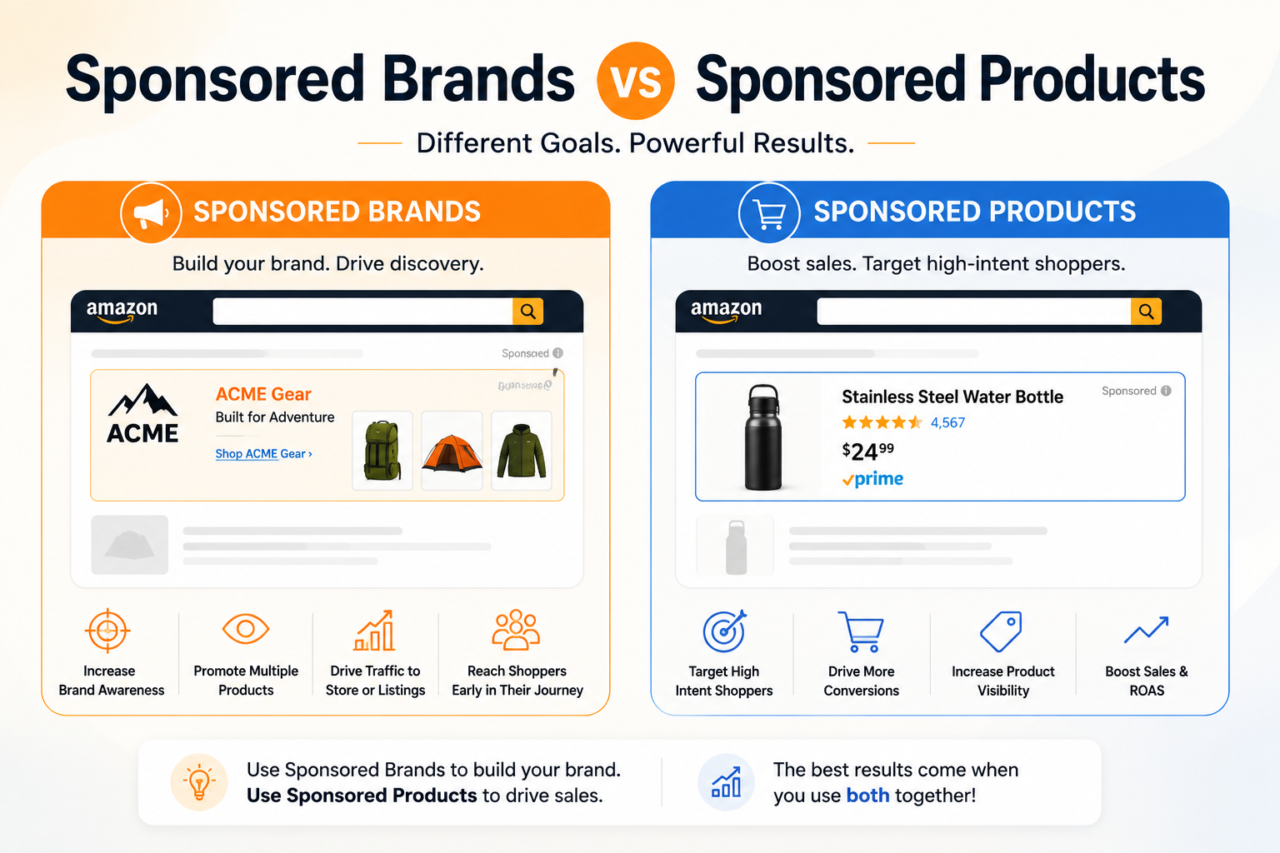
Quick Answer: Sponsored Products should carry most of your Amazon ad budget because it reaches shoppers who are ready to buy. Sponsored Brands earns budget for two jobs: defending your brand name in search, and bringing in buyers who have never bought from you. Most sellers do not need a bigger budget. They need to move money out of weak Sponsored Products keywords into those two jobs. In the worked example below, that move added about $4,900 in monthly profit on the same $30,000 spend.
One thing to know before you read further. Amazon changed Sponsored Brands in ways most published guides have not caught up with. You can now buy it three different ways, not just by the click. That changes the budget math, and we cover it below.
Key Takeaways
- Sponsored Products (SP) appears inside search results and product pages. It captures demand that already exists.
- Sponsored Brands (SB) appears in prominent spots like the top of search. It creates and defends demand.
- SP needs a Professional selling plan and Featured Offer eligibility. SB needs Brand Registry.
- SB now supports three pricing models: cost per click, cost per thousand viewable impressions, and a fixed upfront option that reserves your top of search spot.
- Both formats now support video. Most guides still say only SB does.
- Judging SB by its own ACoS will make you cut it too early. Amazon says so itself.
- Use the SPLIT test below instead of copying somebody else’s percentage split.
Why Does This Question Cost Sellers So Much Money?
Here is the pattern we see on almost every account audit.
The seller has one Sponsored Products campaign that works. It has run for two years. It eats the entire budget. Sponsored Brands is either switched off or running a banner nobody has touched since 2023.
Meanwhile a competitor bids on their brand name. Shoppers type in the brand, see a rival at the top, and click it. The seller pays nothing for that click. They just lose the sale.
That is the real cost. Not a bad ad. A missing one.
The opposite mistake costs just as much. A seller reads about “full funnel,” pushes 40 percent of budget into Sponsored Brands, and sends premium priced traffic to a listing with nine reviews.
Both mistakes come from treating this as a preference instead of a math problem.
What Do Most Guides Get Wrong About These Two Ad Types?
We checked the top ranking articles for this topic against Amazon’s own current documentation. Four claims that appear on page one of Google are out of date or simply wrong.
Claim 1: “Sponsored Brands only supports keyword targeting.”
Not true. Amazon lists both keyword and product targeting for Sponsored Brands. Product targeting puts your banner against specific competitor ASINs and categories. That is how conquesting campaigns get built.
Claim 2: “Only Sponsored Brands has video.”
Also outdated. Sponsored Products supports video creative too. Amazon ran its own US test between August and October 2025. Campaigns with video averaged a 9 percent lift in click through rate. That is a first-party number, not an agency estimate.
Claim 3: “Sponsored Products only shows on Amazon.”
Amazon says Sponsored Products ads also run on select premium apps, other Amazon owned sites, and third-party sites. Your SP budget already buys off-Amazon reach, whether you planned for it or not.
Claim 4: “Sponsored Brands is a cost per click ad.”
This is the biggest gap. Sponsored Brands now supports three pricing models, and the choice changes your entire budget strategy. More on that next.
Why does this matter for a budget decision? Because if your picture of these two formats is two years old, your split is tuned for a product that no longer exists.
How Do You Actually Buy Sponsored Brands Now?
Amazon ties Sponsored Brands pricing to your campaign goal. Three options:
| Goal | You pay by | Best for |
|---|---|---|
| Drive page visits | Cost per click (CPC) | Traffic to your Brand Store or product pages |
| Grow brand impression share | Cost per 1,000 viewable impressions (vCPM) | Category visibility when clicks are not the point |
| Reserve share of voice | Fixed price agreed upfront | Locking your top of search spot on your own brand terms |
Three things worth knowing:
- CPC and vCPM campaigns have no minimum spend. You can start small.
- Reserve share of voice does require a minimum spend commitment, so it is not an entry level option.
- Reserve share of voice is the cleanest answer to competitor brand bidding. Instead of fighting a daily auction on your own name, you buy the placement at a known price.
That last point is genuinely new strategy. Every competitor guide tells you to “run a brand defense campaign and bid aggressively.” Amazon now sells you the placement directly. For a brand with real search volume on its own name, that is worth pricing out.
What Is the Real Difference Between the Two?
Strip the jargon. Here is the honest comparison, checked against Amazon’s current product pages.
| Factor | Sponsored Products | Sponsored Brands |
|---|---|---|
| Promotes | One product listing | Your brand plus products, or video |
| Placement | In search results, on product pages, and off Amazon | Prominent spots like top of search and product pages |
| Who can run it | Professional sellers, vendors, book vendors, KDP authors, agencies | Same groups, but sellers must be in Brand Registry |
| Listing requirement | Must be eligible for the Featured Offer | No Featured Offer requirement |
| Auto targeting | Yes | No |
| Targeting | Keyword and product | Keyword and product |
| Video | Yes | Yes |
| Pricing models | CPC | CPC, vCPM, or fixed reserve |
| Landing page | Product detail page | Brand Store or product detail page |
| Typical direct ACoS | Lower | Higher |
| Core job | Convert demand | Create and defend demand |
The row that matters most is the second to last one.
Sponsored Products almost always shows a better ACoS. That is not because it is a better ad type. It is because it targets people further along in their decision. You are taking credit for a sale that was already close to happening.
Sponsored Brands looks worse for the same reason in reverse. It reaches people earlier, so fewer clicks convert on the spot.
Rank ad types by ACoS and Sponsored Products wins every time. That is exactly why so many sellers cut Sponsored Brands and then wonder why growth stalled.
You do not have to take our word for this. Amazon says this in its own Sponsored Brands documentation. Winning a first-time buyer usually costs more than winning a repeat one. So ACoS and ROAS alone will not capture what Sponsored Brands does for your brand. That is the platform telling you its own headline metric is the wrong scorecard here.
Which Ad Type Actually Helps Your Organic Ranking?
This is the question sellers ask second and almost no comparison article answers. It matters most during a launch.
Here is the mechanism as experienced operators understand it. Amazon does not publish its ranking algorithm, so treat this as informed consensus rather than documented fact.
- A shopper searches a keyword, clicks your Sponsored Products ad, and buys.
- That sale gets attached to both the search term and your product listing.
- Amazon reads that as evidence your product is a good answer for that keyword.
- Repeat it enough and your organic position for that keyword improves.
Sponsored Products feeds this loop directly, because every click lands on a product detail page.
Sponsored Brands is different. You choose where the click goes. Send it to your Brand Store and the shopper may browse several products, or leave. That is great for discovery and basket size. It is a weaker rank signal for any single listing.
What this means in practice:
- Launching and chasing rank? Put the money in Sponsored Products. It is the format that compounds into free traffic.
- Already ranking and want to protect the position? Sponsored Brands earns its place, and the Brand Store destination becomes an advantage rather than a cost.
The metric that shows this working is TACoS trending down while revenue holds or grows. That means organic is carrying more of the load. Our guide on ACoS versus TACoS covers how to read it.
Does Your Price Point Change the Answer?
Yes, and this rarely gets discussed.
Low priced, impulse purchases (roughly under $30):
- Shoppers decide fast and compare little.
- Sponsored Products does almost all the work. Being visible where they already look is the whole job.
- Sponsored Brands has less to add, because there is no long consideration phase to influence.
Higher priced, considered purchases (roughly $75 and up):
- Shoppers compare, leave, come back, and read reviews.
- That gap between first look and purchase is exactly where Sponsored Brands works.
- Brand recognition matters more, because spending real money on an unknown brand feels risky.
Rule of thumb: the longer your buyer takes to decide, the more Sponsored Brands is worth. If your product sells on price and convenience, stay Sponsored Products heavy.
How Does Catalog Size Change the Split?
This is an operations question dressed as an advertising question.
Sponsored Products scales with almost no extra work. You can run it across hundreds of ASINs pulling creative straight from your listings. If your SKU management is clean, adding products to campaigns is close to free.
Sponsored Brands does not scale that way. Every campaign needs a headline, product selection, and image or video. Someone has to make those, refresh them, and keep them on brand.
So:
- Small catalog, few SKUs? Sponsored Brands creative work is manageable. Bundle your best products into a collection ad.
- Large catalog, hundreds of SKUs? Sponsored Products carries the volume. Use Sponsored Brands selectively on your top categories and your brand name, not everywhere.
The mistake is launching twelve Sponsored Brands campaigns, then letting the creative go stale because nobody owns refreshing it. Two well-maintained campaigns beat twelve neglected ones.
Where Does Sponsored Display Fit?
Sponsored Display targets shoppers by behavior and audience instead of by search term, and it can follow them off Amazon.
Two real jobs:
- Retargeting people who viewed your product page and left without buying.
- Defending your own product pages so competitor ads are less visible there.
Treat it as a small defensive line item, usually 5 to 15 percent of budget, and only after SP and SB are both profitable. It is not a growth engine and it will not fix a listing that does not convert.
Be Careful With the Benchmark Numbers You Read
You will find confident statistics on this topic. Sponsored Brands drives a 38 percent new-to-brand rate. Video gets 1.6 times the clicks. Branded search costs jumped 31 percent.
Here is the honest version. Almost none of those come from Amazon. They come from agency blogs quoting their own client accounts, each with a different category mix, budget size, and measurement window. Trace them back and they usually loop to another blog post rather than a dataset.
That does not make them worthless. It just makes them someone else’s account, not yours.
Amazon does publish real figures. It reports total ad revenue in its quarterly results. It defines new-to-brand as first-time buyers inside a 12-month window. And it dates and sources its own performance claims. Everything past that, treat as directional.
The fix is simple. Stop hunting for the industry average split. Pull your own numbers and run the test below.
The SPLIT Test: Where Should Your Next Dollar Go?
We built this to replace the “65 percent SP, 30 percent SB” advice that gets copied between blogs. Percentages are an output. These five checks are the input.
Run them in order. Stop at the first one that fails.
S: Starve Check
Question: Are your Sponsored Products campaigns running out of money before the day ends?
This check matters more than sellers realize. It comes down to how Amazon actually spends your money. Amazon is clear that daily budgets are not spread evenly across the day. A campaign can burn its whole daily budget in minutes if demand spikes. Your daily figure is really a monthly allowance. Set $200 per day and you may spend up to about $6,200 in a 31-day month.
Open your campaign list and check spend timing.
- Profitable campaigns capped before 6pm? Put every extra dollar into SP. Stop here.
- Campaigns spending their full day with room to spare? Move to P.
Nobody should fund a banner ad while their profitable search ads go dark at 3pm. This is the single most skipped check in Amazon advertising.
P: Proof of Conversion
Question: Does the product actually convert?
Pull conversion rate by ASIN. If a product with real click volume converts below 8 to 10 percent, the problem is the page, not the ad.
Sponsored Brands sends traffic to that same page at a higher cost per click. You will burn money faster.
Fix the listing first. Our guides on Amazon product listing optimization and A+ Content cover what actually moves conversion rate. Also confirm you hold the Buy Box, since Sponsored Products requires Featured Offer eligibility in the first place.
Converting above 10 percent? Move to L.
L: Lost Brand Terms
Question: When someone searches your brand name, what shows up first?
Open an incognito window. Search your brand on Amazon. Look at the top of the page.
- A competitor is there? Fund brand defense today. Price out a CPC campaign and the reserve share of voice option. The fixed price version removes the daily bidding fight.
- Your own banner is there, or nobody is bidding? Move to I.
Brand defense is not marketing spend. It is revenue protection. Clicks cost less because your relevance on your own name is high.
I: Incremental New Buyers
Question: Are you acquiring new customers or recycling old ones?
Check your new-to-brand percentage in the ads console. Amazon measures this against a 12-month window, so it tells you whether a buyer is genuinely new to your brand.
If most orders come from repeat buyers and total revenue is flat, you have a demand problem, not a conversion problem. More Sponsored Products on branded and long tail terms will keep converting the audience you already have and keep revenue flat.
Healthy and growing? Move to T.
T: Test Window and True Math
Question: Are you measuring the account or one campaign?
Never judge Sponsored Brands on its own ACoS. Judge the account before and after.
Set a 30 day test. Note total ad spend, total Amazon revenue, and TACoS on day zero. Change the split. Touch nothing else. Compare on day 30.
If revenue rose faster than spend, the split works. If not, roll it back. That is why TACoS beats ACoS as your headline number.
What Does This Look Like in Dollars?
Two worked examples. The first is the starve check. The second is the reallocation.
Example 1: The campaign that runs out of money
A campaign runs at a 22 percent ACoS on a $200 daily budget and consistently spends out by 2pm.
- Raising the budget to $300 per day adds up to about $3,100 in monthly spend.
- At the same 22 percent ACoS, that buys roughly $14,091 in additional sales.
- At a 35 percent gross margin, that is $4,932 in gross profit.
- Subtract the $3,100 you spent: about $1,832 in extra monthly profit.
Nothing clever happened here. You just stopped turning off a profitable ad at lunchtime. This is why S comes first in SPLIT.
Example 2: Reallocating a $30,000 budget
Meet Northline Supply, an illustrative US brand.
Starting position:
- Monthly Amazon revenue: $200,000
- Monthly ad spend: $30,000
- Gross margin after COGS, FBA fees, and referral fees: 35 percent
- Ad split: 100 percent Sponsored Products
- Brand registered, and SP campaigns are not budget capped
Their campaign report shows spend splitting into two very different tiers.
Month zero, all Sponsored Products:
| Spend tier | Spend | ACoS | Ad sales |
|---|---|---|---|
| Top performing keywords | $18,000 | 18% | $100,000 |
| Weak broad match tail | $12,000 | 65% | $18,462 |
| Total | $30,000 | 25.3% | $118,462 |
Profit line:
- Gross profit: $118,462 x 0.35 = $41,462
- Minus ad spend: $11,462 contribution
That bottom tier is the problem. $12,000 buying sales at a 65 percent ACoS is not advertising. It is a donation.
Month one, after the SPLIT test:
SP is not capped, so S passes. Products convert at 12 percent, so P passes. Then L fails. A competitor sits above their brand name. They move $6,000 out of the weak tail into Sponsored Brands.
| Campaign | Spend | ROAS | Ad sales |
|---|---|---|---|
| SP top keywords | $18,000 | 5.6x | $100,000 |
| SP remaining tail | $6,000 | 1.5x | $9,231 |
| SB brand defense | $1,500 | 8.0x | $12,000 |
| SB category and conquest | $4,500 | 2.5x | $11,250 |
| Total | $30,000 | 4.4x | $132,481 |
New profit line:
- Gross profit: $132,481 x 0.35 = $46,368
- Minus ad spend: $16,368 contribution
The result: $4,906 more profit per month. About $58,900 per year. Same $30,000 budget. No extra headcount.
The gain did not come from Sponsored Brands being magic. It came from cutting a 65 percent ACoS tier and buying an 8x placement instead.
Two honest caveats. The 8x brand defense ROAS assumes a brand with real search volume on its own name. A brand nobody searches for yet will not see that. And this model ignores halo effects on organic sales, which are real but hard to prove. Treat $4,906 as the conservative floor.
When Should You Run Sponsored Products Only?
Keep it simple if any of these are true.
- You are not in Brand Registry. Sponsored Brands is closed to you until you are.
- Your products are not eligible for the Featured Offer, which Amazon requires for Sponsored Products in the first place.
- You are launching a product with under 15 reviews. If you are early enough that setup is still in progress, start with our guide to selling on Amazon.
- You have no search term data yet. Auto targeting is your discovery tool and Sponsored Brands does not offer it.
- Your total monthly ad budget is under about $2,000. Split a small budget across two formats and neither gathers enough data to optimize.
- Your profitable SP campaigns are hitting their daily cap.
New sellers should also check Amazon’s ad credit offer for Sponsored Products. It has been worth up to $1,000 for Professional plan sellers who recently listed their first buyable product. Terms and availability vary by marketplace. Confirm it in your own account rather than assuming.
When Does Sponsored Brands Earn Its Budget?
How long does this usually take? For a new product, most operators land somewhere between week six and week twelve after launch. Some wait a full quarter. The range is wide because the trigger is not the calendar, it is the checklist below. A product that hits these marks in five weeks is ready in five weeks.
Turn it on when all of these are true.
- You are brand registered.
- Your SP ACoS sits at or below your break even point.
- Your listings convert above 10 percent.
- You have 15 or more reviews on the products you plan to feature. If review volume is the blocker, our breakdown of whether Amazon Vine is worth it covers the fastest legitimate route.
- You know your proven converting keywords from SP search term data.
Then launch in this order, not all at once:
- Brand defense. Your own name and close variants. Cheapest, fastest payback. Compare CPC against the reserve share of voice price.
- Category keywords. Terms your SP data already proved convert.
- Competitor conquest. Rival brand names and ASINs, using product targeting. Highest cost, run last.
- Video and audience layers. Once static SB is profitable, test video. Then look at the newer bid adjustment audiences. These target shoppers who already bought from your brand or added to cart.
Two practical notes. Amazon reviews Sponsored Brands creative before it runs, usually within 72 hours. Build your launch timing around that. Amazon also offers free AI image generation for SB creative. That removes the usual “we have no assets” excuse.
One warning. Run the same keywords in SP and SB without negative keyword structure and your own campaigns bid against each other. You inflate your own cost per click and corrupt your reporting. Our guide on how negative keywords sharpen targeting covers the structure that prevents it.
How Do You Measure Each One Correctly?
Different jobs need different scorecards.
Judge Sponsored Products on:
- ACoS against your break even point
- Conversion rate by ASIN
- Search term waste, meaning spend on terms with zero orders
- Rolling 14 or 30 day ROAS, never a single day
Judge Sponsored Brands on:
- New-to-brand order percentage, measured on Amazon’s 12-month window
- Branded search volume trend in Brand Analytics
- Impression share on your top category terms, especially if you are buying on vCPM
- Account level TACoS before and after activation
Judge the whole account on:
- TACoS trend over 90 days
- Contribution profit in dollars, not ratios
That last point deserves emphasis. A 15 percent ACoS on $50,000 of sales makes less money than a 28 percent ACoS on $200,000 of sales. Ratios are diagnostic. Dollars pay salaries.
If ACoS is your immediate fire, our breakdown of how to reduce ACoS on Amazon has the tactical sequence.
What Is the Most Common Mistake You Will Make?
Cutting Sponsored Brands in month two.
It plays out the same way every time. A seller turns on SB. Thirty days later the report shows SB at 45 percent ACoS against SP at 22 percent. Looks obvious. They kill it.
What they missed is that total account revenue rose 9 percent while total spend stayed flat. The banner pulled in new buyers who later bought again through cheaper channels.
You cannot see that in a campaign report. Only at account level, over at least 60 days. And as noted above, Amazon itself says ACoS and ROAS alone will not measure this.
The second most common mistake is the reverse. Running SB against a product that does not convert, then blaming the format. Sponsored Brands amplifies whatever your listing already does. If the listing loses, SB makes you lose faster.
How This Works With a Dedicated Team
Most brands do not lose money on Amazon because they picked the wrong ad type. They lose it because nobody owns the weekly rebalance.
Budget splits go stale in about 30 days. CPCs shift. Competitors enter and exit. Amazon ships new formats, like vCPM and reserved placements, and nobody reprices against them. A campaign that was profitable in March bleeds by June. Ads are one of nine things on the founder’s list.
That is an ownership problem, not a strategy problem. Freelancers hand you a report. Agencies hand you a template split. Neither sits inside your numbers every week.
AcquireX builds dedicated offshore teams that live in your account. Same people, every week, running the SPLIT test, pulling the search term report, and rebalancing before waste compounds. Not task delivery. Ownership.
See how our performance marketing and marketplace management teams work, read what Amazon marketplace management covers day to day, or talk to us about what your current split is costing you.
Frequently Asked Questions
Should I start with Sponsored Products or Sponsored Brands?
Always Sponsored Products. It works without Brand Registry. It offers automatic targeting, which finds the keywords your buyers actually use. And it converts best because it reaches people ready to buy. That search term data becomes the base for every Sponsored Brands campaign you build later. Start with Sponsored Brands instead and you are guessing at keywords while paying premium prices.
Do I need Brand Registry to run Sponsored Brands?
Sellers do. Amazon opens Sponsored Brands to vendors, book vendors, Kindle Direct Publishing authors, and agencies. Professional sellers also qualify, but only if they are enrolled in Amazon Brand Registry. Not registered yet? It is one of the highest value steps you can take. Registry also unlocks A+ Content, your Brand Store, and Brand Analytics.
What is a good budget split between Sponsored Products and Sponsored Brands?
There is no universal number. A new seller should run close to 100 percent Sponsored Products. A growing brand with stable ACoS often lands near 70 percent SP and 25 percent SB. An established brand with a large catalog may sit closer to 55 percent SP and 35 percent SB. Use the SPLIT test instead of copying a percentage. The right answer depends on three things: whether your SP campaigns are budget capped, whether your listings convert, and whether competitors bid on your brand name.
Why does Sponsored Brands have a worse ACoS than Sponsored Products?
Because it reaches shoppers earlier in their decision. Sponsored Products intercepts people who already know what they want, so more clicks convert immediately. Sponsored Brands reaches people still comparing options. Amazon says this in its own documentation. Winning a first-time buyer costs more than winning a repeat one. That is why ACoS and ROAS alone do not measure what Sponsored Brands contributes. Measure it on new-to-brand rate and account level TACoS instead.
Can I run the same keywords in both ad types?
Yes. Doing so puts you in the top placement and inside the results on the same search. But you must build negative keyword structure between them. Without it, your own campaigns compete in the same auction. That raises your cost per click and makes your reporting unreliable.
Does Sponsored Brands support product targeting or only keywords?
Both. Amazon lists keyword and product targeting for Sponsored Brands. Product targeting places your banner against specific competitor ASINs and categories. That is how conquesting campaigns work. Several widely shared guides still call Sponsored Brands keyword only. That is out of date.
What is Sponsored Brands reserve share of voice and should I use it?
It is a newer option. You secure a top of search placement on your branded keywords at a fixed price agreed upfront, instead of competing in a daily auction. It does require a minimum spend commitment. Standard cost per click and viewable impression campaigns have no minimum. Price it out if your brand gets real search volume on its own name and competitors keep bidding on it.
Which ad type is better for improving my organic ranking?
Sponsored Products, in most cases. A shopper clicks your Sponsored Products ad and buys. That sale attaches to both the search term and the product listing. Over time that builds the keyword relevance that drives organic position. Sponsored Brands clicks often route to your Brand Store instead of a single product page, which makes the rank signal for any one listing weaker. Amazon does not publish its ranking algorithm, so treat this as operator consensus rather than documented fact. During a launch, put the budget in Sponsored Products.
How long should I run Sponsored Products before adding Sponsored Brands?
For a new product, most operators add Sponsored Brands somewhere between week six and week twelve after launch. But the trigger is a checklist, not a calendar. Add it once four things are true. Your SP ACoS sits at or below break even. Your listing converts above 10 percent. You have roughly 15 or more reviews. And you know your proven converting keywords. Hit those marks in five weeks and you are ready in five weeks.
Does my product price change which ad type I should use?
Yes. Low priced impulse products, roughly under $30, sell on visibility and convenience, so Sponsored Products does nearly all the work. Higher priced considered purchases, roughly $75 and up, involve comparison and repeat visits before the shopper commits. That gap is where Sponsored Brands earns its budget. Brand recognition lowers the perceived risk of spending real money on an unfamiliar brand. The longer your buyer takes to decide, the more Sponsored Brands is worth.
I have hundreds of SKUs. Does that change my budget split?
Yes, mostly for operational reasons. Sponsored Products scales across a large catalog with almost no extra work because it pulls creative from your existing listings. Sponsored Brands needs a headline, product picks, and an image or video for every campaign. Somebody also has to refresh them. Large catalogs should keep Sponsored Products as the volume engine and use Sponsored Brands selectively on top categories and the brand name. Two well maintained SB campaigns outperform twelve neglected ones.
How is Sponsored Display different from both of these?
Sponsored Display targets shoppers by behavior and audience, not by search keyword. It can also reach them off Amazon. Its best uses are two: retargeting people who viewed your product and left, and defending your product pages from competitor ads. Treat it as a small defensive line item, roughly 5 to 15 percent of budget. Add it only after Sponsored Products and Sponsored Brands are both profitable. For the wider paid picture beyond Amazon, see our ecommerce PPC tactics and our Performance Max guide.
How long should I test a new budget split before judging it?
At least 30 days. Make it 60 if your product has a long consideration cycle. Change one thing at a time and keep total spend flat. Compare account level revenue and TACoS, not individual campaign ACoS. Shorter windows show you noise. That pushes you into cutting campaigns that were working.
The Short Version
Sponsored Products is your engine. It should carry most of your budget in almost every account, at every stage.
Sponsored Brands is not a bigger version of that engine. It has two jobs. Stop competitors from taking your brand name. And bring in buyers who have never heard of you. It is also no longer a single cost per click product. Price all three buying options before you assume it is expensive.
Fund those two jobs from your worst performing Sponsored Products keywords, not from a budget increase. Then measure the whole account, not one campaign.
That is the entire strategy.