Quick answer: Advantage+ is Meta’s automated sales campaign. Manual campaigns let you set the audience, placements, and budgets yourself. The choice is not about which is better. It is about whether your budget produces enough purchase events for Meta’s system to learn. Below your threshold, automation starves and manual wins. Above it, Advantage+ scales faster but reports better numbers than it delivers. This guide gives you the exact formula, plus a worked example from $5,000 to $50,000 a month.
Most guides on this topic argue about which campaign type is “better.”
That is the wrong question, and it is why the advice never fits your account.
Advantage+ is a prediction engine. Prediction engines need data. Whether yours gets enough data is not a matter of opinion. It is arithmetic, and you can do it in about ninety seconds.
This guide is that arithmetic. Everything here is derived from how Meta’s system actually works, applied to real unit economics.
In 30 Seconds
| Question | Short answer |
|---|---|
| What decides the choice? | Your weekly purchase event count, not your preference |
| Minimum budget for Advantage+? | Target cost per order times 217, per month |
| Can I run both? | Only above cost per order times 434 a month |
| Below that? | Pick one. Splitting starves both. |
| Best simple setup? | Manual for cold traffic, Advantage+ for warm |
| Biggest hidden risk? | Reported ROAS drifting away from real profit |
What Each One Actually Is
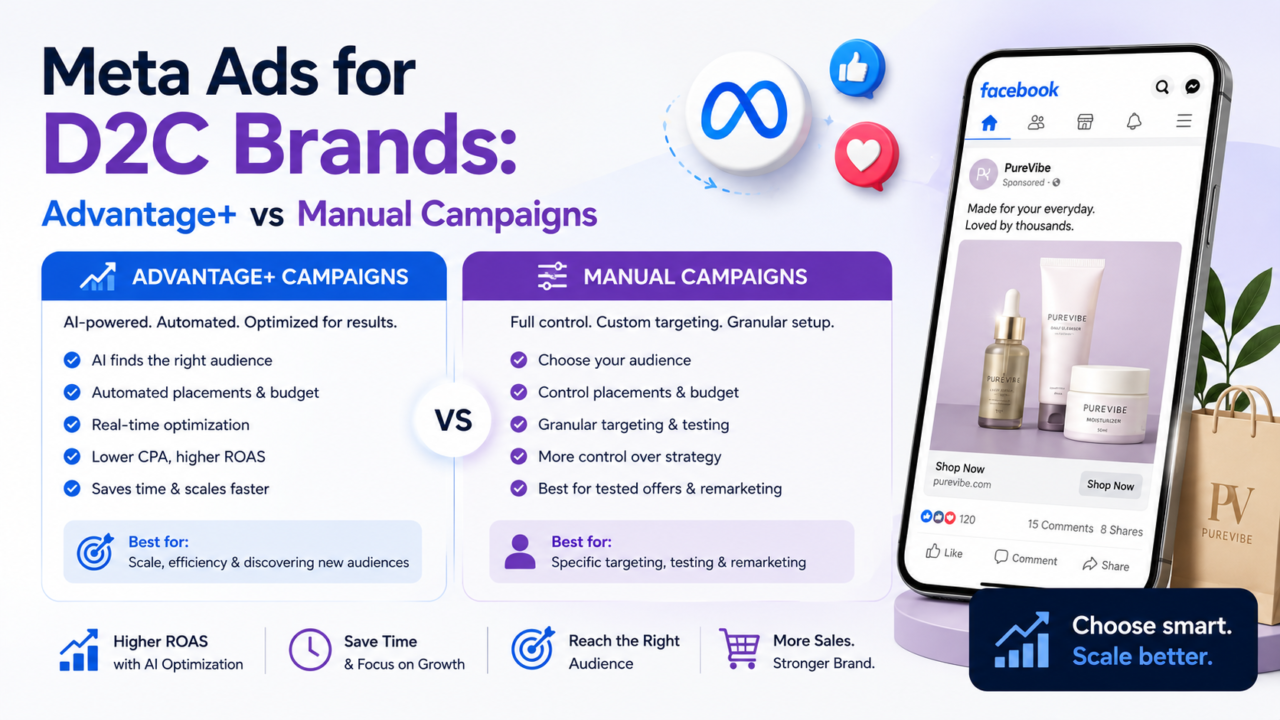
Advantage+ is Meta’s automated sales campaign. You give it a budget, a purchase goal, and creative. Meta picks who sees the ad, where it runs, and how the money splits.
A manual campaign is the older way. You choose the audience. You choose the placements. You set budgets per ad set (ABO) or let one campaign budget flow across ad sets (CBO).
Here is what dates most articles on this topic.
This is no longer a choice between two campaign types. In its Q4 2024 earnings remarks, Meta told investors it was building a flow where advertisers “no longer need to choose between running a manual or Advantage+ Sales or App campaign.” Sales campaigns now start with Advantage+ switched on.
So the real question in 2026 is not which type to pick.
It is how much automation to switch off, and at what spend level.
What changed from the old ASC
If your guide was written before 2025, three things will not match your ad account.
| Old ASC (2022 to 2024) | Advantage+ Sales today |
|---|---|
| No ad sets, one flat campaign | Ad sets are back, up to 50 ads each |
| Existing customer budget cap | Cap removed. Use audience exclusions. |
| Standard audience targeting | Advantage+ Audience: controls and suggestions |
| A campaign type you chose | A setting that is on by default |
Controls vs suggestions
Inside Advantage+ Audience, your inputs land in two buckets.
- Controls are hard rules. Meta always obeys. Country, minimum age, language, and customer list exclusions.
- Suggestions are hints. Meta uses them as a starting point, then goes wherever it wants.
Lookalikes and interest targeting are suggestions. They are not fences.
Drop your customer list in as a suggestion instead of an exclusion and you have excluded nobody. This single mistake explains a lot of disappointing Advantage+ results.
The 217 Rule: Your Budget Floor
Meta publishes one number that decides everything: an ad set needs roughly 50 optimization events per week to leave the learning phase and deliver stably.
That is a conversion count, not a budget. It does not tell a founder what to put in the box.
So convert it into money.
Monthly budget floor = your target cost per order x 217
Where 217 comes from: 50 events a week x 4.33 weeks = 217 events a month. Each one costs you one cost per order.
Run your number:
| Your target CPO | Weekly floor | Monthly floor for ONE Advantage+ ad set |
|---|---|---|
| $20 | $1,000 | $4,330 |
| $30 | $1,500 | $6,495 |
| $40 | $2,000 | $8,660 |
| $60 | $3,000 | $12,990 |
| $90 | $4,500 | $19,485 |
Below that floor, Advantage+ is not underperforming. It is starving. You are asking a prediction engine to learn from a handful of orders.
This is also why flat advice like “$50 a day is enough” falls apart. Fifty dollars a day is fine at a $20 cost per order. It is nowhere near enough at $90. A dollar floor that ignores your economics is not a floor.
One more thing the tables never mention: the multiplier is per ad set, not per account. Three ad sets means three times the floor. Most accounts are built for a budget they do not have.
Not sure of your real number? Start with our breakdown of cost per order for ecommerce.
Why 50/50 Splits Fail (Proved With Arithmetic)
The most common advice on the internet is “run both, split the budget, let the data decide.”
You can show that this is wrong without any study at all. Just do the division.
Take a brand at a $36 cost per order:
| Monthly spend | Weekly events | One structure | Split 50/50 |
|---|---|---|---|
| $10,000 | 64 | Clears 50. Learns. | 32 each. Both fail. |
| $15,000 | 96 | Clears 50. Learns. | 48 each. Both fail. |
| $20,000 | 128 | Clears 50. Learns. | 64 each. Both clear. |
| $30,000 | 192 | Clears 50. Learns. | 96 each. Both clear. |
At $15,000 a month, one structure learns cleanly. Split it evenly and neither one does. You turned a working campaign into two broken ones and the only thing you changed was the split.
This gives you a second formula:
You can only afford to run both structures above cost per order x 434 a month.
At $36 cost per order, that is $15,624. Below it, pick one.
Balance is not the safe choice. Balance is a decision to starve both sides.
The SIGNAL Framework
Six checks, in order. Stop at the first fail and fix it before touching structure.
S: Signal floor. Above CPO x 217 a month? If not, stay manual with one broad ad set.
I: Incrementality check. Does Meta’s reported revenue show up in your bank? Compare platform orders to real store orders over the same 14 days. If Meta claims 400 and you shipped 260, your ROAS is fiction.
G: Guardrails. Customer list as an exclusion under controls, not a suggestion. Country and minimum age set. Nothing else locked down.
N: New customer cost. Not share. Cost. Divide monthly spend by new buyers only. Track it monthly.
A: Allocation skew. Pick a winner. Give it 75% or more. Never split evenly.
L: Learning math. Every ad set needs its own 50 events a week, not 50 shared across all of them. Cut ad sets until the math works.
S I G N A L. Signal floor, Incrementality, Guardrails, New customer cost, Allocation skew, Learning math.
Why Advantage+ Reports Better Than It Delivers
This is the part that costs brands the most, and you do not need a benchmark to understand it. You just need to know what the system optimizes for.
Advantage+ has one job: find the people most likely to convert.
Think about who that is. Someone who visited your product page twice this week. Someone who has bought from you before. Someone who abandoned a cart yesterday.
The system is very good at finding them. That is the whole product.
But here is the problem. A person who was already going to buy is not new profit. They were coming anyway. The ad was standing there when it happened, so the ad gets the credit.
This produces a specific pattern you can spot in your own account:
- Platform ROAS looks strong and stable
- Store revenue does not move as much as the dashboard suggests
- New customer count stays flat while reported conversions climb
- The gap widens the longer the campaign runs
Manual campaigns are worse at this on purpose. When you target cold audiences deliberately, you force spend toward people who were not already converting. That is less efficient on paper and more valuable in reality.
Advantage+ is an intent finder, not a demand creator. Both jobs matter. Just do not pay demand-creation prices for intent harvesting and call it growth.
The fix is not to avoid Advantage+. The fix is to stop grading it on platform ROAS.
Worked Example: $5,000 to $50,000 a Month
A composite D2C skincare brand. Numbers are illustrative. The method is what matters, and it works on your real figures.
Unit economics:
| Line item | Amount |
|---|---|
| Average order value | $68.40 |
| Cost of goods (36.2%) | $24.76 |
| Shipping and fulfillment | $7.15 |
| Payment processing (2.9% + $0.30) | $2.28 |
| Contribution before ad spend | $34.21 |
$34.21 is what a new order can cost before Meta eats your profit. Break-even ROAS is 2.00x. If you have not built this line yet, start with contribution margin for ecommerce.
Stage 1: $5,200 a month
- Daily budget: $171
- Cost per order: $37.10
- Orders: 140 a month, or 32 a week
- Contribution: 140 x $34.21 = $4,789
- Ad spend: $5,200
- Loss: $411
Thirty-two events a week against a floor of 50. Advantage+ cannot learn here.
Run one manual campaign, one broad ad set, purchase optimization, five to eight creatives. No lookalike stacks. Concentrate every event in one place.
And notice the loss. At a $37.10 cost per order against $34.21 of contribution, you are underwater before structure enters the conversation. Your problem here is the offer, the page, or the margin. Not the campaign type.
Stage 2: $16,800 a month
- Daily budget: $552
- Cost per order improves to $32.40 as creative sharpens
- Orders: 519 a month, or 120 a week
- Contribution: 519 x $34.21 = $17,755
- Ad spend: $16,800
- Profit: $955
At 120 events a week you clear the floor for one ad set with room to spare. Not three. And you are just above CPO x 434, so running both structures becomes possible but still tight.
Switch the main campaign to Advantage+ Sales. One or two ad sets. Customer list as a control exclusion. Placements fully broad.
This is where you build your correction factor. Pull Meta’s order count and your store’s order count for the same 14 days. Write the gap down. You will use it forever.
Stage 3: $48,500 a month, with the layer nobody calculates
- Daily budget: $1,595
- Cost per order: $34.90 (efficiency dips as you scale, that is normal)
- Orders: 1,390 a month
- Revenue: $95,076
- Contribution: 1,390 x $34.21 = $47,552
- Ad spend: $48,500
- Loss on paper: $948
Close to break-even. Most founders would call this fine and keep scaling.
Now add the layer almost nobody calculates.
Say 58.7% of those orders are new customers. That is 816 new buyers.
Your real new customer cost is $48,500 divided by 816, or $59.44.
Your first-order contribution is $34.21. You are $25 underwater on every new customer at the first purchase.
That is survivable, but only if they come back. Say 41% reorder once within 12 months. Your 12-month contribution per new customer is $34.21 x 1.41 = $48.24.
$59.44 spent. $48.24 earned. You lose about $11 per new customer, and every one you acquire makes it worse.
The dashboard will not tell you this. Reported ROAS at this stage looks roughly break-even, which reads as “we are close, push harder.” The nCAC math says the opposite: stop scaling and fix acquisition cost first.
That is the entire argument of this article in one calculation.
Where Advantage+ stops working
Two ceilings, and they are different.
The bottom ceiling is the 217 rule. Not enough events, no learning.
The top ceiling is creative supply. Around $30,000 to $40,000 a month, your limit stops being budget and becomes how many genuinely different concepts you ship each week. Advantage+ burns creative fast because it tests aggressively.
Most brands hit the creative wall long before a budget wall. Creator content is the cheapest way through. See profitable influencer marketing for D2C.
Creative Is the Only Targeting Lever Left
When the system picks the audience, your creative is your targeting.
A testimonial video about sensitive skin reaches a different person than a lifestyle shot of the same bottle. You are not choosing that audience in the settings anymore. You are choosing it in the edit.
Which means variation has to be real. Ten versions of one photo is one input, not ten. A new headline is not a new creative. A new color is not a new creative.
To count as genuinely different, change at least two of these:
- Format: creator video, founder talking head, product demo, static, carousel
- Message: problem first, proof first, price first, story first
- Job: introduce, teach, prove, offer
- Ratio: 9:16 for Reels and Stories, 4:5 for feed
Sustaining scale past $30,000 a month generally takes four to five new concepts a week, with a few variations each. That is an operations problem, not a creative-taste problem.
Decision Table: Spend Level and Funnel Role
| Monthly Meta spend | Weekly orders | What to run |
|---|---|---|
| Under CPO x 217 | Under 50 | One manual campaign, one broad ad set. No Advantage+. |
| CPO x 217 to CPO x 434 | 50 to 100 | One structure only. Advantage+ if creative is proven, manual if you are still testing offers. |
| CPO x 434 to $30k | 100 to 190 | Advantage+ core at 75%, one small manual ad set for testing. |
| $30k to $75k | 190 to 480 | Split by funnel role: manual for cold, Advantage+ for warm. Track nCAC separately. |
| $75k+ | 480+ | Same split, plus holdout tests and mid-funnel campaigns for funnel health. |
Notice the shift down the table. Small accounts pick one structure. Large accounts give each structure the job it is good at.
Manual finds new people. Advantage+ converts people already circling. Once you have the volume to run both properly, stop asking which is better and start assigning roles.
Advantage+ vs Google Performance Max
They are cousins, not twins. Both hand audience and placement calls to a machine. Both hide most of the data. But they run on different ad space, with different models and different math.
One real difference: Advantage+ has no version of negative keywords. In Performance Max you can shape delivery with block lists. That lever matters. See how negative keywords help advertisers target better.
On Meta, your only shaping tools are audience exclusions and creative. Which is exactly why creative is the whole game now.
Running both channels? Read our Performance Max for ecommerce guide alongside this. The failure modes rhyme.
When to Stay Manual on Purpose
Manual is not a legacy option. Here is when it is the right call.
- You are under the 217 floor. Not negotiable.
- You are running cold traffic. The optimizer chases the highest conversion probability, which is almost never a stranger.
- You are testing a new offer, price, or page. Advantage+ optimizes away from anything that does not win immediately. Great for scaling, terrible for learning.
- New customer cost is your board metric. Manual keeps prospecting separate from everything else.
- You have compliance or geographic limits. Tight rules and broad automation fight each other.
- Your creative pipeline is thin. Under three new concepts a month means Advantage+ has nothing to chew on.
- You are debugging a funnel. You cannot debug a black box.
Your First 30 Days
Week 1: Fix the signal, not the structure. Confirm Conversions API is live with server-side events and deduplication on. A campaign on broken tracking fails no matter which type you pick. See our Meta Conversions API guide.
Week 2: Run the 217 math. Work out your true cost per order. Multiply by 217. Compare to your budget. That answer decides everything else.
Week 3: Set guardrails and consolidate. Customer list as a control exclusion. Cut ad sets to what your order volume can feed. Most accounts remove more than they add.
Week 4: Build your two numbers. Number one: Meta orders versus real store orders over 14 days. Number two: your true nCAC, spend divided by new buyers only.
Only then start testing structure.
The Uncomfortable Part
Meta told investors that Advantage+ Shopping passed a $20 billion annual revenue run rate, growing 70% year over year in Q4 2024. That is real adoption.
But adoption is not proof of profit. Meta measures success in ad revenue. You measure it in contribution margin. Those two lines can move in opposite directions for a long time before anyone notices.
The brands that win on Meta are not the ones who picked the right campaign type. They are the ones who:
- Fixed tracking before touching structure
- Know their real cost per new customer, not just ROAS
- Check platform numbers against their bank account monthly
- Ship enough genuinely different creative to keep the machine fed
- Picked a side instead of splitting the difference
Number four is where most brands quietly fail. Strategy is not the bottleneck. Execution volume is.
Where AcquireX Fits
Feeding Advantage+ well is an ops problem in a marketing costume. Four to five fresh concepts a week. Weekly customer list refreshes. Monthly reconciliation between Ads Manager and your store. Briefs, edits, QA, naming, tagging, nCAC tracking.
That is not a job for one part-time freelancer or a single in-house buyer.
AcquireX builds dedicated offshore teams that own this end to end. Not a vendor sending a monthly report. A team inside your business running creative, measurement, and structure as one system.
You own the offer, the product, and the brand. We handle execution.
See how performance marketing and growth works, or how brands structure teams while scaling from 7 to 8 figures.
Want to know which setup fits your numbers? Talk to our team and we will run the 217 math and your real nCAC on your account.
Frequently Asked Questions
What is the difference between Advantage+ and manual Meta campaigns?
Advantage+ is Meta’s automated sales campaign. It picks the audience, placements, and budget split for you. A manual campaign lets you choose those yourself. As of 2026 they are not separate campaign types anymore. Sales campaigns start with Advantage+ switched on, and you turn pieces of the automation off if you want more control.
How much do I need to spend for Advantage+ to work?
Use the 217 rule. Multiply your target cost per order by 217 to get your monthly floor. It comes from Meta’s learning phase needing roughly 50 purchase events per ad set per week. At a $40 cost per order, you need about $8,660 a month for one ad set to learn properly. Ignore flat rules like “$50 a day” because they do not account for your cost per order. Below your floor, one broad manual campaign usually beats Advantage+.
Should I split my budget 50/50 between Advantage+ and manual?
Only if you can afford both, and the threshold is higher than most people think. Each structure needs its own 50 purchase events a week, so running two means clearing your budget floor twice over. That works out to roughly your cost per order times 434 a month. At a $36 cost per order that is about $15,600. Below that, splitting evenly drops both structures under the learning threshold and you end up with two broken campaigns instead of one working one.
Should I use Advantage+ for cold traffic or warm traffic?
Warm, in most cases. Advantage+ optimizes toward whoever is most likely to convert, and that is rarely a stranger. It is usually someone who already visited your site or bought before. That makes it strong at converting people already circling your brand and weaker at finding new ones. Use manual campaigns with deliberate cold targeting for acquisition, and let Advantage+ handle the warm end.
Why does my Advantage+ ROAS look great but my store revenue does not move?
Because the system is very good at finding people who were already going to buy. Those sales get credited to the ad, but they would have happened anyway. The pattern to look for: platform ROAS stays strong, new customer count stays flat, and the gap between the two widens over time. Each month, compare Meta’s order count to your real store orders. That gap is your correction factor, and you should apply it to every decision.
What is nCAC and why does it matter more than ROAS?
nCAC is new customer acquisition cost. You calculate it by dividing your ad spend by the number of first-time buyers only, not total orders. It matters more than ROAS because ROAS blends new and repeat customers into one number, which hides whether you are actually growing. A campaign can show a healthy ROAS while losing money on every new customer it brings in. Compare your nCAC to your 12-month contribution per customer, not your first-order margin.
How many creatives do I need for Advantage+?
Start with five to ten genuinely different assets, not ten versions of one image. To hold scale past roughly $30,000 a month, plan on four to five new concepts a week with several variations each. A new headline or a color change is not a new creative. To count as different, change at least two things: the format, the message angle, the job the ad does, or the aspect ratio.
Is Advantage+ the same as Google Performance Max?
No. They are alike in spirit but they are separate products. Advantage+ runs on Meta ad space: Facebook, Instagram, Messenger, and Audience Network. Performance Max runs on Google ad space. The models are different, and so is the way each one counts sales. One real gap: Advantage+ has no version of negative keywords, so audience exclusions and creative are your only shaping tools.
Can I still run manual Meta campaigns in 2026?
Yes. Meta now turns Advantage+ on by default for sales goals, but you can dial it down and run the old way. Manual is the right call in five cases: you are below the budget floor, you are running cold traffic, you are testing a new offer or landing page, you have strict targeting rules, or you are hunting a funnel problem and need a clean view.