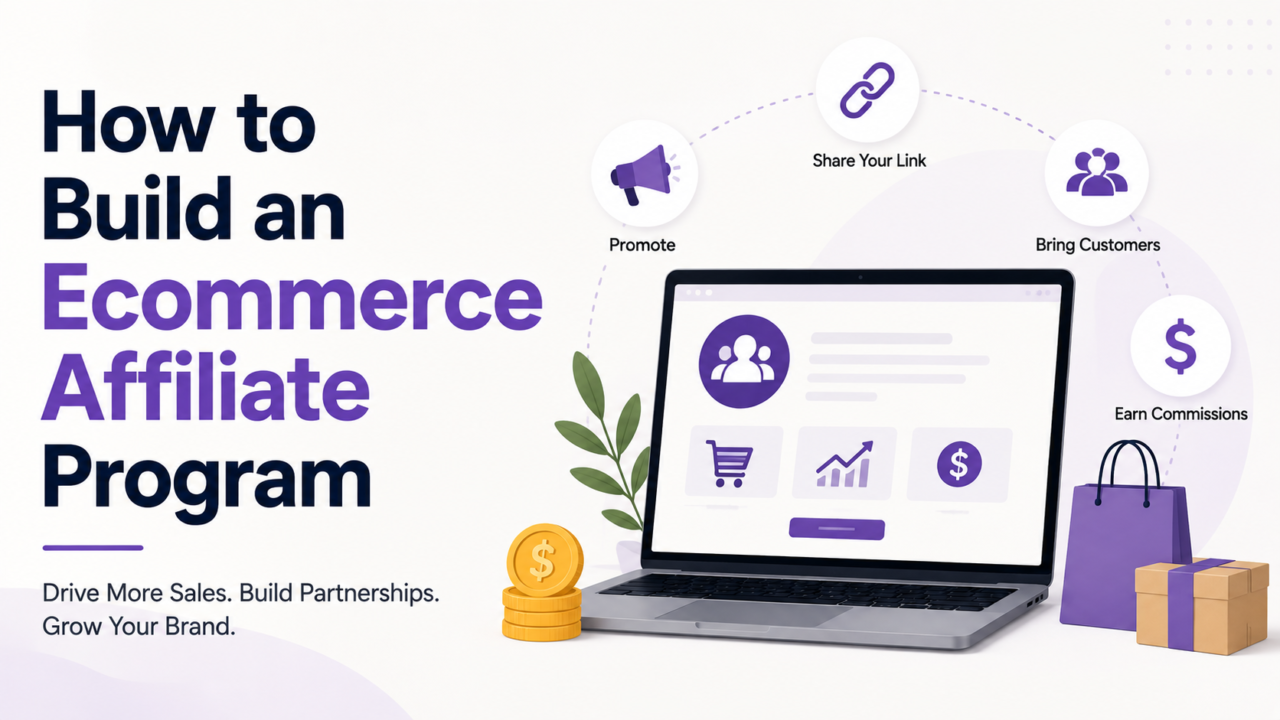
Quick Answer: An ecommerce affiliate program is a pay per sale channel where outside partners send you buyers and earn a commission on orders they cause. To make it profitable, do five things. Set commission off contribution margin, not revenue. Block partners from bidding on your brand name. Cap coupon codes so they cannot leak to deal sites. Hold payouts 30 days to cover returns. Give one named person clear ownership. Most brands skip those five controls and end up paying commission on sales they were going to get anyway.
Here is the part nobody says out loud.
A lot of affiliate programs do not create new revenue. They rename it.
A shopper sees your Meta ad. Clicks. Leaves. Later they Google “your brand coupon code,” land on a deal site, grab a 15% code, and buy. Your affiliate dashboard logs a win. Your paid team logs a win too. You just paid twice for one order.
That is the whole game. Not “how do I get affiliates.” It is “how do I only pay for sales I would not have gotten.”
This guide walks through the exact structure, the math in US dollars, the fraud controls, and who runs the thing on a Tuesday afternoon when a partner emails asking why their payout is short $412.
What Is an Ecommerce Affiliate Program?
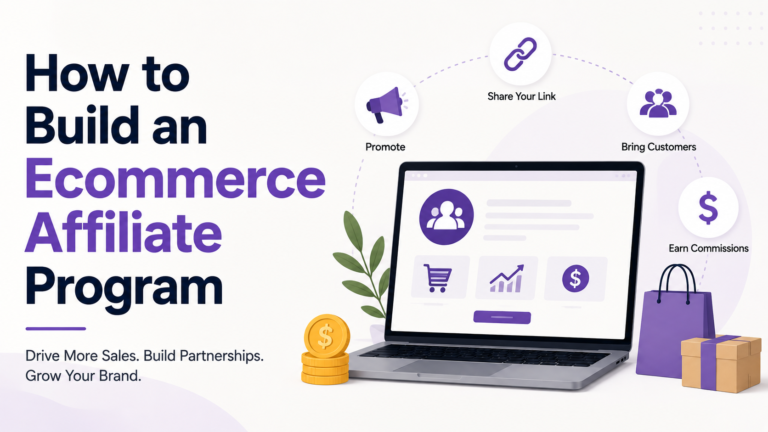
An ecommerce affiliate program is a channel where outside partners promote your products with a tracked link or code. You pay them a set commission only after a sale closes.
Three things separate it from other channels:
- You pay after the sale, not before. No media spend up front.
- Partners choose you. They are not employees. They can drop you tomorrow.
- Attribution decides everything. Whoever gets credit gets paid, which is exactly where the money leaks.
Common partner types:
| Partner type | What they do | Risk level |
|---|---|---|
| Content creators and bloggers | Reviews, comparisons, roundups | Low |
| Niche newsletters | Curated product picks | Low |
| Creators on TikTok, YouTube, IG | Demo and lifestyle content | Medium |
| Coupon and deal sites | Rank for “brand + code” | High |
| Loyalty and cashback apps | Intercept checkout intent | High |
| Sub affiliate networks | Buy traffic and resell clicks | Very high |
The first three usually create demand. The last three usually capture demand you already paid for. That distinction is the single most important idea in this article.
Already running creator partnerships? Our guide to profitable influencer marketing for D2C brands covers the paid side. Affiliate is the unpaid, commission only version of the same partner pool.
Why Most Programs Quietly Lose Money
Ask a brand how their affiliate program is doing and you get a revenue number.
Ask for incremental profit and the room goes quiet.
Here are the four leaks, in the order they usually appear.
1. Last click steals credit. Most affiliate tools use last click attribution. A cashback extension that fires a cookie on your checkout page wins the sale over the YouTube review that actually caused it. You pay the wrong partner.
2. Coupon codes escape. You give a creator a 15% code for their audience. Within a week it is on RetailMeNot, Honey, and three coupon subreddits. Now every shopper on your site sees a discount, and one partner earns commission on all of it.
3. Brand bidding on Google. A partner bids on “yourbrand” in Google Ads, outranks you, and collects a commission on a customer who typed your name into a search bar. That is a toll booth on your own driveway. Google lets advertisers restrict this through trademark complaints, and your program terms should ban it outright. Google explains its <a href=”https://support.google.com/google-ads/answer/6118″ target=”_blank” rel=”noopener nofollow”>trademark policy for advertisers</a> in detail.
4. Commission set on revenue, not margin. A 15% commission on a $60 product sounds fine until you learn the product carries $18 of gross profit. You just handed away half the profit. If contribution margin is a fuzzy number at your brand, fix that first using our contribution margin guide for ecommerce.
None of these are exotic. All four are usually running at once.
The PAYOUT Framework
We built PAYOUT for brands doing $200K to $5M a year who want an affiliate channel that survives a CFO review.
Six steps. Do them in order. The order is the point.
- P Pick what you actually pay for
- A Anchor the rate to margin
- Y Yield rules that protect paid search
- O Onboard with a hard rulebook
- U Uncover leaks before they compound
- T Track, pay, prune
P: Pick What You Actually Pay For
Before you touch software, decide what counts as a win.
Write down which actions earn commission:
- New customer first order (highest value to you)
- Returning customer order (much lower value, pay less or nothing)
- Subscription signup (pay on first order only, or spread across three cycles)
- Bundle or high margin SKU (worth a bonus)
Rule we use: pay full commission on new customers, half on repeat buyers.
Why? A repeat buyer already knows you. Your email flow was probably going to close them. If you are unsure how strong that repeat engine is, look at your own numbers first using this breakdown on turning first time buyers into repeat customers.
Also decide what does NOT earn commission:
- Orders with a sitewide sale code stacked on top
- Orders that get returned or charged back
- Orders from your own email or SMS traffic
- Gift cards
Put this list in your terms on day one. Changing it later feels like a pay cut to partners and burns trust fast.
A: Anchor the Rate to Margin
Never set commission as a percentage of revenue. Set it as a share of contribution margin.
Simple method:
- Take net revenue per order.
- Subtract COGS, shipping, payment fees, and pick and pack.
- What is left is contribution margin.
- Decide what slice of that margin you are willing to trade for a new customer.
Most healthy programs give away 20% to 35% of contribution margin on new customer orders. Above 40% you are running a charity with extra steps.
Then convert that back into the percentage a partner sees.
Sample math:
| Line item | Amount |
|---|---|
| AOV | $84.00 |
| COGS | $27.00 |
| Shipping and fulfillment | $9.50 |
| Payment processing (2.9% + $0.30) | $2.74 |
| Contribution margin | $44.76 |
| Target giveaway (25% of margin) | $11.19 |
| Commission as % of AOV | 13.3% |
So you post a 13% commission. It sounds generous to partners. It is disciplined on your side. That is the whole trick.
Tier it so effort gets rewarded:
| Tier | Trailing 90 day new customer sales | Commission |
|---|---|---|
| Standard | $0 to $2,500 | 10% |
| Growth | $2,501 to $10,000 | 13% |
| Partner | $10,001+ | 16% + flat $250 quarterly bonus |
Tiers cost you nothing at the bottom and buy loyalty at the top. Recalculate every 90 days so a partner who goes quiet drops back down.
Y: Yield Rules That Protect Paid Search
This is the section most guides skip, and it is where the real money sits.
Your affiliate program and your paid team are fishing in the same pond. Without rules, they eat each other.
Put these five clauses in your terms. Non negotiable.
- No brand bidding. Partners cannot bid on your brand name, common misspellings, or “brand + coupon” in any search engine.
- No direct linking to your domain from paid ads. Traffic must land on the partner’s own property first.
- No trademark in display URL or ad copy.
- No browser extensions or toolbars unless explicitly approved in writing.
- No paid social ads using your creative without approval.
Then add the exclusion window. If a shopper touched a paid ad within the last 24 hours, the affiliate does not get credit. Most affiliate platforms support a rule like this. It is called de duplication, and turning it on will make your affiliate revenue number drop. That drop is not a loss. It is the fake part leaving.
If your paid search hygiene is loose, tighten it in parallel. Our piece on negative keywords and better ad targeting pairs directly with this.
Coupon site policy, in plain terms:
| Approach | When it works |
|---|---|
| Ban coupon sites entirely | Strong brand, high organic demand |
| Allow at reduced rate (3% to 5%) | You want the SERP real estate but not the full payout |
| Allow only on approved codes | You control which offer they show |
Most brands under $5M should start with a ban and revisit at scale. You are not big enough for coupon sites to add reach. They will only intercept.
O: Onboard With a Hard Rulebook
Partners break rules they never read. So make the rules impossible to miss.
Your affiliate application should collect:
- Website or social handles with real traffic numbers
- How they plan to promote you
- Whether they run paid ads (and where)
- W-9 for US partners, W-8BEN for international
That tax step is not optional. Payments to US based affiliates over the annual threshold require reporting. The IRS covers this under <a href=”https://www.irs.gov/businesses/small-businesses-self-employed/reporting-payments-to-independent-contractors” target=”_blank” rel=”noopener nofollow”>reporting payments to independent contractors</a>. Collect the form before the first payout, not after.
Approve manually for your first 100 partners. Auto approval is how deal sites and coupon scrapers get in the door.
Give every approved partner:
- A unique tracked link
- A unique code (never a shared one)
- Approved product images and short copy
- A one page rules summary with the five paid search bans in bold
- Payout schedule and hold period in writing
Disclosure is a legal requirement, not a nice to have. US affiliates must clearly disclose the paid relationship. The FTC spells this out in its <a href=”https://www.ftc.gov/business-guidance/resources/disclosures-101-social-media-influencers” target=”_blank” rel=”noopener nofollow”>Disclosures 101 for social media influencers</a>, and the full rules live in <a href=”https://www.law.cornell.edu/cfr/text/16/part-255″ target=”_blank” rel=”noopener nofollow”>16 CFR Part 255</a>. Put the exact disclosure language in your onboarding pack so partners have zero excuse.
U: Uncover Leaks Before They Compound
Set a monthly leak check. Thirty minutes. Same day every month.
Six checks that catch almost everything:
- Google your own brand + “coupon” and “discount code.” If a partner code shows up on a site you did not approve, it leaked. Kill the code, issue a new one.
- Search your brand name in Google, logged out, incognito. Look for partner ads above your own.
- Sort orders by discount stacking. Any order with an affiliate code plus a sitewide sale is a candidate for clawback.
- Check conversion rate per partner. A partner converting at 25% when your site average is 2.5% is not a superstar. That is a cookie stuffer or someone who found your brand search traffic.
- Check time from click to purchase. Under 30 seconds, at volume, means the click did not cause the sale.
- Check refund rate per partner. A partner with a 30% return rate is selling the wrong promise to the wrong audience.
Clawback policy: commission reverses on returns, cancellations, and chargebacks. Say it in the terms. Enforce it in the platform. If chargebacks are already a headache, our chargeback management guide for D2C brands covers the wider fix.
Hold period: 30 days minimum for physical products. Match it to your return window plus a week. Pay before the return window closes and you are financing your partners’ mistakes.
T: Track, Pay, Prune
Three numbers decide whether the program lives.
1. Incremental new customer count. Not orders. New customers, with paid touches de duplicated out.
2. Effective cost per new customer. Total commission plus platform fees plus the labor hours, divided by new customers. Compare it straight against your paid channels using the same method as our cost per order guide.
3. Affiliate sourced LTV to CAC. Affiliate customers often behave differently from paid customers. Sometimes better, sometimes much worse. Coupon led buyers in particular tend to come back only when there is another coupon. Track this cohort separately with the framework in our LTV to CAC ratio guide.
Prune quarterly. Any partner with zero sales in 180 days gets removed. A bloated roster hides your real numbers and slows every report you run.
Full Worked Example: Does This Program Actually Make Money?
A skincare brand doing $2.4M a year launches an affiliate program.
Month 6 raw numbers:
| Metric | Value |
|---|---|
| Affiliate attributed revenue | $96,000 |
| Orders | 1,143 |
| AOV | $84.00 |
| Commission paid (13% avg) | $12,480 |
| Platform fee | $599 |
| Program manager (0.4 FTE offshore) | $1,600 |
| Reported cost | $14,679 |
Looks great. 15.3% cost of sale. CFO smiles.
Now apply de duplication and clawbacks.
| Adjustment | Revenue impact |
|---|---|
| Orders with a paid click in prior 24 hrs (22%) | -$21,120 |
| Orders from leaked coupon code on deal sites (11%) | -$10,560 |
| Returns and cancellations (8% of remainder) | -$5,145 |
| Genuinely incremental revenue | $59,175 |
Now the real profit math:
| Line | Amount |
|---|---|
| Incremental revenue | $59,175 |
| Incremental orders (at $84 AOV) | 704 |
| Contribution margin at $44.76/order | $31,511 |
| Less commission on incremental orders | $7,693 |
| Less platform fee | $599 |
| Less management labor | $1,600 |
| Net incremental profit | $21,619 |
| Effective CAC (563 new customers, 80% new) | $17.55 |
The program still works. But the honest number is $21,619 in profit, not $96,000 in revenue. And the effective CAC of $17.55 is the number you compare to Meta, not the 13% commission rate.
The brand that never runs the second and third tables thinks it has a $96,000 channel. It has a $59,175 channel. Those are very different businesses.
Who Actually Runs This Day to Day?
Affiliate programs fail from neglect more than from bad strategy.
Here is the honest weekly workload for a program with 40 to 150 active partners:
| Task | Frequency | Time |
|---|---|---|
| Review and approve applications | Weekly | 45 min |
| Partner emails and questions | Daily | 3 to 5 hrs/wk |
| Content and asset requests | Weekly | 1 hr |
| Leak check (the six checks above) | Monthly | 30 min |
| Payout run and clawback processing | Monthly | 2 hrs |
| Performance review and tier moves | Quarterly | 3 hrs |
| Recruiting outreach | Weekly | 4 to 6 hrs |
That is roughly 12 to 16 hours a week. Not enough for a full time hire. Far too much for a founder to squeeze in.
Your three options:
| Model | Cost (US, monthly) | Best for |
|---|---|---|
| Founder does it | $0 cash, high opportunity cost | First 90 days only |
| US in house hire (part time) | $2,800 to $4,500 | $5M+ brands |
| Dedicated offshore operator | $900 to $1,800 | Most $500K to $5M brands |
The math on US labor is worth understanding before you hire. We broke it down in US labor costs for D2C brands.
The failure mode we see most often: the program gets assigned to whoever is least busy that quarter. Ownership rotates. Partners stop hearing back. The roster goes dormant.
Fix it with a written SOP and one named owner. Our guide to building ecommerce SOPs for remote teams covers how to document this so the process survives turnover.
When NOT to Build an Affiliate Program
Most guides will not tell you this. Skip the program if any of these are true:
- Your contribution margin is under 30%. There is nothing left to share. Fix margin first.
- You have fewer than 300 orders a month. You do not have enough proof of product market fit to attract good partners, and the admin overhead will eat you alive.
- Your brand search volume is already high. You will mostly pay partners to intercept demand you own. Fix your own SERP first.
- Your return rate is above 20%. Clawbacks will create constant partner friction and you will spend more time in disputes than in growth.
- Nobody can own it. An unowned program is worse than no program. It leaks money silently.
If two or more of these apply, run a loyalty or referral program instead. Customer referrals carry none of the fraud surface and cost far less to run.
Your First 90 Days
Days 1 to 14: Build the rules
- Calculate contribution margin per top 10 SKU
- Set commission rate from margin, not revenue
- Write terms including the five paid search bans
- Pick a platform that supports de duplication and unique codes per partner
Days 15 to 30: Recruit the first 20
- Start with existing customers who already post about you
- Add creators you have paid before (they already know the product)
- Add 3 to 5 niche newsletters in your category
- Manual approval only
Days 31 to 60: Get partners live
- Send assets and code within 24 hours of approval
- Personal check in at day 7 and day 21
- Run your first leak check at day 45
Days 61 to 90: Measure honestly
- Run de duplication against paid
- Calculate true incremental revenue
- Calculate effective CAC
- Compare against your paid channels
- Cut the bottom, double the top
If the effective CAC beats your blended paid CAC, scale it. If it does not, fix the rules before adding partners. Adding partners to a broken structure just makes you lose money faster.
FAQ
What commission rate should an ecommerce affiliate program pay?
Set it from contribution margin, not revenue. Most healthy programs give away 20% to 35% of contribution margin on new customer orders, which usually lands between 8% and 16% of AOV for physical products. Calculate your own margin per order first, then work backwards to the percentage partners see.
How do I stop affiliates from cannibalizing my paid ads?
Use four controls together: ban brand bidding in your terms, ban direct linking from paid ads, turn on de duplication so an affiliate does not get credit if a paid click happened in the prior 24 hours, and check your own brand SERP monthly while logged out. The de duplication rule alone typically removes 15% to 25% of reported affiliate revenue that was never incremental.
How do I prevent coupon code leaks to deal sites?
Issue a unique code to every partner so leaks are traceable to one source. Never use a shared or generic code. Search your brand name plus “coupon” monthly, and kill and reissue any code that appears on a site you did not approve. Cap the discount depth so a leaked code cannot destroy your margin before you catch it.
Should ecommerce brands use an affiliate network or an in house tool?
Under roughly $5M in revenue, an in house tool on your ecommerce platform is usually the better choice. It costs less, you control approvals, and you avoid the sub affiliate traffic that networks bring. Networks make sense once you have a dedicated manager and want reach into publishers you cannot recruit directly.
How long should the payout hold period be?
Thirty days minimum for physical products, or your return window plus one week, whichever is longer. This lets you claw back commission on returns, cancellations, and chargebacks before money leaves your account. State the hold period in the terms so partners are not surprised.
Do affiliates have to disclose that they earn a commission?
Yes. In the US, affiliates must clearly and conspicuously disclose their material connection to your brand under FTC endorsement rules. Put the exact disclosure wording in your onboarding pack. The brand can be held liable for what a partner does, not just the partner.
How many affiliates do I need before the program works?
Quality beats count. Twenty active partners who genuinely reach your audience outperform 500 dormant signups. Most programs see the majority of revenue from their top 10% of partners, so recruit slowly, approve manually, and prune anyone with zero sales in 180 days.
Who should manage an affiliate program day to day?
A program with 40 to 150 partners takes roughly 12 to 16 hours a week across approvals, partner communication, asset requests, leak checks, and payouts. That is too much for a founder. It is not enough for a US full time hire. So most brands in the $500K to $5M range give it to a dedicated offshore operator with a written SOP.
Build It Once, Correctly
An affiliate program is not a growth hack. It is an operations problem wearing a marketing costume.
The brands that win here do three unglamorous things: they price commission off margin, they refuse to pay for demand they already own, and they give one person clear ownership.
Everything else is detail.
If your program is live but the numbers feel too good to be true, they probably are. Run the de duplication math in the worked example above and see what is left.
Want an operator who runs the whole thing? AcquireX builds dedicated ecommerce teams that own the program end to end. Partner recruitment, approvals, leak checks, monthly payouts. See how our performance marketing and growth team works, or talk to us about your program.